



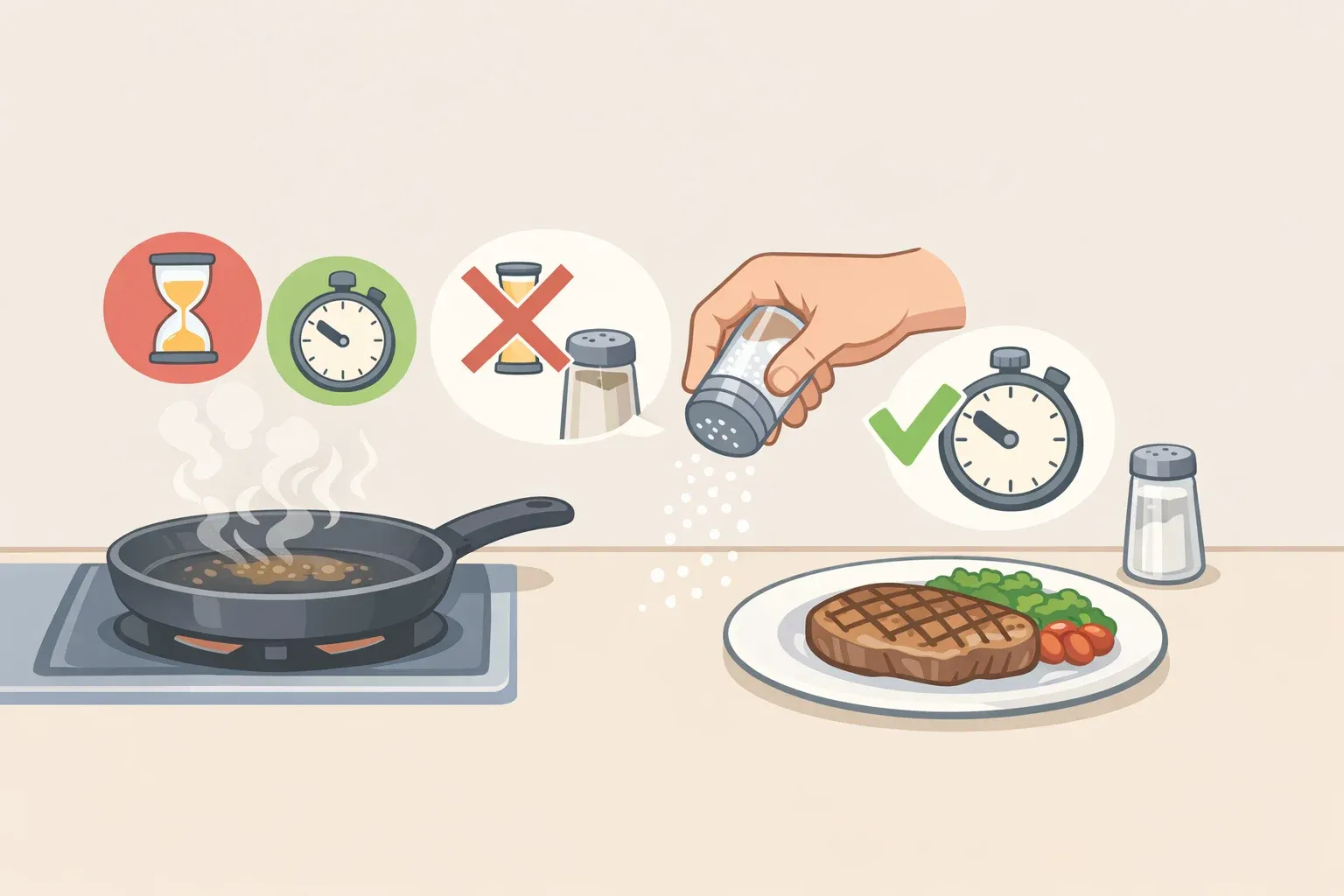
Better cooking often comes down to sequence. Salt early, dry food before searing, give it room to brown, use the browned bits, finish with acid, and check doneness with a thermometer instead of guessing.
The difference between a decent meal and a better one is often practical rather than mysterious. Many home-cooked meals fall short because small technique steps happen too late, too quickly, or not at all. The common cooking mistakes below follow the order of cooking, from what happens before the pan goes on to the final minutes before the food reaches the table.
Mistake 1: Salting too late and too little
Salt is not a last-minute adjustment. It's a flavor amplifier that needs time and adequate quantity to do its job. Added early, it penetrates the food and seasons from within. Added at the end, it stays on the surface and delivers a sharp burst that fades almost immediately, which is why a dish can taste salty on the first bite and register as flat two seconds later.
Quantity is the other half of the problem. Home cooks often season by caution, while experienced cooks season in stages and taste as they go. For many savory dishes, weight-based salting (as explained by Simply Recipes in differentiating table salt from kosher salt) is more reliable than guessing by pinch, especially when switching between fine table salt and lighter kosher salts.
Take chicken thighs. A tip from Serious Eats: salting them 45 to 60 minutes ahead, or overnight in the refrigerator, gives salt time to move inward and helps the surface dry for better browning. If you do not have that much time, salt right before cooking rather than letting the meat sit just long enough for the surface to turn wet.
There's a silent trap for anyone who has recently switched salt brands. Fine table salt, Morton kosher salt, and Diamond Crystal kosher salt do not measure the same by volume, so a teaspoon-for-teaspoon swap can change how salty a dish tastes. If you've switched brands, weigh the salt or use a conversion chart until you've recalibrated.
The fix: Salt your protein first, before you prep anything else, before the pan goes on. Taste at every stage, not just before serving.
Diagnostic: Food that hits salty then goes flat was salted too late. Food that tastes uniformly dull throughout wasn't salted enough.
Mistake 2: Searing wet protein
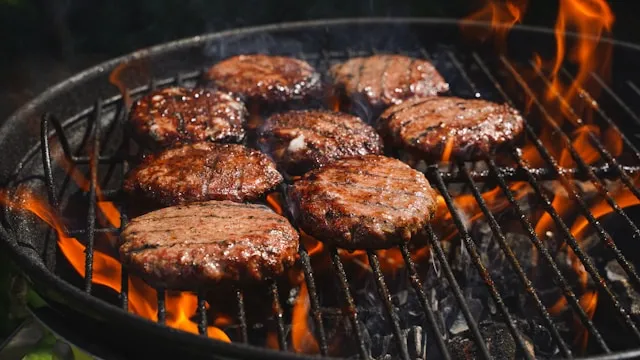
A wet surface does not just delay browning; it gets in the way of it. The Maillard reaction, as defined by Science of Cooking, helps create the savory crust on seared meat and the color on toasted bread, generally speeds up around 140°C/285°F. While surface moisture is evaporating, the food steams instead of browns.
Think about a salmon fillet pulled straight from the refrigerator and dropped into the pan without drying. The surface is damp, the pan temperature drops on contact, and instead of a sear you get a gentle steam. The skin goes limp, the flesh cooks through before any crust develops, and the whole thing sticks. Pat it dry first and the behavior changes entirely: the pan temperature holds, the surface makes immediate contact with the heat, and browning starts within seconds.
Patting proteins dry before searing removes the moisture barrier and lets the surface get hot enough to brown. It applies equally to chicken, fish, tofu, and pork chops.
The fix: Pat the protein dry with a paper towel, then preheat the pan before adding oil and food. It takes seconds, costs nothing, and gives browning a better chance.
Diagnostic: If the pan goes quiet when food hits it, dropping from an aggressive sizzle to a low murmur, the food went in wet or the pan wasn't hot enough.
Mistake 3: Crowding the pan
Even dry protein will steam if the pan is overloaded. When too many pieces go in at once, the collective moisture they release lowers the pan temperature and accumulates around everything cooking simultaneously. Browning stalls. The food cooks through without developing any crust.
Searing in batches rather than loading the pan maintains the surface temperature needed for browning to proceed. With four chicken thighs, that might mean two in the pan, not all four. The second batch takes five more minutes. That's the trade.
The pan residue is also worth using. After the protein comes out, that dark, stuck-on layer is fond: described by Serious Eats as the browned bits that can become the base of a quick sauce. Add a splash of stock, wine, or water while the pan is still hot, scrape the browned bits loose, and you have a simple pan sauce instead of flavor going down the drain.
The fix: Sear in batches. When the protein comes out, add a small pour of liquid to the hot pan and scrape the fond loose. That's your sauce base.
Diagnostic: If the residue is dark and fragrant after searing, that's fond. Use it.
Mistake 4: Skipping acid at the finish
This is the mistake behind the "it's missing something" moment that sends home cooks back to the spice rack. If a dish is properly salted and browned but still tastes dull, it may need brightness rather than more seasoning.
Salt and acid do different things. Salt amplifies existing flavors and suppresses bitterness. Acid creates contrast: it separates flavor components so they register distinctly rather than blending into one undifferentiated mass. A dish built on good salt and browning still reads as flat without something to open it up at the end.
A simple tomato sauce illustrates this well. Properly salted, simmered with a Parmesan rind and a spoonful of tomato paste for umami depth, it tastes rich and rounded. Add half a teaspoon of red wine vinegar just before serving and the tomato flavor sharpens, the sweetness registers more clearly, the whole thing comes into focus. The vinegar isn't perceptible as sourness; it's perceptible as brightness.
The amount needed is usually smaller than most people expect. Following a suggestion by Epicurious, start with a small splash of vinegar or fresh citrus juice, stir, and taste before adding more. Umami-rich additions like tomato paste, soy sauce, Parmesan rind, and miso can build savory depth during simmering; acid at the finish can keep that depth from tasting heavy.
The fix: Keep wine vinegar or a lemon within reach at the stove. Before serving, taste specifically for brightness. Add half a teaspoon of lemon juice, stir, and taste again. That before-and-after comparison teaches more about flavor building than another shake from the spice jar.
Diagnostic: Food that tastes good but muffled, like it's slightly behind glass, needs acid. Food that already tastes sharp or thin does not.
Mistake 5: Guessing doneness and slicing too soon
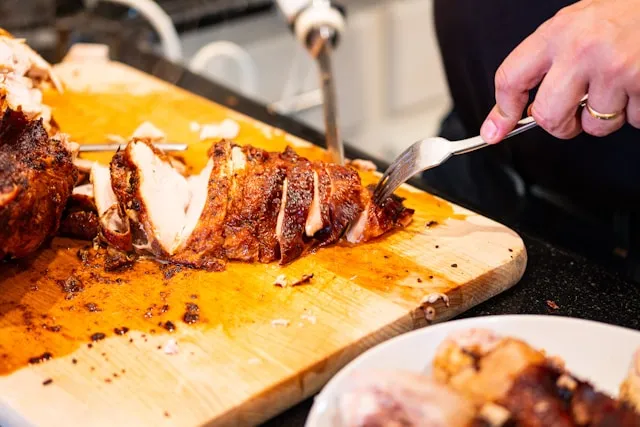
These two errors nearly always arrive together, and they share one root cause: managing a temperature-dependent process with visual cues. Cutting into meat to check color vents heat and tells you almost nothing reliable. A gray exterior can hide a raw center. A pink center doesn't mean unsafe meat. Then serving immediately after that visual check prevents the reabsorption that resting allows. The result is dry meat that was probably cooked correctly.
After heat is removed, meat continues to settle, and some of the juices redistribute instead of spilling out immediately. Slice too soon and more moisture ends up on the cutting board. Tent a roast chicken loosely with foil before carving, and the difference is visible: the board stays drier and the meat stays juicier.
Color is not a substitute for temperature. FoodSafety.gov lists safe minimum internal temperatures of 145°F for whole cuts of beef, pork, veal, and lamb with a three-minute rest; 160°F for ground meats and egg dishes; and 165°F for poultry. For fish, FoodSafety.gov lists 145°F, or cooking until the flesh is no longer translucent and separates easily with a fork. An instant-read thermometer eliminates guesswork and helps you avoid overcooking while still reaching a safe final temperature.
The fix: Use an instant-read thermometer. For larger cuts, you can account for carryover cooking, but the food still needs to reach its safe final internal temperature. Rest whole cuts such as steaks and chops for at least three minutes; rest larger roasts longer.
Diagnostic: If the cutting board is wet after slicing, the meat didn't rest long enough.
Why these mistakes add up
Skipping one of these steps rarely ruins dinner. More often, it leaves food a little dull, soft, dry, or flat, which makes the problem harder to spot.
The pattern is simple: season early, dry the surface, give food enough room to brown, use the browned bits, finish with brightness, and let meat rest before slicing. Those steps make the final dish taste more deliberate without requiring restaurant equipment.
Of the five, salt timing has the fastest visible return. Salt your protein an hour before cooking tonight. Taste the result against your usual approach. That single comparison tends to make the rest of the sequence click.






Comments
Be the first, drop a comment!