



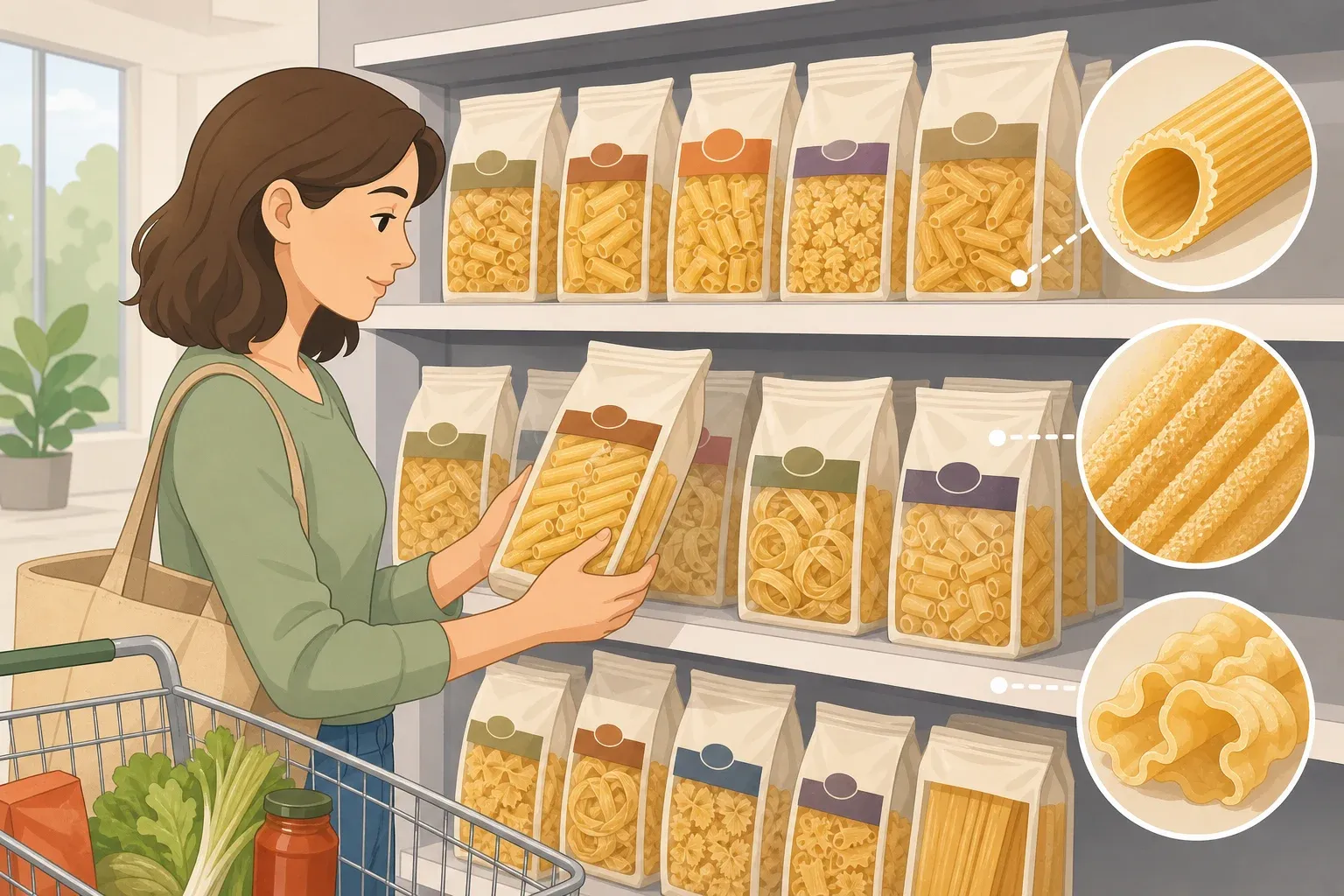
Best grocery store pasta: a chef-approved buying guide
Five chefs with Italian heritage or an Italian restaurant to their name gave the same answer, independently, when asked how to spot the best grocery store pasta: look for noodles cut with a bronze die, according to Allrecipes (11 months ago). Here's the shopping rule in one line: scan the ingredient list for durum wheat semolina and water only, look for "bronze-cut" on the label or a rough matte surface, check that the noodles are golden and intact, and match the shape to whatever sauce is going on top. That's the whole decision, and it takes less time than finding a parking spot.
How much proof backs that advice is a separate question. Lab testing confirms bronze dies really do leave a rougher, more porous noodle than the Teflon dies most mass-market pasta uses. But a research review from Agrofood.it (9 days ago) found no peer-reviewed study that directly measured whether that roughness makes sauce stick better. The texture difference is real and measured. The sauce-clinging payoff is chef experience, not a controlled kitchen test.
This guide covers how to read a pasta box fast, what labels like "bronze-cut" and "slow-dried" actually guarantee, and the one cooking step that affects a finished dish more than the brand on the box. One boundary worth naming up front: this is about standard dried semolina pasta. Egg pasta, gluten-free pasta, legume pasta, and fresh refrigerated pasta follow different rules and sit outside what's covered here.
Why chefs point to bronze-cut pasta, and where the evidence runs out
Bronze-cut vs. Teflon-cut pasta: what actually changes
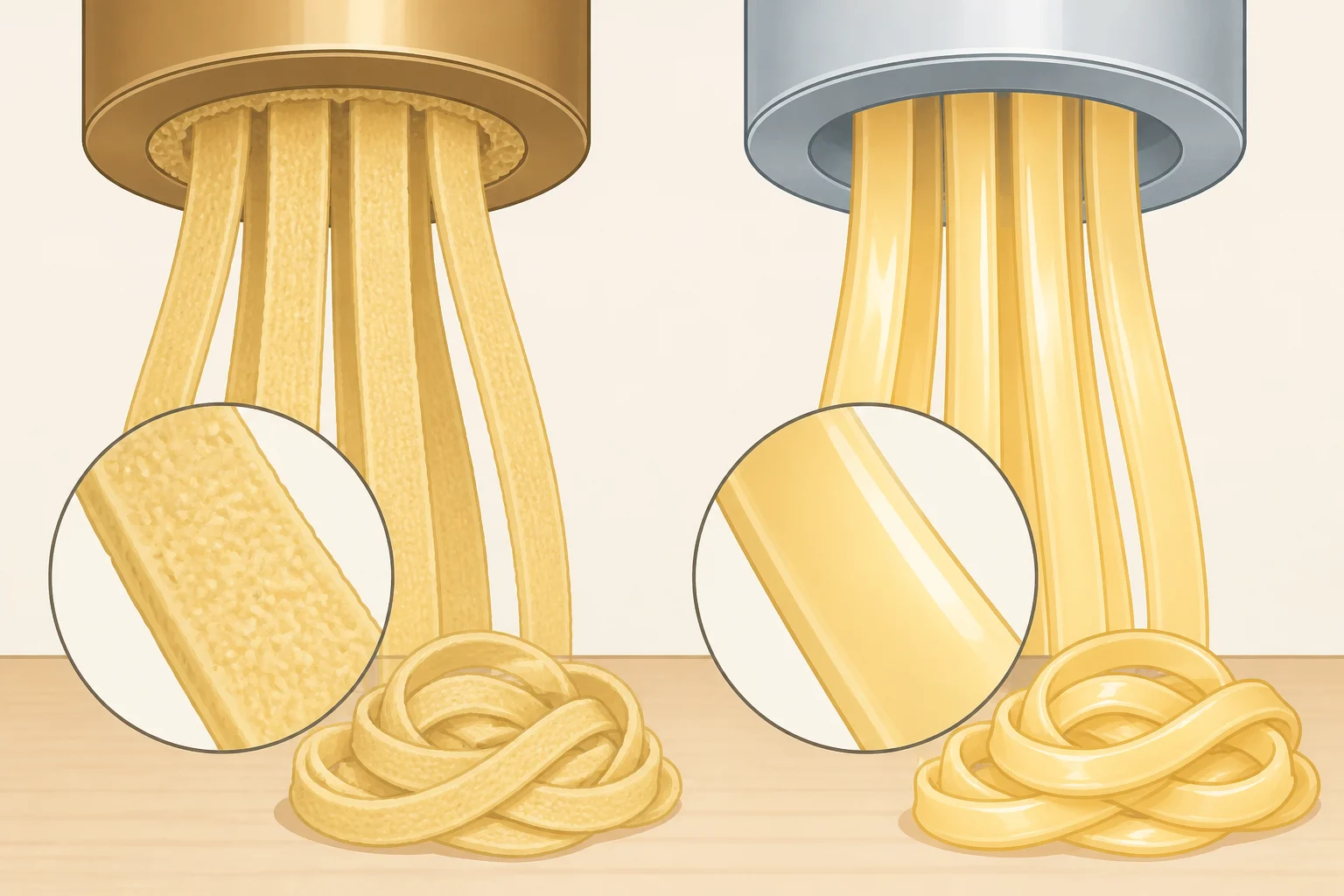
Dough pushed through a rough bronze die moves slowly and picks up texture on the way out. Dough pushed through a Teflon die slides through fast and comes out smooth and shiny. Agrofood.it's review (9 days ago) confirms this difference has been measured in lab settings, not just claimed on packaging.
The strongest data point behind the chef advice comes from a 2008 study by Lucisano and colleagues, summarized by Agrofood.it (9 days ago). Spaghetti made with a bronze die showed higher porosity and 20 to 30 percent lower breaking strength than spaghetti made with a Teflon die. That's a physical difference in the noodle itself: a more porous, more brittle strand, not just a sensory impression.
Here's where the claim gets shakier. Even the legal specification for Pasta di Gragnano PGI, Italy's protected designation for pasta made in that region, credits bronze dies with holding sauce better than Teflon. But Agrofood.it's review (9 days ago) found that claim is unmeasured, both in that document and in the peer-reviewed literature it checked. The one kitchen test that reported better sauce retention for bronze-cut pasta, run by America's Test Kitchen, was never published as a peer-reviewed method.
None of that makes "bronze-cut" a bad word to look for. It's still the most useful, checkable term available to an ordinary shopper, because it reliably signals a rougher, more porous noodle. Chefs interviewed by Allrecipes say that roughness helps sauce cling, per Allrecipes (11 months ago). Studies confirm the roughness itself, not the sauce-retention payoff. Buying bronze-cut means buying a texture difference chefs favor, not a laboratory-proven guarantee.
The aisle checklist: how to choose high-quality dried pasta in under a minute

Reading a box well comes down to four checks, roughly in this order.
-
Start with the ingredient list. Favor pasta made solely from durum wheat semolina and water. Chef Lidia Bastianich recommends this combination for a firmer bite and better flavor, according to The Takeout (10 months ago), and pasta made this way is the legal standard in Italy, France, and Greece, per Frontiers in Food Science and Technology (2024). Treat this as a baseline screen, not proof that one semolina pasta beats another sitting next to it on the shelf.
-
Check for bronze-cut language and surface texture. Look for "bronze-cut," "bronze die," or "trafilata al bronzo" on the label, and choose a noodle that looks matte and slightly rough over one that looks shiny, according to The Takeout (10 months ago). The term carries no legal weight in the U.S.: the federal standard for dried pasta, 21 CFR 139.110, says nothing about dies, per Agrofood.it (9 days ago). In the EU the claim is voluntary too, but that's not the same as unregulated; EU labeling rules still ban information that misleads about how a food is made and require voluntary claims to be unambiguous, per Agrofood.it (9 days ago).
-
Inspect the pasta itself before it goes in the cart. Look for noodles that are golden in color with few or no broken pieces. A chalky, flour-dusted look signals old stock, according to The Takeout (10 months ago).
-
Match the shape to the sauce you're planning to make. Ridged shapes like rigatoni or penne hold onto sauce better than smooth ones, according to chef Tito Marino in Allrecipes (11 months ago). As a general rule, big and rich sauces pair with thick, hearty noodles, while delicate noodles do better with butter or cheese, according to chef Daniele Leon in the same Allrecipes (11 months ago) piece.
-
Don't lean on the words "slow-dried" by themselves. Peer-reviewed food science summarized by Frontiers (2024) notes that drying at higher temperatures can actually increase protein network rigidity, firmness, and sauce retention capacity, the opposite of what "slow-dried" marketing implies. The Pasta di Gragnano PGI specification itself changed in 2020 to allow drying at up to 85°C in as little as four hours, per Agrofood.it (9 days ago). "Slow-dried" has no legal definition, so treat it as a nice detail, not a reliable signal on its own.
A PGI badge is a different animal from "slow-dried" or "artisanal." It's a verifiable certification, and for Pasta di Gragnano PGI specifically, the rules require dies made entirely of bronze, per Agrofood.it (9 days ago). Just don't assume PGI status guarantees slow or low-temperature drying. Since 2020, it doesn't.
A few of the best pasta brands at the grocery store already meet this standard without much hunting. De Cecco makes its pasta with bronze dies and slow-dries it for up to 40 hours, according to Chowhound (2024). Rao's and DeLallo also pair bronze dies with slow, low-temperature drying, per the same Chowhound (2024) report, and Garofalo shows up among the brands chefs name directly in Allrecipes (11 months ago) and The Takeout (10 months ago). Check the specific shape and product line before buying. A brand can run many lines at once, and the label on the box in hand, not the name on the shelf tag, is what actually confirms bronze-cut.
If you're finishing pasta in sauce: the step that matters as much as the box
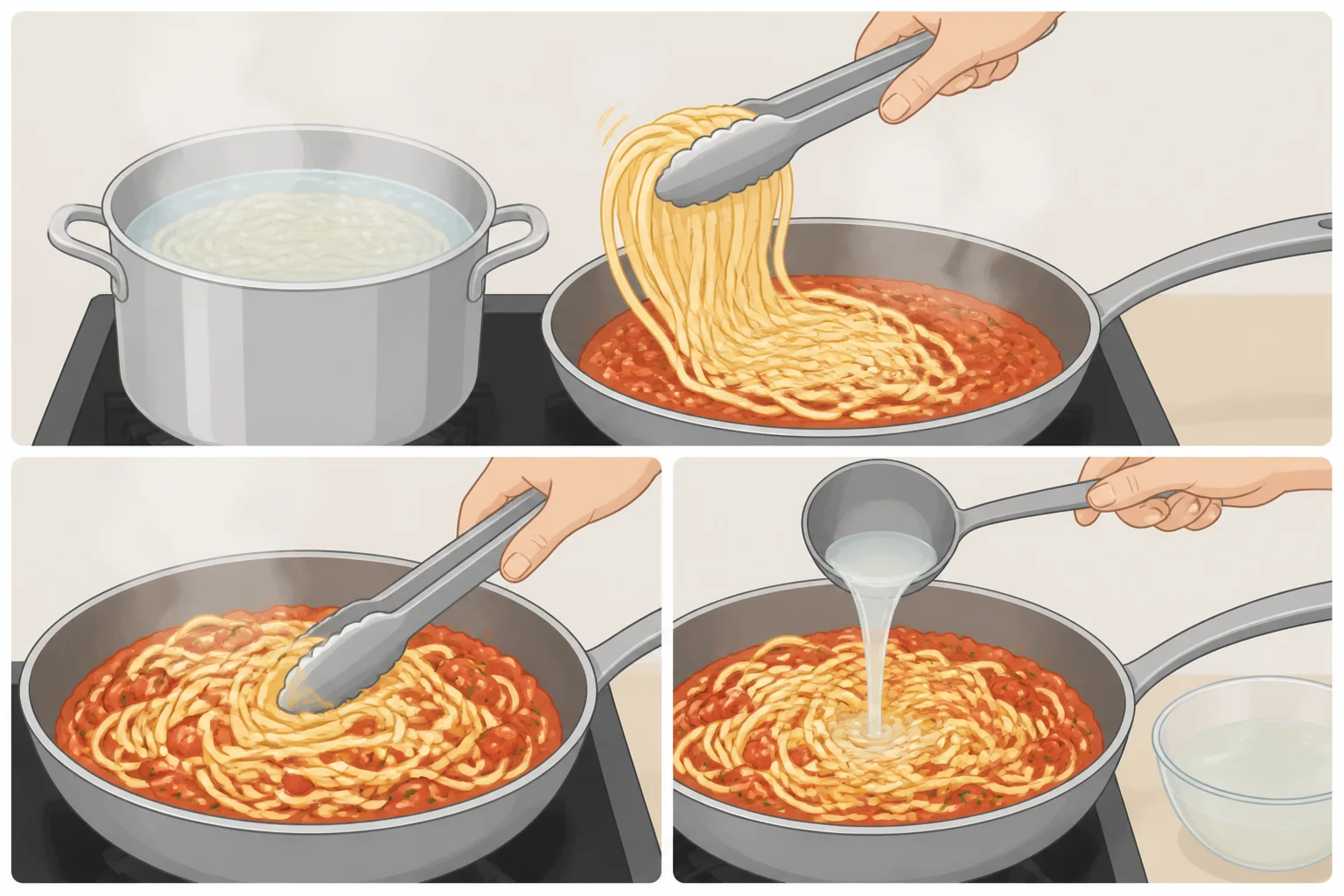
This timing method applies to pasta that finishes cooking in its sauce, the way most stovetop dinners work. It doesn't apply to pasta salad or baked dishes like ziti, which should follow their own recipe timing instead, per Serious Eats (9 months ago).
-
Pull the pasta early. Lift it out of the boiling water one to two minutes before the package's suggested time. Taste it rather than trusting the timer; the center should still have a faint firm core, not a full bite-through softness, according to Serious Eats (9 months ago).
-
Save some cooking water before draining. A splash of the starchy water comes in handy if the sauce needs loosening later, per Serious Eats (9 months ago).
-
Move the pasta straight into simmering sauce. Skip the draining pause, the rinse, and any time spent sitting in a colander, according to Serious Eats (9 months ago).
-
Let them simmer together for that last minute or two. The noodles absorb seasoned liquid and release just enough starch to bind the sauce into a cohesive coating instead of a watery mix, per Serious Eats (9 months ago).
-
Loosen with reserved water if the sauce tightens up too fast. Stir in a splash before the noodles finish cooking, not after.
Done right, the sauce should lightly coat each piece without pooling at the bottom of the bowl. A watery look usually means the pasta went in too early or the sauce needs another minute on the heat. Noodles that taste soft all the way through with no resistance left just mean pulling them a little earlier next time.
Quick decision guide for the pasta aisle
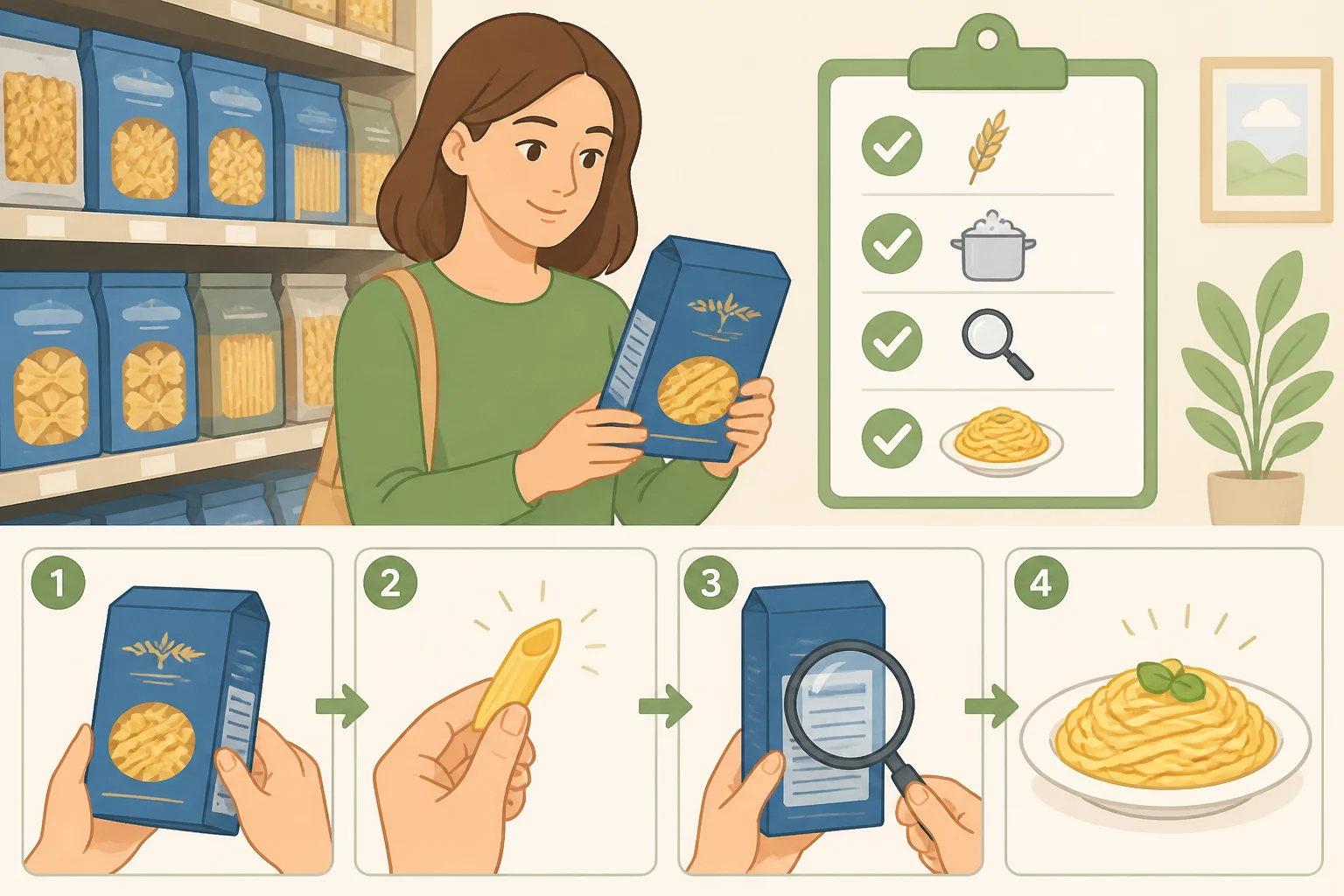
Four checks, in order, next time a wall of pasta boxes needs narrowing down fast:
- Ingredient list reads durum wheat semolina and water, nothing else.
- Label says "bronze-cut," "bronze die," or "trafilata al bronzo," or the noodles look matte and slightly rough rather than shiny.
- Noodles look golden and mostly intact, with no chalky, flour-dusted coating.
- Shape fits the sauce planned for dinner: ridged for chunky and hearty, smoother or thinner for oil, butter, or cheese.
If all four line up, the box is a solid pick. Treat "slow-dried" and "artisanal" as context, not deciding factors, since neither is standardized the way bronze-cut labeling and PGI certification are, per Agrofood.it (9 days ago).
A good box only gets a cook partway there, though. Pulling the noodles early, saving some pasta water, and finishing them in simmering sauce decides the final texture just as much as anything printed on the label.




Comments
Be the first, drop a comment!