



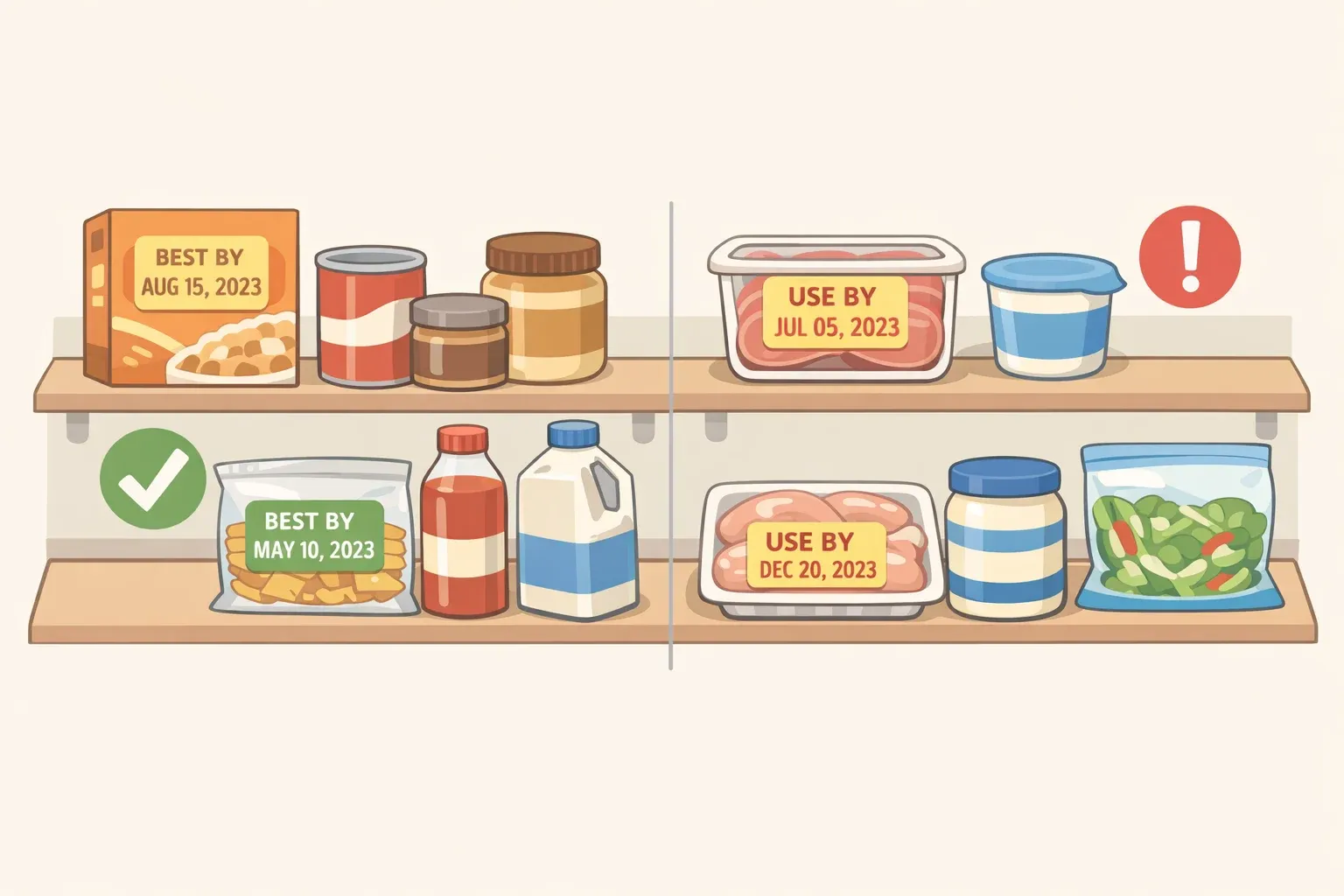
Nearly every date printed on packaged food in the United States is a voluntary quality estimate set by the manufacturer. Not a federal safety deadline. Not a legal discard mandate. A suggestion about peak flavor. The FDA and USDA do not require use-by dates on most foods; infant formula is the only major exception.
So can you eat food after the expiration date? For many packaged foods, yes if storage has been sound and the food shows no signs of spoilage. That single fact explains a lot of unnecessary waste.
The numbers give it weight. Label confusion accounts for roughly one-fifth of all food households throw away, a figure the FDA and USDA cited when they jointly launched a public inquiry into date-labeling practices late in 2024, per the USDA press release. The same announcement put the cost of uneaten food at at least $1,500 per year for a family of four. Knowing when to throw out expired food and when not to starts with understanding what those labels actually say.
This piece decodes what each label phrase means, then walks through a practical decision framework for deciding what to keep and what to discard.
Best by vs. use by date: what the labels actually mean
Start with the structural problem. Because there is no national standard for most food date labels, manufacturers choose their own phrasing. "Best By," "Sell By," "Use By," and a handful of other variations can appear on competing brands of the same product with no consistent meaning across the industry.
Both the FDA and USDA encourage manufacturers to use "Best if Used By" voluntarily, but current federal regulations do not prevent manufacturers from using other phrases as long as they are truthful and not misleading, according to the USDA.
Some states layer in their own requirements on top: Pennsylvania mandates sell-by dating on pasteurized milk and shucked shellfish. Consumer confusion is a predictable outcome of a genuinely fragmented system, not a personal failure.
Here is what each phrase actually signals:
"Best By" / "Best If Used By" quality signal. The manufacturer's estimate of when the product is at peak flavor, texture, or freshness. Food past this date may be slightly less enjoyable but is not automatically unsafe. Both the FDA and USDA recommend this phrasing for quality-based labeling across the industry, per the USDA.
"Sell By" inventory signal for stores. Tells the retailer how long to display the product. It is not a safety or quality cutoff for the consumer. Food is usually still safe for several days to weeks after this date if stored correctly, according to UGA Food Safety.
"Use By" a peak-quality estimate, with a caveat. Found on perishable items like meat, yogurt, and eggs, this label indicates when the manufacturer considers the product at its best. Eating it a day or two past this date may mean changes in texture, taste, or freshness but not necessarily illness. Under current rules, it remains a quality signal, not a discard mandate, though proposed legislation would change that. That distinction matters when building habits around today's terminology.
"Freeze By" a timing prompt, not an expiration. Indicates when to move a product to the freezer to preserve quality. Freezing before this point effectively pauses spoilage; the food doesn't expire at that date, it benefits from being frozen by then.
True expiration dates rare, and worth following. Labeling that reads "Expires On" is uncommon in U.S. grocery stores. Infant formula is the primary case where a federally mandated expiration exists, because nutrient levels degrade in ways that specifically affect infants. When you see this phrasing, follow it.
The through-line: all of these dates, with the narrow infant formula exception, describe quality rather than safety. What they don't tell you is how the food was stored, how it was handled, or what condition it's in right now. That's where judgment comes in.
Is expired food safe to eat? Use this four-step framework
The right question is never just "Has the date passed?" It's: what kind of date is this, how was the food stored, what type of food is it, and does it show any genuine signs of spoilage? The stakes are different for canned beans than for raw meat, which is why food category comes third in the sequence. Work through the four steps in order.
Step 1: Identify the label type. Use the definitions above. "Best If Used By" on crackers is a different situation than "Use By" on ground beef. If the phrasing is ambiguous or unfamiliar, treat it as a quality signal and move to storage assessment.
Step 2: Assess storage history. UGA food safety researcher Sofia Schwan is direct on this point: food safety depends more on storage conditions than any printed date, she noted earlier this year. A refrigerator running above 40°F compromises food faster regardless of what the label says. Penn State Extension recommends using a refrigerator thermometer to verify your fridge is actually holding the right temperature, per their guidance. Consistent storage sealed, refrigerated below 40°F, not left out extends usable life considerably. Inconsistent storage shortens it, regardless of the printed date.
Step 3: Apply category-specific judgment. Perishability varies enormously across food types. Four examples, each illustrating a distinct principle:
Milk (short shelf life, clear signal): Pasteurized milk kept at or below 40°F typically stays safe three to seven days past its sell-by date — a date that tells stores when to rotate display stock, not consumers when to pour it out. Use within days, not weeks, if properly stored.
Eggs and hard cheese (longer buffer than most people expect): Eggs can generally be eaten safely three to five weeks after purchase even if the sell-by date has passed, provided they've been refrigerated consistently. Hard block cheese with visible mold can have the affected area removed, cut at least an inch around and below the spot, and the remainder used. Soft or unpasteurized cheeses should be discarded at the first sign of mold. Keep if storage is sound; inspect before use.
Canned goods (dates are nearly irrelevant): High-acid canned foods like tomatoes remain safe for 12 to 18 months past their labeled date; low-acid foods like beans and corn can last up to five years when stored properly, and the can is undamaged. For cans, shift judgment entirely to physical condition: bulging, heavy denting, or rust are discard signals. The printed date is effectively a note about peak flavor. Keep inspecting the can, not the calendar.
Bread (porous structure changes the mold calculus): Generally safe past a best-by date, and staleness is obvious. Discard at the first visible mold, though: the porous structure of bread allows spores to spread through the loaf even where they can't be seen. Unlike hard cheese, there is no safe "cut around it" option. Discard at any visible mold; otherwise use.
Step 4: Check for spoilage signs, but understand their limits. Once storage and category context are established, observable signs provide useful confirmation for lower-risk foods. Off or sour odors, slimy textures on meat or dairy, visible mold on porous foods, and bulging or heavily dented cans, which can indicate bacterial contamination, are all clear discard signals.
Smell and appearance help, but they are not a complete safety test. Some harmful bacteria leave food looking, smelling, and tasting entirely normal. Schwan's guidance "if it looks fine, smells fine and tastes fine, it's probably fine" applies to generally healthy adults in typical circumstances. For people who are pregnant, over 65, or immunocompromised, a stricter standard is appropriate regardless of what the senses say.
When the framework doesn't resolve it: The USDA offers a free FoodKeeper tool with specific storage timelines for hundreds of individual foods across pantry, refrigerator, and freezer conditions, a more reliable resource than any single printed date.
Habits that make the decision less necessary
Once you understand how to judge food, the better move is reducing how often you need to. The goal isn't maximizing tolerance for food at the edge of its window; it's using food while it still has full quality. Four habits from UGA's food safety guidance do most of the work:
First in, first out. Move older items to the front of the fridge and pantry so they get used before newer stock. This single practice eliminates most of the forgotten-until-too-late problem.
Cook before the date, not after. If meat or produce is approaching its quality date and won't be used that day, cook it thoroughly and refrigerate or freeze the result. Cooked food in the freezer buys weeks; food in the bin is a total loss.
Freeze in single-meal portions, labeled with a date. Portion out meals and ingredients before freezing, then write the date on a strip of masking tape and attach it to the container. No guesswork about how long something has been stored.
Plan meals weekly. Most waste starts at the store. Buying to a plan rather than stocking speculatively reduces the volume of perishables that age past their quality window before anyone gets to them.
What changes when you know this
For the vast majority of packaged foods, a printed date is a quality estimate: voluntary, manufacturer-set, and not tied to a federal safety standard. The more reliable basis for any keep-or-toss decision is storage history, food category, and physical condition, in that order.
The scale of the underlying problem is worth sitting with. The EPA estimated that in 2019, retail, food service, and residential sectors together generated 66 million tons of wasted food, roughly 60% of which ended up in landfills. Label confusion accounts for about a fifth of what households throw away specifically. Neither number improves until consumers understand what they're actually reading.
The regulatory picture is shifting. Legislation introduced in the Senate last year, the Food Date Labeling Act, would require a standardized two-phrase system, with "BEST If Used By" reserved for quality signals and "USE By" designating an actual discard threshold, per the bill text. The bill has not been enacted, and today's labels remain voluntary and inconsistent. If it passes, "USE By" will carry meaningfully more weight than it does now — worth keeping in mind as you build any habits around the current terminology.







Comments
Be the first, drop a comment!