


Dining Hall Food Hacks: A 3-Step System for Better Meals
The best dining hall food hacks have less to do with creativity than with pattern recognition: find the daily anchors, pull one upgrade from a second station, and use the equipment students can actually access. That's the whole system. The specific examples here are drawn from CU Boulder's dining program, but the logic transfers to any campus, including Hope College's.
Eating well in a dining hall is less about cooking skill than knowing which stations offer reliable building blocks every single day. Once you can identify those anchors and trace a path through the hall to combine them, you're no longer at the mercy of whatever the hot line happens to be serving.
CU Boulder is a useful model. As of November 2025, CU Boulder's Division of Student Life ranked the school No. 1 for plant-based dining and sustainability, with more than half its menu offerings plant-based. The college dining hall hacks work at CU because the dining program was built for them. They work elsewhere because the underlying geometry of a dining hall, deli here, pasta line there, salad bar in the middle, is consistent across most campuses.
One thing to know before starting: some components are available every day, and others rotate. CU Boulder's plant-based options cycle on a three-week rotation (November 2025). This system is built around that reality. Anchors are what you plan around. Rotating items are the upgrades when they show up.
Step 1: Map the hall before you build anything
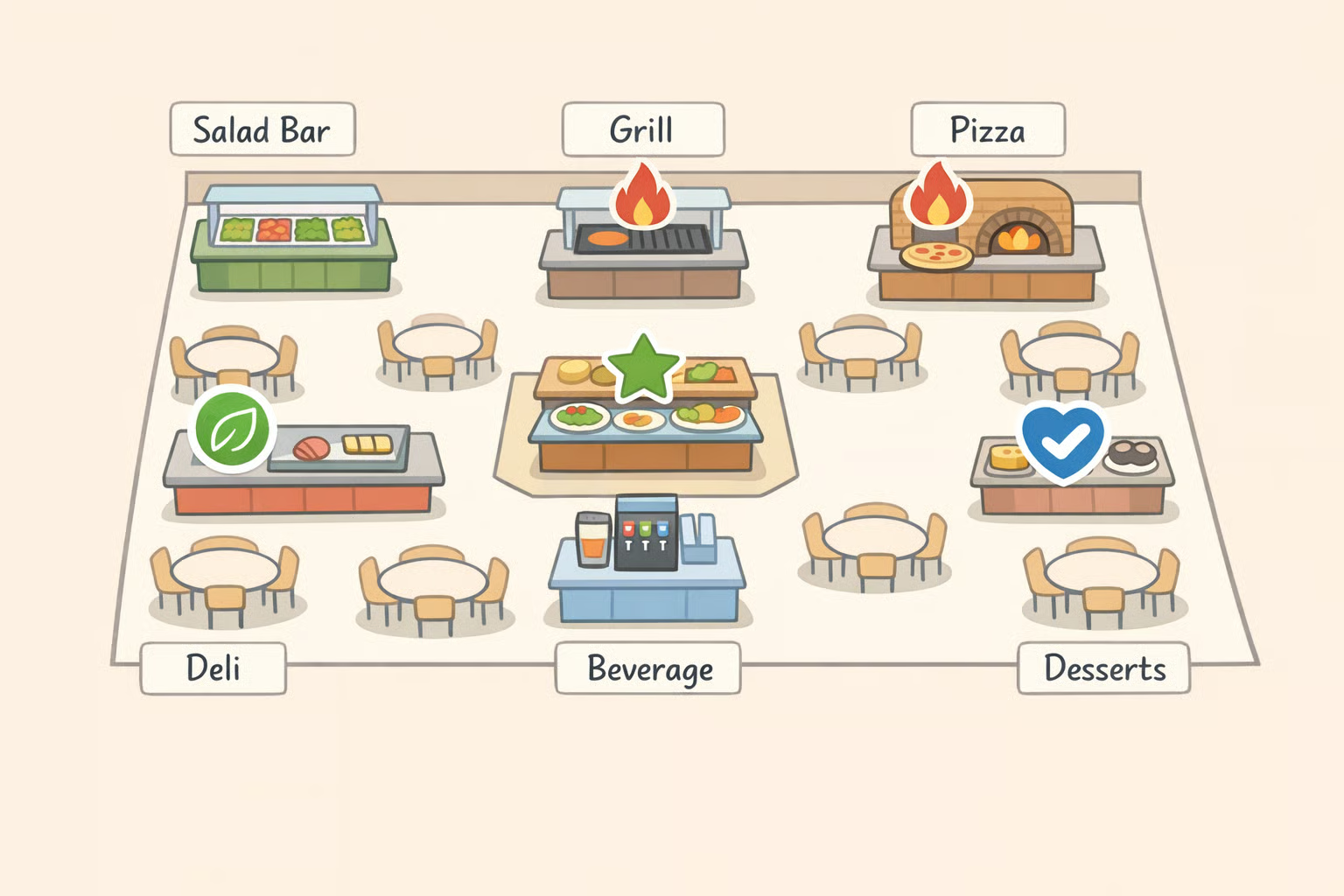
Do this once, early in the semester, before a meal, not during one. Budget five minutes and bring your phone.
The goal is to answer three questions: What's available every single day? Where are the heat sources students can actually use? How does this hall label special-diet items? Everything else follows from those answers.
Identify your anchors first. An anchor is any component that's available daily, pairs well across multiple builds, and doesn't require staff to unlock or confirm. At CU Boulder, the deli bar stocks hummus every day, and the Latin station reliably carries a vegan protein, chipotle tofu, plant-based chorizo, or seitan, regardless of what else is rotating (November 2025). Vegan breads, bagels, and peanut butter are also consistently available. At your dining hall, look for the same characteristics: high in protein or starch, no rotation dependency, no staff intervention required.
Find three or four of these and you have a permanent starting menu.
A useful rule for evaluating a potential anchor: if you're not certain it will be there on a random Tuesday without checking, it's a rotating item, not an anchor. Build your defaults around what you know. Treat everything else as an upgrade.
Locate every heat source students can operate. A panini press, a toaster, and a microwave are what separate a warm, cohesive meal from a plate of cold components. The DIY grilled cheese at CU Boulder works because bread and cheese are at the deli station and a panini press is within reach (March 2025). If the press were staff-only or in a different building, the build wouldn't work. Confirm what's accessible and where before planning any hot build.
This is also where the safety check belongs. Shared equipment is fine to use, but confirm it's intended for student use before assuming.
Check the labeling system. CU Boulder requires every station to mark vegan items with a "V" (November 2025). Where your hall does this consistently, use those labels to locate daily anchors quickly rather than reading ingredient panels one item at a time. Where labeling is inconsistent, ask staff.
Worth stating plainly: a cross-station build does not automatically inherit the allergen safety of its individual parts. An ingredient pulled from a labeled station still carries risk if it contacts equipment or components that weren't. If you have dietary restrictions, check with staff before combining. Build the habit in from the start.
After this walk, you have three things: a short list of daily anchors, a map of available equipment, and a working sense of how your hall labels its components. That's enough to start building.
Step 2: Apply the framework, anchor, add-on, finish
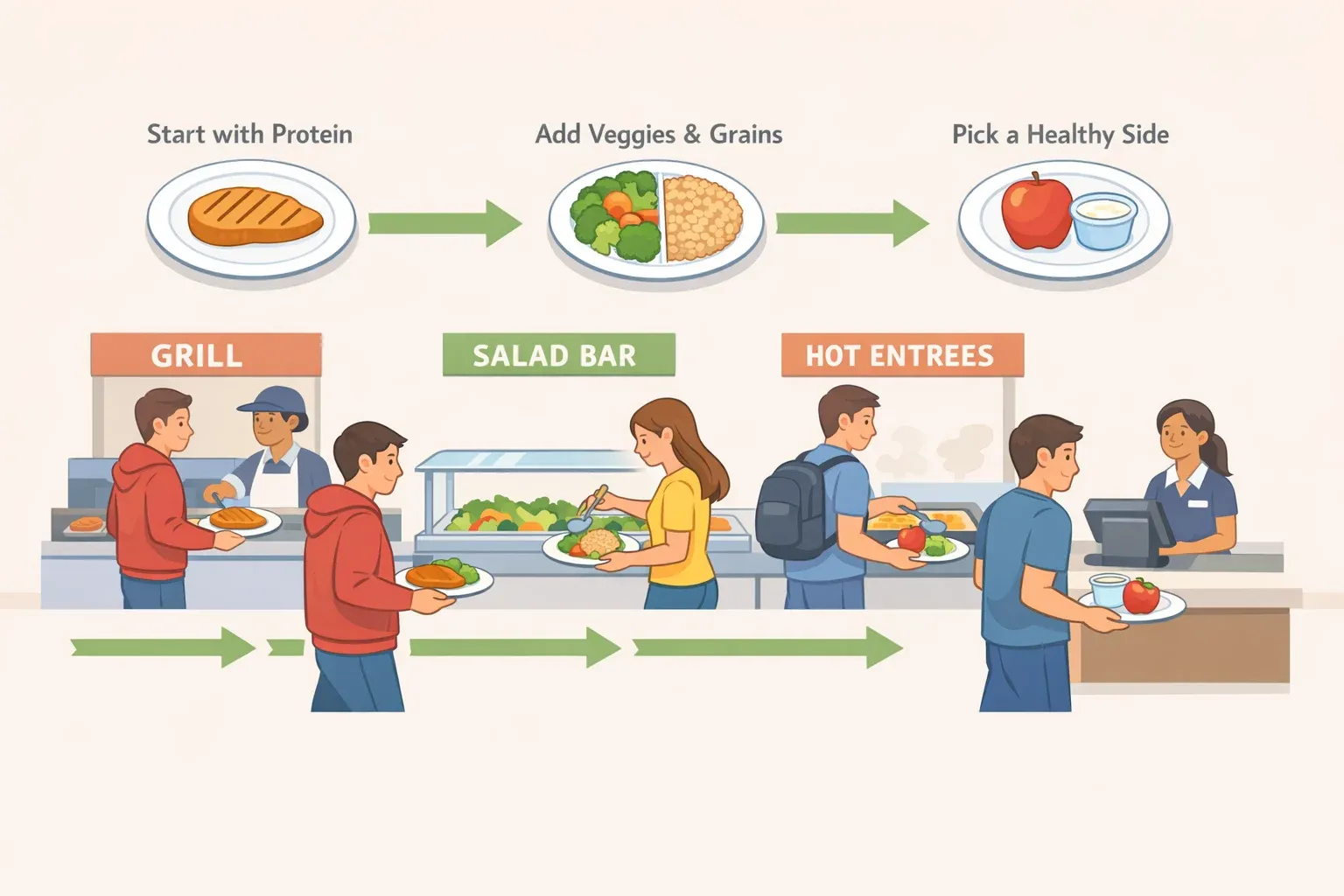
Every build follows the same structure. Start with an anchor, the reliable daily base, starch or protein. Pull an add-on from a second station, a sauce, topping, or filling that changes the character of the dish. Apply a finish, a heat step or final assembly. If you're figuring out how to hack dining hall food efficiently, these four builds are where to start.
Grilled cheese
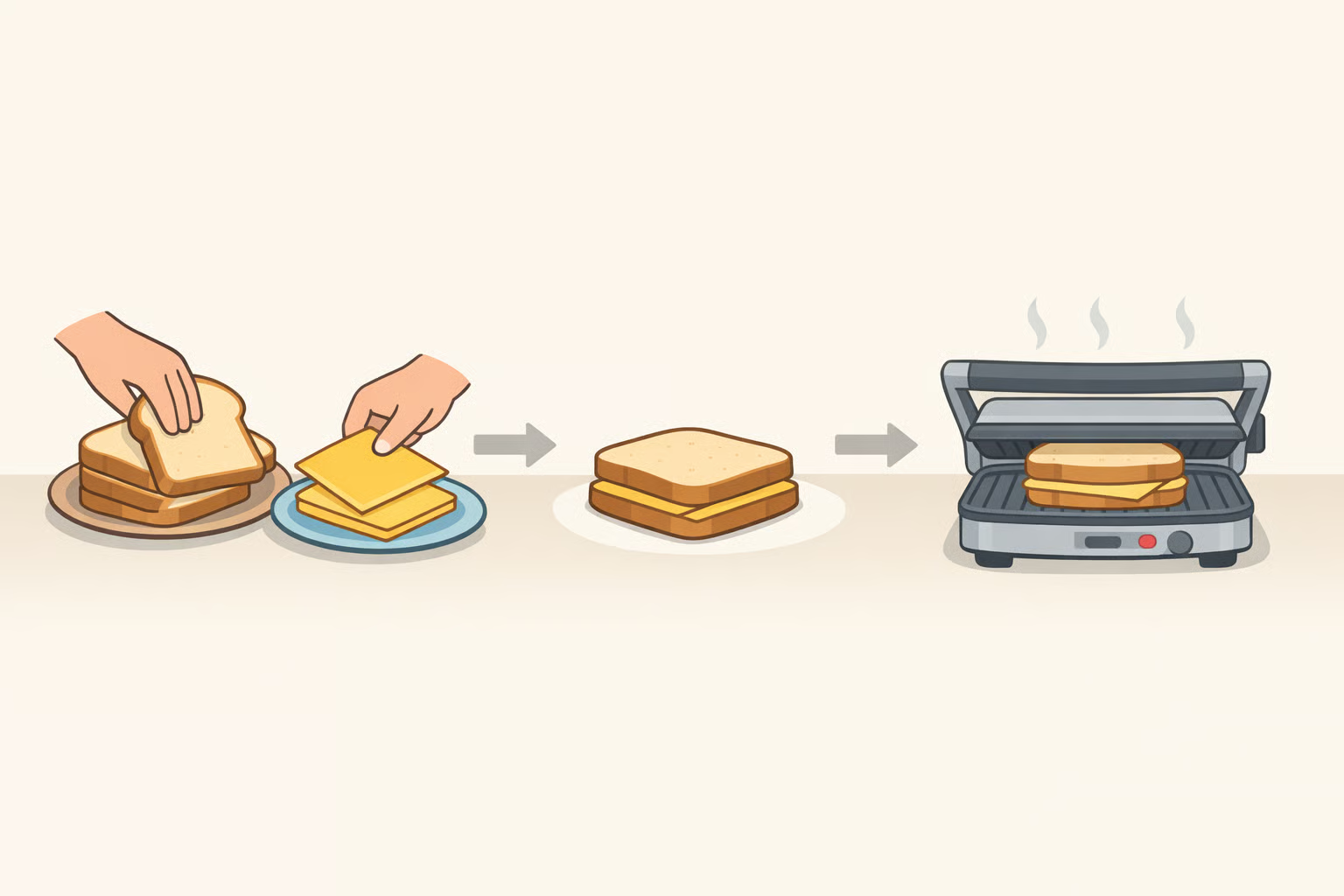
- Anchor: Bread and cheese slices from the deli station.
- Add-on: Spinach, sliced tomatoes, or any available condiment. CU Boulder's snack guide notes these are reliably stocked at the same station (March 2025).
- Finish: Panini press. Assemble at the deli counter, carry to the press, cook.
The generalizable principle: any deli station within range of a panini press is effectively a hot-sandwich station.
Bagel pizza
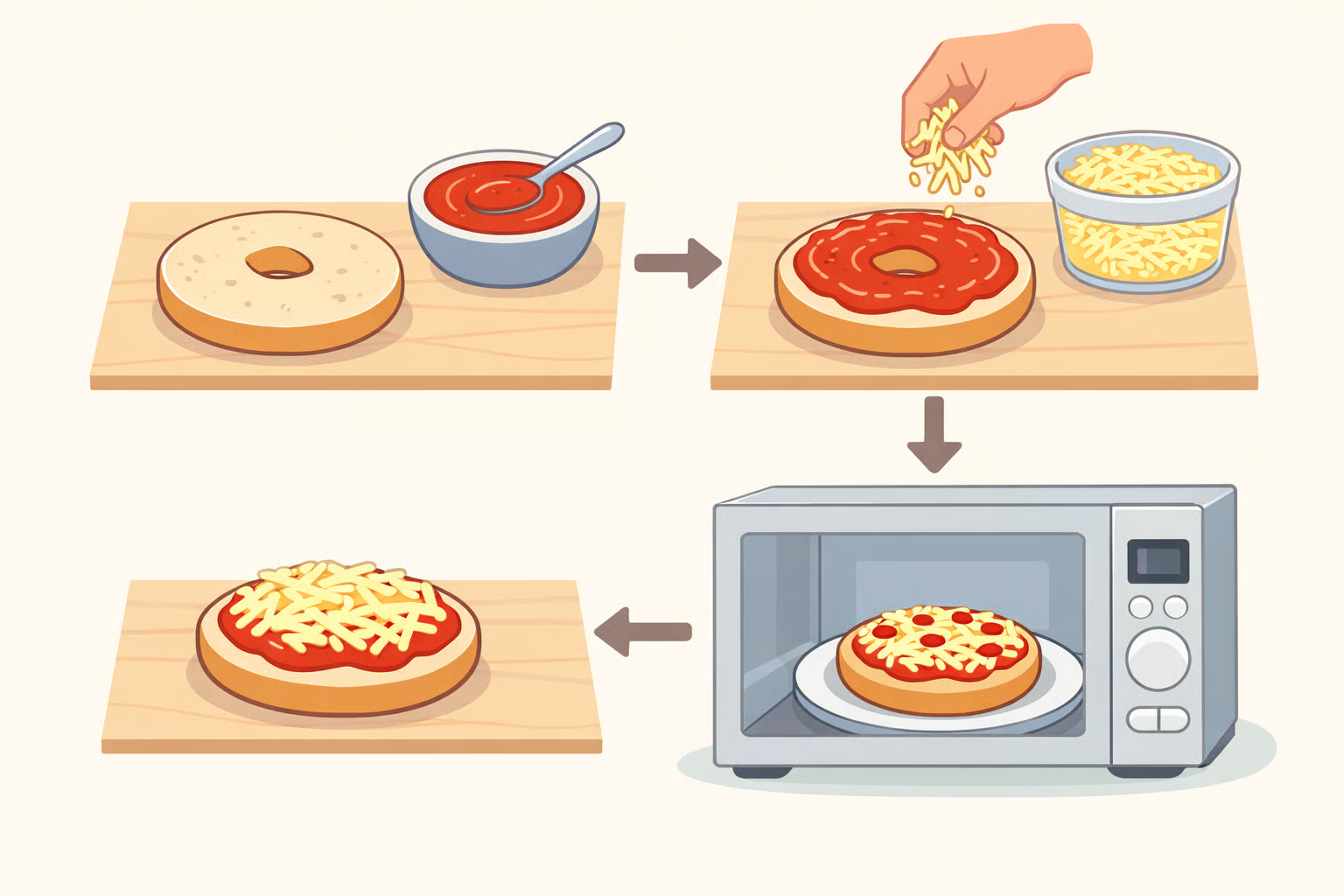
- Anchor: Plain bagel, toasted.
- Add-on: Marinara from the pasta line, shredded cheese from the salad bar.
- Finish: About 30 seconds in the microwave to melt the cheese (March 2025).
Three separate locations feed one build. A pasta sauce station plus a salad bar with cheese equals a pizza topping bar.
Latin station tortilla
- Anchor: Tortilla from the Latin station.
- Add-on: CU Boulder's Latin station carries a vegan protein every day, chipotle tofu, plant-based chorizo, or seitan, alongside rice, beans, avocado, and vegetables (November 2025).
- Finish: No heat required. Straight assembly.
Any station with a guaranteed daily protein is a high-value anchor because it solves the hardest part of a balanced plate. If your hall has a comparable station, build around it first.
Persia station build
This one illustrates what a reliable anchor looks like when the station itself does most of the work. CU Boulder's Persia station offers daily vegan options including vegetable kabobs, rotating stews, two types of rice, and toppings like nuts and herb salads (November 2025).
- Anchor: Rice base.
- Add-on: Whichever stew or protein is running that day, plus a nut or herb topping.
- Finish: Already cooked.
Stations with a starch base and a rotating topping structure are the easiest to build around because they're already designed for variation. These aren't flashy dining hall meal ideas so much as repeatable combinations that hold up even on the worst rotation day.
One timing note. Moving between stations during peak hours adds friction. Assemble components away from service lines. Save panini press and microwave builds for off-peak windows when you can. The builds are worth the logistics, but don't hold up a lunch rush to execute them.
Dining hall food hacks for snacks
The anchor-add-on-finish structure scales down cleanly, with one adjustment: minimize the steps and cut the heat requirement entirely.
Banana peanut butter sandwich
- Anchor: Banana split lengthwise, both halves spread with peanut butter from the condiment station.
- Add-on: Chocolate chips from the dessert station, frozen fruit chunks and granola from the yogurt bar (March 2025).
- Finish: Press the halves back together.
- Optional upgrade: Walnuts or almonds from the salad bar add protein and staying power (March 2025).
Assembles in under two minutes, no heat required.
Rethink hummus
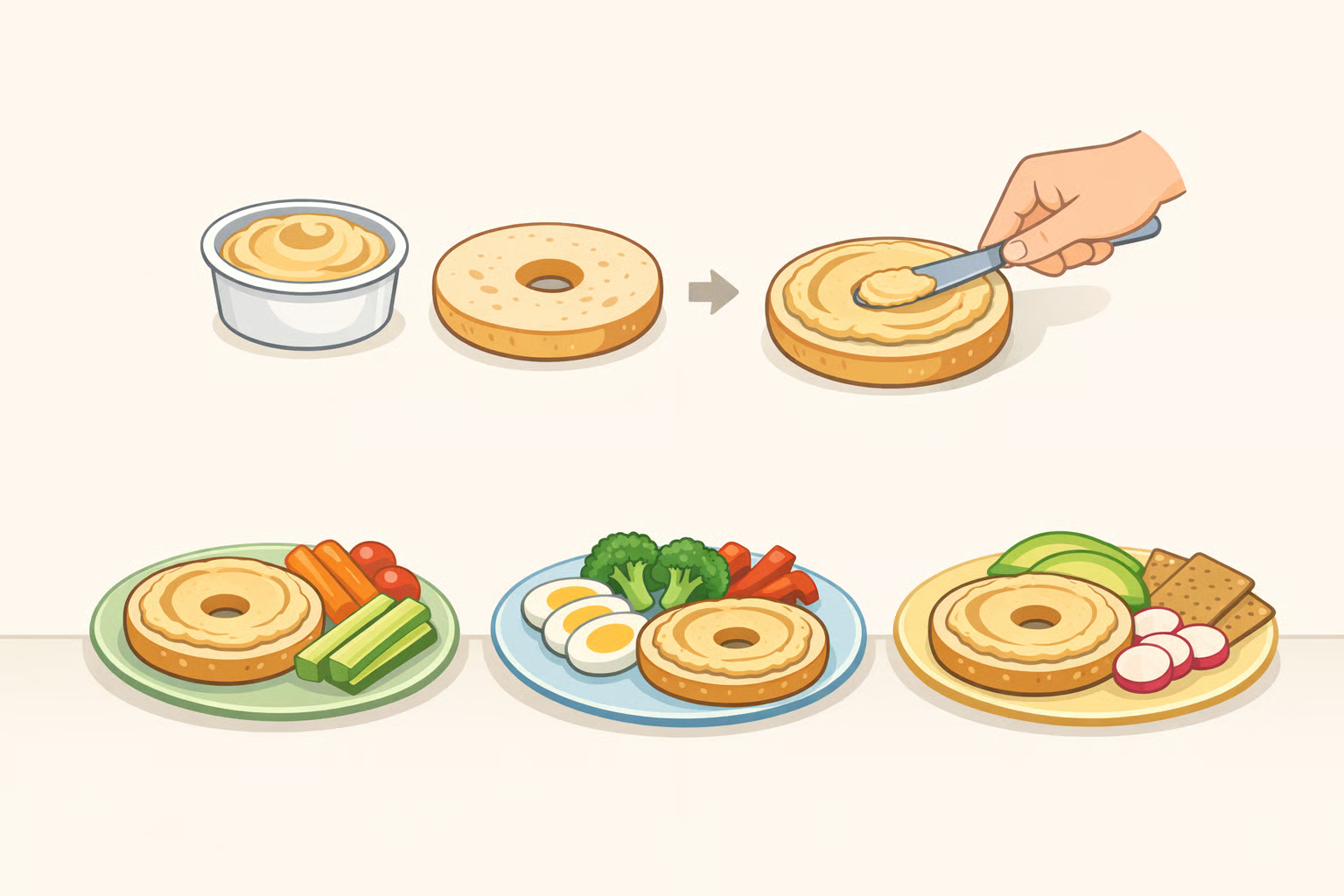
Most students treat hummus as a condiment. It's an anchor. Hummus is available daily at the CU Boulder deli bar and at most campus deli stations (November 2025). Spread it on a bagel, pair it with raw vegetables from the salad bar, or use it in place of butter in a sandwich build.
Peanut butter packets and bean-based spreads follow the same logic: protein-rich bases, not finishing touches.
Grab-and-go options
CU Boulder flags portable snacks like edamame, fresh fruit, and a Greens, Tomato and Quinoa Salad as a smart use of campus meal-plan currency at grab-and-go spots like CU on the Run and The Alley @ Farrand (November 2025). For restock timing at your own hall, observe it the same way you mapped the stations: one early visit, same approach.
The repeatable routine
Once you've mapped one dining hall, you can read almost any other in minutes. The geography varies. The logic doesn't.
The walk-through is the real hack. Every build in this guide depends on cross-station sourcing: the grilled cheese needs the panini press, the bagel pizza needs the pasta line and salad bar, the tortilla depends on the Latin station's daily protein. Those combinations only surface if you know the hall's geography first (March 2025). Do the five-minute walk-through at your own hall, whether that's Hope College or anywhere else, before trying to replicate any of these. Note three daily anchors, find the heat sources, confirm the labeling system, and identify one fallback build you can always execute.
Rotating items are upgrades, not anchors. The difference between a build that works every day and one that works twice a week is whether the anchor is truly daily. CU Boulder's plant-based options rotate on a three-week cycle (November 2025), meaning some components are reliable bets and others are bonuses. At Hope College and every other campus, the same distinction holds.
Build your defaults around what you can count on. Everything else is a good day.

Comments
Be the first, drop a comment!