



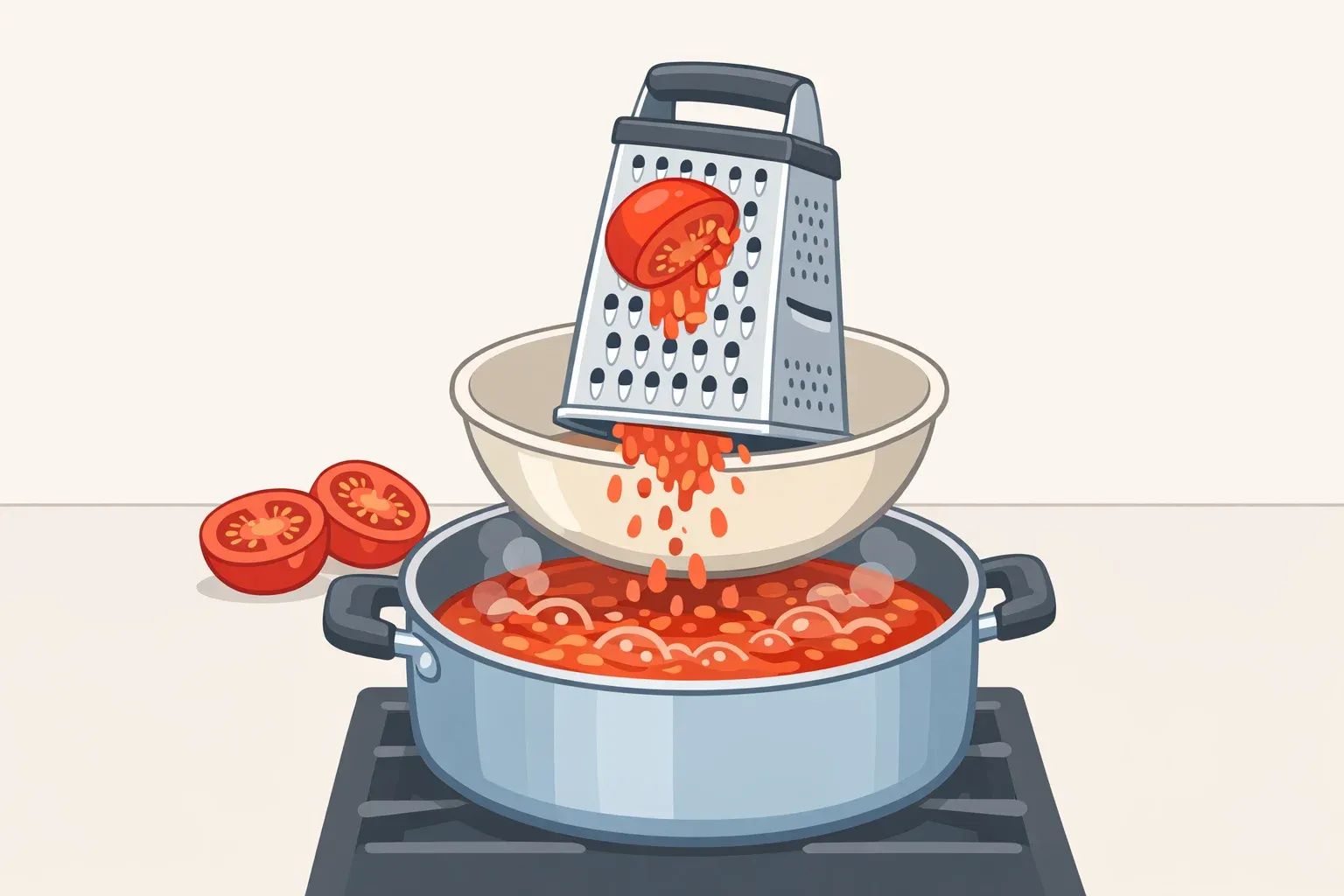
There's a version of grated tomato pasta sauce that skips the cutting board, the peeling pot, and the blender entirely. Run a halved tomato across the large holes of a box grater, and the flesh purées itself while the skin stays in your hand. The whole process takes only a couple of minutes per batch, which is why Country Living ranks it among the fastest homemade pasta sauces around.
That "no-cook" label deserves a caveat before going further. This version gets a quick simmer, just a few minutes, not a fully cooked sauce, so "barely cooked" is a more honest description than "raw." Readers after a genuinely no-heat, raw tomato pasta sauce have an option later in this piece: cookbook author Meryl Feinstein's pomodoro crudo, a no-cook tomato pasta sauce that rests chopped tomatoes, garlic, and basil in olive oil at room temperature with no stove involved at all.
The technique itself takes a few paragraphs to explain and even less time to do. What matters more is which tomatoes actually work, what to do if the sauce turns out thinner than expected, and when the chopped, rested method covered near the end is the smarter call.
How to grate tomatoes for pasta sauce
Prerequisites: a box grater, a shallow bowl to catch juices, ripe-but-firm tomatoes, and a large pot for pasta water.
Start a large pot of salted water boiling before touching the tomatoes. Grating itself takes only a couple of minutes, so there's little risk of the pasta getting ahead of the sauce.
Halve tomatoes across the equator, not through the stem end, which makes them easier to grip.
Set the box grater inside a shallow bowl first. The juice that pools underneath carries real flavor, so it belongs in the sauce, not the sink.
Grate cut-side down against the large holes until only flattened skin remains in hand, then discard it. Switching to the fine side turns tomatoes to mush; the large holes are what give this sauce its texture.
Give the pulp a brief simmer, no more than a few minutes. Country Living doesn't specify a pan, exact seasoning, or a precise minute count beyond that window, only that pushing past it mutes the bright flavor the whole method is built to preserve. Season and taste as you go rather than following a fixed formula.
Toss with hot, fully cooked pasta. Country Living describes the finished sauce as light and silky, the kind that clings to noodles instead of pooling thin or turning chunky. Parmesan and butter aren't part of this method as published; stirring them in borrows from the chopped technique further down, and nobody's confirmed how that pairing behaves on grated pulp specifically.
Finish with torn basil if there's some on the counter, and serve right away.
Because this sauce only gets a few minutes of heat, expect it to taste closer to fresh raw tomato than a long-simmered marinara; that's the tradeoff for speed, not a flaw. The technique never separates seeds from flesh the way chopping and seeding can, so texture depends almost entirely on which tomato goes onto the grater. Nothing here involves blanching, peeling with a knife, or resting; the active time overlaps entirely with the pasta boil.
If the sauce runs thin: prevention and rescue
Once a tomato is grated, there's no picking seeds out of pulp the way a chopped recipe can, so the biggest lever for texture is the tomato chosen before the grater comes out. Very soft tomatoes collapse instead of grating cleanly, which is why ripe-but-firm ones, whether Roma, garden slicer, or vine-ripened, are the better pick. Off-season grocery-store tomatoes will still grate, but peak-season fruit has the better flavor, and flavor is the reason to grate instead of reaching for a jar.
Chopped recipes can squeeze the seeds and jelly out by hand before cooking, which is exactly how Bon Appétit keeps its own chopped version from turning watery. That trick depends on an intact seed pocket to squeeze, so once a tomato has already gone through the grater and turned to pulp, there's nothing left to remove.
Know what "too loose" actually looks like before assuming there's a problem. The sauce pools at the bottom of the bowl instead of coating the noodles, or the pasta looks slick rather than glossy.
If the sauce does run thin once it hits the pasta, Bon Appétit's fix for its own chopped version is to add more finely grated Parmesan and keep tossing; the hot pasta melts cheese and butter into the mix, which is what thickens it.
That mechanism belongs to Bon Appétit's recipe, which builds in cheese and butter from the start; the grated method above doesn't, so treat cheese as an add-on worth testing rather than a proven rescue. If the result turns dry or clumpy instead of loose, a splash of reserved pasta water restores gloss without watering down flavor the way plain water would.
When the chopped, rested version is the better choice
The grated method above is built for one thing: getting a fresh sauce onto pasta before the water's even fully drained. The chopped, rested method, whether it's Bon Appétit's tested version or Meryl Feinstein's pomodoro crudo from her cookbook Pasta Every Day, aims at something else: giving raw tomatoes time to actually taste like something before they hit the noodles.
Bon Appétit's version chops and seeds the tomatoes, squeezing out the surrounding jelly and juice by hand since that liquid can taste bitter and water the sauce down, then lets the mixture sit at room temperature anywhere from 30 minutes to five hours with garlic, vinegar, and red pepper flakes before tossing with hot pasta, butter, and Parmesan.
For a tested sense of proportion, that recipe runs 1½ pounds of tomatoes against 12 ounces of pasta, one grated garlic clove, 2 ounces of finely grated Parmesan, ¼ cup of olive oil, 2 tablespoons of butter, and a cup of torn basil, numbers that apply to seeded, rested tomatoes rather than grated pulp
Feinstein's pomodoro crudo skips the seeding step by design. Her recipe combines halved or quartered tomatoes with chopped garlic and torn basil, seasons generously with salt, drizzles in a third to a half cup of olive oil, and lets the bowl sit covered for at least an hour, ideally somewhere warm and sunny, before tossing in cooked pasta. She prefers leaving the seeds intact for a rustic result, though she'll peel and seed larger tomatoes first if that's what's on hand.
Both chopped versions also want a different tomato than the grated method does. Bon Appétit calls for fruit that's slightly overripe, "full-to-bursting like a water balloon," since that softness makes it sweeter and juicier once mashed. Feinstein is looser on variety, working with anything from heirloom to plum to cherry tomatoes as long as they're flavorful.
The payoff for waiting shows up later, not right at the table. As chopped tomatoes sit with pasta, the noodles keep soaking up garlicky juice, which is why Feinstein rates the leftovers as good as, maybe better than, the fresh batch, a real advantage for picnics or next-day lunches.
Grated (this guide)
Tomatoes: Ripe but firm
Time: A few minutes while the pasta boils
Texture: Silky; retains the seeds and juice
Best for: Serving hot and eating right away
Chopped and rested
Tomatoes: Slightly overripe and meaty
Time: 30 minutes to 5 hours of resting, plus pasta-cooking time
Texture: Chunky and more concentrated
Best for: Making ahead, picnics, and next-day leftovers
Matching the method to the tomato in hand
A quick squeeze test settles most of the guesswork. A tomato that yields slightly under gentle pressure but springs back is still firm enough to grate cleanly; one that dents and stays dented is past that point, which is exactly why very soft tomatoes collapse on the grater instead of shredding.
Tomatoes that fail that test aren't wasted, just better suited to the other method in this piece. Bon Appétit specifically wants fruit that's slightly overripe and "full-to-bursting," so the soft tomatoes sitting near the edge of spoiling are closer to ideal for the chopped, rested route than for grating.
Timing at the table matters too. The grated method isn't designed to rest the way the chopped versions are; it's meant to go straight from grater to skillet to hot pasta, which is the whole basis for Country Living calling it one of the fastest routes to a fresh sauce. Sort the tomato bowl by feel before deciding which recipe to make, and the right method for tonight's dinner mostly picks itself.




Comments
Be the first, drop a comment!