



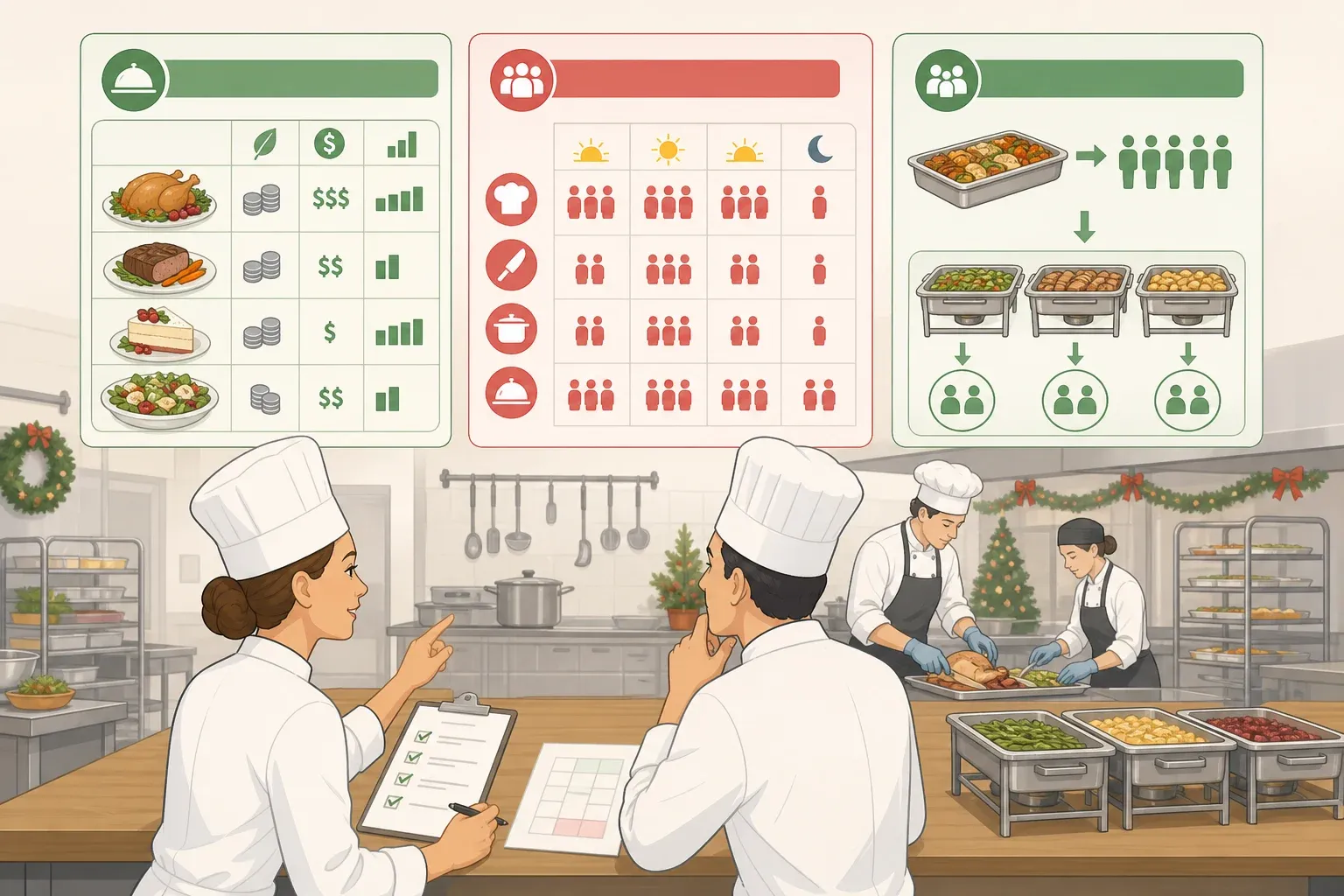
A dish only earns a spot on your catering sheet as one of the high-margin holiday menu ideas worth running once it clears a specific test: ingredient cost, added labor, and event-specific costs like disposables, extra staffing, and delivery, all measured against your restaurant's own price ceiling and kitchen capacity. Skip that test and "festive" just becomes a synonym for expensive to make and hard to hold. This guide walks through that test before a single holiday dish gets built, plus a worksheet to run it on your own numbers.
Group orders and catering requests tend to pick up once the holiday stretch starts, and off-premises orders now make up a bigger share of full-service business than they did before the pandemic. That shift is one reason full-service operators kept median food and non-alcoholic beverage costs at 32.0% of sales in 2024, a bit below the 34% average of the three prior reports, with simplified menus cited as another likely factor, the National Restaurant Association data shows.
This guide is built for independent operators designing a small set of holiday group-order, catering, or private-event items, not a full seasonal menu overhaul and not home holiday entertaining. It covers pulling the right data, costing and pricing each candidate dish, building around shared prep systems, testing kitchen capacity, and adjusting for plated, buffet, or takeout formats before committing to a large order.
Gather the data before you design a profitable holiday menu
Pull three data sets before touching the menu: your POS sales mix and 86 history, current recipe and portion costs, and average prep time per dish. That's the real starting point for holiday menu planning for restaurants: numbers before ideas. Without those three data sets, any "high-margin" label you assign later is a guess dressed up as math.
Set a target outcome up front: two to four seasonal items tied to your existing catering or group-order menu, not a parallel holiday menu built from scratch. Paring down selections lets operators buy steady sellers in larger volume, which lowers per-unit cost and simplifies ordering, a pattern the National Restaurant Association documented in 2022. The same logic applies to a short seasonal add-on: fewer items, deeper purchasing on each one.
Decide which format you're designing for first: plated private events, buffet-style parties, or takeout and catering delivery. Each carries different plating, holding, and packaging constraints. This guide treats catering and group orders as the default case and flags what changes for the other two formats later.
Audit your current menu for slow sellers and capacity drains
Compare each item's weekly sales, prep minutes, and food waste side by side before adding anything new. Call that a velocity check if you want a shorthand for it. Restaurants that run this kind of structured comparison protect throughput, and cutting even one weak performer can restore seconds per transaction across the whole kitchen.
Check whether past supply disruptions already forced changes worth revisiting. During the last major supply crunch, the National Restaurant Association found that 96% of operators had experienced delays or shortages, and roughly eight in ten full-service operators responded by trimming menu items and lightening the kitchen's labor load. If those earlier cuts made service smoother, keep them in place rather than reversing course for the holidays.
Look for seasonal or limited-time dishes that outlived their usefulness. Items left on the menu after demand cools can strain prep flow without generating enough traffic to justify the labor they still consume. Clearing those items opens the bandwidth, inventory space, and station time a new holiday item actually needs.
Cost and price each candidate item: the restaurant holiday menu profitability test
Run each candidate through the same worksheet before it gets approved. Fill in your own numbers, not an estimate:
Ingredients: Per-portion recipe cost
Packaging/disposables: Containers, bags, and utensils for off-premises orders
Paid prep minutes: Labor minutes beyond your normal prep flow, calculated at the loaded hourly rate
Delivery/setup labor: Driver time, event staffing, and mileage
Serviceware: Chafing dishes, linens, and disposable serving pieces
Waste allowance: Expected spoilage or over-production as a percentage of the batch
Total event cost: Sum of all the costs above
Proposed price: What you plan to charge per order or per guest
Contribution per order: Proposed price minus total event cost
A few notes on filling it in:
Set your target contribution using your own numbers as the benchmark, not an industry average. Full-service median food cost sat at 32.0% of sales in 2024 and limited-service at 32.4%, per the National Restaurant Association. That's context for where your overall ratio should land, not a rule to force onto one holiday dish.
Test whether the resulting price is credible to a guest. Would a regular customer agree the plate is worth what you're charging once delivery, extra staffing, and packaging are baked in? If the price only works on a spreadsheet, orders will stall at booking.
Reject or simplify anything that doesn't clear the bar. A holiday item that only pencils out by cutting corners on quality or portion size isn't worth the seasonal bump it might bring in.
This worksheet is what turns "high-margin" from a marketing phrase into a number. Everything in the next section gets built against whatever contribution figure you land on here.
Build the menu around holiday menu items with low food cost
Anchor the menu on one or two mains most guests already order without hesitation: a roast, a filet, a hearty vegetarian stew or pasta. These dishes tend to hold up over a holiday rush because they're familiar to cook, familiar to order, and don't depend on a special ingredient list.
Add one shared spice blend or garnish system as the festive layer, rather than a separate seasonal prep for every dish. A cranberry garnish or warm-spice syrup can dress up both plates and drinks without a new production line, and it works just as well on a holiday drink as it does on a dessert plate.
Check for isolated prep paths before approving an item. Menus that lean on one-off ingredients or unique preparation steps force cooks to shift mental and physical gears constantly, which raises error rates and training complexity during a rush. Model dishes instead on systems where components, like a shared dough, sauce, or protein base, move through compatible stations.
Keep any customization inside fixed choices. Structured build systems that let guests customize within a defined set of core ingredients preserve flexibility without breaking kitchen flow.
A working template looks like this: one core protein, two shared sides that use overlapping prep, one seasonal sauce or garnish, and one dessert or beverage add-on. Approve each addition only if it cleared the worksheet above and it uses equipment and ingredients already in daily rotation. That combination is how holiday menu items with low food cost end up looking festive without adding a second set of prep steps to the line.
Run a capacity test before finalizing the menu
A dish that clears the cost worksheet can still fail on the floor. Map each approved item to its station, equipment, and finishing step, then fill in this worksheet using an actual test batch:
Max orders per 15-minute window: How many plates or orders the slowest station can finish
Station bottleneck: Which station—grill, fry, plating, or expo—caps output
Holding space: How many pans or trays fit in hot and cold holding at once
Plating space: Counter or table space available for simultaneous plating
Test-batch result: Actual time to produce a mid-size batch, such as 20 orders
Congestion during service usually traces back to sequencing and transitions between hot prep, cold assembly, and finishing, not simply to having too many ingredients on hand, according to It's All Goods.
Cap plated items at a small, fixed number of components you can plate quickly and consistently. Fewer moving pieces per plate means faster output with fewer mistakes, and that matters even more at a private event, where the kitchen might need to plate a large run of dishes back to back, a volume most line layouts weren't built to handle without a simplified format.
Align production with your actual demand windows instead of holding every holiday item ready all shift. Matching prep to reliable demand periods stabilizes labor planning and cuts down on food likely to be wasted.
Adjust for plated events, buffets, and takeout/catering
Plated private events: Hold to a small, fixed component count per plate and confirm your plating area has physical room for the expected volume before accepting the booking.
Buffet-style parties: Serve in smaller rounds instead of setting out a full spread at once, so each portion spends less time exposed. Keep hot items above 140°F and cold items at 40°F or below throughout service, staying out of the range where bacteria multiply fastest.
Takeout/catering delivery: Off-premises sales have grown as a share of full-service business, and some of that volume may come at a lower price point, per National Restaurant Association data. Fold packaging, delivery time, and holding equipment into your worksheet regardless; a standard dine-in cost sheet won't automatically catch them.
Before running the buffet bullet above at an actual event, know the limits of that guidance. The 40°F/140°F range and the two-hour holding window are baseline food-safety rules, not a full commercial holding protocol. Confirm your specific cooling, holding, and re-service procedures against your local food code or HACCP plan before you replenish a buffet or hold food for an extended service window.
Control time, temperature, and waste during service
Do not let perishable food sit between 40°F and 140°F, the "Danger Zone," for more than two hours. Bacteria multiply quickly in that range, and food held longer should be discarded rather than served.
Refrigerate or freeze anything not served within that two-hour window, and reheat any re-served leftovers to 165°F, checked with a food thermometer, before putting them back in front of a guest. Sauces, soups, and gravies should come back to a full rolling boil before re-service.
Treat these figures as the floor: they're written for home and simple buffet service, not a commercial kitchen's cooling, cooking, and reheating procedures under local health code, and they say nothing about food that's already been plated and returned from a table. Check your health code directly for anything beyond simple hot-and-cold holding.
Batching service this way protects the margin built into the menu as much as it protects guests. Food discarded after sitting out too long erases the cost work done on the worksheet earlier, and no amount of clever pricing recovers it.
Before you accept the booking
Run through this list before confirming a large private event or catering order:
Two to four items, each tied to equipment and ingredients already in daily rotation
Each item priced through the cost worksheet and clearing your target contribution
The capacity worksheet filled in for your busiest expected order size
One test service run at moderate volume, with actual times checked against that worksheet
A buffet or delivery plan checked against your local food code, not just the baseline temperature guidance above
Don't overbuild the festive factor. Choose the simpler special unless your test service shows the more complex dish can be produced consistently at the required margin. After the season wraps, rerun the sales-versus-prep comparison from earlier: if an item's prep time still outweighs its sales contribution, drop it before next year instead of carrying it forward out of habit.

Comments
Be the first, drop a comment!