




Bland soup often isn't missing some secret ingredient. The better starting point is a taste test, because the right fix depends on what's actually missing from the pot: salt, acid, or savory depth.
The safest way to rescue it is to make one small adjustment at a time. Salt usually fixes muted flavor, acid can wake up a soup that already tastes seasoned but heavy, and an umami-rich ingredient can add depth when the flavor still feels thin.
Culinary writer Terumi Morita's flavor-balancing framework treats salt, acid, fat, and umami as separate things to diagnose rather than ingredients to add blindly.
For soup specifically, Cristina's Kitchen recommends starting with salt, moving to acid if salt isn't the problem, and adding umami if something still feels missing.
This is a rescue method for soup that's already cooked, not a recipe rewrite.
Why does my soup taste bland?
Taste a spoonful when the soup is warm enough to eat comfortably rather than piping hot.
Cristina's Kitchen recommends tasting warm soup because very hot food makes it harder to judge seasoning accurately.
Then decide what kind of "bland" you're actually tasting.
Muted or dull, with ingredients that don't stand out: Try salt.
Seasoned but heavy, muddy, sweet, or one-note: Try acid.
Flavorful at first but lacking depth or persistence: Consider umami, or fat if the soup is also lean.
Clearly too salty throughout: Dilute instead of adding more seasoning.
That last distinction matters.
Morita describes a thin flavor that disappears quickly as potentially lacking fat or umami, not automatically umami alone.
A clear vegetable broth may need savory depth. A very lean soup may instead need a little richness.
Start with salt, but go slowly
Salt is the first thing to check when a soup tastes muted.
Cristina's Kitchen notes that many soups contain naturally sweet ingredients, including onions, vegetables, and some proteins, which can make an underseasoned broth taste flatter than expected.
The margin between bland and oversalted can also be narrow.
For a 3- to 4-quart pot, Cristina's Kitchen says as little as half a teaspoon of additional salt can sometimes move a soup from underseasoned to oversalted.
That doesn't mean every bland pot needs half a teaspoon.
Start with less.
Add a small pinch of salt.
Stir thoroughly.
Warm the soup through.
Taste again.
Repeat only if it still tastes muted.
Stop when the ingredients taste clearer and more distinct.
The goal is seasoned soup, not soup that tastes noticeably salty.
If the salt is right, test acid
A soup can contain enough salt and still taste flat.
That often happens with soups that are:
Rich
Creamy
Sweet from vegetables
Heavy with slow-cooked ingredients
Savory but dull
Acid can sharpen those flavors without adding more salt.
Useful options include:
Lemon juice
Lime juice
Sherry vinegar
Red or white wine vinegar
Apple cider vinegar
Rice vinegar
Morita gives a tablespoon of vinegar or a squeeze of lemon as an example for a pot that tastes heavy despite adequate seasoning.
For rescue work, it is safer to start smaller.
Cristina's Kitchen recommends beginning with a few drops of vinegar or a small spritz of citrus, stirring, tasting, and adding more until the soup lifts.
That approach gives you much more control.
How to add acid without making the soup sour
Start with a small amount.
For a full pot:
Add a few drops or a small splash of vinegar, or a squeeze of citrus.
Stir well.
Taste.
Add more only if the soup still feels dull.
Acid registers quickly, so there is no need to simmer the soup for 20 minutes just to tell whether it worked.
Creamy soups often respond especially well to a small acidic finish because the acidity cuts through richness.
Tomato, bean, lentil, vegetable, and long-cooked meat soups can benefit too, depending on the recipe.
Choose an acid that makes sense with the existing flavors rather than treating all vinegars as interchangeable.
When bland soup needs umami
If salt and acid are in balance but the soup still feels thin or hollow, savory depth may be the missing piece.
Umami-rich additions include:
Soy sauce
Tamari
Miso
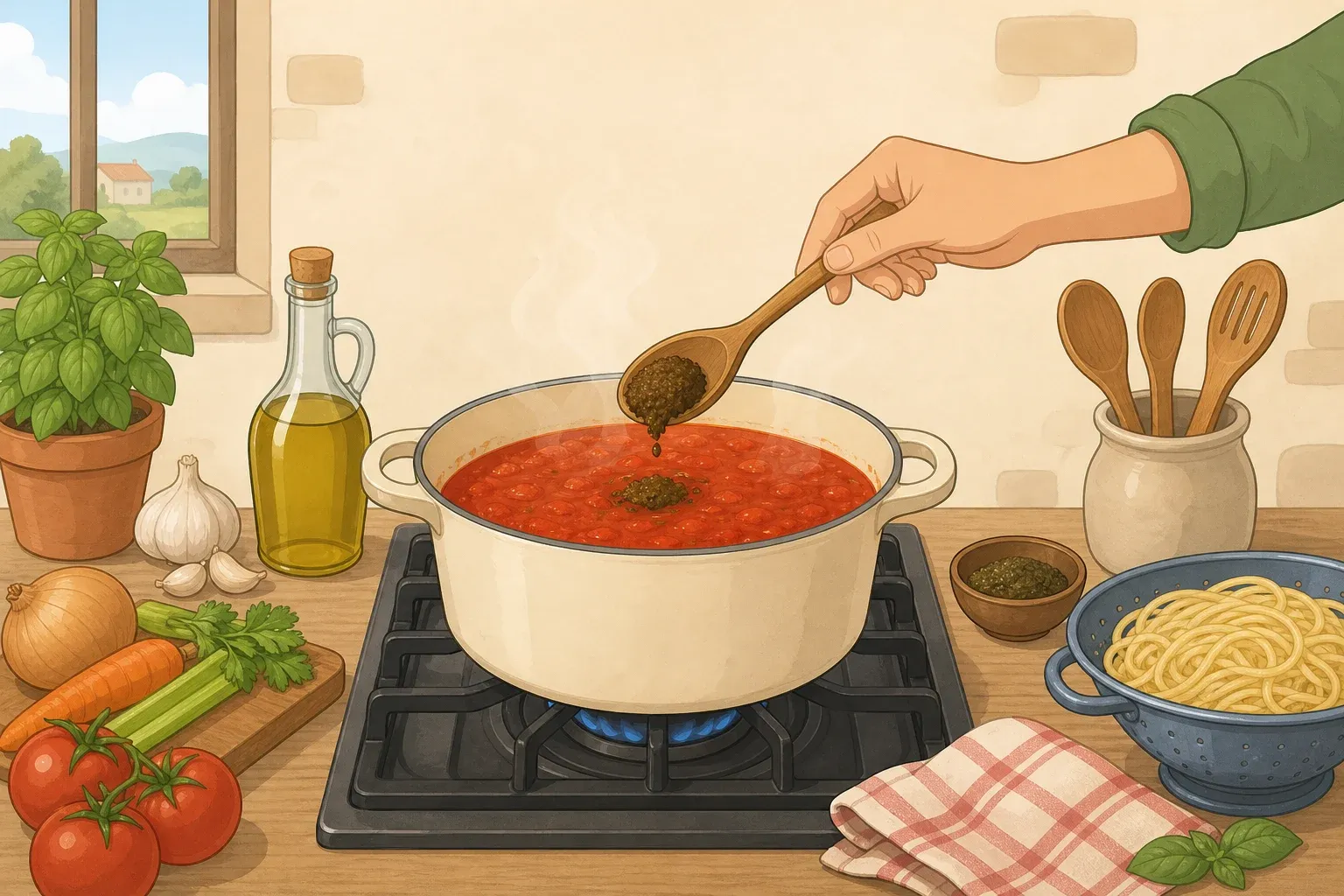
Tomato paste
Bouillon or stock concentrate
Parmesan or a Parmesan rind
Fish sauce
Anchovy paste
Dried mushrooms
Kombu
Use ingredients that suit the soup.
A teaspoon of miso can make sense in a vegetable or mushroom soup. Parmesan can suit tomato, bean, or Italian-style soups. Fish sauce can disappear into many meat-based broths when used sparingly.
You don't need all of them.
Pick one.
Not every umami ingredient needs a long simmer
This is where the timing depends on what you're adding.
Cristina's Kitchen recommends simmering browned mushrooms or meat for at least 15 to 20 minutes after adding them to a finished soup so their flavors have time to integrate.
That timing does not apply equally to every umami booster.
Ingredients such as:
Soy sauce
Tamari
Fish sauce
Miso
Bouillon concentrate
can be stirred in in small quantities and tasted much sooner.
Tomato paste benefits from being thoroughly incorporated, and a Parmesan rind or dried mushrooms make more sense when they have time to simmer and infuse the broth.
For miso, dissolve a small amount into hot broth before stirring it back into the pot so it distributes evenly.
Remember that many umami boosters also add salt
Don't treat savory ingredients as sodium-free flavor.
Many common umami boosters are salty themselves, including:
Soy sauce
Tamari
Miso
Bouillon
Stock concentrate
Parmesan
Fish sauce
Anchovy paste
That means the salt check and umami check can overlap.
If the soup is already well seasoned, start with a very small amount and taste before adding more.
A low-sodium broth or unsalted ingredient such as mushrooms can give you more room to adjust when the soup is already close to its salt limit.
A quick bland-soup rescue sequence
Use this order when you don't know where to begin.
1. Taste the soup warm
Let a spoonful cool enough that you can taste it comfortably.
2. Ask whether it tastes underseasoned
If everything feels muted, add a small pinch of salt.
Stir, warm through, and taste again.
3. Ask whether it feels heavy or dull
If the salt level seems right but the soup still feels muddy, add a little acid.
Start with drops rather than a large pour.
4. Ask whether the flavor has enough depth
If the soup tastes reasonably bright and seasoned but still seems hollow, try an umami-rich ingredient that suits the recipe.
If the soup is extremely lean, a little fat may also be the missing piece.
5. Retaste before making another change
Don't add salt, lemon, soy sauce, and butter all at once.
Change one thing, taste the result, and then decide whether anything else is still missing.
What if the soup is actually too salty?
Once a soup is genuinely oversalted, more acid or umami isn't the primary fix.
Dilution is.
Cristina's Kitchen's oversalted-soup guide recommends adding small amounts of unsalted liquid or unsalted solids to lower the overall salt concentration.
Possible liquids include:
Water
Unsalted stock
Milk or cream when appropriate
Possible solids include ingredients that already make sense in the soup, such as:
Potatoes
Rice
Pasta
Beans
Lentils
Vegetables
Add a little at a time rather than dramatically increasing the volume of the pot.
Cristina's Kitchen suggests adding no more than about 1/4 cup of extra liquid at a time, reheating, stirring thoroughly, and tasting before adding more.
Acid can help a soup that's only slightly too salty
There is one exception.
If a soup is only slightly too salty, a few drops of lemon juice or vinegar can sometimes make the flavor feel more balanced.
Cristina's Kitchen describes this as rebalancing rather than actually removing salt.
The sodium concentration hasn't changed.
If the soup tastes strongly oversalted throughout, dilution remains the more reliable fix.
Don't use the potato trick as a salt sponge
Dropping a potato into oversalted soup and removing it later does not selectively suck salt out of the pot.
A potato absorbs some surrounding liquid, but that liquid contains roughly the same salt concentration as the rest of the soup.
If you add potatoes and leave them in the dish, they can help by increasing the total amount of unsalted food in the pot.
That is ordinary dilution.
The potato is not acting as a salt magnet.
If a vegetable broth still tastes thin
Vegetable broths can sometimes remain light even after salt and acid are corrected.
This is where longer-building sources of savory flavor make sense.
Options include:
Dried mushrooms
Kombu
Tomato paste
Miso
Browned mushrooms
A compatible stock concentrate
Morita specifically points to dried mushroom, kombu, miso, or additional reduction as ways to give a vegetable broth more depth.
Reduction is the one option to use cautiously.
Reducing a soup concentrates salt as well as flavor, so don't simmer an already well-seasoned broth down substantially without tasting along the way.
Texture can also read as blandness
Not every disappointing bowl has a seasoning problem.
Cristina's Kitchen notes that a soup with little textural contrast can also feel bland even when its seasoning is technically balanced.
Depending on the recipe, toppings can add contrast:
Croutons
Toasted nuts
Seeds
Roasted vegetables
Fresh herbs
That won't repair an underseasoned broth, but it can make an otherwise balanced soup more satisfying.
What success looks like
A rescued soup should taste complete rather than obviously salty, sour, or loaded with soy sauce.
If one corrective ingredient announces itself immediately, you probably went too far.
The simplest sequence is:
Taste.
Correct salt if needed.
Add acid if the soup is seasoned but dull.
Add umami if it still lacks depth.
Consider fat or texture if those three aren't the real problem.
Retaste after every change.
If the soup is genuinely oversalted, stop seasoning and dilute it.
The point isn't to keep adding ingredients until something works. It's to identify the missing piece, make the smallest useful correction, and stop when the soup tastes balanced.









Comments
Be the first, drop a comment!