



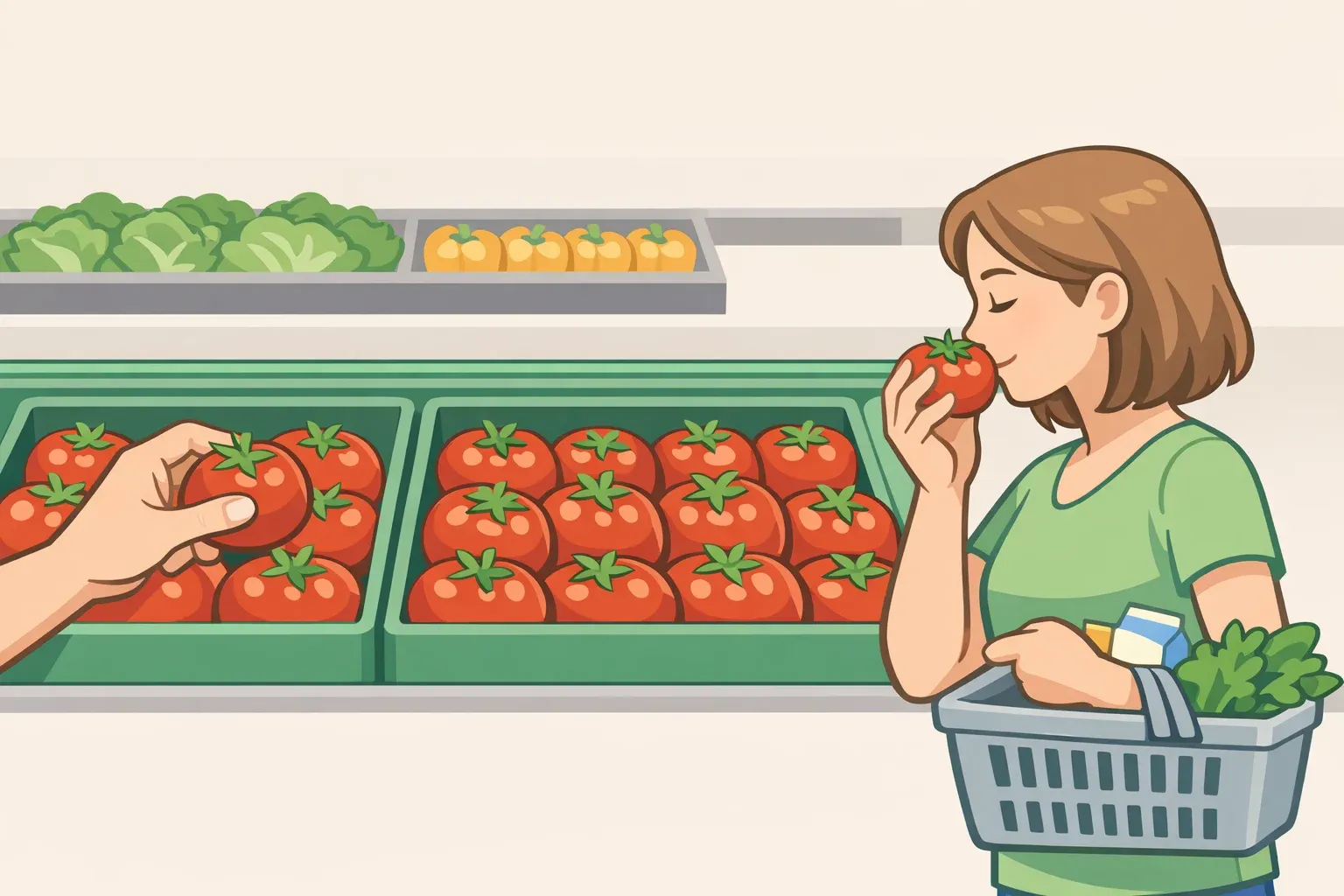
How to pick ripe tomatoes at the grocery store: a checklist
Learning how to pick ripe tomatoes at the grocery store comes down to four checks you can run right in the produce aisle without cutting anything open: weight, skin, gentle give near the stem, and smell. None of these cues proves ripeness by itself, but running through all four is a safer bet than trusting color or firmness alone (Colorado State University Extension, 10 months ago; Purdue Extension, three years ago).
Color is the cue most shoppers lean on, and it's also the one that tells you the least. Many commercially handled round and Roma tomatoes are harvested green and treated afterward with ethylene gas to bring on color, so a fully red tomato at the store hasn't necessarily had time to develop full flavor or been picked at the right stage of maturity (University of Florida IFAS Extension, three years ago). This guide covers the checklist, how to adjust it by variety and use, what to do when nothing on the shelf looks ripe, why color can't tell you what you need to know, and how to store what you bring home.
What to look for when buying tomatoes
This is a no-tools job. All that's needed is a hand and a nose, and each check takes only a moment. Whether you're standing in front of a supermarket display or a farmers market table, the same approach works for how to choose fresh tomatoes: check weight, skin, give, and smell before you ever look at color.
Pick up a few tomatoes of the same variety and similar size, then run through these four checks to tell if a tomato is ripe:
- Weigh it in your hand. Compare tomatoes of similar size and type, and choose the one that feels heavier than the others (Colorado State University Extension; Purdue Extension). Weight only means something when you're comparing similar fruit side by side, not a cherry tomato against a beefsteak.
- Check the skin. Look for taut skin, rich color, and no bruising, pitting, or insect damage (Colorado State University Extension; Purdue Extension). Skip anything with obvious physical damage and move to the next one.
- Press gently near the stem. The flesh should give slightly under light thumb pressure (Colorado State University Extension). Don't squeeze hard; tomatoes bruise easily, and a light touch is enough to feel the difference between ripe and rock-hard.
- Smell the stem end. Tomatoes with the strongest aroma tend to have the richest taste (Purdue Extension). Use smell to break a tie between two tomatoes that look and feel similar. A faint smell isn't automatically bad, but a strong one is the better bet.
How ripe a tomato should feel also depends on what you're cooking. A slicing tomato headed for a sandwich or salad should feel heavy for its size, smell noticeably like a tomato, and give slightly without feeling soft. A tomato bound for sauce, especially a Roma or plum type, doesn't need that same softness: a firmer fruit with less give is normal, and even one with a surface bruise still works fine, since bruised tomatoes are good for sauce even though they're not ideal eaten raw (Colorado State University Extension).
A tomato that's heavy for its size, has taut unbroken skin, gives slightly under gentle pressure, and smells like a tomato at the stem is a strong candidate for the cart, even without cutting into it.
Choosing tomatoes by variety and how you'll use them
Grocery shelves in most of the country carry round, Roma, grape, cherry, and occasionally heirloom tomatoes, since these are the main types grown commercially, largely out of Florida during the fall, winter, and spring seasons (University of Florida IFAS Extension). Round and Roma types get the most attention in commercial handling guidance because they're the ones most commonly grown and harvested green for later ethylene treatment (University of Florida IFAS Extension).
The weight and firmness checks above only work when you compare like with like. A cherry tomato will always feel lighter than a beefsteak, so judge it against other cherry tomatoes in the container, not against the whole display.
Vine-ripened tomatoes, whether homegrown, from a farmers market, or labeled as such at the store, generally have the best shot at good flavor, since nothing beats a tomato that actually ripened on the plant (Colorado State University Extension). A label alone can't confirm every step of how that specific tomato was handled, but it's still a reasonable signal to look for. Imported tomatoes marked vine-ripe, often grown in Mexico or Canada, are typically raised under protected culture like greenhouses (University of Florida IFAS Extension); whether that's a good stand-in for local, in-season fruit comes down to personal taste more than anything the research settles.
What to do when every tomato looks underripe
Sometimes the whole bin looks pale or feels rock-hard. Look for tomatoes that are roughly 60 to 80% colored. Those can finish ripening at home rather than sitting unsold on the shelf (Colorado State University Extension). That's a different pick than what you'd want for dinner tonight, but a reasonable one if you're shopping a few days ahead.
A tomato that's still solid green with no hint of color is harder to call. It may still ripen at home, but there's no way to tell from the outside whether it was harvested mature enough to develop full color and flavor in the first place. If a tomato was picked too immature, more time on the counter won't fix it, though you can't diagnose that just by looking at it (University of Florida IFAS Extension).
Why color alone doesn't guarantee a ripe tomato
The reason weight, give, and aroma matter more than color comes down to how tomatoes actually reach the produce aisle. A tomato left on the vine until it's genuinely ripe has an advantage no amount of gas treatment fully replicates, which is why growing your own or buying local, in-season fruit tends to produce the best flavor (Colorado State University Extension).
Once picked green, round and Roma tomatoes are commonly treated with ethylene gas, a ripening hormone that occurs naturally in fruit anyway, to speed up and even out ripening (University of Florida IFAS Extension). The treatment itself doesn't automatically mean a tomato will taste bad. The limitation is that tomatoes needing more than five days of ethylene exposure to reach the color "breaker" stage were likely picked too immature, and they won't develop normal color or flavor no matter how much longer they're treated (University of Florida IFAS Extension). Shoppers have no way to see how long a given tomato spent under gas, which is exactly why color by itself isn't a reliable way to judge ripeness.
Cold temperatures during shipping and storage compound the problem. Tomatoes held below 68°F show reduced flavor development, and once temperatures drop below 55°F, the damage becomes visible: uneven color, water-soaked spots, pitting, and eventual decay (University of Florida IFAS Extension). Color can tell you a tomato was ripened. It can't tell you how mature it was when it was picked or how cold it got along the way, which is exactly why the physical and aroma checks carry more weight than what's on the skin.
How to store tomatoes so they stay flavorful
Once home, sort tomatoes by ripeness. Fully ripe ones can go straight to the counter; anything with less color needs a few more days.
Tomatoes ripen best between 55°F and 77°F, with the richest red color developing around 68 to 72°F (University of Florida IFAS Extension). Keep them on the counter, not in direct sun or on a hot windowsill. Fruit left in the sun for an hour can run up to 25°F hotter than shaded fruit, which shortens how long it keeps (University of Florida IFAS Extension). Prolonged temperatures above 85°F also lead to poor color and flavor, so keep tomatoes away from the oven or a hot car for extended periods (University of Florida IFAS Extension).
Whole ripe tomatoes don't belong in the fridge. Refrigeration reduces flavor and can leave the flesh grainy, and ripe fruit holds its best quality for about two to three days at room temperature (Colorado State University Extension; Purdue Extension). The one exception is a tomato that's gotten extra-ripe; refrigerate it only then, to slow further softening (Colorado State University Extension; University of Maine Cooperative Extension, last year). The same paper-bag method mentioned above works for any pale tomatoes still finishing on the counter.
Wash and refrigerate tomatoes after cutting
Wash tomatoes under clean running water and dry them with a paper towel right before you cut or eat them, not when you first bring them home (Colorado State University Extension; University of Maine Cooperative Extension). Once a tomato is cut, cover it and refrigerate it, and use it within two to three days (University of Maine Cooperative Extension).
A bruise on the skin isn't the same as spoilage. Bruised but still-firm tomatoes are fine cooked into sauce (Colorado State University Extension), but treat a soft, moldy, or leaking tomato differently. Tomatoes, like any other fresh produce, can pick up bacteria from soil, water, animals, or handling, and visible decay is a sign that's already happened (Colorado State University Extension).
Quick decision guide
Once tomatoes are home, sort them into three piles instead of treating the whole bag the same:
- Eat tonight: heavy for its size, fragrant, full color, slight give. Slice it for a sandwich or salad.
- Ripen a few more days: roughly 60 to 80% colored. Finish it in a perforated paper bag on the counter.
- Cook soon: firm with a surface bruise but no soft spots, mold, or leaking. Skip raw uses and cook it into sauce.
If a tomato passes every check but still tastes flat once you slice into it, don't throw it out. Cook it into a sauce with a little olive oil instead: heat breaks down the tomato's cell walls and makes its lycopene easier for the body to absorb, and a bit of fat helps that absorption along even more (Colorado State University Extension).

Comments
Be the first, drop a comment!