



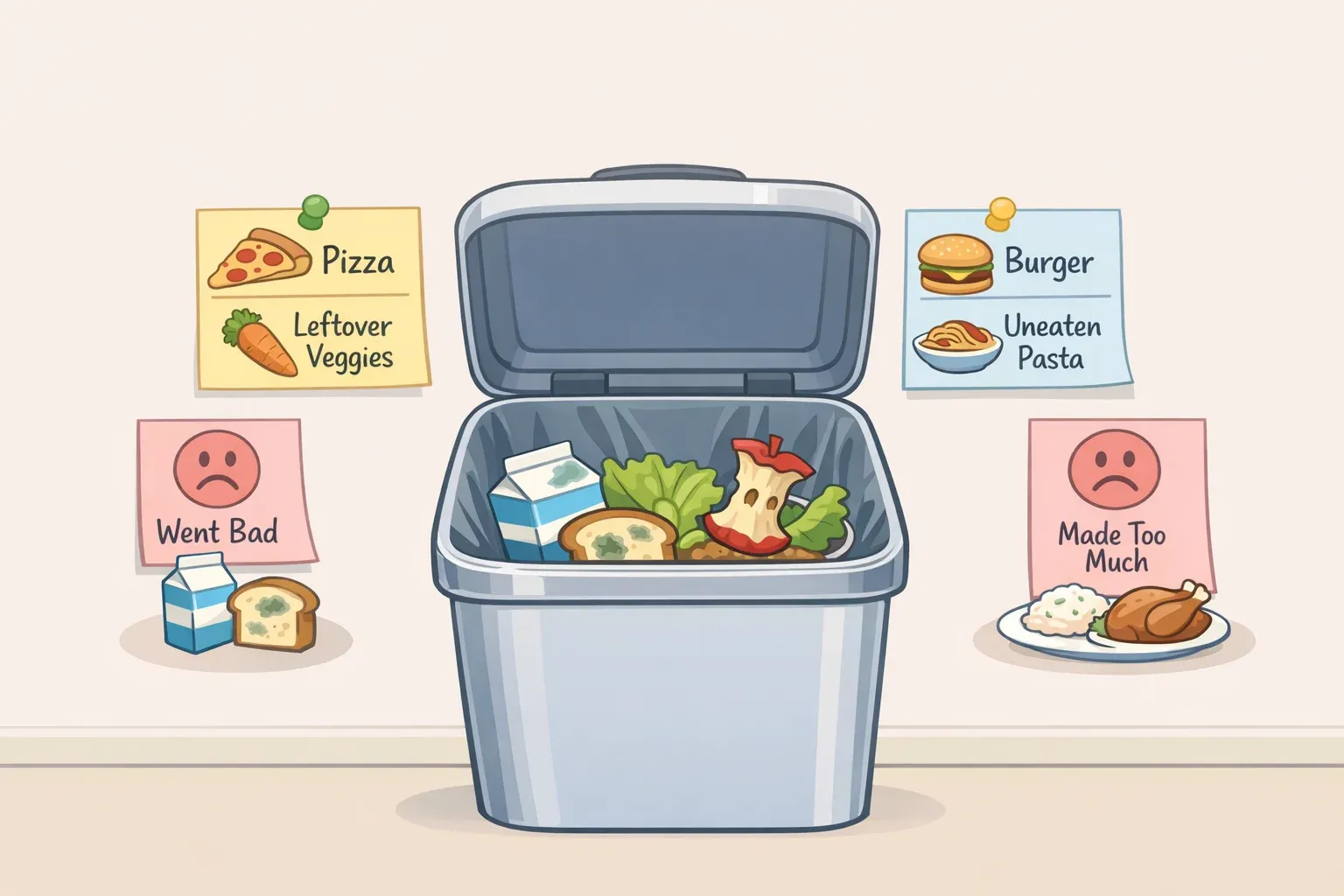
How to Reduce Food Waste and Save Money: Track Your Trash
A family of four throws away close to $2,913 worth of food every year, about 11% of what they spend at the grocery store, according to US EPA estimates. Broken down per person, that comes to roughly $728 a year, or about $14 a week, quietly disappearing into the trash can (US EPA).
This guide walks through how to reduce food waste and save money without overhauling meals or hunting for cheaper groceries. It works whether someone's trying to reduce food waste at home for the first time or just wants to stop throwing money away without knowing why. The method is a two-week waste log: write down what gets thrown out and why, then use that record to buy less of whatever keeps ending up in the trash. Pair it with a weekly storage and leftovers routine, and the whole system runs on a few minutes a day.
The payoff isn't only financial. Wasted food is responsible for 58% of the methane released from landfills into the atmosphere, according to US EPA research on food waste disposal methods. Preventing waste in the first place does more to bring that number down than composting after the fact ever will.
What you'll need
- A notepad, phone notes app, or simple spreadsheet for the log
- Masking tape and a marker for dating containers and leftovers
- Resealable bags or containers you already own
- Freezer space (optional, see the workaround below if space is tight)
If freezer space is limited, skip it. Buy perishables in smaller amounts more often, or plan to cook them within a day or two of bringing them home. Both approaches show up in Step 2.
Plan on a few minutes a day to jot down what gets tossed, plus about 15 minutes once a week to check the fridge. Two weeks of tracking is usually enough to spot the pattern worth acting on.
Step 1: Start a two-week waste log
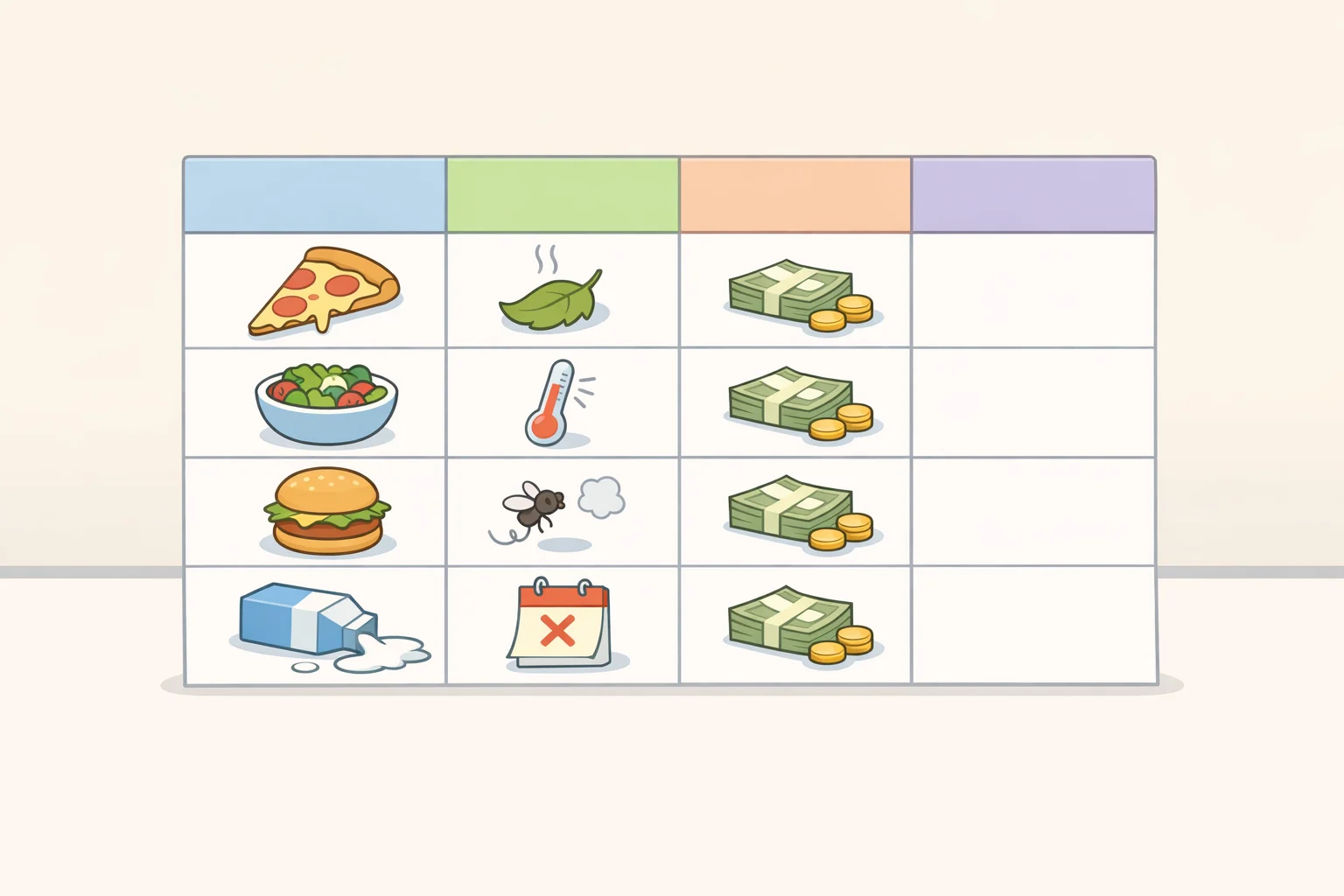
Before anyone can reduce household food waste, they need to see it clearly. Set up a log with four columns: the item, roughly how much of it, why it got thrown out (spoiled, forgotten, made too much, nobody liked it), and a rough replacement cost. A few real entries might look like this:
- Half a rotisserie chicken, forgotten in the back of the fridge, spoiled, about $4
- A bag of spinach, wilted before it got used, spoiled, about $2.50
- Rice made for six when only four people ate, too much made, about $1
Write down every discard for two weeks, even the small stuff. US EPA guidance on cutting waste is simple: buy only what you'll actually use. The log is how a household figures out, in its own kitchen, exactly where that's breaking down. By the end of day one, aim for at least one entry, even "nothing thrown out today" counts, with all four columns filled in.
Step 2: Food waste reduction tips that start with your next grocery list
Before writing a shopping list, open the fridge, freezer, and pantry and look for anything that's been sitting a while or is closest to going bad. Build two or three meals around those items first, then shop for whatever else those meals need.
Write the rest of the list against specific meals instead of a general stock-up. If a recipe calls for half a bag of spinach, decide what the other half is for, a smoothie, a side salad, before it even lands in the cart.
Bulk deals only pay off if there's a plan for the extra: portioning it, freezing it, or using it within a few days. Without that plan, buy the smaller package, or split a bulk pack with someone else. If freezer space is tight, shopping for perishables two or three times a week in smaller amounts tends to work better than one big trip, though it does mean more stops, so weigh that against the schedule.
This isn't just tidiness. EPA's review of roughly 250 life-cycle studies found that preventing food waste before it happens does more good than composting or any other after-the-fact fix, because it cuts the need to grow, ship, and process replacement food (US EPA). Before checking out, make sure every perishable on the list has a specific meal or use attached to it. If nothing comes to mind, put it back.
Step 3: Store and label food the day it comes home
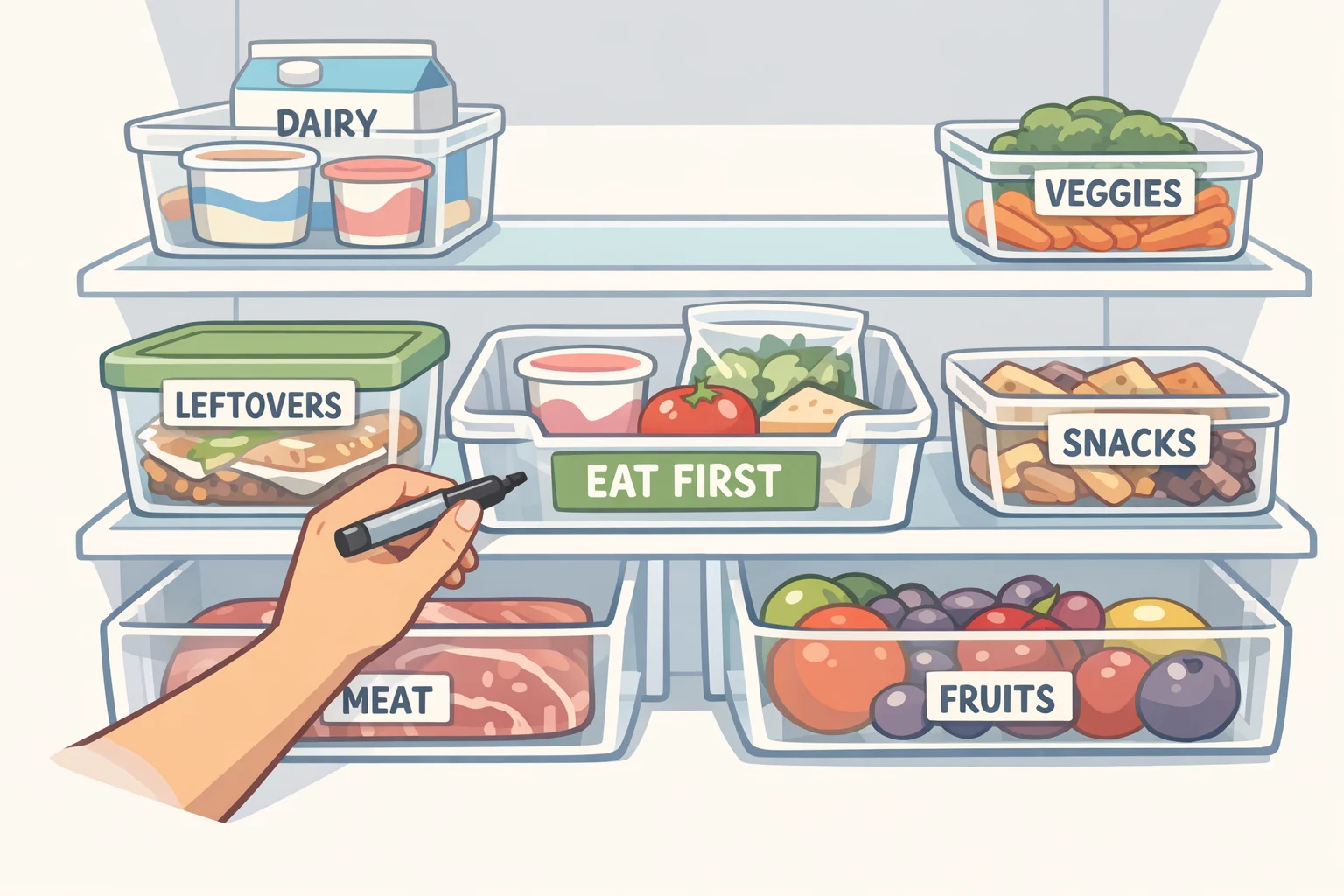
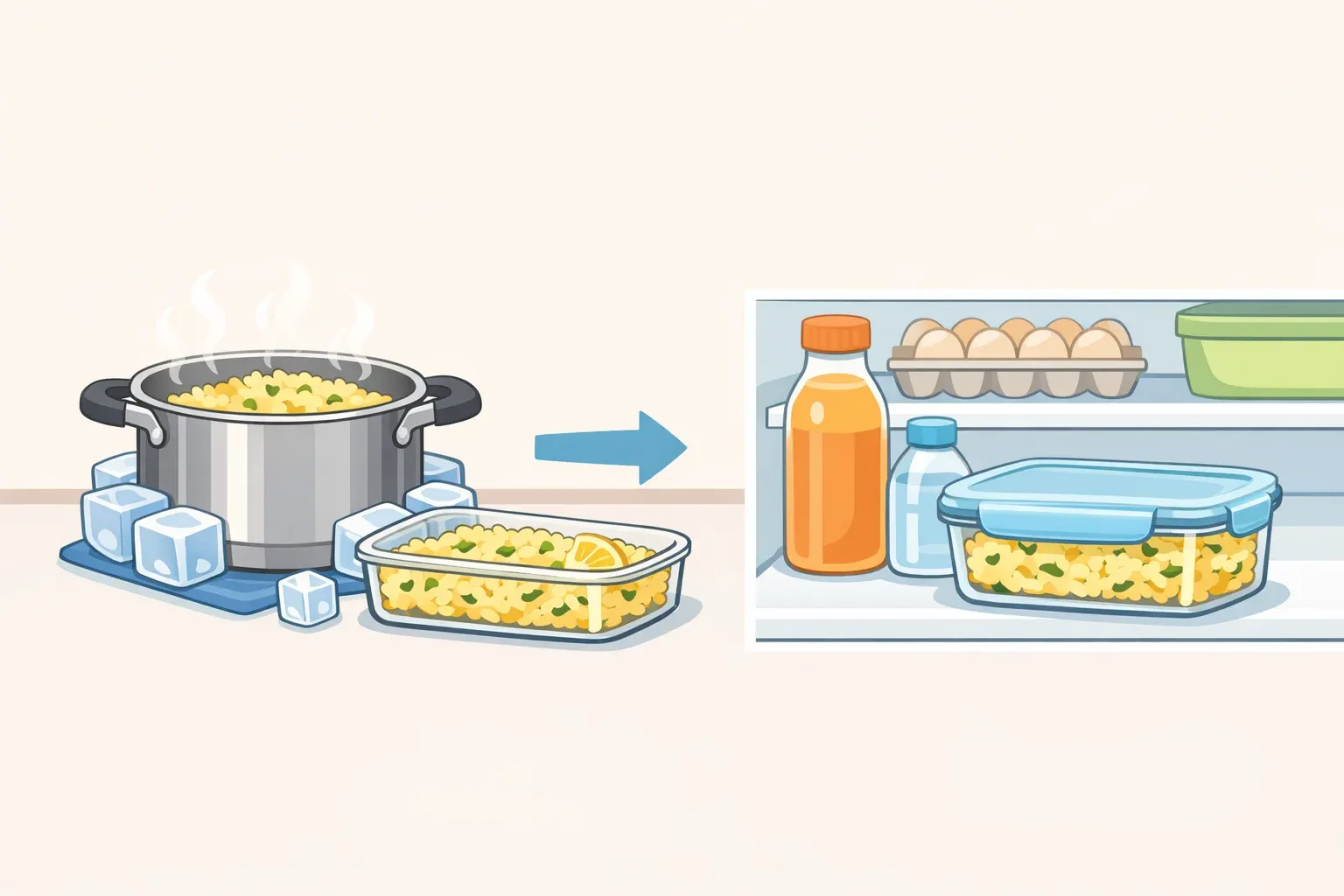
Grab the tape and marker before groceries even get put away. Label anything easy to lose track of, leftovers, opened packages, anything going in the freezer, with the date it was bought or cooked.
Clear one shelf or bin and mark it "eat first." Anything nearing the end of its shelf life goes there instead of drifting to the back of the fridge where it's easy to forget. Raw meat, poultry, and cooked leftovers don't hold up long once they're refrigerated. If something in the eat-first bin has been sitting for several days and it's unclear how fresh it still is, don't taste-test it to find out. Throw it out.
Once groceries are put away, everything in the eat-first bin should be visible at eye level, and nothing else in the fridge should be a mystery.
Step 4: Run a weekly leftovers night
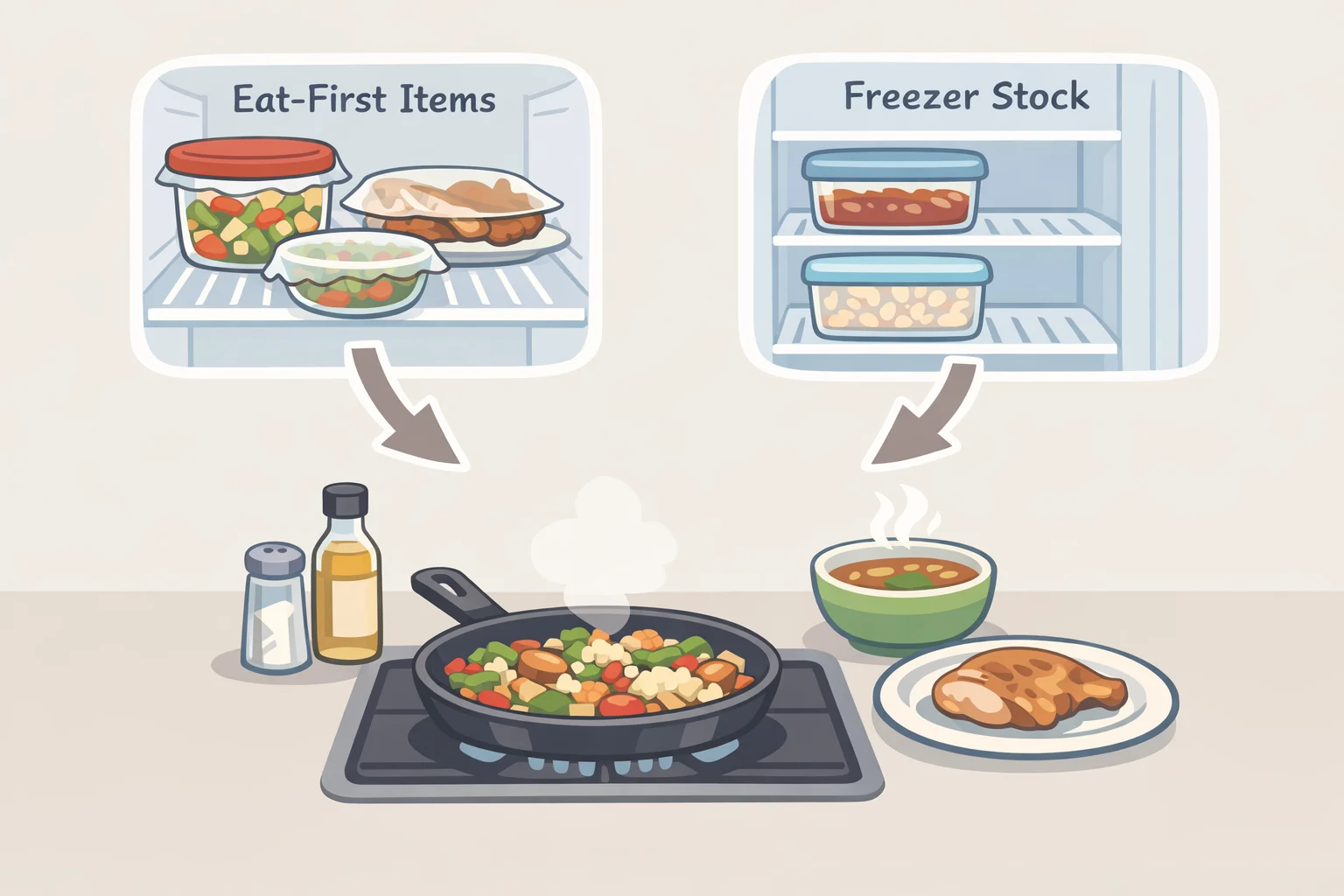
Pick one night a week that draws entirely from the eat-first bin and the freezer: no new recipe, no new shopping trip. This is the step that actually clears out what Step 3 flagged.
Extra vegetables, grains, or broth can usually become a quick soup or stir-fry while they're still good, and the same goes for vegetable trim saved for stock. If a scrap looks slimy, smells off, or shows any mold, don't try to cook it into safety, just throw it out. When reheating leftovers, make sure they're hot all the way through, not just warm on the surface.
After leftovers night, the eat-first bin should be empty or close to it. If something in there sat around and never got used, that's useful information for the log, not a failure to fix mid-week.
Step 5: Decide where food goes before it becomes trash
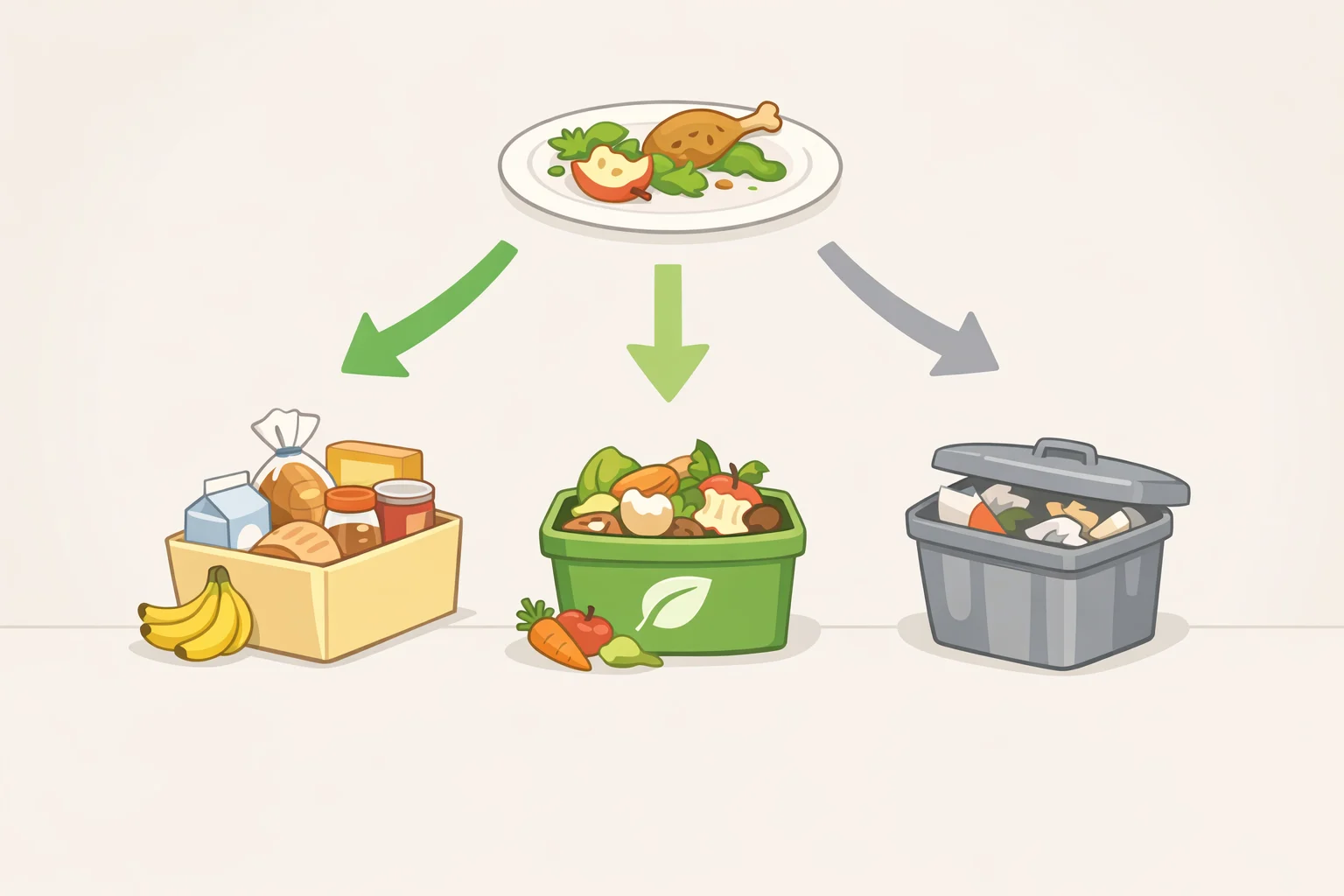
Not everything makes it into a meal, and that's fine as long as the leftovers don't default straight to the trash. US EPA's Wasted Food Scale ranks prevention and donation as the most environmentally preferable options, with landfilling, incineration, and pouring food down the drain at the bottom. Based on that ranking, here's a practical order to work through before anything gets tossed:
- Still safe and unopened: Call a local food bank or pantry before dropping anything off. What they can accept, especially opened packages or perishables, varies by organization, so check first.
- Spoiled or inedible scraps, like peels, cores, and bones: Use municipal curbside compost or a drop-off site if one exists, or a home compost bin with outdoor space. Accepted materials vary by program, and some exclude meat, dairy, or cooked food, so check local rules first.
- Last resort: the trash or garbage disposal. Food sent down the drain decays quickly and generates methane in the sewer system, and that methane goes straight into the atmosphere (US EPA). Landfilled food is the source of the 58% figure mentioned earlier.
Organizations that donate healthy, safe, edible food can claim tax benefits, and the Bill Emerson Good Samaritan Act protects food donors from legal liability (US EPA). Before anything lands in the trash, run it through these three options in order.
What to do when you fall behind
If the fridge is already overflowing, don't add to it. Do a same-day sweep: pull out anything that looks like it's on its way out, turn it into one meal, or freeze what's freezable, and hold off on the next shopping trip until things settle down.
If leftovers night got skipped and something in the eat-first bin sat too long, don't taste-test it to decide. Throw it out and log it under "forgot it," not "spoiled," so the pattern in the log stays accurate. Those two categories point to different fixes: forgotten food usually means the eat-first bin isn't visible enough, while spoiled food might mean the shopping list needs to shrink.
If a shopping trip brought home more than the plan called for, whether from a sale, a bulk buy, or a bad estimate, freeze what's actually freezable right away, while it's still in good shape, and log the item as a bulk-purchase mistake rather than a one-off. Not everything freezes well; leafy greens and some dairy lose their texture, so only freeze what will still work once thawed.
This system targets avoidable waste. It isn't built to prevent peels and bones, spoilage from an illness or a schedule disruption, or food that gets correctly tossed on safety grounds. Those losses are normal and don't count against the household.
Turn your log into a shorter grocery list
After two weeks, go back through the log and sort by estimated replacement cost, not just how often something shows up. An item tossed once at $15 can matter more to the budget than something tossed five times at a dollar each.
The loop itself is short: check what's on hand before shopping, buy against a specific plan, label and store groceries the day they arrive, run one leftovers night a week, and route anything unused to donation or compost before it hits the trash. That sequence is how to save money on groceries by wasting less food, without changing a single recipe.
Keep the log running for a second two-week stretch and compare it to the first. If the same one or two items keep showing up, that's the system doing its job, it just found the leak. Cross those items off the next list entirely, or cut the quantity in half, and check whether the log looks different two weeks from now.




Comments
Be the first, drop a comment!