



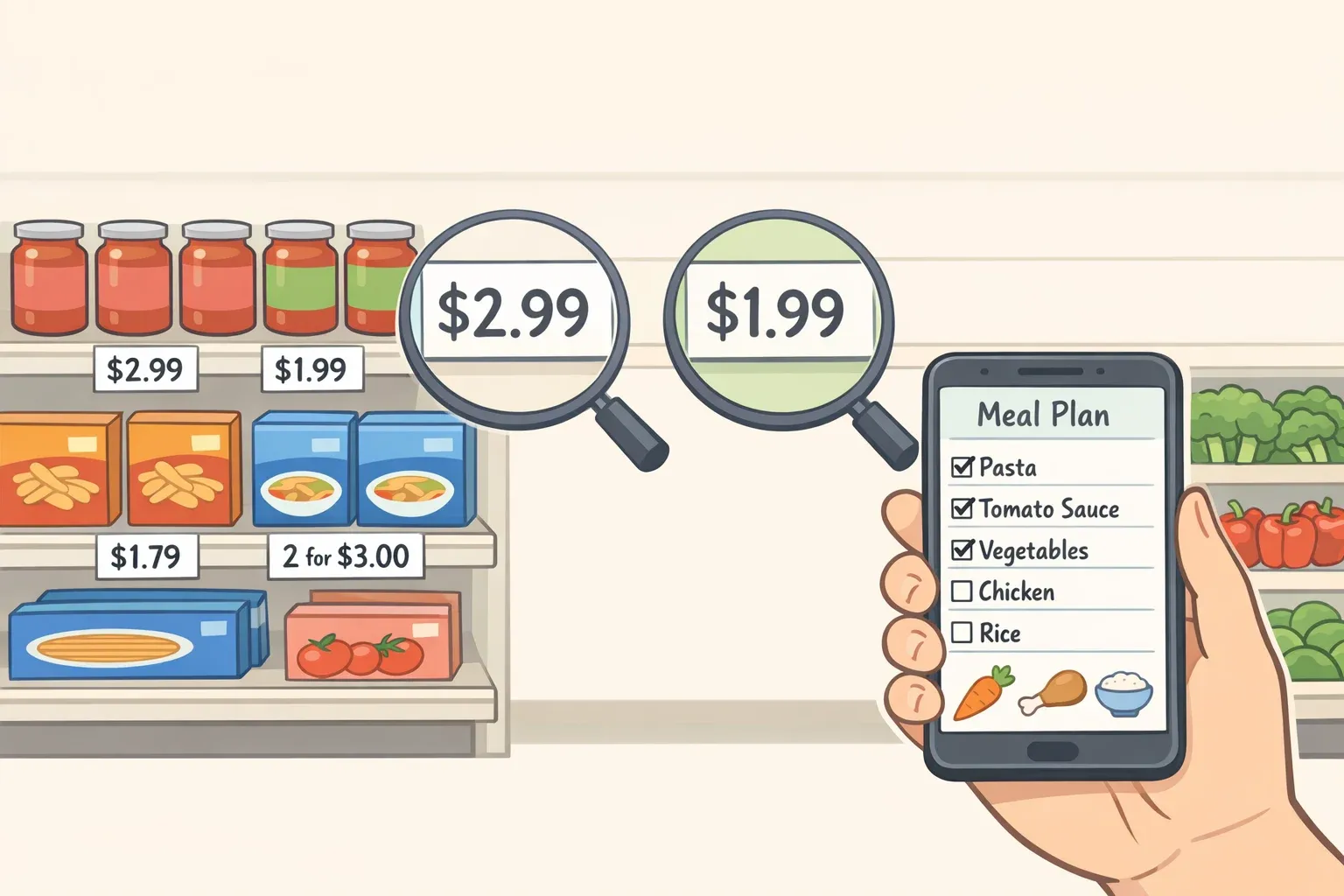
How to Save Money on Groceries When Food Prices Rise
Food-at-home prices were 2.7% higher in June 2026 than a year earlier, a number that sounds manageable until you look at what's hiding inside it. Beef and veal ran 11.8% higher over that same year, while egg prices dropped 27.9% (USDA ERS). Produce splits just as unevenly: retail lettuce cost 32.1% more than a year earlier, while potatoes were up only 1.4% (USDA ERS).
That unevenness is exactly why a fixed list of "cheap foods" stops working after a month or two. The better approach to saving money on groceries when food prices rise is comparing similar options against each other before you shop, not memorizing which items are supposedly safe. This guide walks through building one week's grocery list around three meal roles, protein, produce, and starch, so a price jump in one role doesn't wreck the whole budget or force you to cut a food group entirely. Pull up your store's app or a weekly circular and you can put the whole list together in one sitting before you leave the house.
This method works regardless of what's driving a particular price up, whether it's weather, disease, or fuel costs. It isn't a list of foods immune to every disruption. It's a way to stay flexible when the disruption lands somewhere you didn't expect.
One rule before anything else: allergies, medical diets, and religious dietary restrictions always override a swap. If a substitute conflicts with any of those, skip it and treat the original ingredient as fixed for the week.
Why the national average won't tell you what's on sale
The food-at-home number USDA tracks is a nationwide category average. It isn't a shelf price, and it says nothing about the package size or unit cost at your specific store (USDA ERS).
Prices also behave differently depending on where they're measured. Farm-level vegetable prices ran 59.2% higher than a year earlier as of June, while retail vegetable prices were up only 9.9% over the same stretch. Volatility shrinks as goods move from the farm to the wholesale sector to the shelf (USDA ERS).
There are also two different clocks running in USDA's numbers, and mixing them up leads to bad decisions. Year-over-year figures, like beef's 11.8% increase, describe what already happened. USDA's 2026 annual forecast for beef sits at 10.7%, with a range of 7.2% to 14.6%, which is a separate, forward-looking estimate that can shift as new data comes in (USDA ERS). Use the annual forecast to flag which roles are worth double-checking this month. Use the price tag in front of you to actually decide what goes in the cart.
National trend data tells you where to look twice. It never replaces checking your own store's price.
What you'll need before you build your list
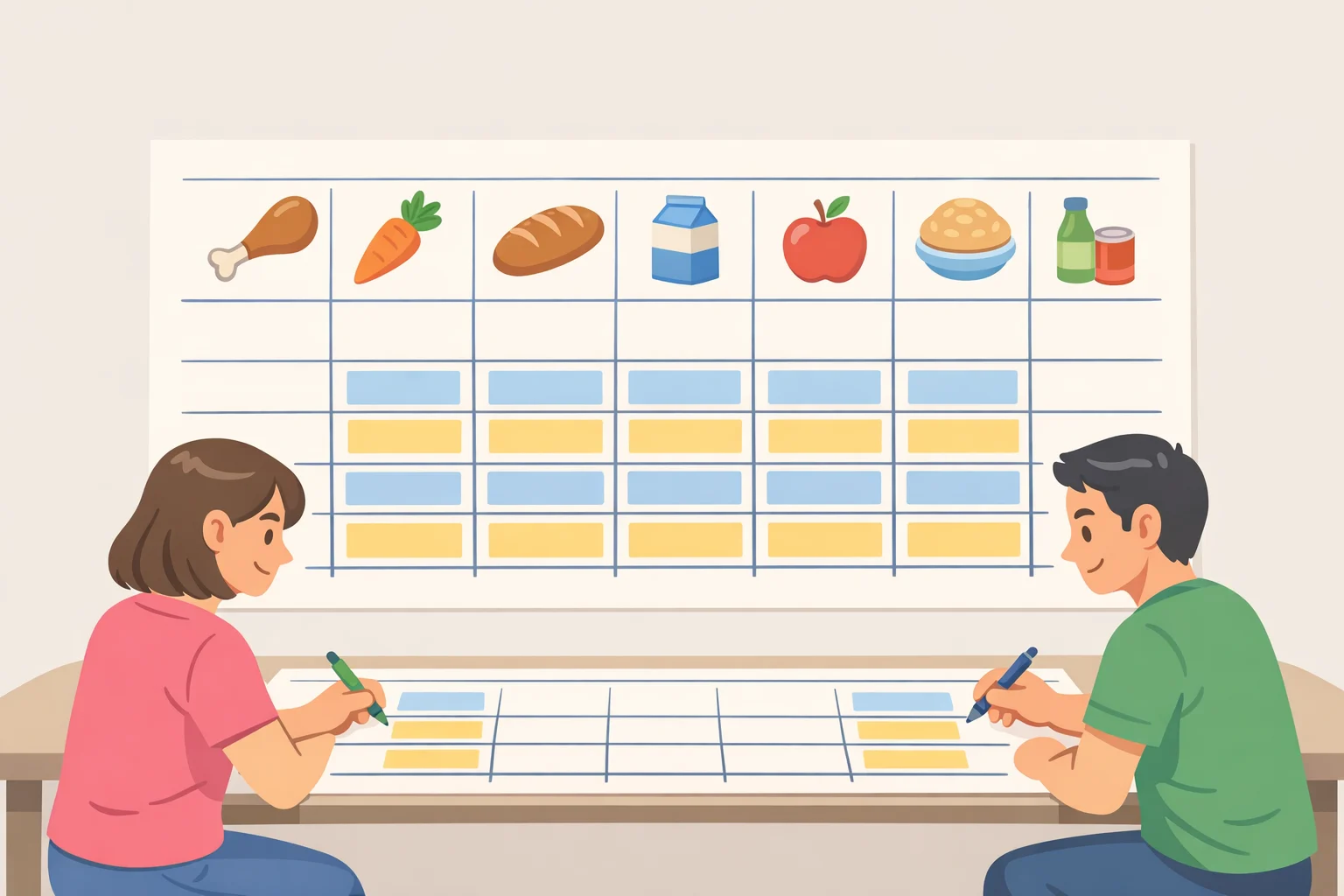
- Your store's app, weekly ad, or a willingness to check shelf tags in person. This is the only price source that actually applies to you.
- A meal count for the week, five dinners for example, and a rough dollar target.
- A quick look through your pantry and freezer so you don't buy duplicates.
- A written list of household non-negotiables: allergies, religious dietary rules, medical restrictions, or vegetarian and vegan choices. Everything on this list stays fixed.
- A worksheet with six columns, described below, to fill in as you price things out.
- A realistic starting assumption of one store, one trip, one week. If your situation is different, single-store access, tight pantry space, few flexible items, the adjustments section covers that before you shop.
Your worksheet just needs these columns:
| Meal | Role | Fixed or flexible | Current price/serving | Substitute candidate | Substitute price/serving |
|---|---|---|---|---|---|
| Ground beef chili | Protein | Flexible | Canned or dried lentils | ||
| Chicken stir-fry | Protein | Flexible | Extra-firm tofu |
Leave the price columns blank until you're standing in the aisle or scrolling the app. Guessing defeats the point.
Grocery shopping tips for rising food prices: compare meal roles, not products
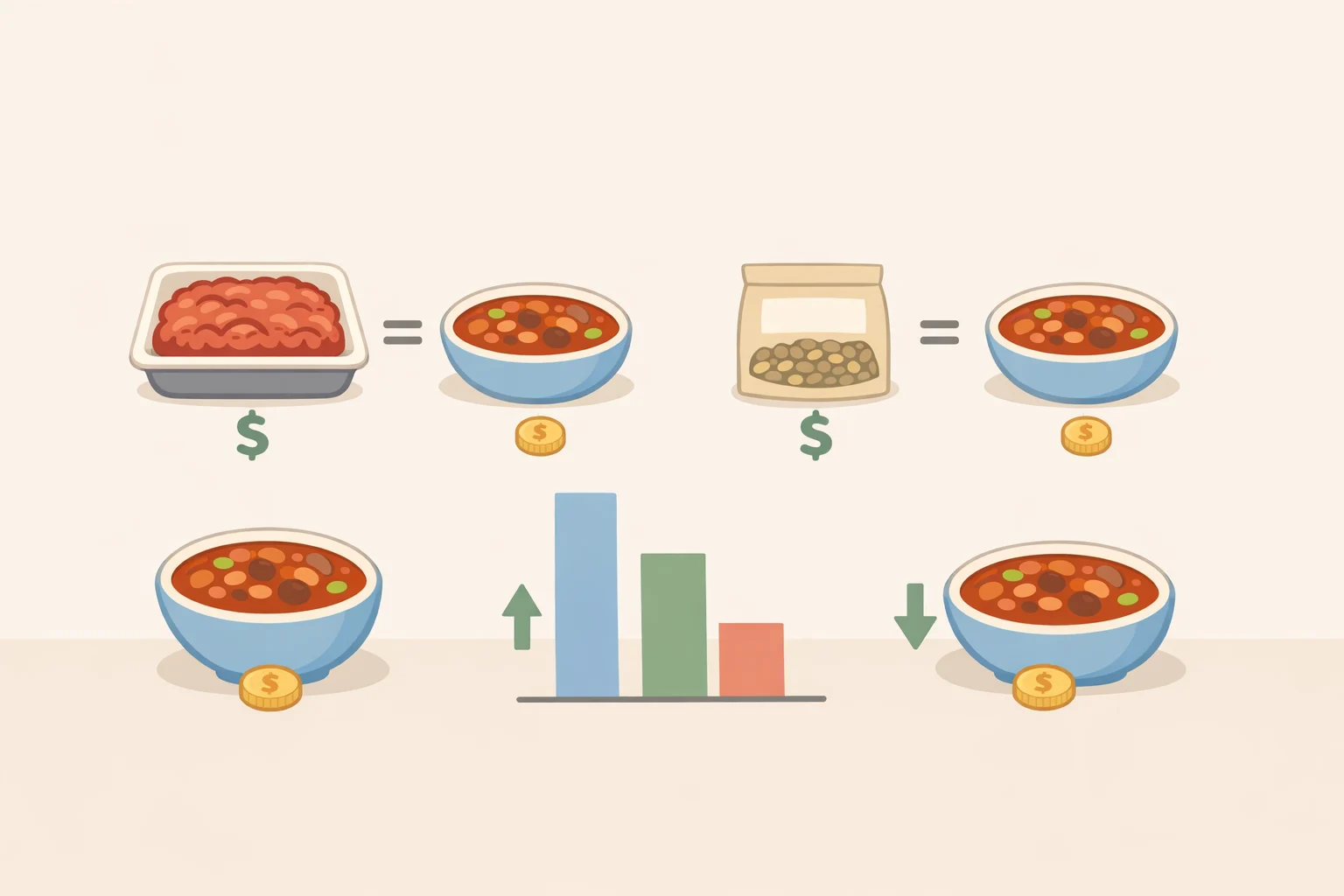
Define each role by what the meal needs, not by a fixed ingredient. A potato is the starch in a roast dinner. Leafy greens or peppers are the produce. Beans or lentils fill the protein role in a chili or stew. Decide the role first, since the same ingredient plays different parts in different meals.
Calculate cost per serving the same way every time: divide the package price by the number of servings the label lists, or by the servings your recipe actually produces. Never compare by weight alone, since a pound of ground beef and a pound of dried lentils don't turn into the same number of usable servings once cooked.
Here's what that looks like with numbers. Say your store prices ground beef at $6.49 a pound, and that pound yields about four quarter-pound cooked servings, roughly $1.62 per serving. A 15-ounce can of lentils runs $1.29 and yields about three half-cup servings, or $0.43 per serving. Swapping the protein in a four-serving chili saves roughly $1.19 per serving, close to $4.76 across the whole pot. That's well past a meaningful gap, so the swap is worth making. Run this same math with your own store's prices before deciding anything, since these numbers are just illustrating the process.
On the protein side, USDA's national direction as of June showed eggs down 27.9%, poultry essentially flat at 0.1% lower, pork up 2.4%, and beef up 11.8% (USDA ERS). Beans, lentils, and tofu aren't tracked in this USDA series, so price them the same way, per serving, at the shelf.
On produce, potatoes rose just 1.4% over the year through June, versus 32.1% for lettuce and 19.5% for tomatoes. Fresh fruit is forecast to rise a comparatively mild 2.0% for all of 2026, an annual figure worth checking rather than acting on immediately (USDA ERS). Treat fruit as a separate, optional check for breakfast and snacks. It doesn't need to fit the dinner template at all.
Set a swap threshold so you're not chasing pennies. A reasonable starting point is 25% or more, or enough to save at least a dollar or two across the whole recipe. Treat that number as your own rule to adjust, not a standard anyone has proven. Smaller gaps usually aren't worth a special trip or a new pantry item.
Step-by-step: build and price this week's list
-
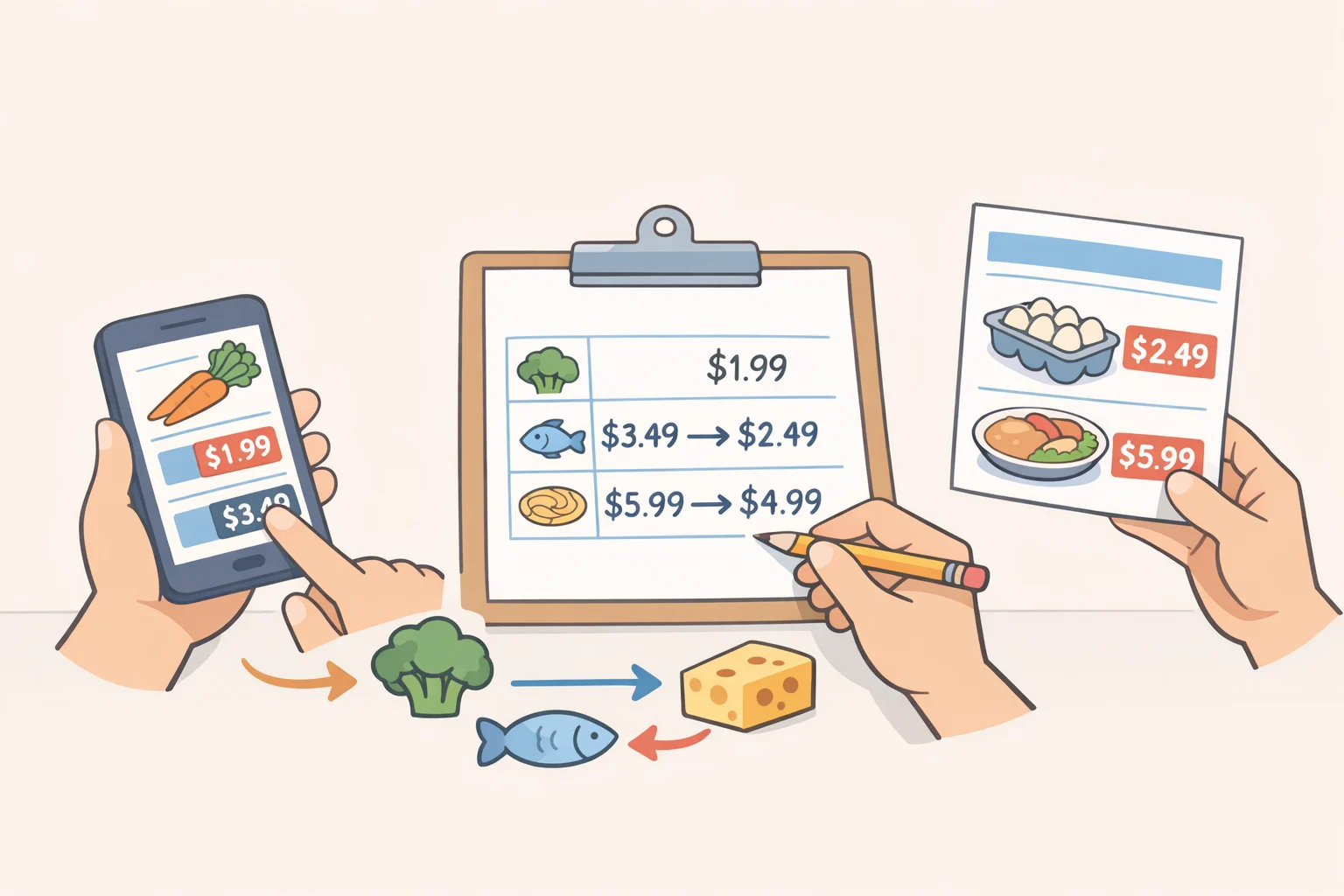
List your planned meals using the three-role template. Protein plus produce plus starch covers stir-fries, sheet-pan dinners, soups, and grain bowls. Write down the actual number of meals you're planning.
-
Mark each role fixed or flexible. Fixed items come from your non-negotiables list or are essential to the technique, a Sunday roast needs the roast. Everything else counts as flexible.
-
Price each flexible role at your store, using the cost-per-serving method above. Fill in the current-price column on your worksheet as you go.
-
Compare a same-role substitute against your threshold. For a planned ground beef chili, if beef's cost per serving clears your threshold above canned or dried lentils, make the swap. Tomatoes, spices, onion, and stock stay fixed. Canned and dried lentils behave differently from beef and from each other, so check the can label or a tested lentil-chili recipe for liquid amounts and simmer time rather than guessing.
-
For a vegetarian swap, compare pressed, drained extra-firm tofu against chicken breast per serving. Tofu behaves differently in the pan, so press it first and add it later in the stir-fry sequence, following the package directions. The produce and starch roles stay unchanged, which keeps the meal balanced.
-
If nothing clears the threshold this week, whether that's due to dietary restrictions, limited store selection, or genuine price parity, don't just cook the meal less often. Compare the full recipe cost against a pantry meal you'd already need to plan for, substitute in that meal instead, or keep the original ingredient and count it as a fixed cost for the week.
-
Recheck your pantry and freezer, cross off anything you already have, and finalize the list.
One mistake to avoid here: don't treat a single lower price as a new trend. Fresh vegetable prices fell 1.2% from May to June 2026 but were still 9.9% higher than a year earlier (USDA ERS). Judge a role by the year-over-year direction and your own recent receipts, not one lucky sticker.
Adjusting the method for your store, pantry, or household
Single-store shoppers can run the same role comparisons within that one app or circular. The method still works with a smaller set of options per role.
If freezer or pantry space is tight, check protein and produce prices fresh each week instead of stocking up. Storage limits make bulk-buying impractical regardless of the unit price.
With little dietary flexibility, apply the swap threshold only to roles marked flexible. The method still cuts spending on whatever can move, even if most of your meals are locked in.
For recheck rhythm, revisit your own worksheet every two to three weeks. That's enough to tell a real trend from a one-month blip without obsessing over every ad.
Don't assume a current bargain will stay one. Egg prices are forecast to fall 30.7% in 2026, but they rose 21.9% in 2025 and 32.2% in 2022 during avian flu outbreaks. USDA notes fewer new bird flu detections in early 2026 than in early 2025 as one reason behind the current outlook (USDA ERS). Recheck any role that looks cheap right now instead of building your whole plan around it.
Finish line: check your list before you shop
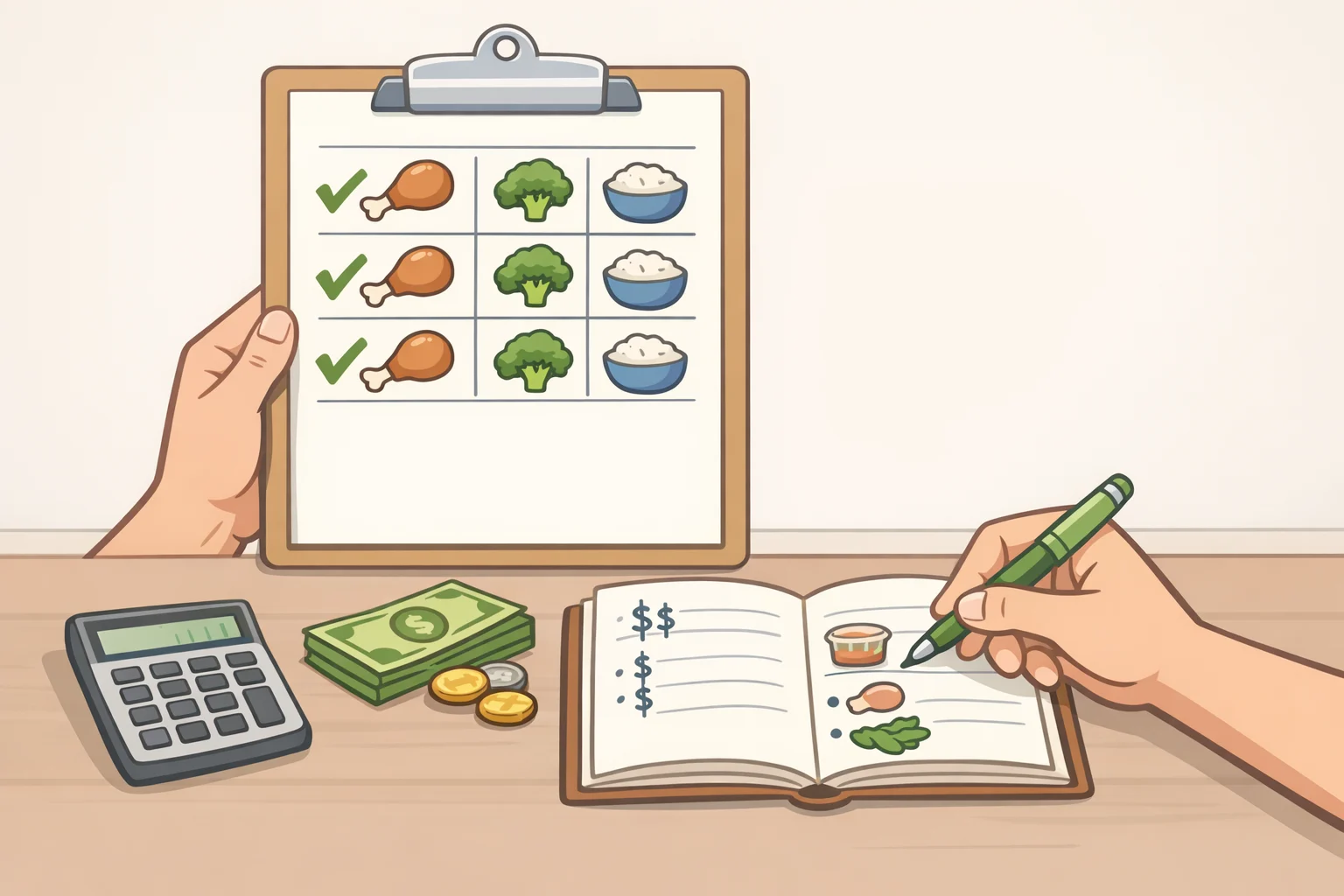
Before calling the list done, confirm every planned meal still has an acceptable protein, produce, and starch component. Record what you actually spent against your usual bill, and note any perishables that went unused. Repeated over a few weeks, that comparison tells you whether the method is working, not any single forecast.
USDA's own 2027 outlook for food-at-home prices carries a wide range, from negative 5.6% to positive 12.3% (USDA ERS). That spread is the whole argument for building a list that bends instead of one that breaks the first time a category moves the wrong way.





Comments
Be the first, drop a comment!