



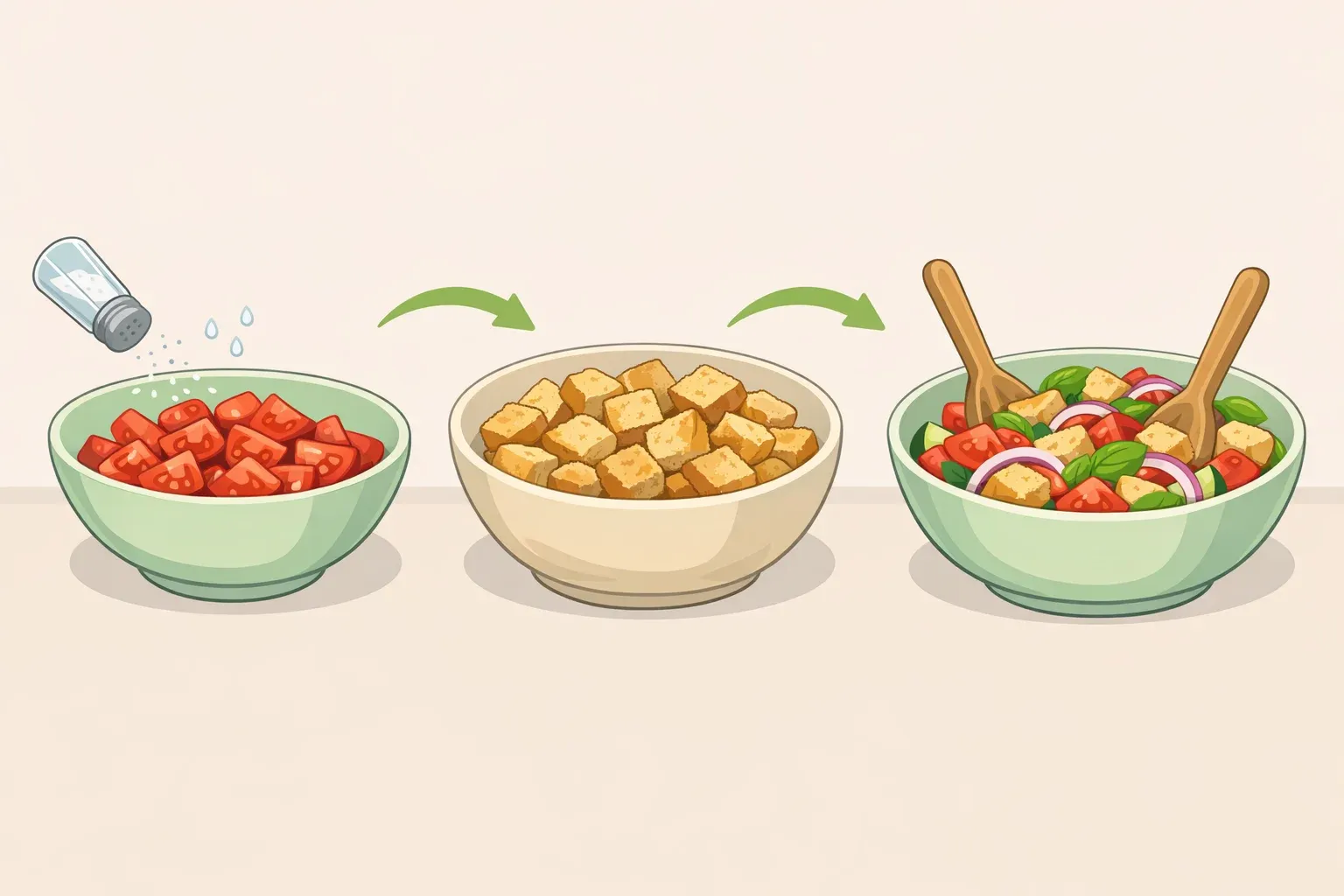
Panzanella salad recipe: how to avoid watery, mushy bread
The failure mode in most panzanella salad recipes isn't the recipe. It's what happens to tomato liquid the moment a knife hits the cutting board.
Left untreated, that liquid seeps into crisp bread and turns it to paste. Managed correctly, the same liquid becomes the backbone of the dressing. The difference between a panzanella salad recipe that holds together and one that turns to mush comes down to sequencing, not ingredients.
Worth defining the target before going further, since "prevent sogginess" is easy to misread. The goal isn't crunchy bread floating in a puddle of tomato juice. It's bread that's fully dressed and tender, with a slight bite still intact, softened through deliberate absorption rather than drowned by runoff nobody planned for.
A few facts explain why this works. Salting chopped tomatoes pulls liquid out of them through osmosis: the salt raises solute concentration outside the tomato's cells, and water migrates out through the cell walls to balance it (Serious Eats). This isn't a one-off trick. The same salt-and-drain technique shows up in two separate Serious Eats recipes, one a classic Tuscan bread salad recipe and one built around seared lamb chops, which points to a repeatable method rather than a single cook's quirk (Serious Eats, last year).
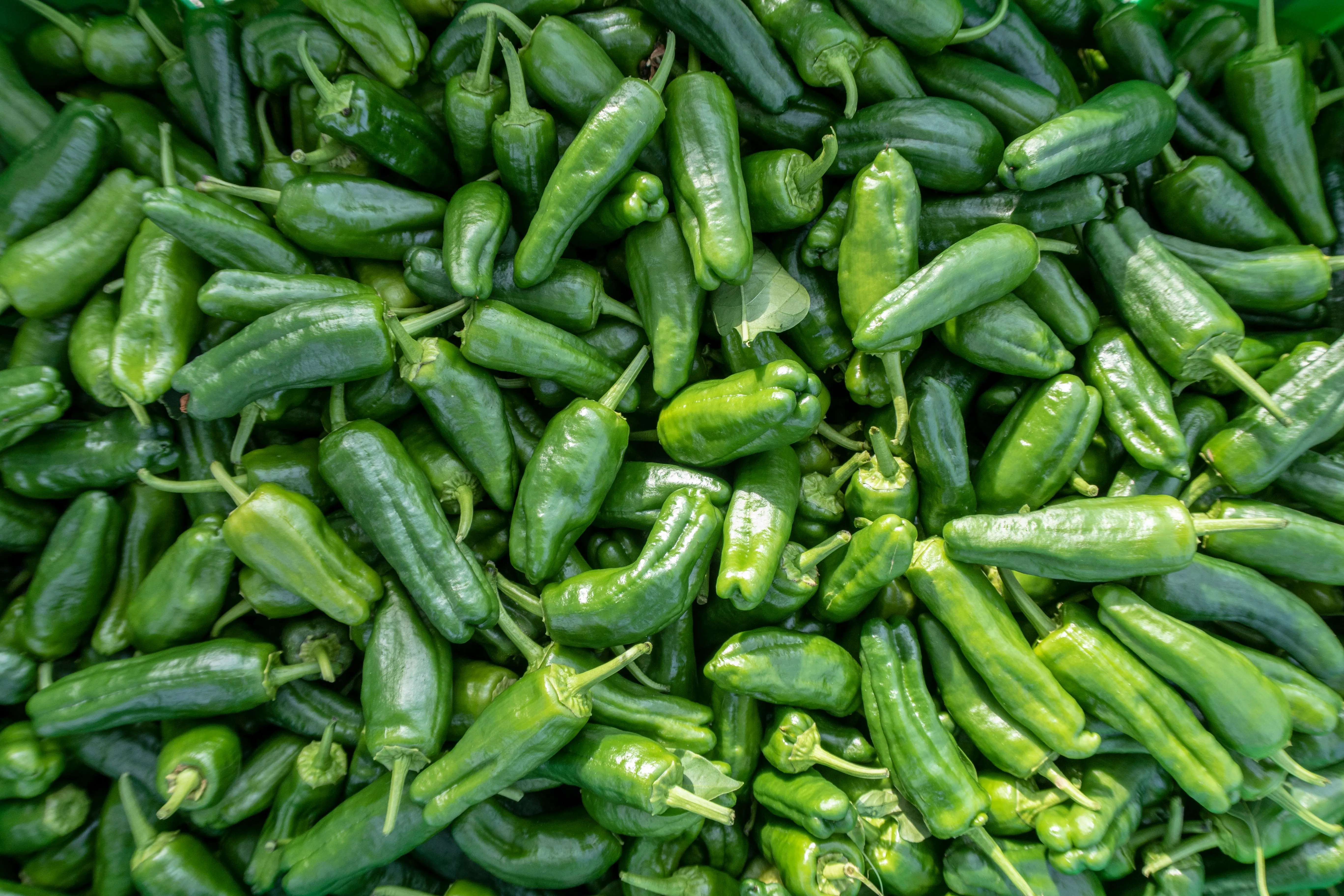
None of this matters if the tomatoes are mediocre to begin with. Tomato quality sets the ceiling on flavor before technique even enters the picture. Colorado State University Extension recommends choosing tomatoes that are heavy for their size, richly colored, and slightly yielding to gentle pressure (CSU Extension, last year).
This guide walks through a complete, sequenced method for building this Italian tomato salad with bread: salting and draining tomatoes while the bread dries in the oven, building a dressing from the reserved liquid, and resting the assembled salad for a fixed window. It also covers the troubleshooting points that explain why panzanella goes wrong in the first place, plus a warm variation that keeps the same moisture-management logic intact.
Before you start: ingredients and prep
Getting this right starts at the grocery store, not the cutting board. Here's what the classic version calls for:
- 2½ pounds mixed ripe tomatoes, cut into bite-size pieces
- 2 teaspoons Diamond Crystal kosher salt for the tomatoes (use half as much table salt), plus more to taste
- ¾ pound ciabatta or rustic sourdough, cut into 1½-inch cubes (about 6 cups)
- 10 tablespoons extra-virgin olive oil, divided
- 1 small shallot, minced (about 2 tablespoons)
- 2 medium garlic cloves, minced (about 2 teaspoons)
- ½ teaspoon Dijon mustard
- 2 tablespoons white wine vinegar or red wine vinegar
- Freshly ground black pepper
- ½ cup packed basil leaves, roughly chopped
(Serious Eats)
Choose tomatoes that are round, heavy for their size, richly colored, and free of bruising. CSU Extension notes that fully vine-ripened tomatoes deliver better flavor than any other option, including tomatoes ripened after picking (CSU Extension, last year). If a tomato feels light for its size or looks dull, keep looking.
Storage matters more than most people assume. Store whole, ripe tomatoes at room temperature, away from direct sunlight. Both CSU Extension and the University of Maine Cooperative Extension warn that refrigerating uncut tomatoes dulls their flavor (CSU Extension, last year; University of Maine Cooperative Extension, last year). Save the fridge for tomatoes that are already overripe and need to stop ripening, or for anything already cut.
Wash tomatoes with clean water right before you prep them, skipping soap or detergent entirely. Raw tomatoes have been linked to Salmonella outbreaks, so a rinse under the tap is a real food-safety step, not a formality (CSU Extension, last year; University of Maine Cooperative Extension, last year).
One measurement mistake trips up more cooks than anything else in this recipe: salt type. The recipe calls for 2 teaspoons of Diamond Crystal kosher salt for the tomatoes. If the only salt in the cabinet is table salt, use half that volume instead. Table salt is denser than kosher salt, and matching the volume measurement will oversalt both the tomatoes and the dressing built from their liquid later (Serious Eats).
Panzanella salad recipe method: salt, dry, dress, rest
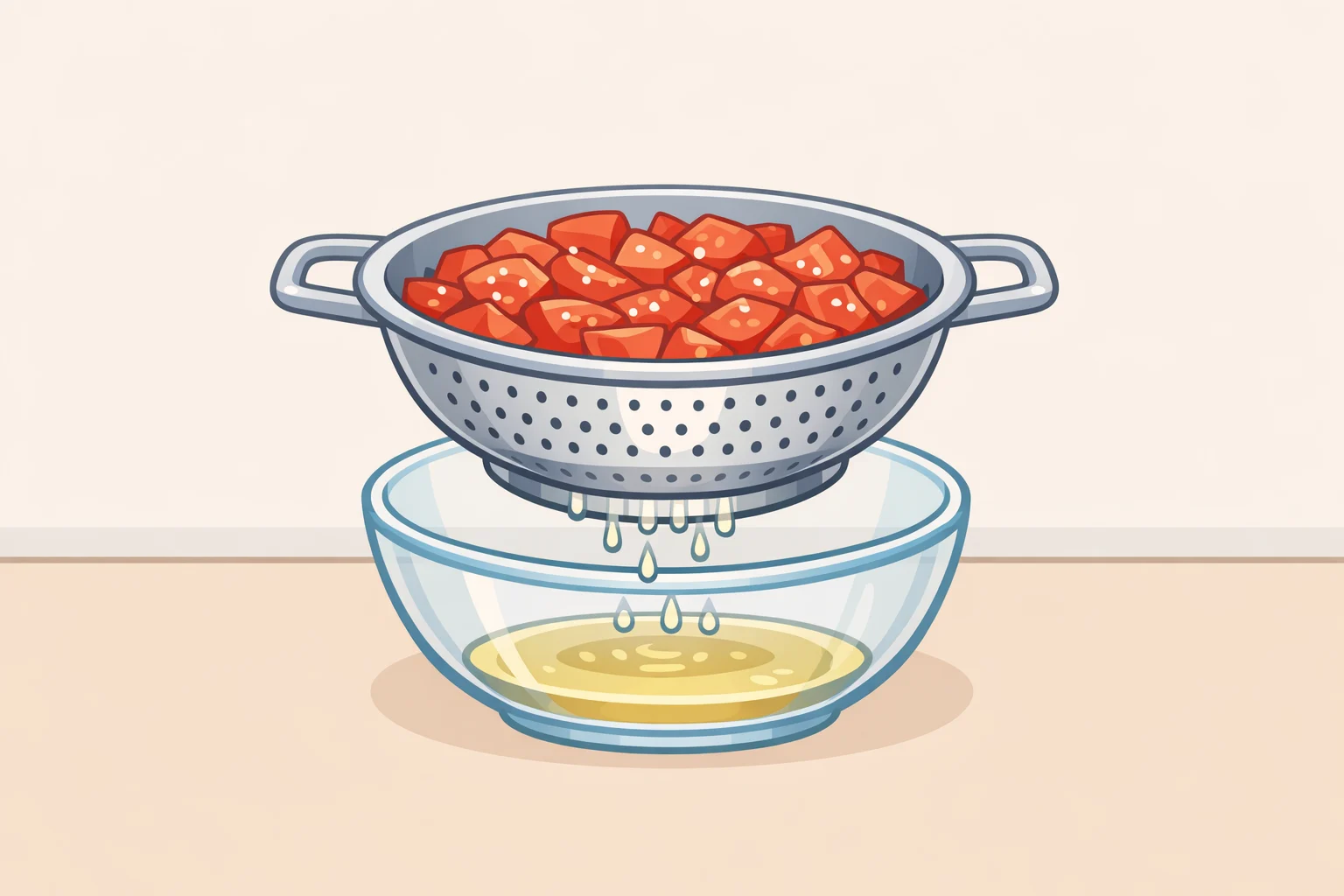
This sequence runs two steps in parallel, so the total active time is shorter than it looks on paper. Each step below tells you what to expect before moving to the next.
-
Chop the tomatoes into bite-size pieces and place them in a colander set over a bowl. The bowl underneath isn't optional; it catches the liquid used to build the dressing in step 4 (Serious Eats).
-
Season with the kosher salt, toss, and set aside to drain for at least 15 minutes at room temperature. Visible liquid collects in the bowl below the colander. That's exactly what should happen. Reserve it (Serious Eats).
-
While the tomatoes drain, dry the bread. Toss the bread cubes with 2 tablespoons of olive oil, spread them on a baking sheet, and bake at 350°F (180°C) for about 15 minutes, until crisp and firm but not browned. Serious Eats draws a useful distinction between drying and staling: drying removes moisture directly, while staling happens when water migrates out of starch molecules and recrystallizes into a rigid structure over time. These are different processes with different results, and drying the bread deliberately gives more control over how it absorbs dressing later (Serious Eats). Let the bread cool before moving on; warm bread has less resistance to absorbing liquid quickly once it meets the dressing.
-
Build the dressing in the same bowl that caught the tomato liquid. Whisk in the shallot, garlic, Dijon, and vinegar, then slowly drizzle in the remaining olive oil while whisking continuously to emulsify. Season with salt and pepper to taste (Serious Eats).
-
Combine the cooled toasted bread, drained tomatoes, dressing, and basil in a large bowl. Toss everything together to coat evenly.
-
Rest 30 minutes before serving, tossing occasionally until the dressing is absorbed by the bread. This is the absorption window: the bread should end up dressed and tender without going mushy. The full recipe yields about 6 servings (Serious Eats).
One note on timing before moving on: this is a same-day dish. The sourced recipe describes a 30-minute rest for peak texture but offers no guidance for holding the assembled salad longer than that, so treat it as something to serve the day it's made rather than a make-ahead salad.
Why this works: troubleshooting watery or mushy panzanella
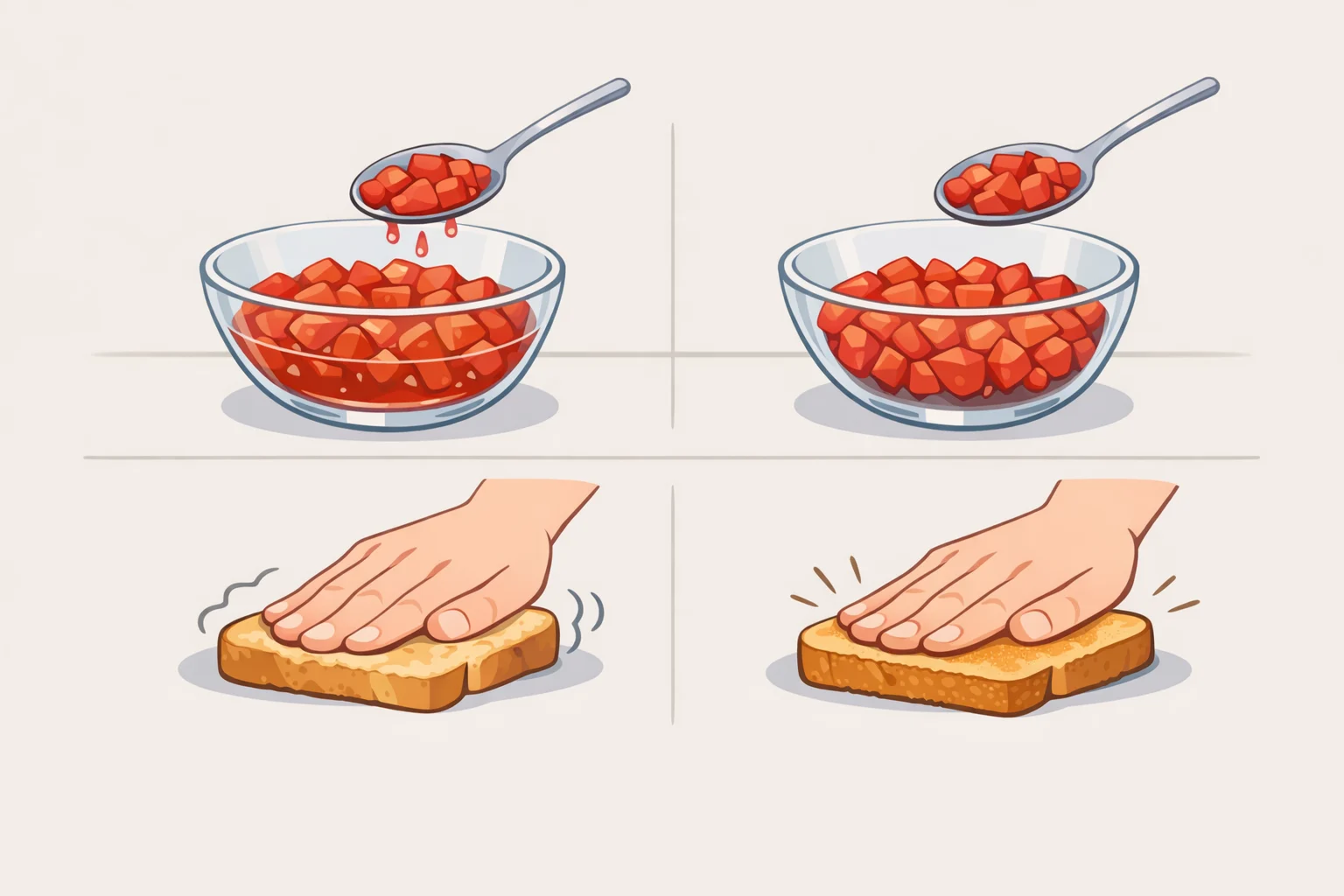
Most panzanella failures trace back to one of two shortcuts, and knowing which one you took helps fix it next time.
Under-draining is a real cause of watery panzanella, but it's not the only one. Skipping the 15-minute drain, or cutting it short, leaves more liquid inside the tomatoes. That liquid then transfers directly into the bread instead of into a dressing you control (Serious Eats).
Under-dried bread compounds the problem even when the tomatoes are handled correctly. Bread that's still moist, or under-toasted before it meets the dressing, has less capacity to absorb liquid gradually; it softens fast instead of softening slowly. The 350°F bake for roughly 15 minutes is calibrated to leave the bread crisp and firm without browning, which gives it the buffer to absorb dressing over the full rest period (Serious Eats).
Timing the rest matters as much as getting the ingredients right. The recipe calls for 30 minutes, tossing occasionally, until the dressing is absorbed. For the texture described here, serve once the dressing has absorbed rather than holding the salad indefinitely (Serious Eats).
Beyond the sourced steps, a couple of visual cues from this method are worth watching for, though they're not drawn from any formal testing: bread cubes that bend rather than crumble when pressed, and tomatoes that look glossy rather than sitting in a visible pool of dressing. If there's still standing liquid in the bowl after a final toss, the drain step probably needed a few more minutes.
A warm lamb variation and flexible swaps
Once the core sequence is second nature, it flexes to fit other meals without breaking.
Warm panzanella with seared lamb chops uses the identical salt-and-drain logic at different proportions. Three pounds of tomatoes get 1½ teaspoons of kosher salt, compared to 2 teaspoons for 2½ pounds in the classic version, so the ratios differ even though the process doesn't. The reserved tomato water goes into a warm dressing built directly in the skillet used to sear the lamb, with red wine vinegar, garlic, and rendered fat standing in for the room-temperature emulsion (Serious Eats, last year).
Serving timing differs here for a specific reason, not because resting is bad practice. The lamb needs 45 minutes to an hour at room temperature before searing, which accounts for most of the recipe's listed 65-minute resting window. Once the salad is assembled with hot dressing and seared lamb, though, it's served immediately rather than rested further, since the warm components would keep softening the bread past the target texture (Serious Eats, last year).
Smaller swaps preserve the same balance without touching the mechanics. Using white wine vinegar instead of red, or rustic sourdough instead of ciabatta, doesn't change how the salad behaves; both published recipes use one or the other with zero adjustment to the salt-drain-dry-dress-rest sequence itself (Serious Eats; Serious Eats, last year). Treat bread type, vinegar type, and even the exact salt-to-tomato ratio as flexible. Keep the salt-and-drain process itself consistent: salt the chopped tomatoes, let them sit at room temperature for at least 15 minutes, and reserve the liquid. That's the part both recipes never skip.
The technique, and where to take it next
Both recipes converge on the same control point, even though one serves cold and the other hot: manage when the liquid leaves the tomato, and make sure the bread is ready to receive it when it does. Get that timing right, and the tomato and the bread stop competing for texture and start working together.
From here, the warm lamb chop version is the clearest test of whether the method has actually stuck rather than just the recipe. Same salt-drain-dry-dress rhythm, different ratios, a hot dressing instead of a cold one, and a plate served the moment it's assembled instead of one that rests. If that version comes together without a recipe card in hand, the technique has replaced the recipe, which was the point all along.


Comments
Be the first, drop a comment!