



Can You Eat Decorated Easter Eggs Safely? 3 Key Rules
Hard-boiled eggs colored with food-safe dye are safe to eat. That's the short answer to whether you can eat decorated Easter eggs, and it comes with one important clarification: the dye is almost never the actual problem. What determines whether a decorated egg ends up on the table or in the trash is how long it sat out, whether the shell cracked, and which batch was meant for the hunt in the first place.
Virginia Tech food safety expert Melissa Wright stated plainly in guidance published this month: "There is nothing about dying eggs that makes them unsafe for consumption." Michigan State University Extension confirms it: colored hard-boiled eggs are safe when food safety guidelines are followed.
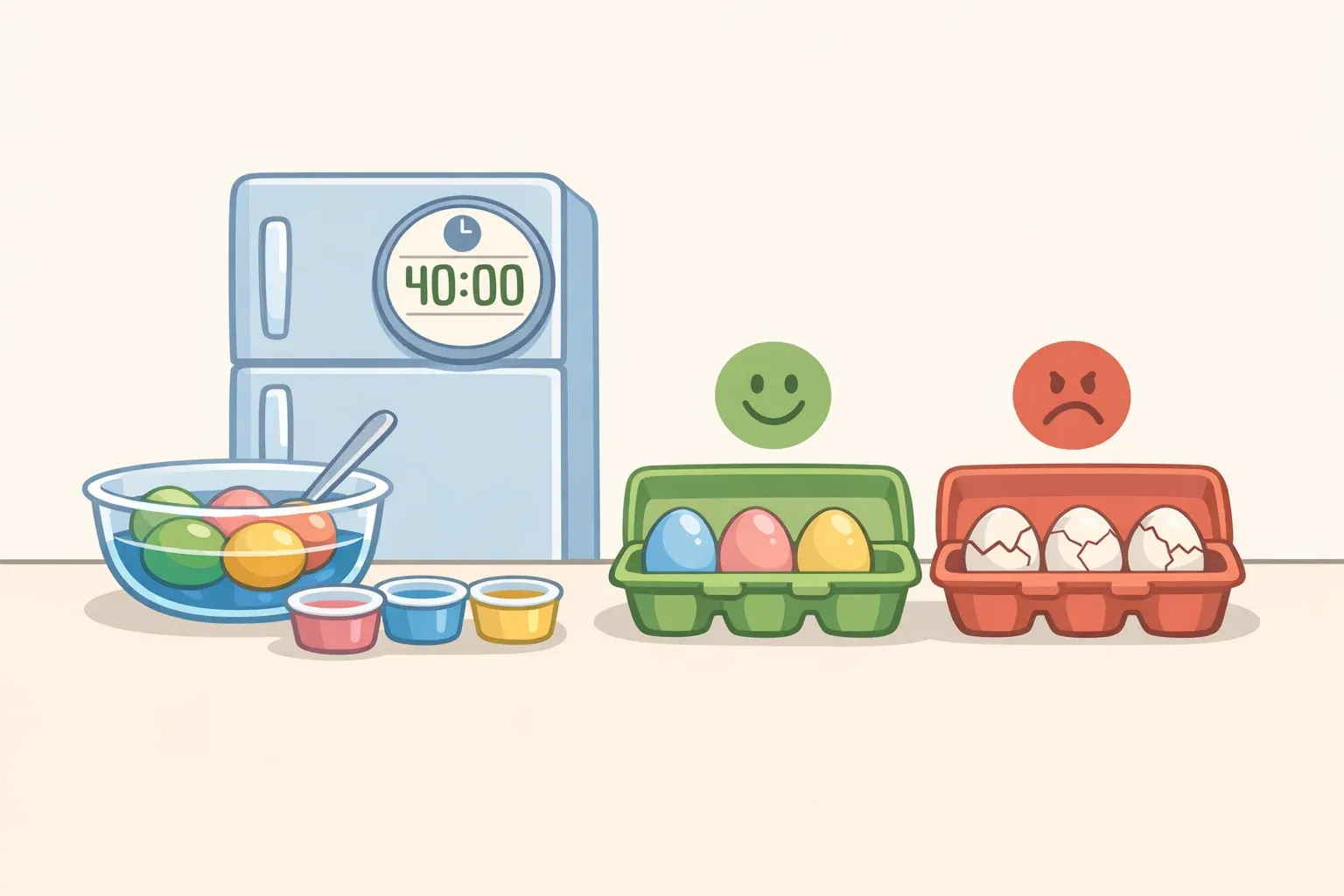
Three conditions must all hold at once. The egg was colored with food-grade dye. The shell stayed uncracked. And the egg spent no more than two hours outside the refrigerator, total, across every step from cooking through dyeing. Any single failure is reason to discard.
Quick reference: safe or toss?
Safe to eat only if all of the following are true:
- Dyed with food-safe or natural dye only
- Shell uncracked throughout
- Never left unrefrigerated for more than two hours total
- Stored below 40°F and eaten within seven days of cooking
Toss if any of these apply:
- Shell cracked at any point
- Used for display all day or overnight
- Used in an egg hunt
- Left out past the two-hour mark
- Decorated with craft paint, markers, or fabric dye
If you want the simplest system, make two batches. One set stays cold and goes to the table. The other goes to the hunt, the basket, or the mantelpiece, and gets discarded afterward. No clock-watching, no guesswork. Both MSU Extension and Delish recommend this approach, and it eliminates most of the risk before it starts.
This guide covers the categories of eggs that should never be eaten, which dyes are safe, and how to handle the eating batch correctly from boiling through storage.
Display eggs, hunt eggs, and cracked eggs: start here before decorating
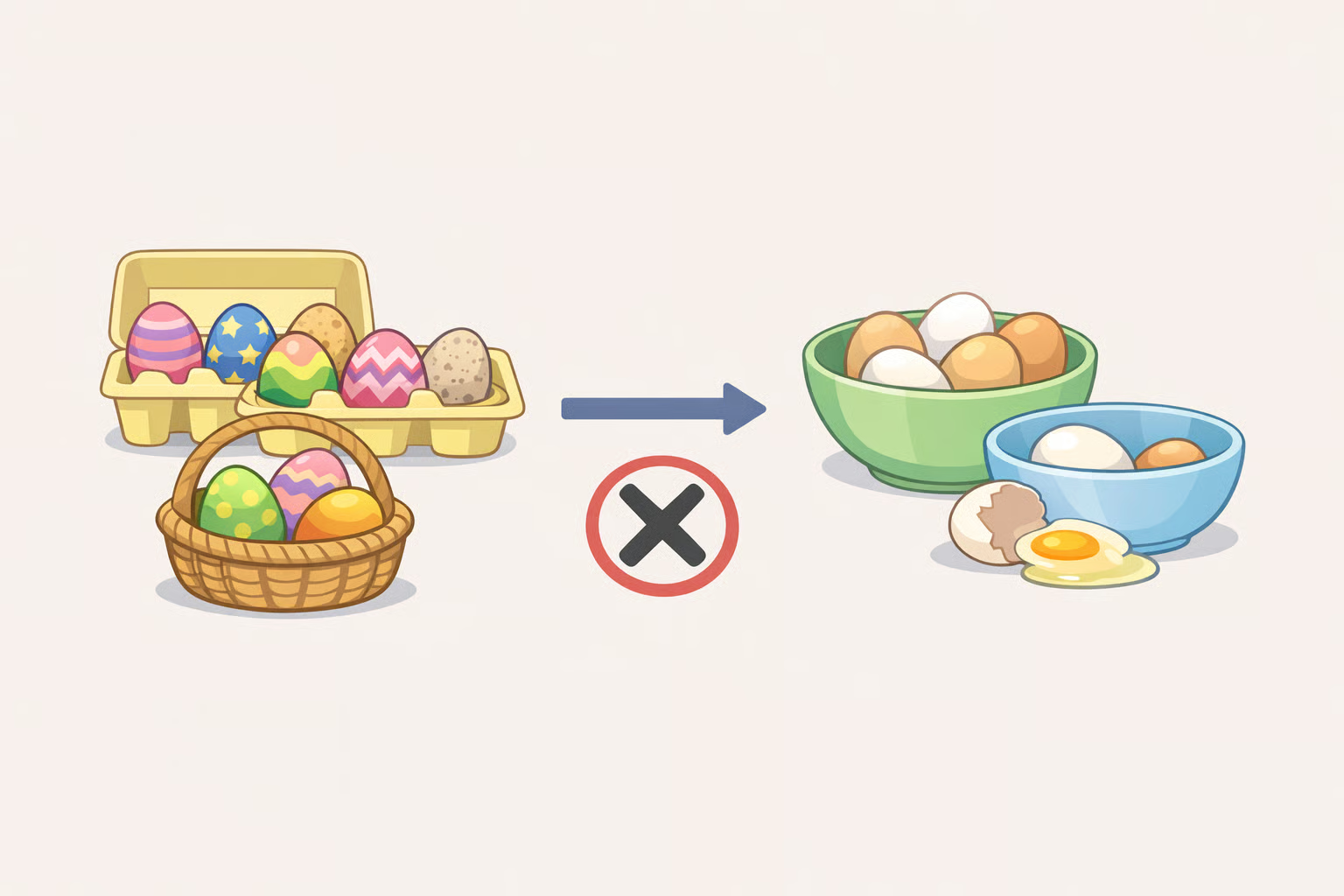
Before any decorating begins, make one decision: is this egg meant to be eaten or not? Eggs used as table décor, left out on display, or used in a hunt are a different category entirely. Treat them as non-edible from the start.
USDA Food Safety and Inspection Service is direct: the agency does not recommend eating hard-boiled eggs after they've been hidden or handled during a hunt, because bacteria picked up on the shell surface can transfer to the edible interior, particularly if the shell cracks. The same logic applies to display eggs. EggSafety.org is explicit: any egg kept out of refrigeration for many hours or days, whether for decoration or hiding, should be discarded.
There is a conditional read on hunted eggs. MSU Extension notes that hunted eggs may be eaten if the total hiding-and-hunting window stays under two hours, shells remain uncracked, and the eggs are immediately refrigerated and consumed within seven days of cooking. USDA's guidance is stricter and simpler. For families with young children, older adults, pregnant individuals, or anyone with a compromised immune system, Clemson HGIC identifies these groups as particularly vulnerable to Salmonella. The conservative call is the right one: skip the hunted eggs.
Cracked shells are a hard discard in every scenario. An eggshell has more than 4,000 pores, according to University of Guelph food scientist Keith Warriner, cited by Yahoo Life. Hard boiling removes the egg's natural protective coating, which leaves those pores more exposed to bacterial entry, per Virginia Tech and Clemson HGIC. A crack removes the shell as a barrier entirely. EggSafety.org says to dye only uncracked eggs and discard any that crack during dyeing or display; USDA FSIS and Clemson HGIC both confirm that a cracked shell creates a direct route for bacteria to reach the interior.
The two-batch system cuts through all of this. Which eggs were hunted? Doesn't matter those aren't the eating eggs. How long were the display eggs out? Also irrelevant, because they were never candidates for the table.
Can you eat Easter eggs after decorating? Three rules decide
Food-safe dye is the entry requirement; here's what that means in practice
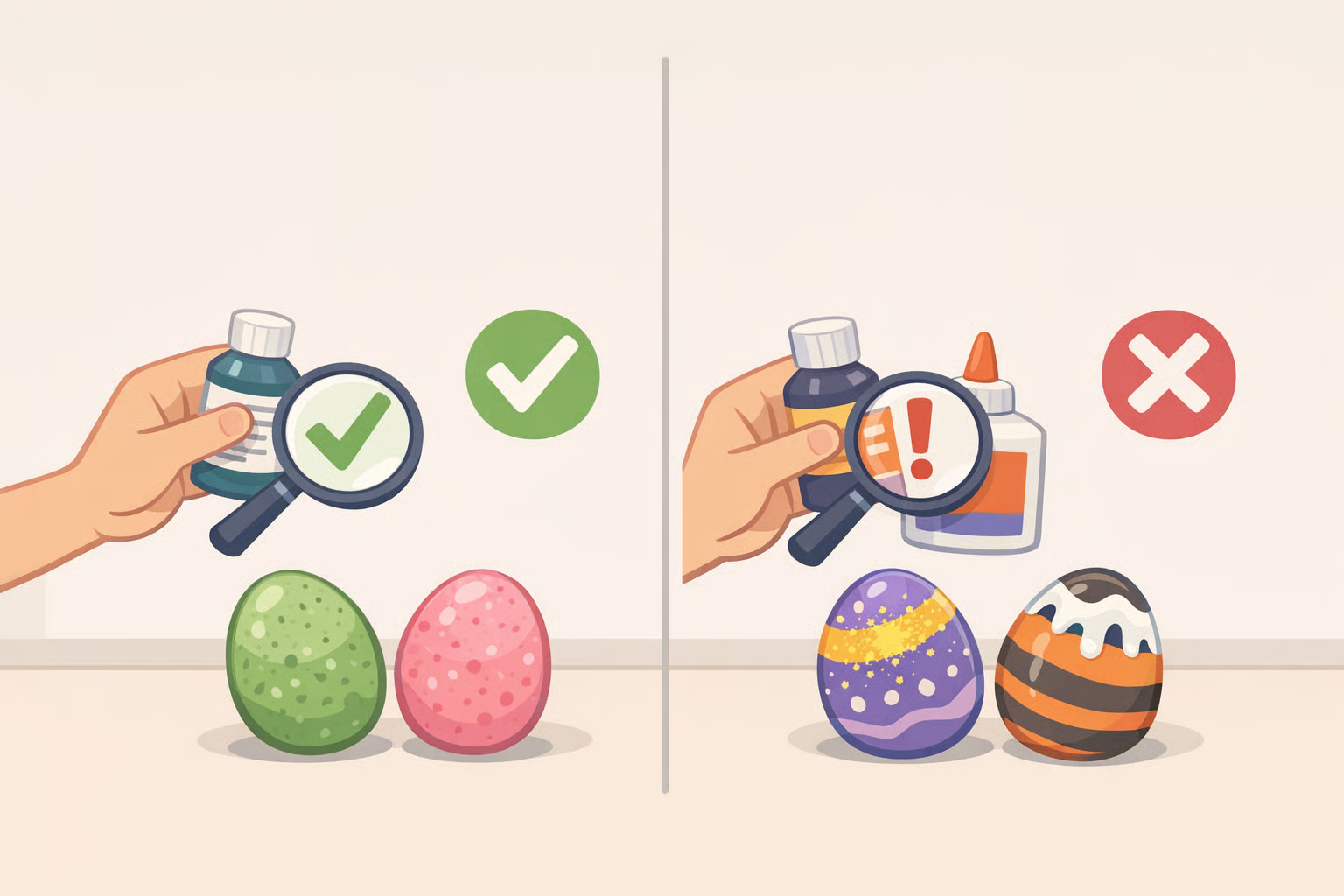
Two categories of dye. Food-grade options, including FD&C-certified colorants in commercial Easter kits and natural kitchen-based dyes, are formulated for food contact. Craft materials such as acrylic paint, permanent markers, and fabric dye are not.
USDA FSIS is unambiguous: if the eggs will be eaten, use a food-safe coloring. The concern isn't cosmetic. Because eggshells are porous, Warriner warned via Yahoo Life that solvents in acrylic paints can migrate through the shell into the egg itself. MyKitchenGallery adds that non-food-grade dyes are often formulated with industrial chemicals that haven't been tested for food applications. If the label doesn't say food-safe, it doesn't belong on an egg you plan to eat.
Commercial kits sold for Easter are generally safe. Check for a food-safe label and look for FD&C dyes in the ingredient list, per MyKitchenGallery. FD&C dyes are colorants approved by regulatory bodies for use in food, drug, and cosmetic products the same class of ingredients in sports drinks and candy.
Natural kitchen dyes are a fully safe alternative and require nothing specialized. Virginia Tech's March 2026 guidance lists reliable color sources:
- Yellow: turmeric or carrots
- Pink and red: beets, raspberries, or blueberries
- Green: spinach or matcha
- Blue: purple cabbage
- Brown: onion skins, per MyKitchenGallery
The tradeoff, as Warriner noted via Yahoo Life, is lower color intensity compared with commercial food dyes. The safety profile is identical; the saturation isn't.
For natural dye preparation, Virginia Tech recommends boiling the chosen ingredient in water, straining out the solids, and adding a teaspoon of white vinegar per batch. The acetic acid in vinegar lightly etches the shell surface, giving the color something to grip. Prepare solutions before the eggs come out of the fridge, not after every minute of unrefrigerated time counts toward the two-hour clock.
How to handle the eating eggs: time, temperature, and the two-hour clock
The most common safety mistake has nothing to do with dye it's leaving eggs out too long
Cooking removes the egg's natural protective cuticle, which is exactly why the two-hour rule carries more weight for hard-boiled eggs than for raw ones. Once that coating is gone, Virginia Tech and Clemson HGIC both note, the shell's pores are more exposed. Warriner put the consequence plainly via Yahoo Life: leaving hard-boiled eggs at room temperature for more than two hours can lead to bacterial growth.
The two-hour clock is cumulative that's the detail that catches people off guard. MSU Extension specifies that the clock starts the moment eggs leave the refrigerator and includes cooking cool-down time, dyeing time, travel time, and any time sitting on the counter or table. The window drops to one hour when outdoor temperatures exceed 90°F, per Virginia Tech. Two hours goes faster than it seems when children are involved.
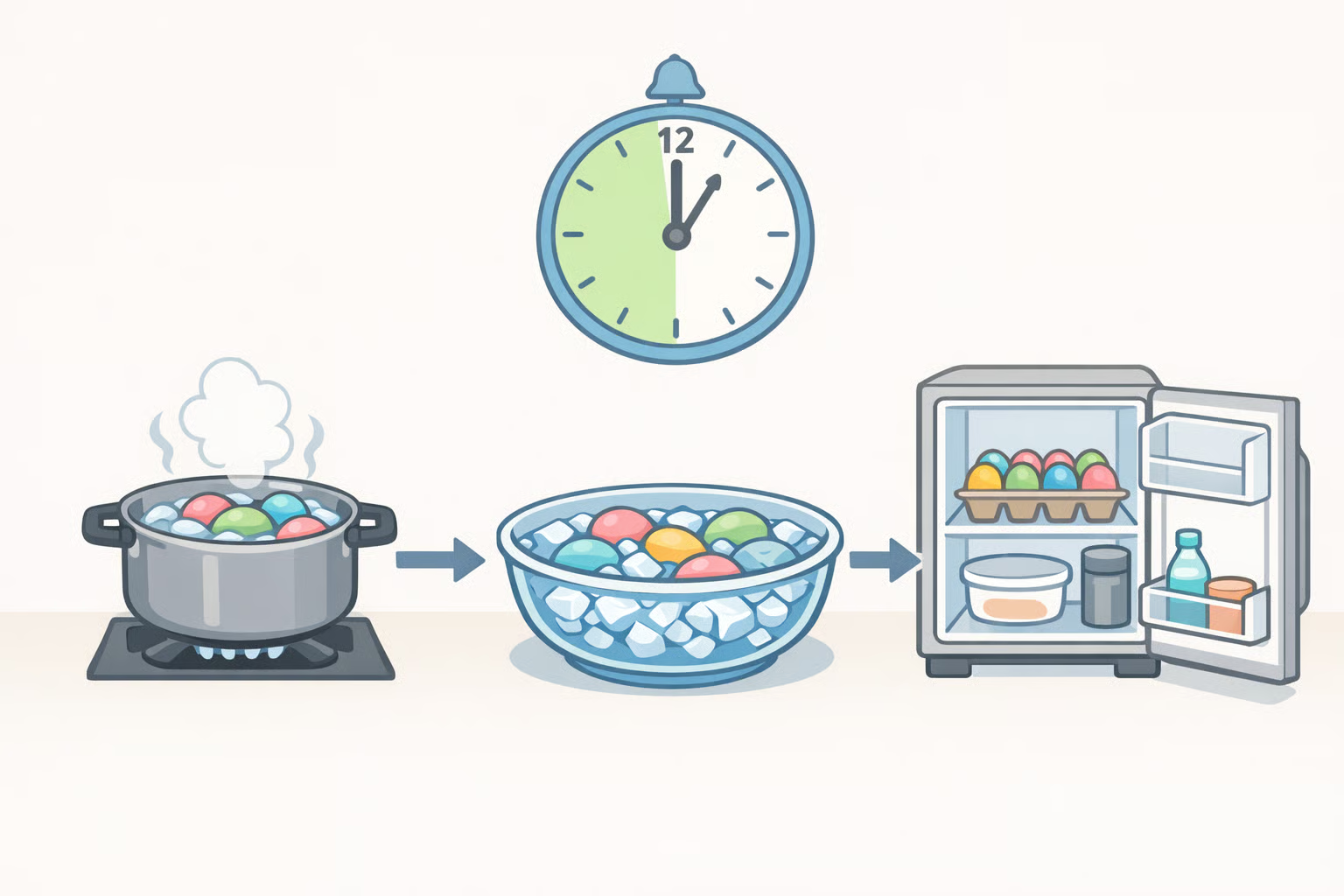
The recommended process, drawn from Virginia Tech's March 2026 guidance:
- Cover eggs with cold water in a pot and bring to a rolling boil of at least 212°F
- Remove from heat and let eggs sit for 15 minutes
- Transfer immediately to an ice bath; cool quickly, then dry and refrigerate
- Keep refrigerated until ready to dye; prepare dye solutions in advance so eggs spend as little time out as possible
For large batches, Warriner's advice via Yahoo Life is worth following: rotate eggs in and out of the fridge in smaller groups rather than letting the whole batch sit out while you work through them one at a time.
Once colored and dried, refrigerate eggs promptly in a covered container. Maximum safe storage is one week from the time of cooking, kept below 40°F, per Virginia Tech, USDA FSIS, MSU Extension, and Clemson HGIC.
Spoilage is easy to detect without tasting: a sulfuric odor or slimy texture means discard, per MyKitchenGallery. Don't taste a suspect egg to confirm.
Three rules, one practical strategy
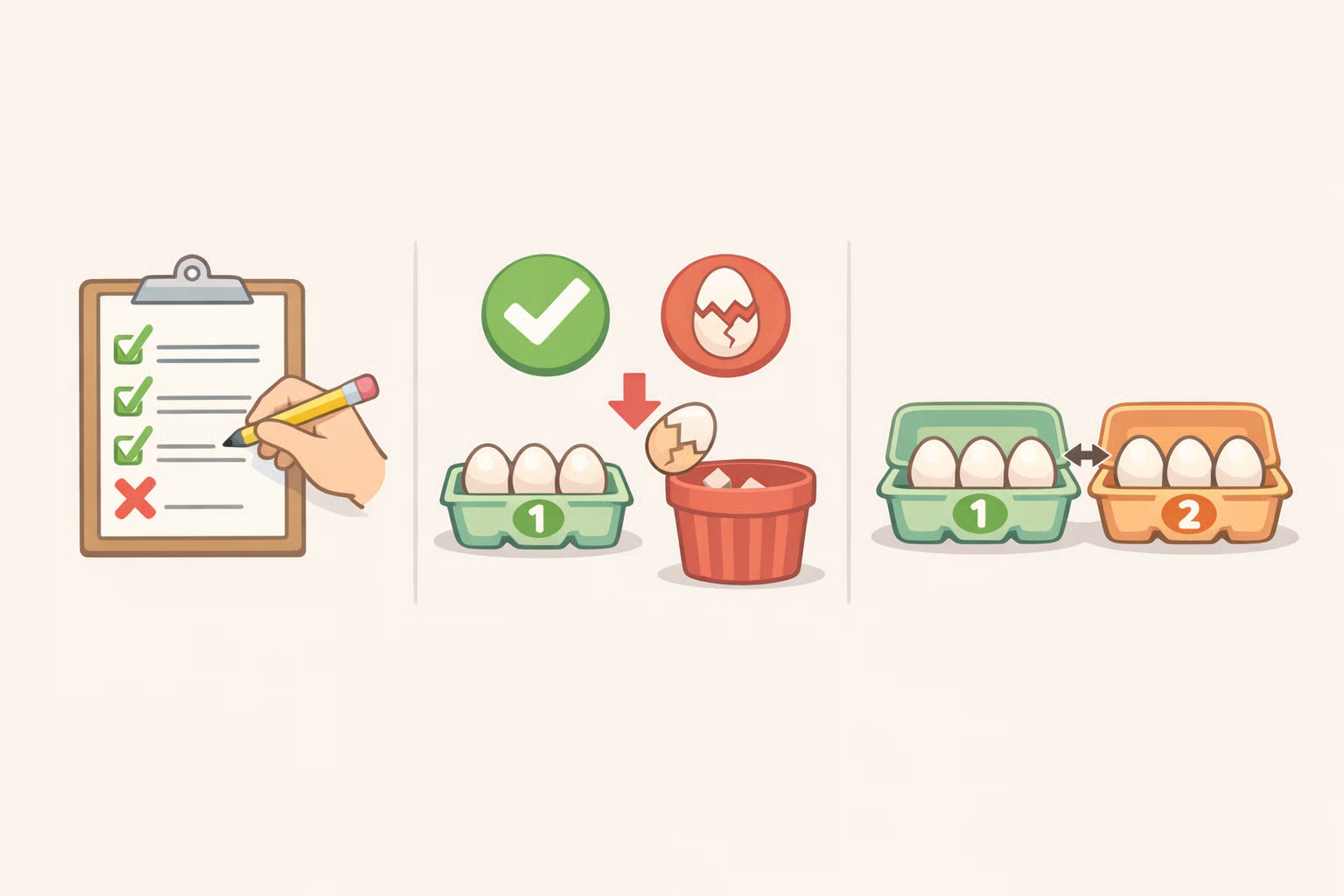
A decorated Easter egg is safe to eat when all three conditions hold: food-safe dye, uncracked shell, and no more than two hours out of refrigeration. One failure in any of those three is enough to toss it.
The rules, with their sources:
- Use only food-grade or natural dyes USDA FSIS and Virginia Tech (March 2026)
- Back in the fridge within two hours of leaving it; eat within seven days of cooking MSU Extension and Clemson HGIC
- Discard cracked eggs and any egg left out for extended display or handled during a hunt EggSafety.org (2025) and USDA FSIS
The two-batch approach removes most of the complexity. MSU Extension and Delish both recommend it: one set stays cold and is reserved for eating; the other handles display, hunts, and baskets, then gets discarded. No counting down the clock, no uncertainty about which egg was where.
For readers who want to go further on natural dye methods, color ratios, and step-by-step process, Virginia Tech's full seasonal guide from this month covers the practical details in full.




Comments
Be the first, drop a comment!