



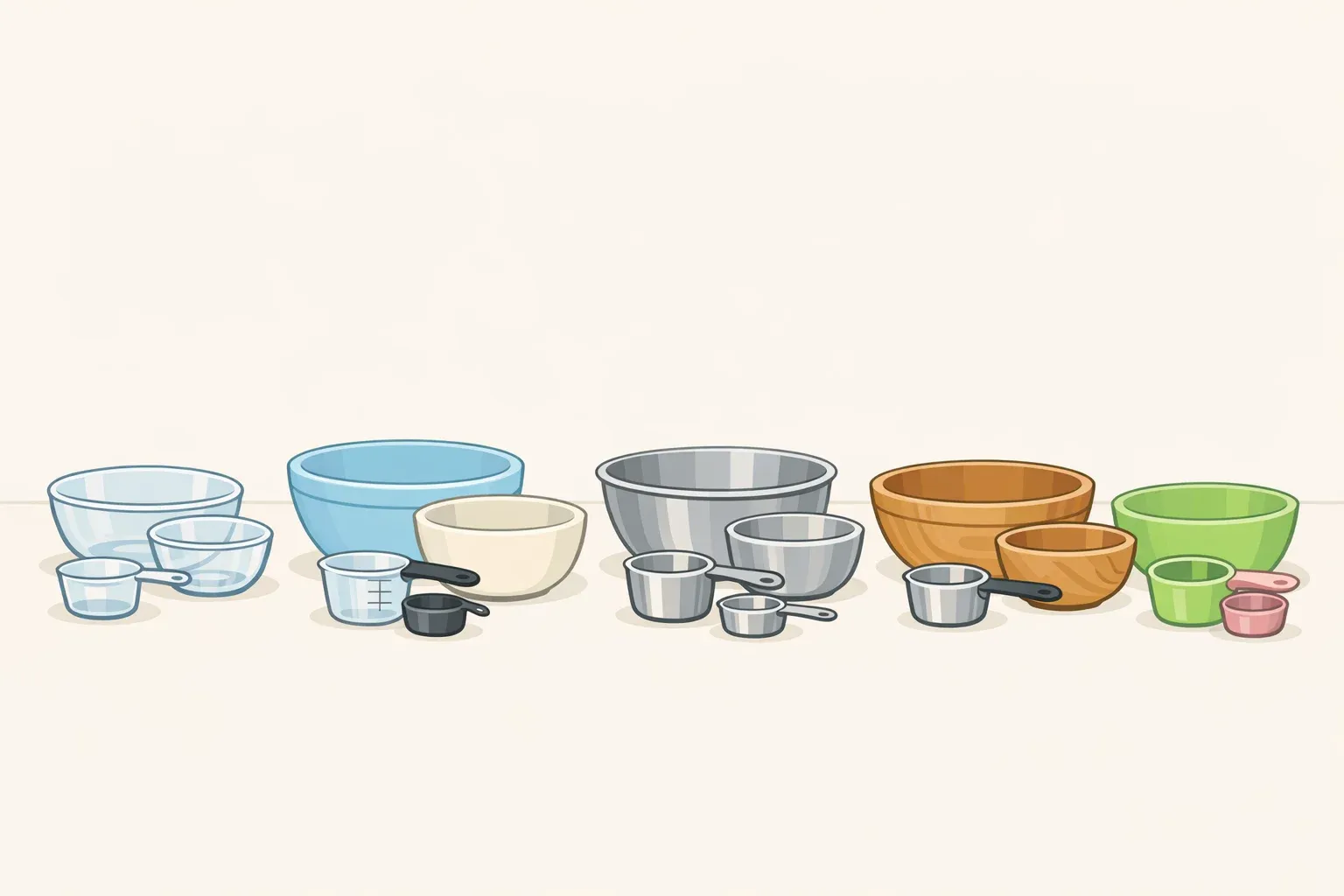
If you're only going to own one from the many types of mixing bowls out there, make it a mid-size one, around 2.5 to 3 quarts. In a review from two years ago, Serious Eats editor Rochelle Bilow found her 2.75-quart reBowl large enough for most recipes after more than a year of near-daily use, handling batters, meatballs, scrambled eggs, and salad dressing. It won't replace a small bowl for whisking a quick vinaigrette or a large one for a crowd-size batch of cookie dough, so knowing the tradeoffs before you shop saves both money and cabinet space.
There are really only a handful of mixing bowl materials worth knowing: stainless steel, glass, ceramic, and a newer bioplastic category. Stainless steel is lightweight and pours more cleanly when the rim is thin and flared; glass and ceramic are microwave-safe. Microwave-safe doesn't mean oven-safe, though. Check the label before a bowl goes in the microwave, oven, freezer, or over heat.
This guide covers how to choose mixing bowls by matching material to the task, figuring out how much capacity actually makes sense, and running a quick shopping checklist so the cabinet doesn't end up full of bowls that never get used.
Types of mixing bowls: choose a material based on the job
For everyday whisking, folding, and prepping, stainless steel is the least fussy option. In testing published last year, Serious Eats ran every bowl through the same two rounds: whisking a vinaigrette until it emulsified, then mixing a boxed cake batter.
Only the top-performing sets moved on to a whipped-cream test with a hand mixer and a sink-drop durability check, so the vinaigrette and batter rounds are the fair comparison across materials, not the later ones.
Glass and ceramic earn a specific advantage: both are microwave-safe, which settles the stainless steel vs glass mixing bowls question for anyone who reheats often. Oven use is where it gets more particular.
One tested ceramic set, four bowls of chip-resistant earthenware in the style Mason Cash has produced for more than a century, was rated dishwasher-, microwave-, freezer-, and oven-safe up to 320°F, and was also the heaviest tested lineup at 10.6 pounds for four bowls. That rating belongs to that specific set, not to ceramic mixing bowls as a category. Confirm both the oven rating and the weight on whatever ceramic set is actually in the cart.
Bioplastic is the newest entry, and it's worth a look for anyone who wants something light that can double as a serving bowl. The Material reBowl is made from Astrik, a plant-based biodegradable thermoplastic; it's dishwasher- and microwave-safe and weighs about 13 ounces even at 2.75-quart capacity.
Bilow's review noted that more than a year of near-daily use hadn't turned up the whisk scratches that showed up on her ceramic and metal bowls. Those specifics describe that one product rather than bioplastic bowls generally, but they point to what's worth checking in this category: low weight, scratch resistance, and a rim that pours cleanly.
The limitation to plan around with bioplastic is heat. Unlike some metal or glass bowls, the reBowl can't go over direct heat, according to Bilow's review. If a recipe calls for a double boiler or a stovetop step, that's a job for a different material entirely.
What each material can't replace is worth keeping straight, too. Stainless steel can't substitute for a microwave-safe bowl. The reBowl, and bioplastic bowls generally, can't go over a stovetop or into a double boiler. And one ceramic set's oven rating doesn't transfer to every ceramic bowl on the market; check the specific product, not the category, before assuming any bowl can take the heat.
Stainless steel
Best for: Daily mixing, whisking, and lightweight lifting
Not for: Microwave or oven use without checking the manufacturer's heat instructions
Confirm before buying: Rim shape; thin, flared rims pour more cleanly
Glass
Best for: Microwave reheating and seeing the contents
Not for: Oven use unless the product is specifically rated for it
Confirm before buying: Oven rating for the specific product
Ceramic
Best for: Microwave use; the tested Mason Cash-style set was also oven-safe to 320°F
Not for: Shoppers who need lightweight bowls; the tested four-bowl set weighed 10.6 pounds
Confirm before buying: Oven-safe temperature limit and total set weight
Bioplastic
Best for: Lightweight serving and scratch resistance, according to Bilow's reBowl review
Not for: Stovetop or direct-heat use
Confirm before buying: Whether a lid is included
How much mixing bowl capacity you actually need
A 2.5- to 3-quart bowl handles many everyday jobs, but it has real limits. It won't replace a small bowl for measuring and staging ingredients before they go into a recipe, and it won't stretch far enough for whipped cream in volume or a big batch of dough.
For a full set, tested lineups commonly stepped through 1.5, 3, and 5 quarts, with some adding an 8-quart bowl for large-batch jobs. General guidance backs up that progression: smaller households are usually fine with a 3- to 4-quart maximum, while anyone who regularly cooks for a crowd should own at least one bowl that holds 5 quarts or more, per that same Serious Eats testing.
Storage matters just as much as capacity, and nesting doesn't scale the way you'd expect. One tested five-bowl set spanning 0.75 to 8 quarts nested down to 13.75 inches wide and 5 inches tall, while a different five-bowl set, made from Astrik and covering 0.5 to 5 quarts, nested into a noticeably smaller 9.4 by 5.6 inches. Two sets with a similar number of bowls can take up very different amounts of cabinet space, so check the nested footprint, not just the quart range or bowl count.
Leftovers are worth thinking through before buying, too. Sets that come with lids simplify storage; where a bowl doesn't have one, silicone covers, beeswax wraps, or plastic wrap fill the gap (Serious Eats). The reBowl illustrates the tradeoff clearly: it doesn't ship with a lid, which Bilow's review says makes putting away leftovers a little less convenient even after more than a year of otherwise happy daily use.
Shape and stability: what to check before you buy
For whisking and folding, go shallow. Shallower bowls make whisking and folding easier and adapt to more tasks than deep, narrow ones.
For pouring, check the rim before the price tag. A thin, flared rim, the kind on the reBowl, made pouring easy with minimal drips and spills, according to Bilow's review. If pouring matters, test the rim in person when possible; a straight, unflared rim is more likely to dribble down the side on the way to a jar or pan.
For vigorous mixing, look for a stable base. A footed bottom kept the reBowl from sliding across the counter while whisking waffle batter or tossing salad with vinaigrette, per Bilow's review, which matters most when mixing one-handed. If a bowl doesn't have a stable base built in, setting it on a lightly dampened towel creates enough grip between towel, counter, and bowl to keep things steady while stirring.
For long-term durability, one detail is worth flagging: the sink-drop test that simulates a washing slip was only run on the winning sets in last year's testing, not every bowl in the lineup. Separately, Grace Kelly, the Serious Eats editor who first tested and named these bowls winners in 2023, has kept using her favorites since and says they've held up through multiple drops on the floor, distinct from the formal sink-drop test. That's a reasonable bar to hold any bowl to before buying it, even though it hasn't been confirmed across every material and set out there.
How to choose mixing bowls: a quick shopping checklist
Once the material and size fit how the cooking actually happens, a few practical checks head off most mixing bowl regrets, whether that's a store aisle or a product page.
Rim and base. Run a finger around the rim for a thin, flared edge, and look for a footed or wide base. Both decide whether the bowl pours cleanly and stays put while whisking.
Nested footprint. Ask for the nested dimensions, not just the number of bowls in the set. Two sets covering a similar quart range can nest to very different footprints, as the sizing section above shows.
Lid or cover plan. Confirm whether a lid is included. If not, plan on silicone covers, beeswax wraps, or plastic wrap before leftovers force the issue.
Heat ratings on that exact bowl. Microwave-safe, oven-safe, and freezer-safe are separate manufacturer ratings, and one doesn't guarantee the others. Check all three before a bowl goes into the microwave, the oven, the freezer, or over a double boiler.
Weight when full. Compare the empty weight on the label with what the bowl will hold once loaded, especially with glass or ceramic. A bowl that feels light on the shelf can get heavy fast once it's full of cookie dough or bread ingredients.
Size to task, not just to household. A small bowl, around 1 to 1.5 quarts, earns its keep staging measured ingredients or whisking a small batch of dressing. A medium bowl, 2.5 to 3 quarts, covers most everyday batters and mixing. A large bowl, 5 quarts or more, is for recipes that need headroom, whipped cream, dough, or group-size portions; Serious Eats points to that 5-quart threshold specifically for anyone who regularly cooks for a crowd.
Headroom while mixing. Beyond picking the right size, leave room above the ingredients once they're in the bowl. A bowl filled close to the rim leaves little room for whisking or folding, no matter how good the rim or base is.
Check your cabinet before you buy anything new
Before adding a bowl to the collection, run what's already there through the checklist above. A bowl with a stable base, a flared rim, and a capacity that matches what gets cooked most often doesn't need replacing, no matter how it looks next to something new online.
If a current bowl slides around while whisking or drips when pouring, that's a shape problem, not a reason to buy a whole new set. Try the damp towel trick underneath first and see if that solves it before spending anything.
Save an actual purchase for a real gap: a confirmed oven-safe bowl if nothing on the shelf carries that rating, or a 5-quart-plus bowl if the current rotation can't handle group-size cooking, per Serious Eats guidance. Measure the cabinet, check the care ratings, and buy only the size or heat-safe material the current bowls lack.








Comments
Be the first, drop a comment!