



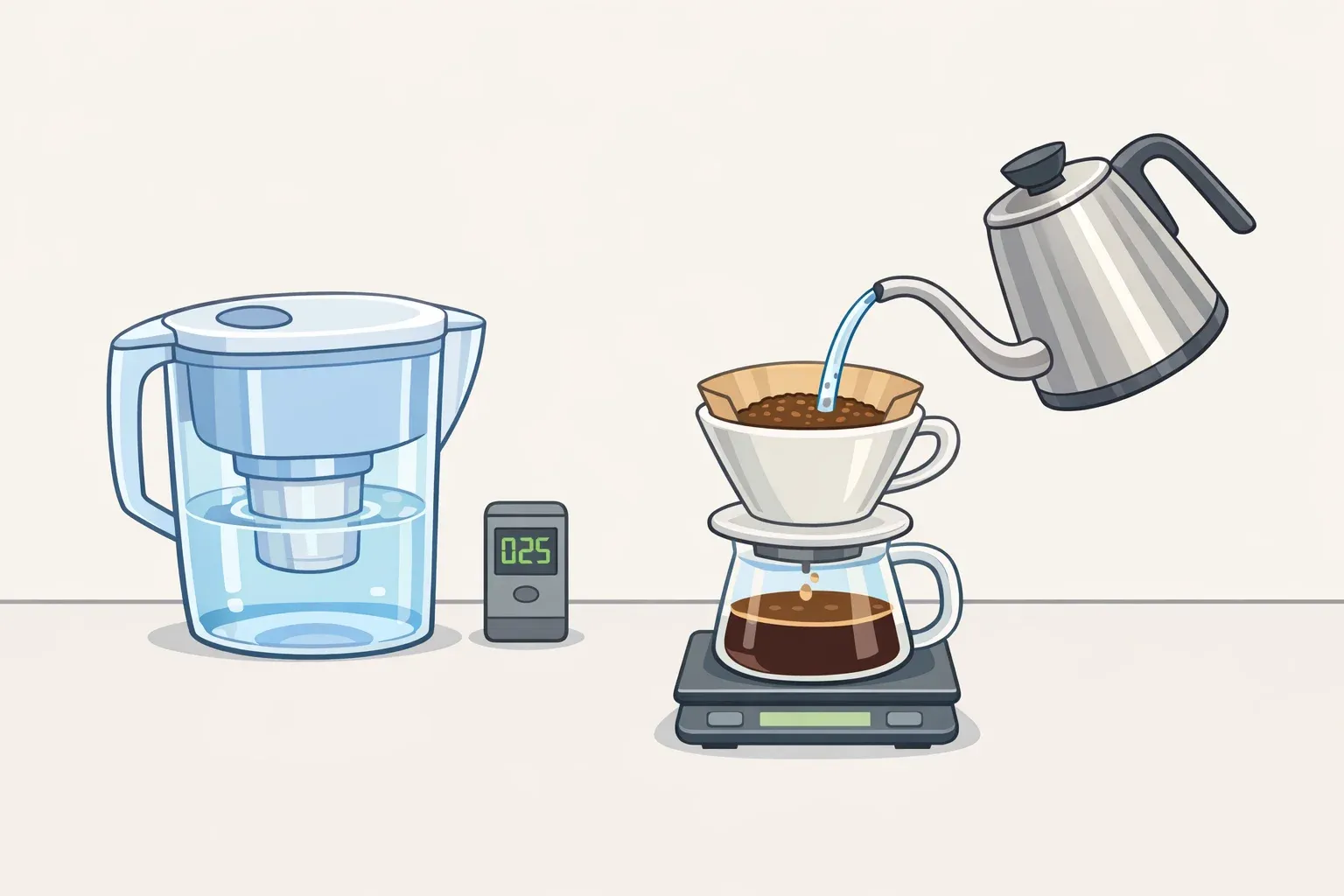
Brewed coffee is roughly 98.5% water. The beans — the thing most home brewers obsess over — account for the remaining 1.5% of dissolved solids, according to BrewFYI. That ratio should reframe where improvement is actually possible. If you want to know why you should use filtered water for coffee, the short answer is this: because the wrong water undermines every other decision you make, and the right filtration is usually simpler and cheaper than people assume.
There are two distinct reasons to filter brewing water. The first is removing disinfection chemicals that create off-flavors. The second is checking whether your tap water's mineral profile is helping or hurting extraction. The practical goal is not maximum purity. It's the lightest intervention that gets the water right.
Start here: what's actually in your tap water
A basic TDS (total dissolved solids) meter available for around $10–15 measures how much mineral content your water carries in parts per million (ppm). That reading is a useful first screen, BrewFYI explains: water in the 75–200 ppm TDS range is generally workable for coffee; below 75 ppm, extraction may be weak; above 250 ppm, harder treatment becomes worth considering.
Coffee consultant Scott Rao has argued that the industry's long focus on TDS has created a genuine blind spot: water can measure within a perfectly acceptable range and still brew poorly if its alkalinity is miscalibrated. For anyone troubleshooting seriously, pair the TDS reading with the annual water quality report from your local utility. These reports are public and usually downloadable. The numbers worth finding are: total hardness, alkalinity or bicarbonate, TDS, pH (though Rao notes pH matters less than alkalinity for cup flavor), and disinfectant type; whether your utility uses chlorine or chloramine affects which filter you need.
That diagnostic determines everything that follows.
Why filtered water for brewing coffee removes the first problem: chlorine off-flavors
Chlorine and chloramine are added to municipal supplies to kill pathogens. They work. They also keep working after the water leaves the treatment plant, including when it hits your coffee maker, where both compounds produce a faint medicinal or bleach-adjacent edge in the cup.
Activated carbon filters, the kind found in standard pitcher filters and under-sink inline units, are certified under NSF/ANSI Standard 42 testing to reduce chlorine and chloramine, along with some volatile organic compounds and trace heavy metals including lead and copper. Chloramine can be harder to remove than chlorine and may require adequate filter contact time, so check that any pitcher or inline filter you buy carries the NSF/ANSI 42 certification for both.
The useful thing about basic carbon filtration is what it doesn't do. Most pitcher filters reduce TDS by only around 10–20% and do not meaningfully affect hardness or alkalinity, according to Podium Coffee Club. Think of it like a bouncer who removes the troublemakers without clearing the room; the calcium and magnesium that extraction depends on stay behind; the disinfectants that flatten the cup are shown the door.
On cost: a standard pitcher runs $25–50 upfront, with replacement cartridges adding roughly $30 per year, each rated for about 40 gallons. Under-sink inline carbon filters cost $60–200 upfront with cartridges rated for 500–1,500 gallons lasting six to twenty-four months, considerably lower cost per gallon. For most home brewers making a few cups a day, a pitcher is sufficient capacity. If your TDS is in the moderate range and the issue is a slight chemical edge in the cup, this is likely where the fix stops.
How water affects coffee taste: the mineral balance problem
Chlorine removal is the accessible fix. The mineral question is where things get more consequential for anyone brewing specialty coffee.
Calcium and magnesium are the primary extraction agents. They bond with flavor compounds in ground coffee and pull them into solution during brewing without adequate levels of both; the resulting cup tends toward flat and underdeveloped. Bicarbonate, the component that determines alkalinity, functions differently: it acts as an acid buffer during brewing. A moderate amount prevents harsh, sharp sourness. Too much neutralizes the bright, fruity acidity that characterizes well-made specialty coffee and leaves the cup tasting dull and muted.
Scott Rao identifies alkalinity as the single most important water variable for coffee flavor, more significant than TDS as a standalone number. His preferred alkalinity for well-developed light roasts is 30–40 ppm. The Specialty Coffee Association's benchmark sits at 40 ppm alkalinity and roughly 68 ppm total hardness.
BrewFYI notes that many champion baristas brew outside these ranges. The SCA targets are useful as a diagnostic benchmark — a reference point to check your utility report against, not a mandate to hit precisely.
Mineral balance functions a bit like seasoning in cooking: too little and flavors don't fully develop; too much of one element and it crowds out everything else. If your tap water falls within a reasonable mineral range, carbon filtration to address chlorine may be the only intervention needed.
Rao reached exactly that conclusion when consulting for the Prodigal roastery, whose alkalinity was slightly above his preferred range but close enough that a sediment filter and carbon filter satisfied the result without further treatment. If your water is very hard or very soft, the mineral question requires a different answer.
When filtration goes too far
Some systems remove so much that the water becomes useless for coffee. Reverse osmosis strips 95–99% of dissolved minerals; the output typically measures under 20 mg/L TDS, making it too empty to extract flavor properly, much like distilled water. Certain high-end pitcher filters with ion exchange resin. ZeroWater, in particular, can reach near-zero readings similarly.
The fix for RO or near-zero output is remineralization: adding minerals back in controlled amounts. Options include pre-measured packets such as Third Wave Water (available in "Classic" and "Espresso" formulations) or a DIY concentrate using food-grade magnesium sulfate and sodium bicarbonate dissolved in distilled water.
The widely used Barista Hustle water recipe produces approximately 40 ppm hardness and 40 ppm alkalinity close to the SCA target, BrewFYI notes. RO paired with remineralization gives the most precise control over mineral content; it's also the most involved path, and it makes most sense for households with very hard tap water or serious espresso setups.
There's an equipment dimension worth noting briefly. Hard tap water above roughly 250 ppm TDS deposits limestone scale inside boilers, heating elements, and pipes over time, reducing heating efficiency and restricting flow. For espresso machines, where pressurized water contacts metal components repeatedly at high temperatures, water quality is especially critical due to scale buildup.
The other direction is equally real: very soft or acidic water can corrode copper and brass boiler fittings, which is why distilled water used without remineralization is a machine risk as well as a flavor problem. Water that tastes good in coffee, with moderate hardness, controlled alkalinity, and zero chlorine, also tends to be the least damaging to internal components.
Best water for brewing coffee: a practical decision map
Moderate TDS (75–200 ppm) with a slight chemical taste: Chlorine or chloramine may affect flavor. Use a basic carbon pitcher or inline filter (about $25–$200 upfront).
Moderate TDS (75–200 ppm) with no chemical taste: Your water may already be suitable. Test it with a TDS meter and check your utility report for alkalinity before buying a filter.
High TDS (above 250 ppm): Scale buildup or mineral imbalance may be an issue. Use a reverse osmosis system or an adjustable-output coffee pitcher, such as Peak Water, and consider remineralization.
Very low TDS (below 50 ppm): This can cause flat extraction and possible corrosion. Add minerals with remineralization packets or a DIY concentrate.
Espresso machine, regardless of TDS: Scale and corrosion risks are more consequential. Use filtered or recipe water and follow the manufacturer's descaling schedule.
Two specialty options sit between a basic carbon pitcher and a full RO. The Peak Water pitcher uses an adjustable cartridge that lets you set the level of mineral removal based on your tap water's starting point, more control than a standard pitcher without the complexity of building custom mineral recipes. BWT inline filters, common in European cafés, take a different approach: they add magnesium while reducing calcium, shifting the mineral ratio toward the profile the specialty coffee world generally considers better for extraction.
The goal in choosing among these is to match the solution to the problem you've actually diagnosed, not to buy the most sophisticated system available.
The upgrade most coffee drinkers haven't made.
For the majority of home brewers on average municipal tap water, a basic carbon filter is the highest-value, lowest-effort water upgrade available. It removes chlorine and chloramine without disturbing the mineral content that extraction depends on. Around $30–50 to start, roughly $30 per year to maintain.
If removing the chemical off-flavor doesn't fully solve the problem, the mineral profile, particularly alkalinity, is the next variable to examine. Pull your local utility's annual water quality report, find the alkalinity or bicarbonate figure, and check it against Rao's preferred window of 30–40 ppm for light-roasted coffee. That comparison will tell you whether further treatment is worth the effort or whether the water was never the main problem.
Good coffee water is not the same as pure water. Pure water extracts coffee poorly and corrodes equipment; the minerals matter. What you're aiming for is balanced water: moderate hardness, controlled alkalinity, no chlorine, and the lightest filtration path that gets you there from wherever your tap starts.








Comments
Be the first, drop a comment!