


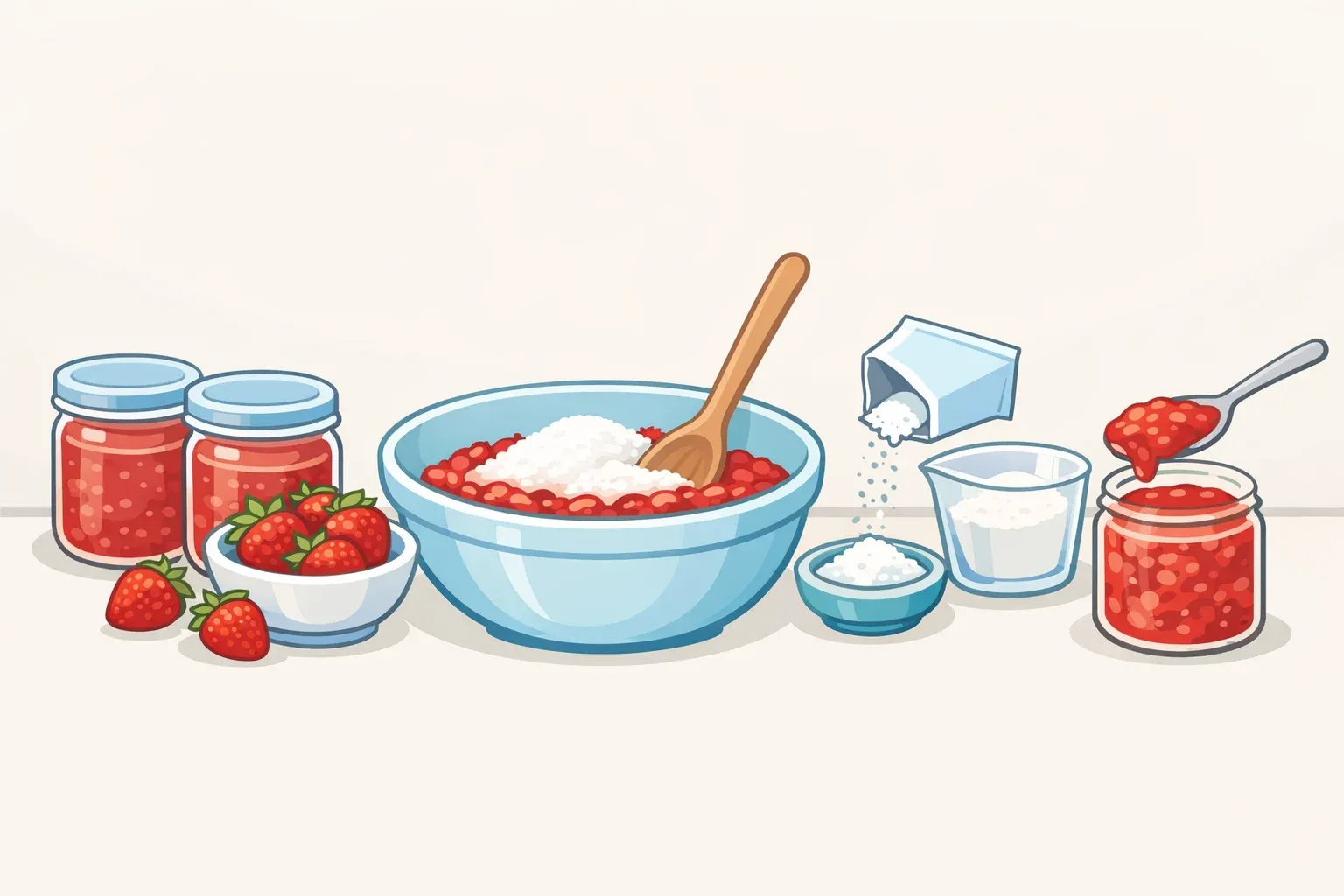
This strawberry freezer jam takes about 30 minutes of active work and uses three main ingredients: strawberries, granulated sugar, and one box of standard powdered pectin. You'll also need water to dissolve the pectin.
No boiling-water canner, water-bath processing, or prior canning experience is required. OSU Extension's freezer jam guidance says freezer jams are made with fresh fruit, sugar, and pectin, and success depends on following the recipe for the specific pectin brand you use.
One caveat matters before you start: this guide is for standard powdered pectin only. Instant freezer pectin, low-sugar pectin, liquid pectin, Pomona-style pectin, and other specialty pectins may use different ratios and different steps. If your box is not standard powdered pectin, follow the package insert instead.
Do not reduce the sugar in this recipe unless your pectin package gives a tested low-sugar version. Regular powdered pectin depends on the recipe's sugar ratio to set properly.
Recipe at a glance
Ingredients: 4 cups crushed strawberries, 3 cups granulated sugar, 1 box standard powdered pectin, and 1 cup water
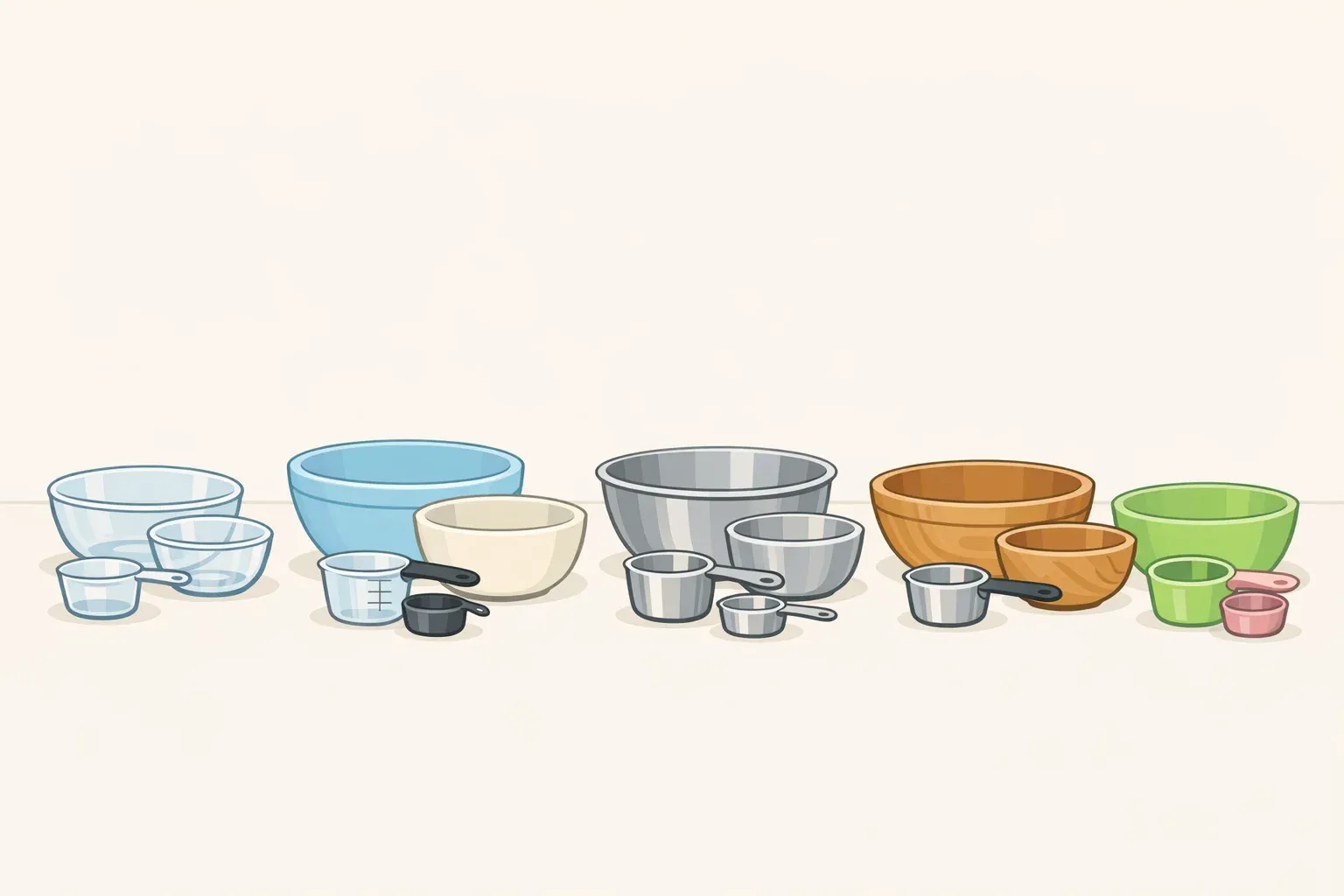
Equipment: Potato masher, medium saucepan, dry and liquid measuring cups, freezer-safe jars or containers with tight-fitting lids
Active time: About 30 minutes
Set time: About 24 hours at room temperature, or as directed by your pectin package
Yield: About 5 to 6 half-pint jars
Refrigerator shelf life: Up to 3 weeks
Freezer shelf life: Up to 1 year, though some pectin formulas specify a shorter window
Freezer jam is not shelf-stable. Every jar must go into the refrigerator or freezer after the setting period. This is not pantry jam, and it should not be stored like canned preserves.
Choosing the right strawberries
Fruit quality matters more here than in cooked jam. Nothing gets concentrated or corrected on the stove, so what you put in is what you get out.
Use strawberries that are fully ripe: deep red through to the stem, fragrant, and slightly soft to the touch. Avoid berries with white or pale shoulders near the hull; they are underripe, lower in natural sugar, and more likely to produce a weak set.
Overripe berries can also cause problems. If the fruit has gone soft, weepy, or bruised, it brings extra moisture into the mixture and can leave you with looser jam. Use the best ripe berries you have rather than waiting until they start breaking down.
When mashing, stop before the fruit turns to liquid. The goal is crushed strawberries with small chunks, not a smooth puree. Those small pieces help give freezer jam its body.
Measure after crushing, not before. Four cups of crushed strawberries is not the same amount as 4 cups of whole berries.
How to make strawberry freezer jam with pectin
Step 1: Prepare your containers
Choose containers designed for freezer use, such as plastic freezer containers with tight lids or glass jars labeled freezer-safe. Have them clean, dry, and ready before you start the fruit.
If using glass jars, check each one for chips or cracks before use and prepare the lids according to the manufacturer's directions. A chipped jar is more likely to crack in the freezer.
Step 2: Wash, hull, and crush the strawberries
Rinse the berries first, then remove the hulls. Order matters: wash the berries before hulling so the cut fruit does not absorb extra water and turn mushy.
Mash the hulled berries with a potato masher until you have 4 cups of crushed fruit. Small chunks are fine; this is a textured jam, not a commercial-style spread.
Step 3: Combine the fruit and sugar
Stir 3 cups of granulated sugar into the crushed strawberries until well mixed. Let the bowl sit for 20 minutes, stirring occasionally.
This rest gives the sugar time to dissolve before the pectin solution is added. Rushing this step can leave the jam grainy or interfere with the set.
Step 4: Boil the pectin solution
Combine the pectin packet and 1 cup of water in a medium saucepan. Bring the mixture to a boil over medium-high heat, stirring constantly.
Once it reaches a rolling boil, boil for exactly 1 minute, then remove the pan from the heat. Boiling for one full minute helps activate the pectin.
The fruit does not go on the stove in this method, but the pectin step is not optional. It is the difference between jam that sets and jam that stays syrupy.
Step 5: Combine and stir for 2 minutes
Pour the hot pectin solution into the strawberry-sugar mixture. Stir continuously for 2 full minutes.
Stirring for the full 2 minutes helps distribute the pectin before the jam begins to set. The mixture should look glossy and slightly thickened — not fully set, but no longer completely liquid.
A small amount of foam on the surface is normal. Skim it with a spoon before filling the containers.
Step 6: Fill the containers
Ladle the jam into the prepared containers, stopping about half an inch from the top of each one. That headspace gives the jam room to expand as it freezes.
Wipe the rims clean and cover the containers.
Step 7: Let the jam set
Leave the covered containers undisturbed on the counter during the setting period. For this method, plan on about 24 hours at room temperature, unless your pectin package gives different timing.
Tilt a jar gently to check the texture. Set jam should move slowly and hold together rather than slosh like juice. It will not be as firm as refrigerated jelly yet; that firmness develops in the cold, but the jam should have clear body.
Once the jam is set, move every container to the refrigerator or freezer.
Fixes for runny jam, cracked jars, and separation
Runny jam after 24 hours usually comes from using the wrong pectin type, changing the sugar amount, measuring the fruit before crushing, or not fully dissolving the sugar. Each pectin brand and type has its own ratios, and those directions do not transfer cleanly across products.
Soft batches are still useful. Refrigerate the jam and use it as a sauce for pancakes, waffles, yogurt, ice cream, or oatmeal.
A cracked jar in the freezer is usually caused by too little headspace, a container that was not freezer-safe, or a chip in the glass. Discard jam that leaks through cracked glass.
Separation after thawing is not a failure. Stir thawed jam before serving to recombine any separated liquid or fruit solids.
Storage and shelf life
Once set, every jar belongs in the refrigerator or freezer. Allrecipes' freezer jam guide gives a general storage window of up to 3 weeks in the refrigerator or up to 1 year in the freezer.
After thawing a frozen jar, keep it in the refrigerator. Thawed freezer jam is often softer than canned jam, which makes it especially good stirred into yogurt, spooned over ice cream, spread on pancakes, or whisked into a vinaigrette.
You can use the same freezer-jam idea with other fruits, including blueberries, raspberries, blackberries, cherries, apricots, peaches, and plums, but do not carry this strawberry ratio over automatically. Check your pectin insert for the fruit-specific measurements before switching.
If you have more strawberries than one batch can handle, freeze the extra fruit for another round later. Wash, hull, and dry the berries completely, spread them in a single layer on a baking sheet, freeze until solid, then transfer them to a dated freezer bag.
Strawberries are naturally low in pectin, which is why this recipe uses commercial powdered pectin for a more reliable set. Food & Wine's pectin explainer notes that low-pectin fruits such as strawberries often need added pectin to thicken efficiently.

Comments
Be the first, drop a comment!