



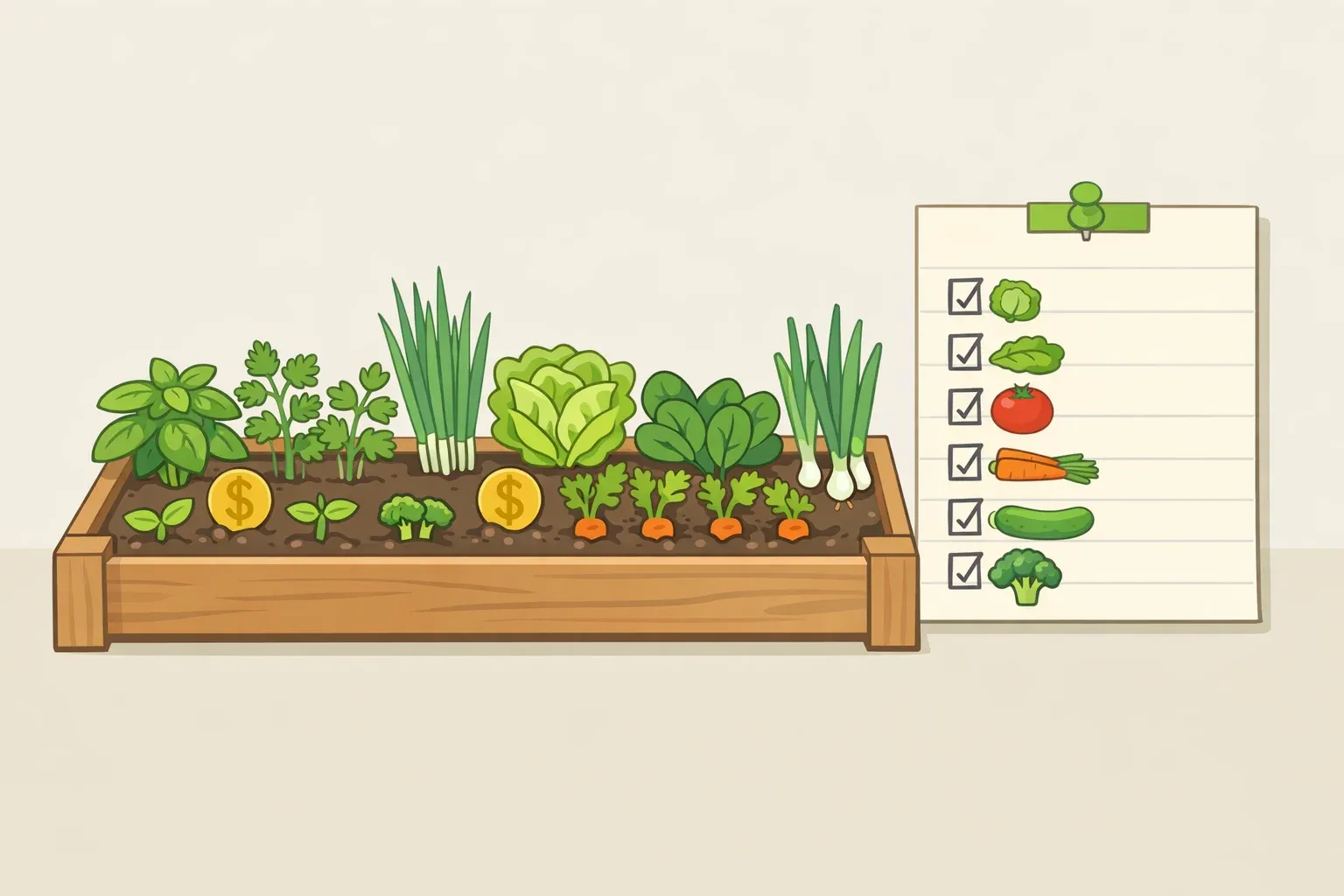
The best plants to grow to save money on groceries are not the ones most people plant first. This guide walks through four crops that offer the most reliable grocery savings, why they work where carrots and onions don't, and which one belongs in your garden based on how your kitchen actually runs.
The vegetables people reach for first — onions, carrots, potatoes — are also among the cheapest to buy. Baby carrots run about $0.40 per cup equivalent and onions about $0.42, putting them among the least expensive in a dataset covering more than 150 products, according to data from the USDA ERS.
A bed of homegrown onions won't move your grocery bill. The midrange doesn't fare much better: sweet potatoes at $0.58, canned corn at $0.68. At the top of the vegetable category, frozen asparagus and fresh okra tie at $2.60 per cup equivalent. That price spread is the framework this list is built on.
The crops worth growing share three characteristics: they're expensive to buy repeatedly, they produce harvests again and again over weeks or months rather than once, and they replace something you actually use on a regular basis. Leaf lettuce, spinach, fresh herbs, and peppers all meet that bar. Onions, carrots, and sweet corn don't they're single-harvest crops you dig once, and they're cheap at the store anyway.
One honest caveat before the list: UGA horticulture specialist Timothy Coolong notes that established gardeners are the ones who save considerably, because startup costs in soil, transplants, and trial-and-error are real and take time to recover. The four crops here are the strongest foundation for that system. Not a first-season miracle.
Before you start: You need a bed, raised box, or containers with at least 4–6 hours of direct sun and compost-amended soil. Nothing specialized. Pick the one crop below that matches your cooking, get it working, then add a second.
The four crops and the logic behind each one
1. Leaf lettuce and salad greens
Leaf lettuce is the easiest win on this list. It germinates fast, reaches harvestable size within a few weeks, and if cut correctly, keeps producing for the length of an entire cool season. What it replaces: bagged salad mixes that last three to four days in the fridge and go soft before most households finish them.
Mixed lettuce is one of the clearest examples of a fast-maturing, cut-and-come-again crop suited to small spaces. Spinach and lettuce can be harvested within weeks of planting and repeatedly across multiple weeks. The harvest mechanic is what drives the savings: cut outer leaves about an inch above the soil line, leave the center intact, and the plant regrows. A single patio container can realistically replace a household's weekly bag purchase through an entire spring or fall season.
Step 1: Sow seeds directly in a container or bed. Thin seedlings to 6 inches apart once established.
Step 2: Begin harvesting outer leaves when plants reach 4–5 inches tall. Never pull the whole plant; the center is your next week's harvest.
Step 3: Sow a small second batch 2–3 weeks after the first, rather than waiting for the initial planting to finish. This succession planting approach is essential for a consistent supply; it spreads crop-failure risk and prevents a single glut followed by a gap.
Gotcha: Lettuce bolts above roughly 80°F, turning bitter and shutting down leaf production. Grow it in spring and fall. Late-spring plantings outpace fall ones because longer days accelerate growth.
Start here if: Bagged salad is on your weekly shopping list and it's the first thing in your fridge to go bad. If you eat salad once or twice a month, one small planting will overproduce.
2. Spinach
Spinach belongs on this list for one specific reason: the organic premium. Coolong notes that cost savings can be particularly good for fans of organic produce, and leafy greens are where that gap is hardest to ignore. What a seed packet costs versus what organic spinach costs at retail is not a close comparison.
Like lettuce, spinach is a cut-and-come-again crop: harvest outer leaves at the stem, leave the central crown alone, and the plant keeps producing. It's also among the fastest-maturing greens, making it viable even in short cool-season windows.
Step 1: Direct-sow as soon as the soil is workable in spring, or in late summer for a fall harvest. Spinach tolerates light frost; it doesn't tolerate heat.
Step 2: Harvest outer leaves at the stem, leaving the growing crown intact.
Step 3: Succession-sow a second batch three weeks after the first. When the first planting bolts, it will pull it immediately and let the next batch take over.
Gotcha: Spinach bolts faster than lettuce once temperatures climb, and it doesn't recover. When you see a flower stalk forming, don't wait. Pull the plant and sow the next batch. Waiting costs you two weeks.
Start here if: Fresh spinach shows up in your kitchen multiple times a week, you're buying organic, and you're regularly throwing away the bottom half of a container before you finish it. That combination of frequency, premium price, and routine waste is exactly where growing your own displaces store purchases most reliably.
3. Fresh herbs
Fresh herbs carry some of the steepest per-weight markups in the produce section. A small bunch deteriorates in three to five days, and most purchases are made for one recipe, used partially, and discarded before the next cooking day. Growing your own means cutting exactly what you need, when you need it, which cuts both the waste and the repeat purchase.
Coolong notes that one or two herb plants can supply a household's full fresh needs, with surplus left to freeze or dry. A single mid-summer basil plant makes it easy to believe the leaf output outpaces what most households can use fresh in a week.
Step 1: For basil, start indoors four to six weeks before last frost, or buy transplants. Plant in a sunny, warm spot; basil stalls below 60°F.
Step 2: Pinch flower buds off as soon as they appear. This is the step most people skip, and it's the one that ends herb productivity mid-season. A bolted basil plant stops producing usable leaves.
Step 3: For cilantro, which bolts quickly regardless of what you do, direct-sow every three weeks rather than treating it as a single planting. Parsley is slower but produces across two full seasons; plant it once, and it largely runs itself.
Gotcha: Match herbs to your actual cooking. Three basil plants produce abundantly from June through September if you cook Italian regularly. If you make one batch of guacamole a month, a single cilantro plant will bolt before you finish it. Grow what you go through, not what sounds impressive.
Start here if: You're regularly buying small herb packages, using half, and throwing the rest away. Per-weight, fresh herbs carry the highest markup of any crop on this list, and waste is built into every grocery purchase.
4. Peppers
Peppers have the longest lead time of anything here — eight to ten weeks indoors before transplanting — but they also have the longest productive window. A single plant begins yielding mid-summer and keeps going until first frost: several months of consistent picking from one transplant.
Peppers are among the multi-harvest crops that continue producing over weeks, provided you pick them regularly; leaving mature fruit on the plant signals it to slow new production. Chili peppers are one of the categories where home growing can supply all of a household's fresh needs, with surplus left to preserve.
Peppers are also the easiest crop to preserve without any equipment investment, which matters because canning isn't the cost-free savings it appears to be. Once you factor in jars, lids, canning tools, and processing time, home preservation can equal or exceed the cost of store-bought. Freezing peppers requires only a sheet pan and a zip bag. That's it.
Step 1: Start seeds indoors eight to ten weeks before the last frost. Transplant only after all frost risk has passed; a cold snap that lettuce would shrug off can set pepper plants back by weeks.
Step 2: Harvest frequently once fruit reaches usable size. Don't wait for full color change on every pepper; consistent picking keeps production running through the season.
Step 3: At season's end, slice remaining peppers, spread on a sheet pan, freeze until solid, then transfer to a bag. That's the entire preservation process.
Gotcha: In short-season climates with fewer than 120 frost-free days, prioritize fast-maturing varieties and get transplants in the ground as early as your last frost date allows. Losing a week to a late cold snap in a short season is costly.
Start here if: Peppers appear in your meals multiple times a week, you buy specialty varieties, or you want a crop that keeps producing through the end of summer without replanting.
Best vegetables to grow for cost savings: how to pick your first crop
The fastest way to choose: identify which of these four shows up most often in your weekly cooking, costs the most per unit at retail, and spoils fastest after you bring it home. That overlap of frequent use, meaningful price, and short shelf life is where home growing displaces store purchases most reliably and most quickly.
A compact decision rule by situation:
Easiest first win, minimal space: Leaf lettuce. Productive in weeks, minimal skill required, replaces one of the most reliably overpriced items in the bagged produce section.
Buying organic greens regularly: Spinach. The organic price gap is large enough that it pays for itself faster than almost any other crop on this list.
Cook with fresh herbs weekly: Herbs. The per-weight markup is the highest of anything here, and two plants will outperform a season's worth of grocery bunches.
High-volume summer cook: Peppers. Longest setup, longest payoff window, easiest surplus preservation.
Start with one. Pick the crop that fits your cooking. Get it producing consistently. Then add a second from a different category. Herbs and lettuce pair well for fast-turnover savings; peppers and spinach cover volume and season length. Any working combination of two beats a large monoculture of one.



Comments
Be the first, drop a comment!