



Best Lasagna Without Ricotta: Why Béchamel Works Better
This guide walks you through building a lasagna that slices cleanly, tastes creamy in every layer, and doesn't gamble on whatever ricotta your grocery store happens to stock. By the end, you'll have a concrete method for the best lasagna without ricotta: a reduced ragù, a reliable béchamel, a noodle-soaking trick that eliminates an entire pot to clean, and a few non-negotiable steps around layering and resting.
Most home lasagna fails in one of two directions. It bakes up dry and grainy, with ricotta that seized in the oven and left chalky white pockets in every slice. Or it comes out a watery mess that collapses the moment you lift it. Both failures trace back to the same root cause: moisture that isn't managed before or during assembly.
When two lasagna experts with different backgrounds were asked independently how to fix lasagna, one who grew up just outside Venice and one an Italian American culinary producer, they gave identical advice: ditch the ricotta, make béchamel (The Kitchn, March 2026). Four chefs surveyed separately on the same question all pointed to moisture management as the single most important factor in getting the dish right (Simply Recipes, January 2026).
Béchamel solves this not by being fancier than ricotta, but by behaving predictably. It doesn't seize, it doesn't release unexpected liquid, and it doesn't depend on ingredient quality to stay creamy. That predictability is the practical argument, and it's the one this guide builds on.
Why béchamel is the best ricotta substitute for lasagna
The difference between the two in a lasagna isn't aesthetic. It's structural.
Ricotta is a fresh cheese with residual moisture that can behave unpredictably under oven heat. At its worst, it dries out and crumbles; at its best, it still sits in discrete dollops that can harden at the edges while releasing moisture at the center. Béchamel sidesteps this entirely. It spreads evenly across each sheet, stays hydrated throughout baking, and sets into a smooth, sliceable structure once the dish rests.
Italian chef Francesco, when asked for his top lasagna tip, led with "No ricotta. Never," and defined the dish's three essential components as pasta, Bolognese, and béchamel nothing else (The Kitchn, December 2025). That's northern Italian tradition, and it holds up for practical reasons.
A 10-person holiday dinner in which every guest preferred the béchamel version over ricotta-based lasagnas they'd eaten before isn't controlled science, but it maps to what the technique actually does differently (The Kitchn, March 2026). A small grating of nutmeg into the sauce adds a low-level depth that ricotta fillings rarely achieve. The sauce is also rich enough to carry the dish without mozzarella in the layers.
On keeping ricotta: If you prefer to work with it, the same moisture management principles apply, but the margin for error is narrower. Choose ricotta whose label lists only milk, an acid or starter culture, and salt; anything with gums or stabilizers signals a product that's harder to control in the oven (Serious Eats, September 2023). You'll also need to reduce the ragù more aggressively and layer more thinly than feels intuitive. Béchamel is simply more forgiving. If ricotta-based lasagna has let you down before, the issue is almost certainly the ingredient, not your technique.
How to make creamy lasagna with béchamel: step-by-step
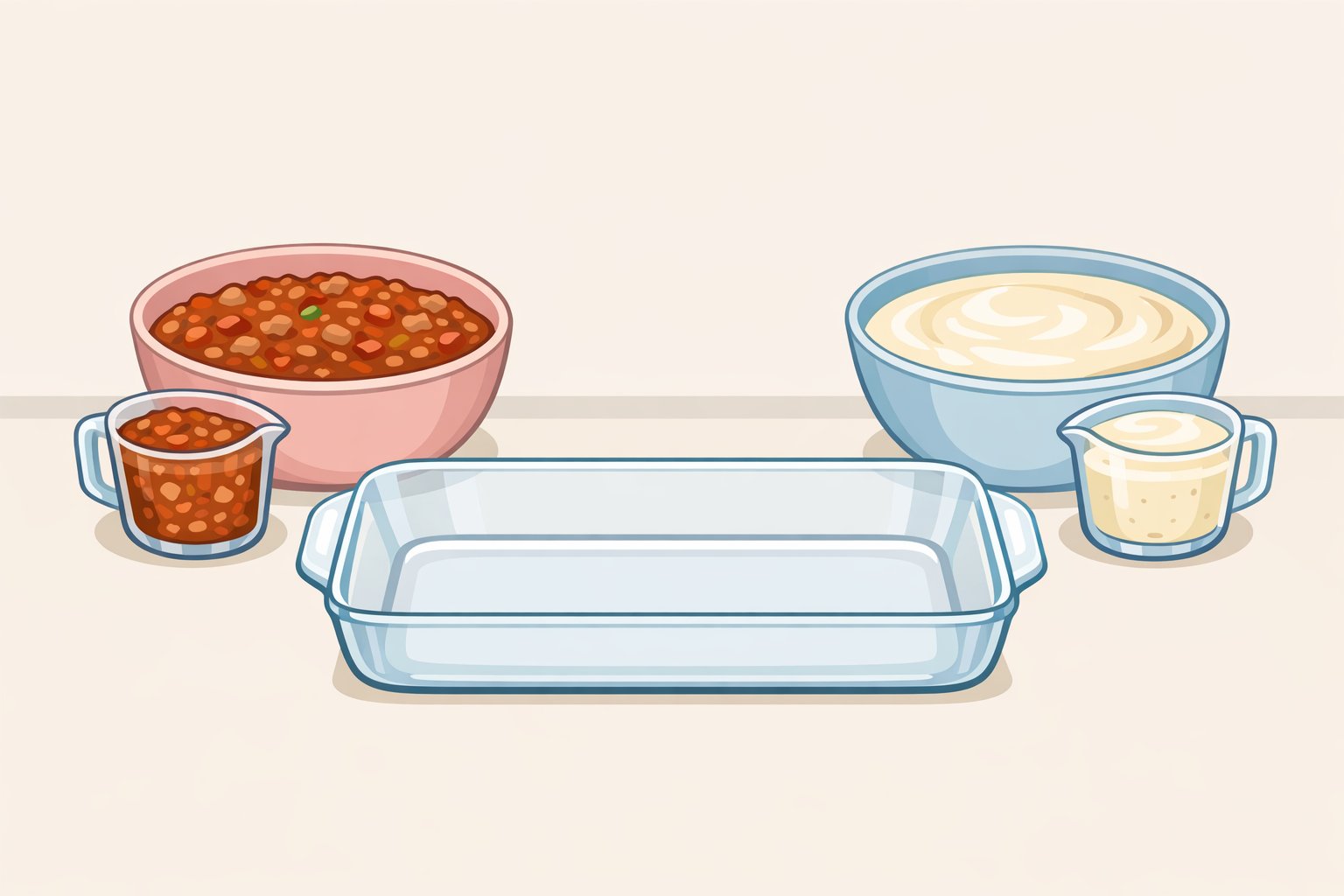
Before you start: You need a 13x9-inch baking dish, a heavy-bottomed pot for the Bolognese, and a medium saucepan for the béchamel. Make both sauces up to two days ahead and refrigerate them separately. This compresses same-day assembly to about 30 minutes and lets the ragù deepen in flavor overnight.
Step 1: Build and reduce the Bolognese until it holds its shape.
Start by rendering diced pancetta until crisp, then sweat finely chopped carrots, onion, and celery in the rendered fat rather than olive oil. The pancetta fat adds a richness that olive oil can't replicate (The Kitchn, March 2026). Add ground meat, crushed tomatoes, and a can of tomato sauce for concentrated body. Once everything is in the pot, the ragù needs about 30 minutes of simmering, but that simmer has to run low and slow until the excess moisture cooks off and the sauce holds a clean edge when spooned onto a plate (Simply Recipes, January 2026).
The test: spoon a small amount onto a flat surface. It should mound slightly and not run. If it spreads, keep simmering. A loose ragù is the single most common cause of watery, collapsed lasagna. No technique downstream fixes it.
If you're adding vegetables, sauté them first to drive off excess moisture before folding them into the sauce. Same logic.
Step 2: Make the béchamel.
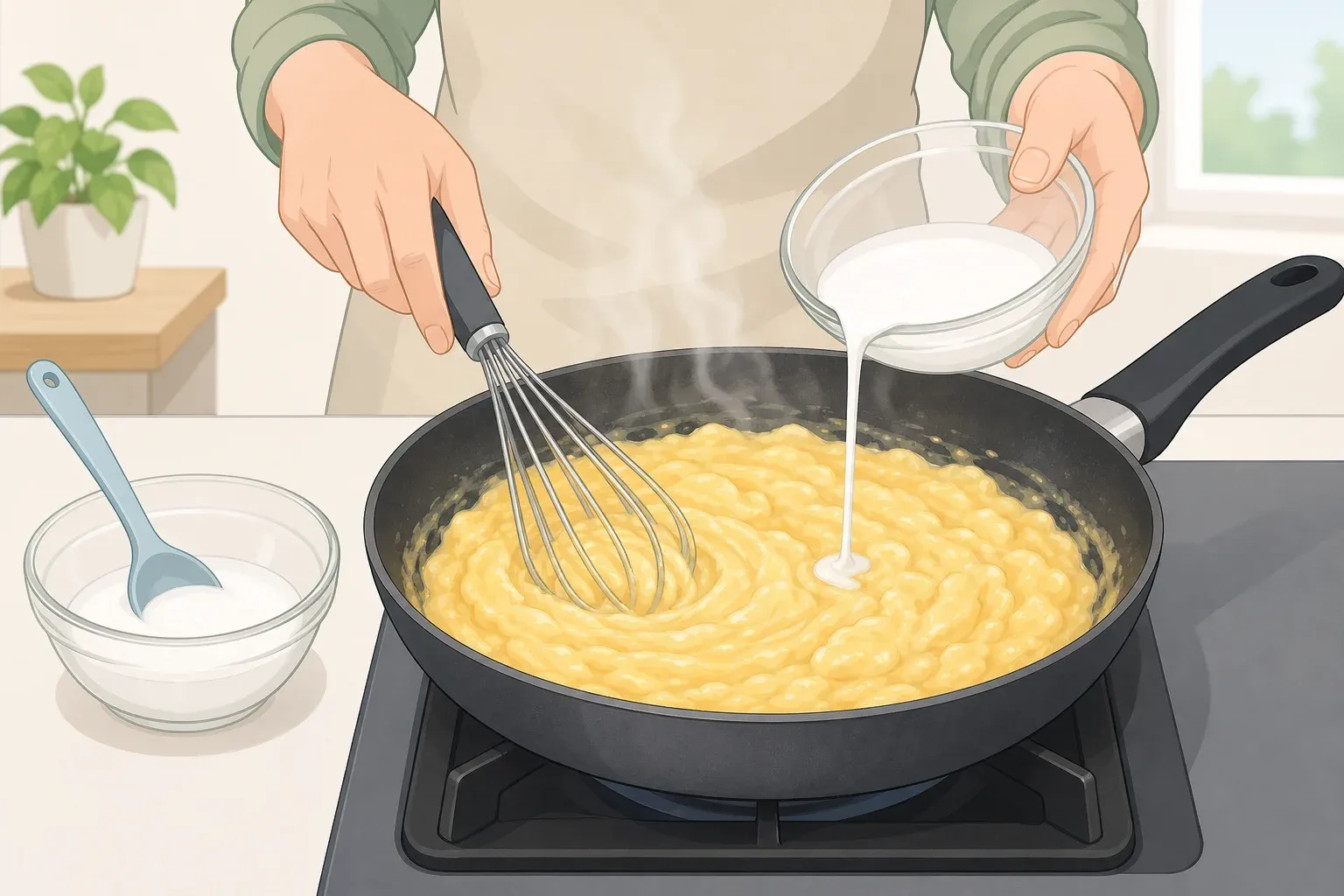
Melt butter over medium heat, whisk in flour, and add warm whole milk gradually, stirring constantly until the sauce thickens enough to coat the back of a spoon and hold a clean line drawn through it. Season with salt and a small grating of fresh nutmeg. That's the whole sauce. No additional cheese, no cream.
If making ahead: press plastic wrap directly onto the surface of the warm sauce before refrigerating. This prevents a skin from forming (The Kitchn, March 2026). Reheat gently over low heat, stirring until smooth and fluid, before assembling. It will thicken slightly in the fridge; that's normal and expected.
Step 3: Soak the noodles, skip the boiling pot.
Place dried lasagna sheets flat in the empty baking dish. Cover completely with very hot tap water and let them soak for about 30 minutes, then drain and pat dry. This produces noodles with a texture close to fresh pasta: pliable, slightly resistant, ready to absorb sauce during baking. It also eliminates an extra pot to clean (The Kitchn, March 2026; Simply Recipes, January 2026).
The goal is noodles that go in slightly underdone. They finish absorbing liquid in the oven. Sheets that are fully cooked before assembly come out mushy and lose structural integrity once layered (The Kitchn, December 2025).
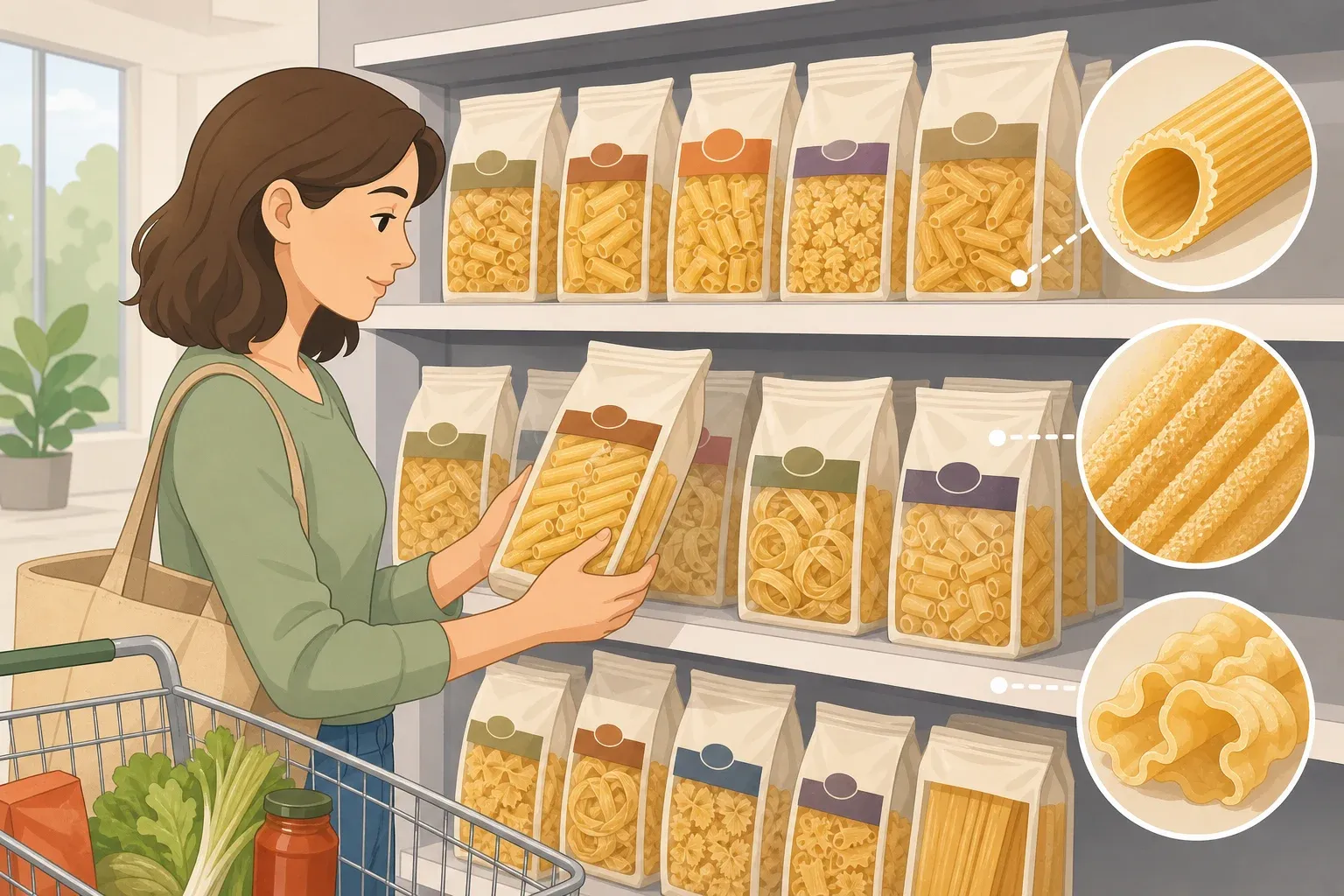
On oven-ready noodles: they work in tomato-sauce-heavy builds where there's enough free moisture to hydrate them. With béchamel, which is thicker, hydration can be uneven. Stick with the hot-water soak here. It's faster than boiling and more reliable than oven-ready sheets in this context.
Step 4: Layer thin and layer often, aiming for six or seven layers.
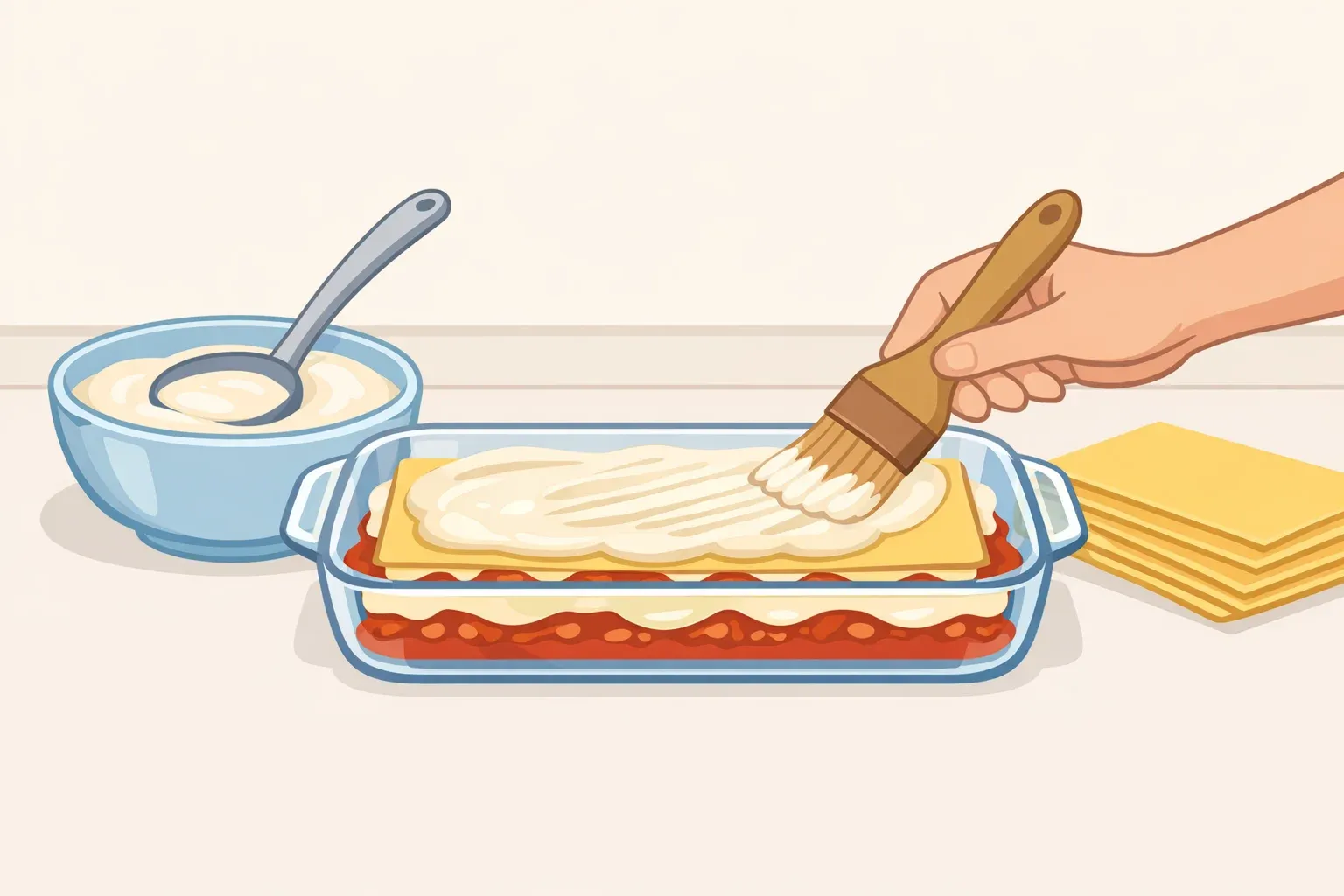
Spread a thin coat of Bolognese across the bottom of the dish first. This anchors the first sheet and gives it something to absorb immediately. Then alternate: noodle, thin Bolognese, thin béchamel. Repeat. The layers should be genuinely thin, not generous, not loaded.
Francesco's standard at his restaurant is seven layers using fresh pasta rolled thin enough that you can see your hand through the dough (The Kitchn, December 2025). More thin layers create more surface area to absorb sauce, better structural cohesion, and the right ratio of every component in each bite. Overstuffed layers lead directly to the sloppy, watery slice that won't hold together on the plate (Simply Recipes, January 2026).
Finish the top with béchamel and a generous layer of finely grated Parmigiano-Reggiano.
On additional cheese in the layers: if you want more cheese beyond Parmigiano on top, choose low-moisture varieties only. Standard supermarket mozzarella, fresh buffalo mozzarella, and burrata all release water during baking and recreate exactly the structural problem you're working to avoid. Dry-aged mozzarella is the safe choice if you want it (Parade, November 2024).
Step 5: Bake covered, then uncover to finish.
Cover the dish tightly with foil, tented slightly so it doesn't touch the béchamel top, and bake at 375°F for roughly 35-40 minutes. The foil traps steam, keeps the interior from drying out, and lets the noodles finish absorbing liquid. Remove it for the final 10-15 minutes to brown and crisp the top layer of béchamel and Parmigiano.
The lasagna is done when the edges are visibly bubbling and the top has a golden crust with darker spots at the rim.
Step 6: Rest for at least 15 minutes before cutting.
Straight out of the oven, the layers are held in suspension by liquid and heat that hasn't set. Cut immediately and you get a molten, shapeless pile. Rest it for 15-20 minutes and the structure firms into clean, stackable slices. Tent loosely with foil if you're worried about temperature loss (Simply Recipes, January 2026; The Kitchn, March 2026).
This step is not optional. Every technique in the build depends on it.
Troubleshooting: when the lasagna doesn't work
If something goes wrong, it almost always traces back to one of three places. Check these before blaming the recipe.
- Watery, collapsed slices: The ragù wasn't reduced enough before assembly. Cook it longer on lower heat and test with the spoon before assembling next time. There's no fix after baking.
- Dry, uneven texture despite using béchamel: The sauce was too thick at assembly, either overcooked or not properly reheated before spreading. It should be fluid enough to coat a spoon easily. Applied cool and stiff, it won't spread into the noodles during baking.
- Noodles still tough or gummy after baking: Either the soak wasn't long enough (30 minutes minimum), the water wasn't hot enough, or oven-ready sheets were used and didn't hydrate sufficiently with the béchamel build. The hot-water soak is the most reliable fix.
- Can't get a clean slice even after resting: The layers were too thick, or the dish was cut before it had time to set. Thinner layers and a full 15-20 minute rest resolve both.
The variables that don't matter as much as you think: the exact brand of tomatoes, whether you use pancetta or prosciutto, and whether you end up with seven layers or six. Get the ragù consistency, béchamel fluidity, noodle texture, and rest time right. Those four control nearly every outcome.
Lasagna fails when moisture is treated as an afterthought. Ricotta demands careful sourcing, precise layering, and an aggressively reduced ragù and even then, results vary depending on the product you happened to buy that week. Béchamel removes most of that variability by behaving the same way every time, regardless of brand or batch. Once you understand that every step here is solving a moisture problem, the dish stops being unreliable. Nail the four variables above, and it takes care of itself.





Comments
Be the first, drop a comment!