


This guide walks through a specific sequence for making homemade French bread pizza that comes out crispy rather than soft. By the end, you'll have a default formula with exact amounts, a topping framework that preserves texture, and a freezer batch method that yields roughly 30 individual pieces from a single prep session.
The total time runs 35–40 minutes, not 20. Worth flagging upfront. The extra time comes from a pre-toast step that many recipes skip, and across several tested recipes, the same anti-soggy pattern keeps showing up: pre-toast the bread, seal it with fat before sauce touches it, keep sauce thin, bake hot. Skip the step, and dinner is faster. It's also softer.
At a glance: preheat, pre-toast buttered bread, add toppings lightly, bake 10–15 minutes, broil 1–2 minutes.
Two cuts, one method. For a dinner serving 2–4 people, slice one standard French loaf lengthwise into two halves. For freezer prep, slice multiple loaves crosswise into 1-inch rounds. Three loaves yield about 30 individual pieces. The steps below apply to both formats.
Default build formula per quarter-loaf section (or 2–3 crosswise rounds):
Bread: One standard grocery store French loaf, 12–15 oz. Not a baguette.
Fat layer: 1 tablespoon softened butter mixed with garlic powder and kosher salt on the cut side; olive oil brushed on the rounded exterior. For more flavor, substitute a garlic-pesto butter using butter, basil pesto, dried oregano, garlic salt, and a pinch of red pepper flakes
Sauce: About 2 tablespoons of thick pizza sauce per section. Thicker pizza sauce holds up better under heat than thinner marinara, though marinara works in a pinch.
Cheese: Approximately ¼ cup shredded mozzarella per section, plus a light dusting of grated Parmesan. Low-moisture shredded mozzarella melts clean and doesn't release the excess water fresh mozzarella can.
Equipment: Rimmed baking sheet lined with foil or parchment
Step 1: Prep the oven, pan, and bread
Preheat to 400–425°F. A fully preheated oven at this range helps the bread crisp rather than steam. At lower temperatures, moisture builds before the surface sets. Line a large rimmed baking sheet with foil.
Cut the loaf lengthwise into two halves for a dinner-sized pizza, cut side up. For freezer rounds, slice crosswise into 1-inch pieces and arrange flat on the sheet.
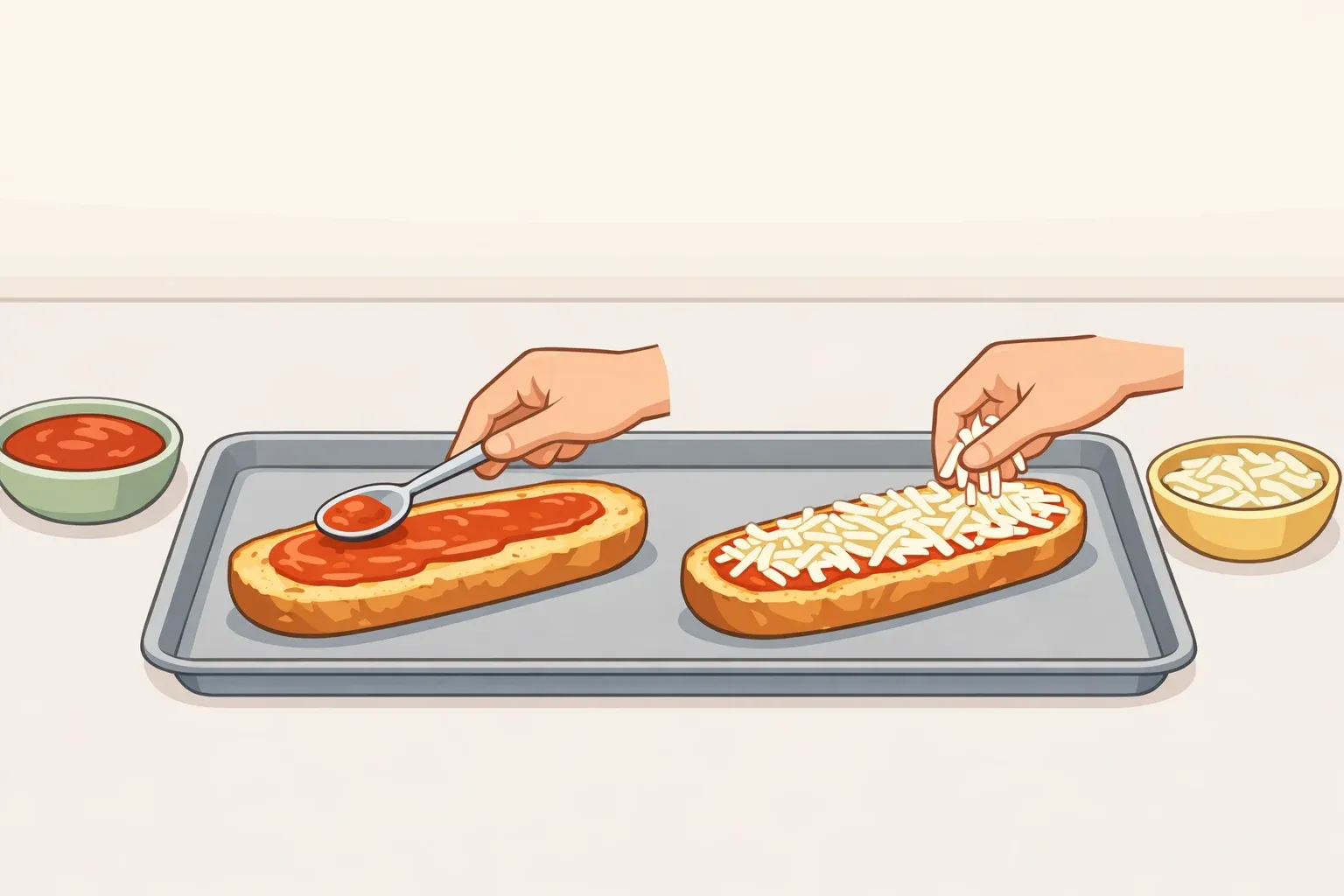
Apply the fat layer. Brush olive oil across the rounded exterior of each half, then coat the cut face with garlic butter: softened butter, garlic powder, and kosher salt stirred together. The olive oil helps the outside crisp; the garlic butter on the cut surface adds flavor and also helps the top side firm up during the pre-toast.
How to make French bread pizza without a soggy crust
This is the step that separates a crispy result from a limp one, and it's the most commonly skipped.
Bake the buttered bread alone at 400°F for 8–10 minutes, until the cut surface is firm and lightly golden at the edges. The goal is to dry the surface and build a barrier before sauce goes on.
Without it, the sauce liquid wicks down into the crumb and produces a spongy texture, especially with a soft loaf or a thinner marinara. If the loaf is particularly soft, extend the pre-toast by 2–3 minutes rather than skipping it.
Remove the loaves when the edges are lightly golden, and the surface holds firm to the touch. Not fully browned, just set. Once there, it's ready to build on.
French bread pizza toppings that won't make the crust soggy
Sauce: thin coverage, not depth. Spread about 2 tablespoons of thick pizza sauce per quarter-loaf section in an even layer. Once you go past a light coat, the risk of sogginess rises quickly, regardless of how carefully you pre-toasted. Using a thinner marinara? Apply it more sparingly still.
Cheese: ¼ cup mozzarella per section, plus Parmesan. Parmesan adds salt and a sharper finish that mozzarella alone doesn't provide. A three-cheese combination of mozzarella, Parmesan, and provolone adds more complexity if that's the direction.
Topping principles:
Keep it to a single layer. Piling toppings high traps steam under the cheese and undoes the work of the pre-toast. One layer, pressed lightly into the cheese so it adheres.
Pre-cook wet vegetables. Bell peppers, mushrooms, spinach, and onions all release water during baking. Sauté or roast them briefly first, or at minimum blot them dry before they go on.
Use cooked meats only. Pepperoni is cured and goes on fine. Sausage, bacon, and ground beef need to be cooked and drained first.
Budget option: The grocery store salad bar lets you pick small amounts of multiple toppings without buying full packages, pay by weight, and keep quantities modest. Leftover cooked proteins and roasted vegetables from earlier in the week work well here, too.
Sauce swaps: Pesto substituted for pizza sauce changes the flavor profile entirely and pairs well with fresh mozzarella added after baking. Barbecue sauce with cooked chicken is another straightforward variation.
One note on pepperoni: Microwave the slices on a paper towel for about 40 seconds before placing them on the pizza. It renders off some fat and produces a crispier result than going on raw.
Step 4: Bake, then broil
Return the topped pizza to the oven and bake at 400–425°F for 10–15 minutes. The cheese should be fully melted, and the bread edges visibly browned and firm.
Broil on high for 1–2 minutes at the end. This gives the cheese browned spots instead of a pale, melted surface. Watch it closely, one minute is often enough, and the window between golden and burnt is narrow.
Visual cues for doneness: cheese bubbling with scattered brown spots, bread edges firm and golden, the bottom of the loaf holds its shape when you lift a piece, rather than bending.
Let it rest 2–3 minutes before slicing. Cutting immediately causes toppings to slide and makes the cheese rubbery.
Troubleshooting common problems:
Still soggy despite pre-toasting: sauce quantity is likely too high, or the loaf was exceptionally soft. Reduce the sauce to about 1.5 tablespoons per section and extend the pre-toast by 2–3 minutes.
Cheese not browning: the oven may not have reached full temperature before the second bake, or the broiler wasn't given enough time. Confirm the oven temperature before loading.
Toppings sliding off: most common when the pizza is cut too soon, or the topping layer was too thick to adhere properly to the cheese.
Bottom soggy, top fine: try moving the pan to a lower rack, or set the pan on a rack inside the sheet pan to allow air circulation underneath.
How to freeze homemade French bread pizza for ready-to-bake meals
Homemade French bread pizza freezes well and bakes straight from frozen with no thawing required. Three standard loaves sliced crosswise into 1-inch rounds yield roughly 30 individual pieces a month of quick lunches or weeknight dinners from one prep session.
Assemble fully first. Complete the pre-toast, then apply sauce, cheese, and toppings. Do not bake. Press toppings lightly into the cheese so they stay put when frozen.
Freeze flat before packaging. Lay the assembled pieces on a baking sheet in a single layer and freeze until completely solid, at least an hour, sometimes longer, depending on piece size. Once solid, wrap each piece individually in plastic wrap or foil, then transfer to a freezer-safe bag. The two-step process prevents toppings from sticking to the bag and keeps pieces separate.
Baking from frozen. That's Nerdalicious bakes frozen pieces at 350°F for about 15 minutes. Ahead of Thyme suggests bumping the heat to 400–425°F to cut through the chill faster. Either approach works; add a few extra minutes either way and pull them when the cheese is melted and bubbly. Frozen pizzas keep for up to two months.
Reheating refrigerated leftovers: Baked pizza keeps in the fridge for two to three days. Reheat at 350°F for 5–10 minutes in the oven or air fryer; either method re-crisps the crust in a way the microwave will not.
Air fryer note. Ahead of Thyme lists air fryer French bread pizza as a supported reheating method. For cooking from fresh in an air fryer, the same assembled method applies; use the reheating guideline of 350°F for 5–10 minutes as a starting point and adjust based on your model.
What you end up with
The method works because every step applies the same idea: treat the bread like garlic bread first, then build pizza on top of it. Pre-toast, fat before sauce, thin sauce layer, hot oven, broil at the end. That sequence is what the recipe developers who tested this kept arriving at independently.
From there, the freezer batch is the same method scaled up. Three loaves, one session, 30 pieces ready when you need them. The rest are toppings.

Comments
Be the first, drop a comment!