



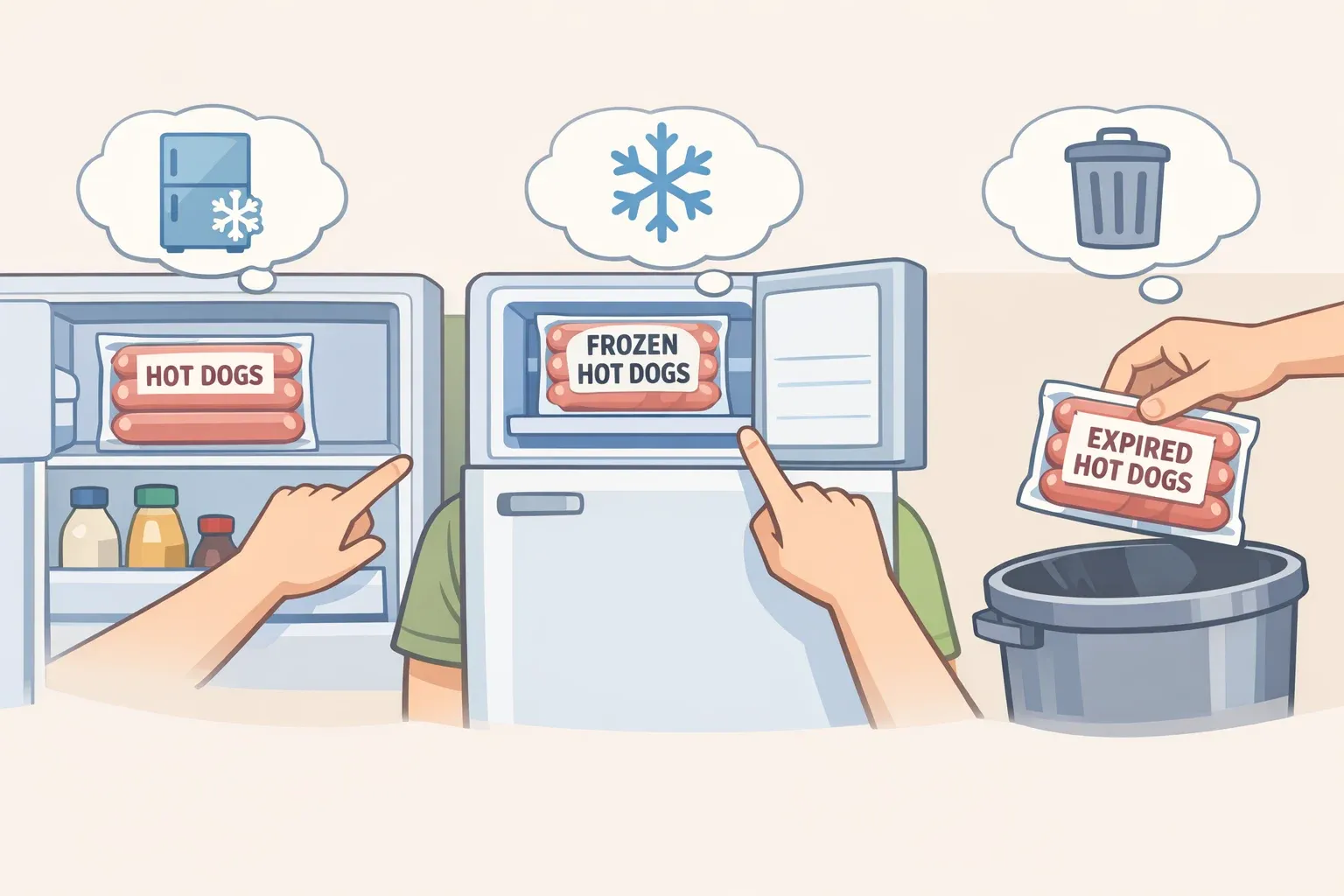
The best way to store hot dogs comes down to one question: will you eat them within the week? If yes, refrigerate. If not, freeze them now. If the window has already passed, discard. That's the governing logic, and almost every hot dog storage situation fits inside it.
An unopened pack stays safe in the refrigerator for up to two weeks; once you break the seal, that drops to one week. Cooked leftovers get three to four days. And regardless of which scenario you're in, no hot dog should sit at room temperature for more than two hours, or one hour when it's above 90°F outside.
The list below is the quick-answer version of this entire guide. If you're scanning for a specific situation, find your row and go from there. If you want to understand why the rules work the way they do, particularly how sell-by dates interact with storage windows and what "safe" actually means past the two-month freezer mark, keep reading.
What to do with your hot dogs right now
Unopened, in the fridge: Keep refrigerated. Use within 1 week of the sell-by date if dated, or within 2 weeks if undated.
How long: Up to 2 weeksOpened, in the fridge: Transfer to an airtight container or zip bag.
How long: Up to 1 weekPartially used pack: Refrigerate the rest and freeze any portion you won't eat within the week.
How long: Fridge portion: up to 1 week; frozen portion: 1–2 months for best qualityCooked leftovers: Refrigerate within 2 hours of cooking.
How long: 3–4 daysNot using in time: Freeze before the fridge window closes.
How long: 1–2 months for best qualityLeft out more than 2 hours: Discard.
How long: Do not save or refrigerate after this pointFrozen beyond 2 months: Food kept at 0°F remains safe, but quality declines over time.
How long: Eat soon or discard if the texture is poor
How to store hot dogs in the fridge: timelines and what the package date actually means
Step 1. Unopened packages: refrigerate immediately and check the date
Get hot dogs into the refrigerator as soon as you're home from the store, not after you've put everything else away. The factory seal is intact, so leave the original packaging alone.
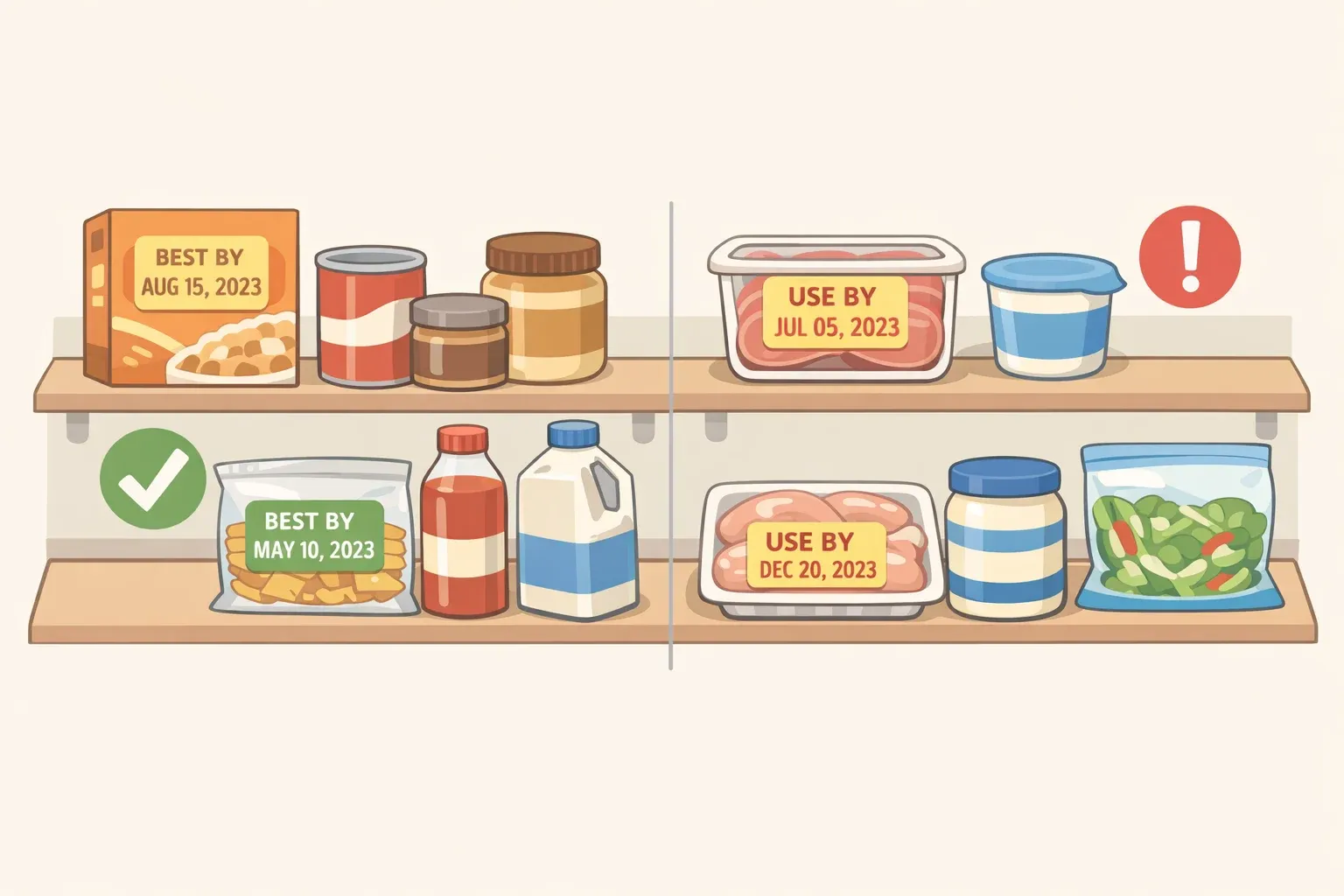
Without a package date, an unopened pack is safe in the refrigerator for up to two weeks. With a sell-by date, you can safely keep an unopened pack for one week after that date. The sell-by date marks when the store should pull the product for freshness purposes, not a hard safety cliff.
That said, "sell-by" and "use by" are not the same thing, and a hot dog a day past its sell-by date is not automatically unsafe. The ceiling that matters is the two-week maximum for undated packages, or one week past the sell-by date for dated ones. Whichever applies to your pack, don't push beyond it.
Step 2. Opened packages: transfer and use within one week
Once you open a pack, the original packaging won't reseal cleanly. Move the remaining hot dogs into a zip-seal bag or an airtight container. The safe fridge window after opening is consistently one week across multiple food safety sources. Good packaging won't extend that window, but it keeps the refrigerator from smelling like a deli counter.
If you froze some hot dogs from the same pack, the refrigerated portion still runs on the one-week clock. The frozen portion is its own category with its own timeline. Don't let freezing part of a pack give you a false sense of extra time for the rest.
Step 3. Cooked leftovers: chill fast, eat within four days
Cooked hot dogs need to go into the refrigerator within two hours of cooking, or within one hour if temperatures are above 90°F. Store them in a sealed container rather than loosely wrapped. Once refrigerated, they keep for three to four days. When reheating, go for steamy hot throughout, not just warm to the touch.
The two-hour rule applies in both directions: before eating and after. A pack sitting on the cookout table has been accumulating time in the danger zone from the moment it left the refrigerator. That time counts toward the two-hour limit whether the hot dogs were raw or already cooked.
Can you freeze hot dogs? Yes, here's how to do it right
Step 1. Freeze early, not at the last minute
The decision to freeze should happen well before the fridge window closes. Ideally, if you know you won't get through the whole pack within a week, freeze part of it the day you buy it. Waiting until day six of a seven-day window works technically, but for the best quality, freeze early.
One rule with no flexibility: any pack that sat at room temperature for more than two hours goes in the trash, not the freezer. Freezing doesn't reverse time spent in the danger zone.
Step 2. Package for the freezer
For the best quality, overwrap the original package or move the hot dogs to a freezer bag with as much air pressed out as possible before sealing. Label the bag with the date. You're not tracking safety with that label; you're tracking quality, which is a different thing entirely.
For partially used packs, freeze the remaining hot dogs as a single bundle or individually, depending on how you plan to use them. Individually wrapped hot dogs let you pull one or two without thawing the rest.
Step 3. Understand the quality window versus the safety window
At a steady 0°F, frozen hot dogs remain safe from a bacterial standpoint indefinitely. The one-to-two-month recommendation is about flavor and texture, not safety. Beyond that window, hot dogs tend to get drier and lose their snap.
A hot dog frozen for three months and held at a steady 0°F is still safe. It may just taste worse. That's a quality call, not a safety one.
Thawing and spoilage: the final steps in the chain
Thawing: three options, one firm rule
Counter thawing is not safe, even if the packaging is intact. Leaving frozen hot dogs on the counter allows the exterior to enter the bacterial danger zone before the center thaws. Three options that are safe:
Refrigerator: Move the package to the fridge the night before. It thaws in roughly 24 hours and stays below 40°F throughout, making this the easiest, lowest-risk method.
Cold water: Submerge the sealed package in cold tap water, changing the water every 30 minutes. Takes one to two hours. Cook immediately after.
Microwave: Use the defrost setting and cook immediately after. The microwave heats unevenly, so there's no safe holding period once you've started.
There's also a fourth path: skip thawing entirely. Hot dogs can go straight from frozen to the grill, boiling water, or a pan, with roughly 50% more cook time than usual. Check for even heating rather than relying on a timer.
Spoilage: signs matter, but timelines matter more
Hot dogs can become unsafe before visible spoilage appears. A pack that looks and smells fine but has been open for nine days should be discarded. Appearance is not a reliable safety test.
Some spoilage signs are definitive, though. Discard immediately if you notice a sour or sulfur-like smell, a slick or slimy surface, dull gray or brown color paired with any off-odor, visible mold, or a package that's bloated or hisses when opened. Don't taste-test when there's any doubt.
Power outages are a specific case worth knowing. A closed refrigerator holds safe temperatures for up to four hours; if yours climbed above 40°F for longer than that, discard opened packs and cooked leftovers. A full freezer holds safe temperatures for roughly 24 to 48 hours if it stays closed.
Anything still containing ice crystals or cold throughout can be refrozen; anything that warmed fully belongs in the trash. For power-outage situations, your state's cooperative extension service or the FDA's food safety resources are more authoritative than any single article.
What to do right now
Pull out whatever pack is currently in your fridge. Opened? Count the days since you broke the seal. Past the one-week mark? It goes. Inside the window, but not planning to use it soon? Move it to the freezer today, not tomorrow. Still sealed? Check the sell-by date. If you're within one week of that date and plan to eat them, you're fine. If not, freeze now.
That's the whole framework. The timelines are consistent across food safety guidance. The only variable is which scenario applies to your pack right now.


Comments
Be the first, drop a comment!