



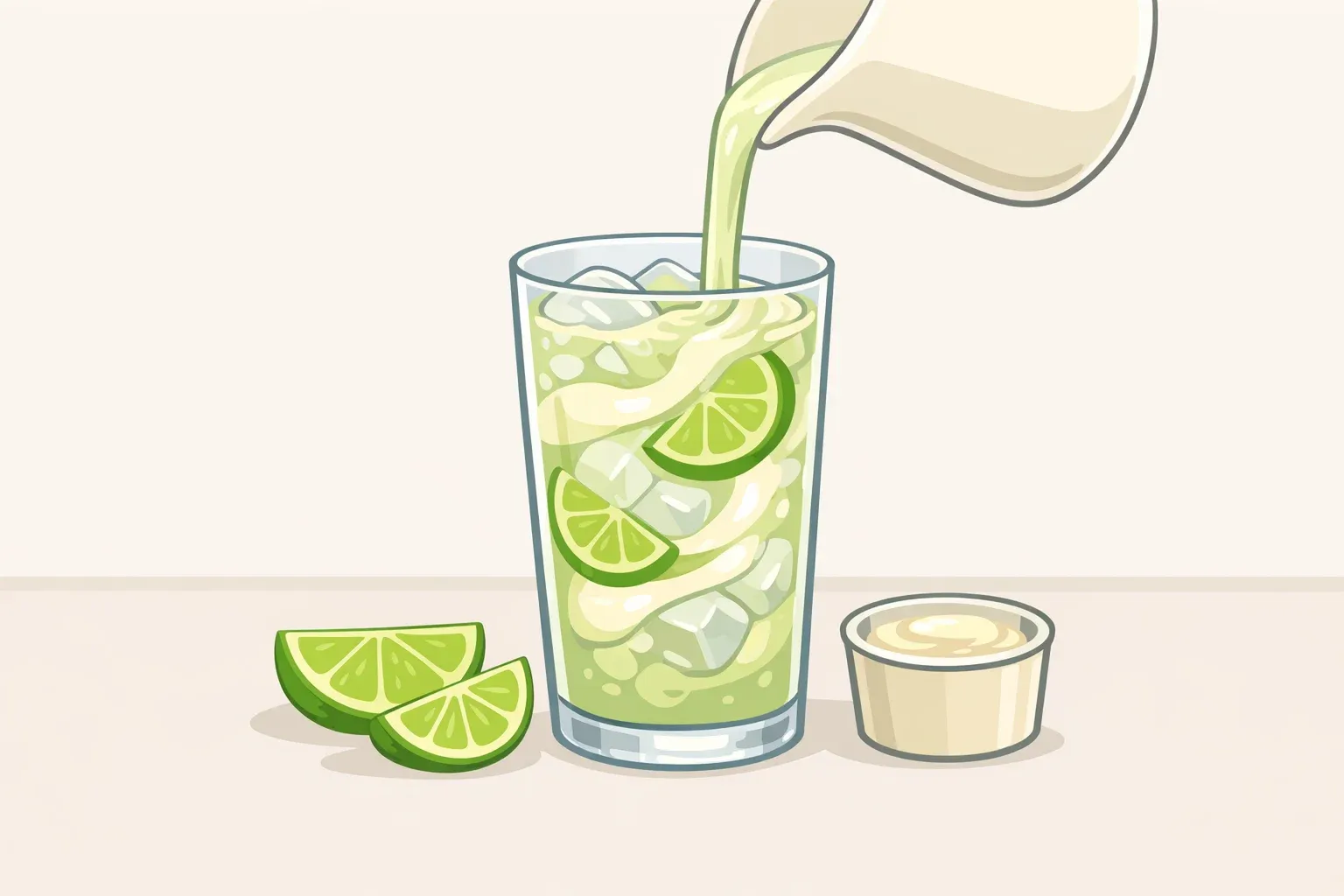
This Brazilian lemonade recipe uses limes, not lemons, and that's the least interesting thing about it. The name is partly a translation quirk, according to Budget Bytes: Brazilian lemonade is usually lime-based because limão commonly refers to lime in this context, while limonada is often translated into English as lemonade.
What makes this drink genuinely worth making is sweetened condensed milk. The specific version many US readers encounter is limonada suíça, or Swiss lemonade, and many popular versions include sweetened condensed milk; simpler limonada versions may use sugar instead. That one ingredient transforms a tart citrus drink into something frothy and creamy. Because it is thick and heavily sweetened, it blends into the lime drink more smoothly than plain milk would.
This guide walks through the classic whole-lime version: three main ingredients, six servings, ten minutes, and under $4, per Budget Bytes. There's also a zest-and-juice alternative for when consistency matters more than simplicity.
Ingredients and how to choose limes
Budget Bytes' recipe calls for four medium limes, four cups of cold water, and one 14-oz. can of sweetened condensed milk, which works out to roughly $3.46 for six one-cup servings. That is the full ingredient list.
Sweetened condensed milk earns its place here. It's made by combining whole milk with sugar and removing about 60% of the water, yielding a thick, shelf-stable product that blends smoothly with citrus, as A Pinch of Salt Lake describes. It also softens tartness, which is why the drink stays balanced even at a high lime concentration. Do not substitute evaporated milk; the flavor and thickness are completely different and the drink won't work.
Use whole fresh limes, not bottled juice. A Pinch of Salt Lake notes that bottled juice can't replicate the vivid flavor notes of fresh fruit. For the classic method, reach for Persian limes, the standard grocery store variety. They're lower in acidity, nearly seedless, and easy to quarter. Each yields 1–3 tablespoons of juice; one pound (6–8 limes) produces about ½–⅔ cup.
Lime selection: Look for smooth, deep-green skin, heavy weight for the size, and a slight give when squeezed. Rock-hard fruit is under-ripe and low on juice. Squishy fruit is past it. Avoid both.
If you use Key limes: They're smaller, more acidic, and seedier than Persian limes. One pound of Key limes (12–16 fruits) produces the same ½–⅔ cup of juice as a pound of Persians, but you'll squeeze twice as many. Stick with Persian limes unless Key limes are all you have.
How to make Brazilian lemonade
The default is Method A. Whole limes, blender, done. Budget Bytes favors it for its simplicity and bold citrus flavor when blended correctly. The only variable that matters is blend time: 15 seconds on high, then stop. The white pith between the zest and flesh can make the drink bitter the longer it spins, so speed is the technique.
Use Method B instead if you've made this before and had bitterness problems, or you want a process with no timing pressure. It uses lime zest and fresh-squeezed juice rather than whole quartered limes, so pith never enters the blender. More prep, but A Pinch of Salt Lake describes the result as a frothy, tart drink that's easy to adjust to taste. The ingredient set is different too: more limes, added sugar, a partial can of condensed milk.
You'll need for either method: A blender, a fine-mesh strainer, a pitcher, and ice.
Method A: classic whole-lime Brazilian lemonade
Ingredients: 4 medium Persian limes (washed and quartered, ~250g), 4 cups cold water, one 14-oz. can sweetened condensed milk (Budget Bytes).
Wash the limes thoroughly under running water, then quarter them. Leave the peel on; that's where much of the aroma comes from.
Add the lime quarters, water, and the full can of sweetened condensed milk to the blender.
Blend on high for exactly 15 seconds, then stop. You should see a pale, frothy liquid, not green, not clear.
Strain immediately through a fine-mesh strainer into a pitcher. Tap the strainer to help the liquid pass through, then discard the solids.
Pour over ice and serve right away. The foam on top is characteristic of the drink; resist the urge to stir it off.
⚠ If it tastes bitter: The pith over-extracted. A small amount of additional condensed milk may soften it slightly, but bitterness from over-blending whole limes is difficult to reverse once it's in the drink. Next time, stop the blender sooner, or switch to Method B.
Method B: Less-bitter zest-and-juice method
Ingredients: 8–10 large Persian limes (1–1¼ lbs.), zested to yield ⅓ cup zest and juiced to yield 1 cup fresh juice; 1 cup ice; ¾ cup sugar; 3 cups cold water; ⅔ cup sweetened condensed milk (A Pinch of Salt Lake).
Note: This method uses a little more than half of the liquid volume in a standard 14-oz. can of sweetened condensed milk. According to Eagle Brand's FAQ, a 14-oz. can yields about 10 liquid ounces, and leftovers should be transferred to an airtight container and refrigerated for 3–4 days. Since ⅔ cup is about 5.3 fluid ounces, this method will leave you with a little less than half a can.
Zest 8 of the limes with a microplane until you have ⅓ cup of zest. Set aside.
Halve the zested limes and squeeze until you have 1 cup of juice. Strain out any seeds.
Add the lime juice, zest, ice, and sugar to the blender. Pulse several times to combine.
Add the water and condensed milk, then blend on high until frothy.
Taste. The condensed milk already softens tartness; squeeze in another lime if you want it sharper. The baseline ratio is 1 part juice to 2.5–3 parts water, and because the condensed milk adds sweetness, you can safely push the water higher without the drink going flat.
Serve over ice immediately with a thin lime slice as garnish.
Serving, storage, and variations
Serve immediately. Budget Bytes is consistent on this: the drink takes only minutes to prepare and should go straight into a glass. This is not a pitcher-in-the-fridge situation.
Leftovers will keep in a sealed container in the refrigerator for one to two days, but the flavor and texture won't be quite the same. If you're serving a crowd, blend in batches and serve each as it comes out of the blender.
Berry variation: Muddle about two tablespoons of chopped strawberries or raspberries per serving directly in the glass, then pour the limeade over the crushed fruit. The condensed milk is sweet enough that nothing else needs adjusting. That said, muddled fruit does raise the overall sugar level, so lean toward a slightly more tart base if you know you're going that route.
Which method should you use?
Choose based on whether you care more about speed or consistency.
Method A is the right call when you want maximum citrus punch and you're comfortable stopping the blender at exactly 15 seconds. Faster, uses fewer limes, done in ten minutes. Method B is the right call when consistent results matter more than speed. Because most of the pith stays out of the blender, Method B greatly reduces the bitterness risk, and the ratio is straightforward to adjust on the fly.
Bold flavor with a strict clock, or reliable results with more prep. Pick one and make the drink.





Comments
Be the first, drop a comment!