



Cottage Cheese Pancakes: The One-Ingredient Batter Upgrade That Makes Them Noticeably More Tender
Blending cottage cheese into pancake batter sounds like the kind of tip you try once out of curiosity and then abandon. It isn't. It produces a pancake that's noticeably more tender, holds together better, and doesn't taste cheesy at all because blending eliminates the curds entirely.
A New York Times Cooking recipe published this week puts it plainly: a blender processes the cottage cheese curds smooth, so they contribute tenderness and protein to the finished pancake without any detectable dairy flavor. That's the whole case for this upgrade. These are protein pancakes with cottage cheese doing structural work, not flavoring the batter.
The broader chef pattern supports the logic. Food & Wine reported last August that multiple award-winning chefs reach for thick cultured dairy ricotta, sour cream, buttermilk in combination to achieve a soft, pillowy interior that plain milk-and-butter batters can't replicate. Cottage cheese follows the same principle; it's just less expected.
This guide covers why cottage cheese in pancake batter works structurally, who should try it, the steps that matter most, and the failure points worth knowing before you start. It does not attempt to replace a full recipe. For quantities, use the NYT Cooking source linked above.
Why cottage cheese works: what this ingredient does that plain milk cannot
The core problem with standard pancake batter is that plain milk contributes liquid but not much else. Cultured dairy products add two things milk can't: acidity and viscosity. Buttermilk's acidity (pH 4–5) reacts with baking soda to produce the carbon dioxide lift that creates a fluffy interior, while its thickness keeps batter from spreading too thin on contact with the griddle, per Dickinson College's Chemistry in the Kitchen series. Plain milk acidified with lemon juice or vinegar restores the acidity but loses the thickness. That's why, the same source explains, a sour cream-plus-milk combination outperforms a milk-plus-acid shortcut: it keeps the acidity without sacrificing body.
Blended cottage cheese operates on the same logic. Once the curds are processed smooth, the mixture is thick and mildly acidic consistent with how cultured dairy behaves in batter, though this is reasoned inference rather than a lab-tested comparison. The mechanism is the same one chefs exploit when they reach for ricotta or sour cream. Using cottage cheese in pancake batter isn't a departure from that approach; it's a less obvious version of it.
Baking powder adds a second wave of lift regardless of which dairy you use. It reacts once when mixed with liquid and again when heated, according to the Dickinson chemistry source. The bubbles breaking across the surface during cooking are that second reaction which is why that visual cue is a reliable indicator that the batter is ready to flip.
One honest caveat: if your goal is an ultra-light, airy diner-style pancake with minimal chew, this probably isn't the method. This batter is richer and slightly denser. That's a feature, not a flaw, but it is a different pancake. The payoff is tenderness and staying power, not maximum loft.
How to make cottage cheese pancakes: what to expect before you start
Before committing to the blender, know what you're signing up for.
Choose this method if you want a more substantial pancake with better texture and more protein, you're comfortable using a blender, and you can accept a batter that spreads more on the griddle than a standard recipe. The NYT Cooking recipe specifically flags the spread leave at least 2 inches between portions.
Stick with a classic batter if you want the fastest possible weekend pancakes, you don't have a blender, or you're after a very light, almost soufflé-like texture. This blended cottage cheese pancake recipe adds a blending step and a rest period that a basic batter doesn't require.
Prerequisites: A blender (standard or immersion), a nonstick skillet or griddle, and cottage cheese. The NYT recipe calls for full-fat; low-fat will work but may produce a less rich result, since fat content contributes to the texture.
What the batter should look like: After blending the wet ingredients, the mixture should be smooth and pourable slightly thicker than regular pancake batter, with only a few very small curds visible at most. If it still looks chunky, keep blending. Once flour is added, the batter will thicken further. That's normal and correct.
The steps that determine whether this works
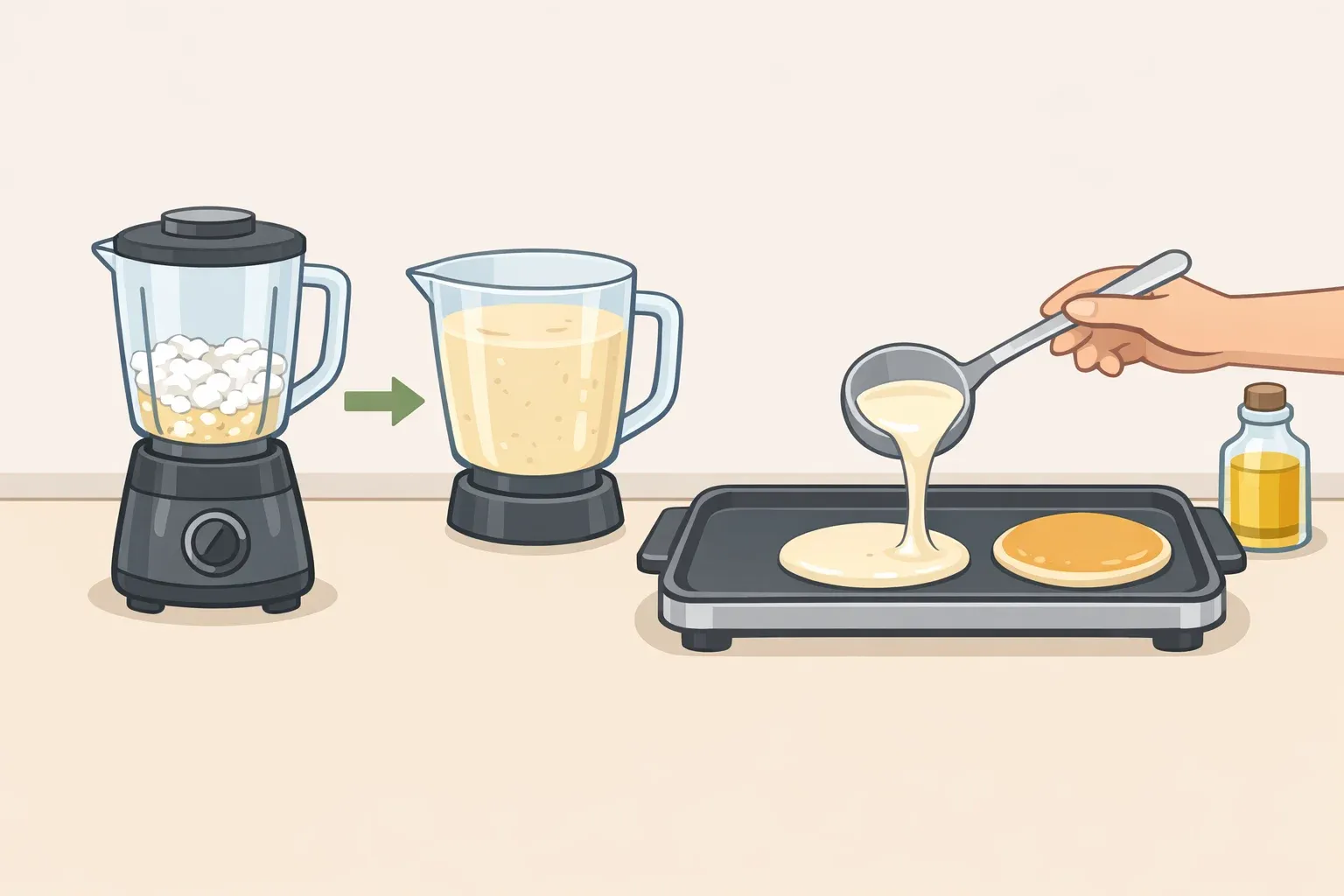
Step 1: Blend the wet ingredients including the cottage cheese until smooth
Combine cottage cheese, eggs, milk, sugar, and vanilla in a blender. Process until mostly smooth; a few small remaining curds are acceptable. Per the NYT Cooking recipe, both a standard blender and an immersion blender work.
This step is not optional. Stirring cottage cheese in by hand leaves visible curds in the finished pancake, which affects both texture and the "doesn't taste cheesy" outcome this method promises.
Step 2: Add dry ingredients and stop mixing before the batter looks smooth
Fold flour and leavening into the blended wet mixture. Mix only until the dry ingredients are barely incorporated. Lumps are fine stir slowly, and stop well before the batter looks uniform. Not overmixing was the single most consistent piece of advice from the award-winning chefs surveyed by Food & Wine last August. Aggressive mixing develops gluten and produces a tough, rubbery result.
Gotcha: The blending step applies to wet ingredients only. Once flour enters the bowl, treat it like standard pancake batter. The two stages require completely opposite handling, which catches people off guard the first time.
Step 3: Rest the batter for at least 10 minutes
Set the batter aside before cooking. During this window, flour absorbs the liquid and releases starches and proteins that contribute lift, per Dickinson's chemistry analysis. Chef Sue Zemanick recommends a minimum 10-minute rest, according to Food & Wine.
Resting the batter in the fridge is worth considering if spread is a concern. Bon Appétit notes that a chilled batter hydrates and cools, with the fat firming up enough to help it hold its shape when it hits the hot griddle.
Step 4: Heat the pan to the right temperature before any batter goes in
A properly hot surface is what creates even golden browning. Food & Wine recommends flicking a few drops of water onto the surface if they sizzle and skitter immediately, it's ready. For fat: coat the hot pan with a thin film of neutral oil, then wipe off the excess with a towel. This leaves just enough residue to release the pancakes cleanly, and the browning will be noticeably more even than a pan with fat pooling at different depths across the surface.
Step 5: Cook until bubbles break and edges look set, then flip once
Drop batter in ¼-cup portions spaced at least 2 inches apart. These pancakes spread more than standard batter before they set, per the NYT Cooking recipe. An ice cream scoop speeds up portioning and keeps sizes consistent.
Cook 2–3 minutes on the first side until bubbles break across the surface and the edges appear matte and set. Flip once and cook another 2–3 minutes. If the exterior is browning before the interior is cooked through, reduce heat. Don't rush the flip.
Troubleshooting, variations, and storage
Common problems:
Curds still visible in the finished pancake: The wet ingredients weren't blended long enough. Next time, blend until the mixture looks uniformly smooth before adding any flour.
Pancakes browning too fast on the outside: Heat is too high. Reduce it and extend the cook time. Per the NYT Cooking recipe, the fix is lower heat, not a faster flip.
Batter too thick to pour easily: Add a small splash of milk to loosen it. The batter should be pourable but noticeably thicker than a standard recipe. If it won't move off the spoon at all, it needs thinning.
Pancakes tough instead of tender: Overmixing after the flour was added. The damage can't be undone in the pan, but the fix for next time is to fold minimally and stop well before the batter looks smooth.
Variations that work: The NYT Cooking recipe treats this as a reliable base for mix-ins blueberries and chocolate chips both work. Fold them in after the flour is incorporated, not during blending. A splash of lemon juice is a worthwhile addition; Food & Wine attributes this to the acidity helping activate leavening and adding mild tang. Lemon zest does something different it adds aromatic brightness without touching the chemistry, per Bon Appétit. Both are worth trying. Just don't conflate them.
Storage: Leftovers keep in an airtight container for up to 3 days and reheat in roughly 30 seconds in the microwave, per the NYT Cooking source.
When this upgrade is worth it
Fluffy cottage cheese pancakes made this way earn the extra effort when texture is the priority. The trade-off is real: you need a blender, a rest period, and a little more attention to spread on the griddle. What you get in return is a pancake that's noticeably more tender and satisfying than a basic milk-and-butter batter produces.
The first time, keep it simple. Blend the wet ingredients until smooth, fold in flour until just incorporated, rest 10 minutes, and cook on a properly preheated surface with a wiped-thin film of oil. Get that sequence right before experimenting with mix-ins or variations. The technique is what makes this work the cottage cheese just sets it up.




Comments
Be the first, drop a comment!