



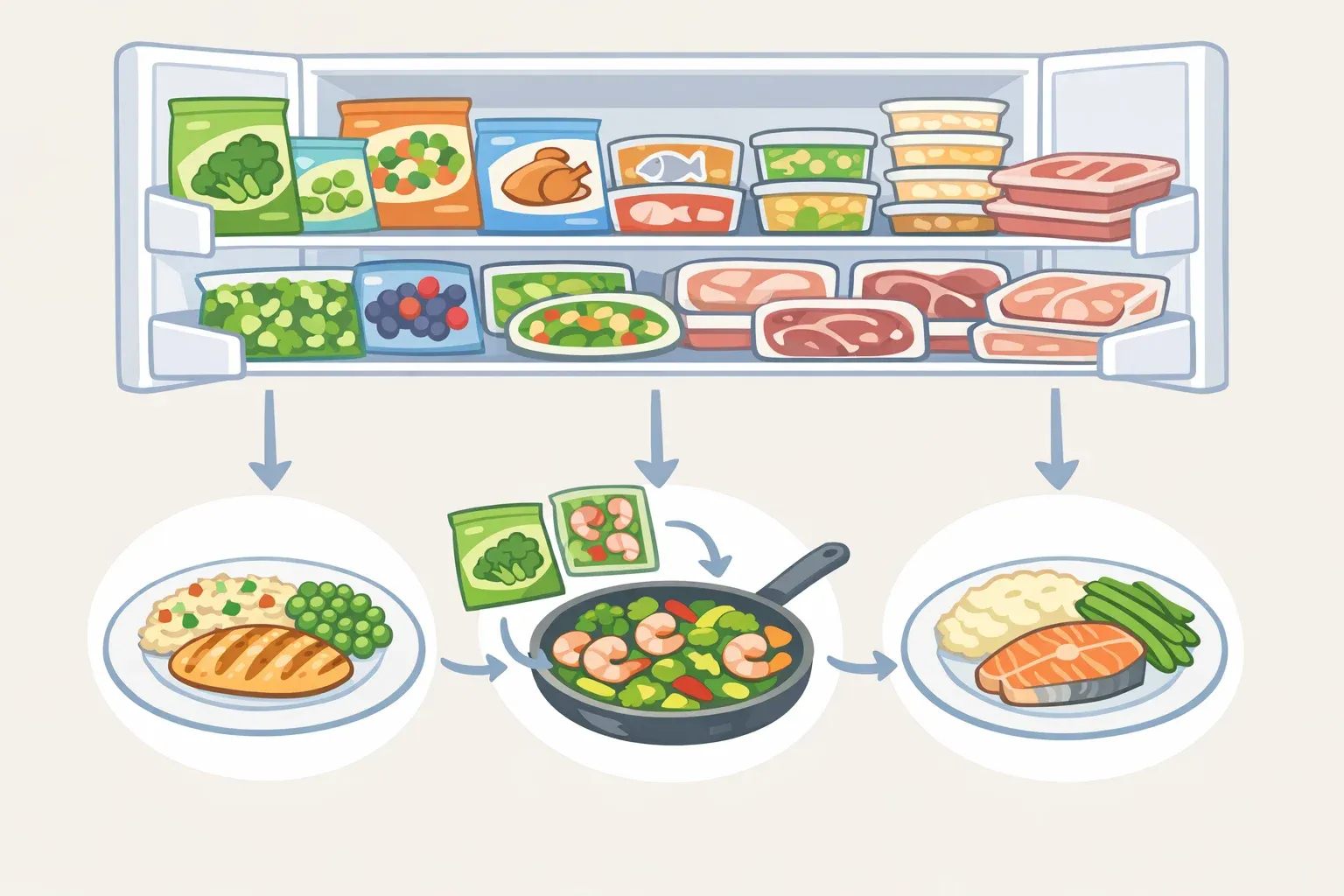
This guide walks through how to turn your freezer into a working meal-building system, stocking the right basics, choosing prepared frozen meals that hold up to scrutiny, and assembling balanced dinners faster and often cheaper than defaulting to fresh every time. These healthy frozen food hacks work whether you're cooking for one or feeding a family on a weeknight with nothing thawed.
Most people treat the freezer as a holding tank for emergency pizzas. That undersells it considerably. Fruits and vegetables are picked at peak ripeness and often frozen within hours, locking in nutrients before they can degrade in transit or on a store shelf, according to the Academy of Nutrition and Dietetics.
Registered dietitian Sofia Whitefields of the University of Utah Health puts it plainly: "From a nutrient standpoint, they are in some ways superior." Produce picked at peak ripeness and frozen immediately doesn't face the same degradation as something that traveled on a truck and spent days in a refrigerator case.
A controlled UC Davis study confirmed the point. Culinary Medicine's summary of the J. Agric. Food Chem. findings show that frozen corn, green beans, and blueberries had measurably higher vitamin C than their refrigerator-stored counterparts, and frozen peas, spinach, and corn contained nearly twice the vitamin E of fresh samples. The Academy of Nutrition and Dietetics notes that families who regularly incorporate frozen foods into their routine may have better overall diet quality, partly because frozen items are often more affordable and help reduce food waste.
Step 1: Stock a freezer that actually cooks for you
The first move isn't buying more frozen dinners. It's stocking a short list of plain, versatile ingredients that assemble into a meal in under 15 minutes. A frozen pantry, not a supply of last resorts.
The assembly framework: one frozen vegetable + one protein + one grain or starch + one flavor booster (sauce, spice blend, citrus, olive oil). That combination covers the plate without requiring a recipe.
Frozen produce grab-and-go
Frozen vegetables and grains are among the fastest ways to add fiber and nutrients to any meal, and most cook directly from frozen with no thawing required. Peas, edamame, spinach, broccoli, corn, and stir-fry mixes all work straight into a hot pan.
Plain frozen vegetables with no added sauces, seasonings, or syrups retain their vitamins and minerals without contributing sodium, saturated fat, or sugar. Check the ingredients list: it should read only the vegetable itself.
Kept continuously at 0°F, frozen foods remain safe indefinitely, far outlasting fresh produce, which spoils within days. For small households or anyone who routinely wastes fresh greens, this is the practical case for frozen fruits and vegetables nutrition: they're available when you need them, not when the produce drawer decides.
Cook-from-frozen proteins (no planning required)
Frozen shrimp cooks directly from frozen in a hot pan, no thawing, no planning. Some keep a bag in their freezer specifically for this. Pre-cooked frozen proteins, such as chicken sausage, meatless meatballs, and lentil-based pasta heat from frozen in minutes and add substantial protein without advance preparation. These are the workhorses of a functional freezer.
Proteins that need a plan (raw meat and poultry)
Frozen fish, meat, and poultry are cost-effective staples, but raw cuts require safe thawing before cooking: in the refrigerator overnight, in a sealed bag submerged in cold water changed every 30 minutes, or in the microwave followed by immediate cooking. Never thaw on the counter. Bacteria multiply rapidly between 40°F and 140°F, and counter-thawing keeps food in that range far too long.
Reserve raw cuts for planned meals. For everything else, shrimp and pre-cooked proteins are the faster system.
Watch for quality loss over time
Frozen foods held at 0°F won't become unsafe with time, but texture and flavor do degrade. "Safe indefinitely" and "at peak quality" are not the same thing. Use raw proteins within a few months for best results and rotate stock so nothing gets buried in the back.
Step 2: Choose better prepared frozen meals, then improve them
Frozen entrées are a legitimate shortcut, but the aisle contains enormous variation. Some are well-balanced; others exceed 1,000 mg of sodium per serving. The nutrition label is the filter. Read it before buying, not after.
What to look for on the label
Check serving count first. Some frozen dinners list two servings per package. Eat the whole box and every number on the label doubles calories, sodium, saturated fat, all of it. This is the most common way people miscalculate what they're actually eating.
Sodium is the biggest variable. Many prepared frozen meals exceed 1,000 mg per serving. Aim for 400–600 mg as the target range, with 600 mg as the practical ceiling.
Calories: aim for 350–500. Meals under 200 calories barely constitute a snack and won't provide the energy and nutrients needed for a full meal; meals over 800 calories are more than most people need at one sitting. UF/IFAS suggests 250–400 calories for lighter meals. Treat the combined range as a flexible guide.
Fiber: look for 3 grams or more. For other nutrients, the %DV column offers a quick read: 5% DV or less is low, 20% DV or more is high. For saturated fat and sodium, low is what you want. For fiber, push toward the high end.
Check the ingredient list for balance. Well-formulated frozen meals include a vegetable or fruit, a lean protein source, and a whole grain or starch in the same proportions as a well-assembled plate from scratch. Shorter ingredient lists with recognizable items are a reliable quality signal. The Academy of Nutrition and Dietetics recommends avoiding meals with added sauces, which often front-load sodium and calories.
Watch the sugar line. Total sugars don't carry a %DV on the nutrition label, so the percentage column won't flag a high-sugar meal. Scan the ingredient list directly, particularly for sauce-heavy entrées and breakfast items. The American Heart Association recommends keeping added sugars under about 6% of daily calories.
Skip the front of the package entirely
"Organic," "non-GMO," and "gluten-free" labels say nothing about sodium, saturated fat, or calorie count. Go straight to the nutrition panel. The front is marketing; the back is information.
Now improve what you've chosen
A frozen meal that clears the label thresholds above is a solid starting point. Most still benefit from one addition.
If the meal is under 350 calories: it's probably too light. Low-calorie frozen meals can leave people hungry again within an hour, Whitefields notes. Add a bag of steamed frozen vegetables or a can of white beans, cheap, fast, and more filling.
If the meal is calorie-dense but light on vegetables (frozen pizza, pasta): add frozen or fresh vegetables and canned beans to increase fiber and stretch the meal without dramatically raising calories.
If the meal has protein but no whole grain: pair it with microwaved frozen brown rice or a frozen grain blend. Frozen grain and vegetable bowls already tend to come in under 400 calories with around 20 grams of protein; they need only a small protein addition to round out.
Step 3: Turn your freezer staples into easy healthy meals with frozen food
Knowing what to stock is half of it. The other half is having a few repeatable patterns so you're not staring into the freezer at 6:30 pm trying to invent dinner from scratch.
Three scenarios that cover most weeknights:
The 10-minute bowl (no plan required)
This is the shrimp-and-vegetables situation. Pull frozen shrimp and a stir-fry vegetable mix from the freezer, start both in a hot pan, microwave a bag of frozen brown rice, add whatever sauce or spice is on hand. Nothing needs to be thawed in advance. It works because shrimp and pre-cooked proteins are specifically suited to unplanned cooking they don't require the forethought that raw meat does.
The high-protein lunch
Frozen lentil-based pasta heated from frozen, a handful of frozen spinach stirred in at the end, a drizzle of olive oil, and a squeeze of lemon. Lentil flour pasta delivers both fiber and protein in one ingredient, which means this meal is already reasonably balanced without adding anything else. Takes about 10 minutes.
The backup dinner (when the freezer is the whole plan)
A frozen grain-and-veggie bowl forms the base. Most come in under 400 calories with around 20 grams of protein, but they can leave a fiber gap. Drain and rinse a can of chickpeas, add them cold or briefly heated, and finish with hot sauce. The chickpeas close that gap and add enough bulk to make the meal satisfying without requiring anything fresh or thawed.
Three combinations to start with:
Frozen grain-and-veggie bowl + canned chickpeas + hot sauce
Frozen shrimp + frozen stir-fry vegetables + frozen brown rice
Frozen lentil pasta + frozen spinach + olive oil + lemon
Each of these healthy frozen meal ideas uses the assembly framework from Step 1, and each works with whatever's already in the freezer.
What changes when the freezer becomes part of weekly planning
Once the freezer is stocked as a system rather than a storage space, the decision calculus shifts. Fresh produce is still worth buying for salads, for roasting, for anything where texture matters. But it stops being the default assumption for every meal, which is where the waste tends to accumulate.
Plain frozen vegetables require no label scrutiny and form the most flexible base for how to use frozen foods for easy meals. For prepared entrées, check servings per container, aim for 400–600 mg sodium and at least 3 grams of fiber, and look for a meal that already includes protein, vegetables, and a whole grain. Add frozen vegetables or canned beans to whatever falls short.
The result is often cheaper and less wasteful than frequent fresh-produce shopping, and contrary to the freezer aisle's reputation, nutritionally sound.
Next step: On the next grocery run, apply the label criteria to one prepared frozen meal before buying it. Check serving count first, then sodium. If both clear the thresholds, add it to the rotation and pair it with whatever frozen vegetable is already in the freezer.


Comments
Be the first, drop a comment!