



Healthy Frozen Food Hacks for Busy Nights: A 3-Step System
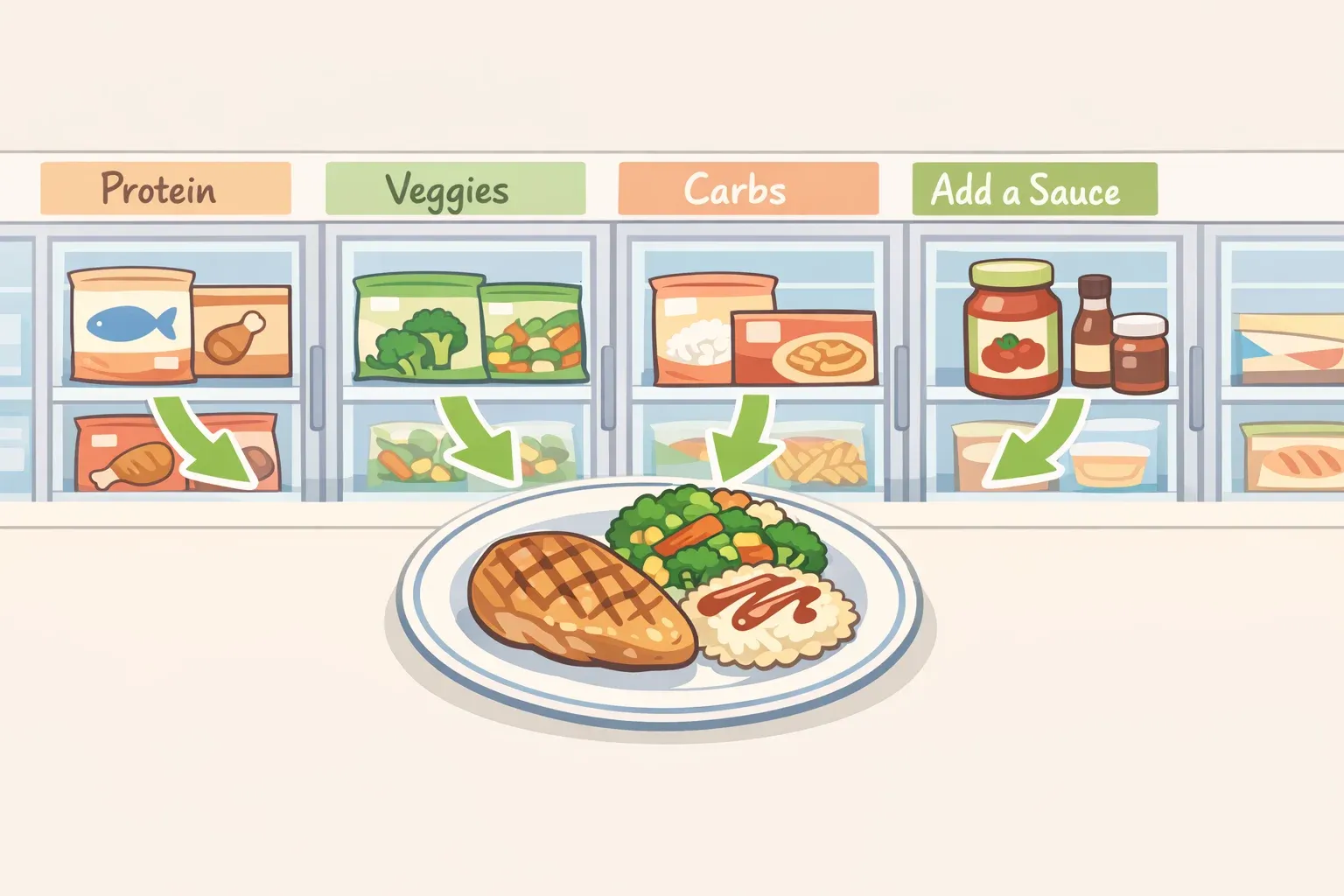
A healthy freezer dinner doesn't require a miracle entrée. It requires a system: stock the right components, run a quick label screen when you do buy a prepared meal, and patch whatever the meal is missing before you sit down. By the end of this guide, you'll have all three steps in hand and a repeatable formula for building a balanced dinner from the freezer aisle in under 15 minutes.
Start with the foundational fact that makes the whole system work: freezing helps preserve food quality and nutrients. Fruits and vegetables are typically harvested at peak ripeness and flash-frozen, locking in vitamins that can degrade over days of shipping and shelf time in fresh supply chains. Some frozen produce is nutritionally comparable to, or better than, its fresh equivalent by the time it reaches your kitchen (University of Utah Health and NCHPAD). For nutritional quality specifically, what matters most is what goes into the package and how it was processed before freezing (Charitable Smiles).
That distinction points to a better question than "is frozen food healthy?" The better question is: what kind, and how are you using it?
Prerequisites: No cooking skills beyond a microwave and a stovetop pan. A willingness to flip the box and read the label before it goes in the cart.
Step 1: Stock the freezer with components, not just convenient entrées
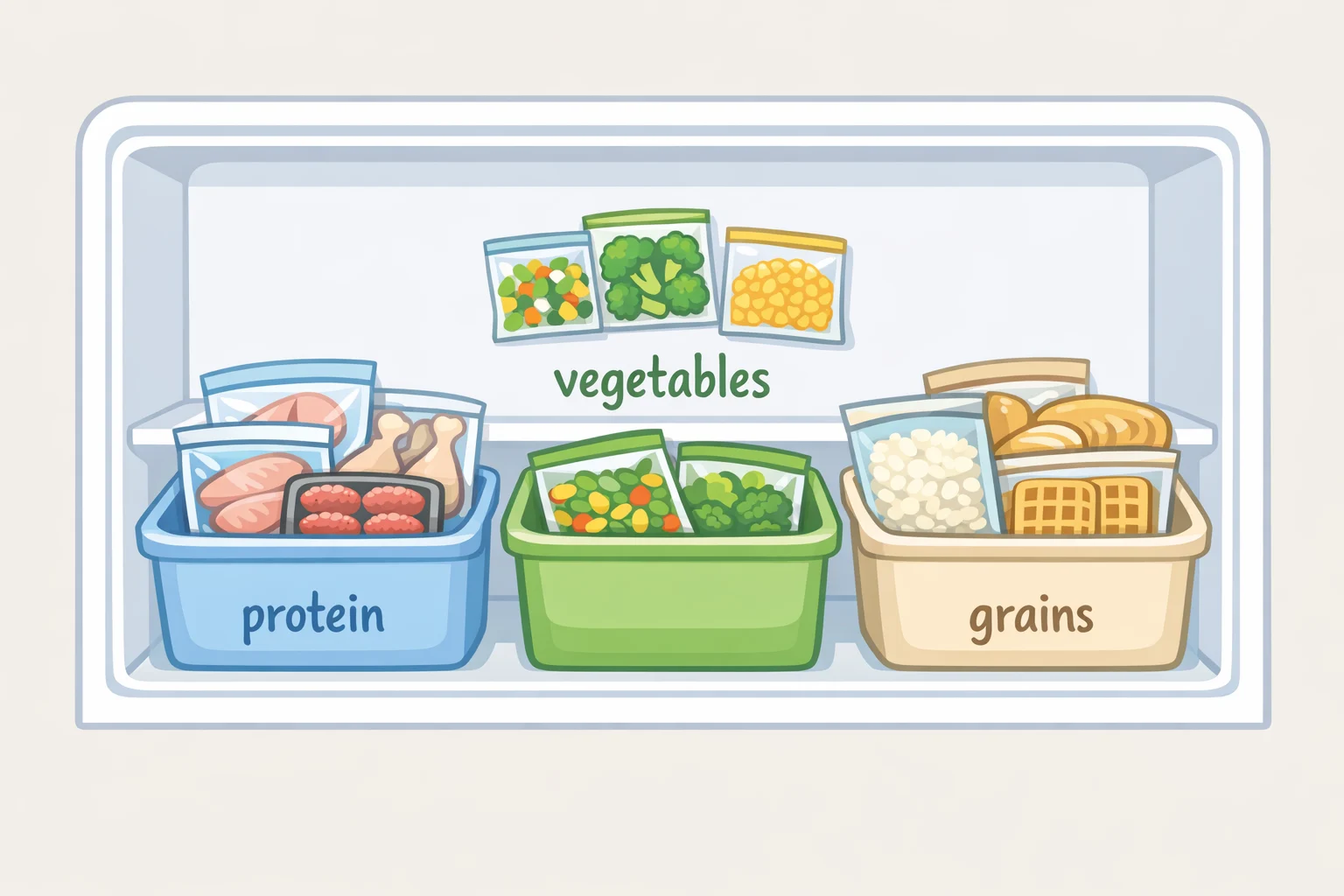
The fastest path to healthy frozen meals for busy weeknights is not a single prepared meal. It's three modular components: a protein, a vegetable, and a grain. Combined, they form a complete plate in 10 to 12 minutes. Think of the freezer as a mise en place, not a meal-delivery locker.
Vegetables: Keep bags of plain spinach, broccoli, edamame, or stir-fry blends on hand, with no added sauce or seasoning packets. Dietitians consistently recommend frozen items that resemble their fresh forms; minimal processing preserves more nutrients and keeps sodium low (Charitable Smiles). Stir-fry blends and spinach are particularly versatile, steaming in minutes and working as a base, a side, or mixed directly into a grain bowl (NCHPAD).
Protein: Plain frozen shrimp, fish fillets, chicken breasts, or plant-based alternatives without pre-applied breading or sauce. Shrimp cooks directly from frozen in a pan in about three minutes, no thawing required. A University of Utah Health dietitian describes this as her go-to move on evenings when nothing is defrosted: frozen shrimp into a hot pan, add vegetables and a grain, done (University of Utah Health). NCHPAD specifically flags plain frozen fish fillets, shrimp, and chicken breasts as accessible protein staples that cut prep without sacrificing nutrition (NCHPAD).
Thawing note: Whole cuts of meat, including chicken breasts and thicker fish fillets, generally require thawing before cooking, either overnight in the refrigerator or via cold-water method. Never thaw protein on the counter. Bacterial growth accelerates between 40°F and 140°F (University of Utah Health). Reserve the "straight from frozen" move for shrimp and pre-portioned seafood.
Grains: Frozen brown rice, quinoa, or whole-grain blends heat in under five minutes and eliminate the biggest time drain in weeknight cooking. NCHPAD calls these "time-savers that cut down on prep without sacrificing nutrition" (NCHPAD). Cleveland Clinic dietitian Anna Taylor specifically favors grain alternatives like cauliflower rice and bean pasta in frozen meals, and treats refined grains like white rice as a disqualifier when evaluating prepared options (Cleveland Clinic).
The assembly formula in practice:
- Shrimp bowl: Frozen shrimp pan-cooked 3 min + microwaved frozen broccoli + microwaved frozen brown rice 3 min. Season with soy sauce or chili flakes from the cabinet.
- Grain bowl: Frozen quinoa + frozen edamame + frozen spinach, topped with a fried egg. Ten minutes, no thawing.
- Fish plate: Thawed fish fillet (planned ahead) pan-seared 6 min + frozen stir-fry blend.
These aren't recipes so much as a template: protein + vegetable + grain, seasoned with whatever's in the cabinet. When you control the components, you control the sodium, the sauces, and the portion size. That flexibility is the point.
Step 2: Healthy freezer aisle shopping tips for prepared meals
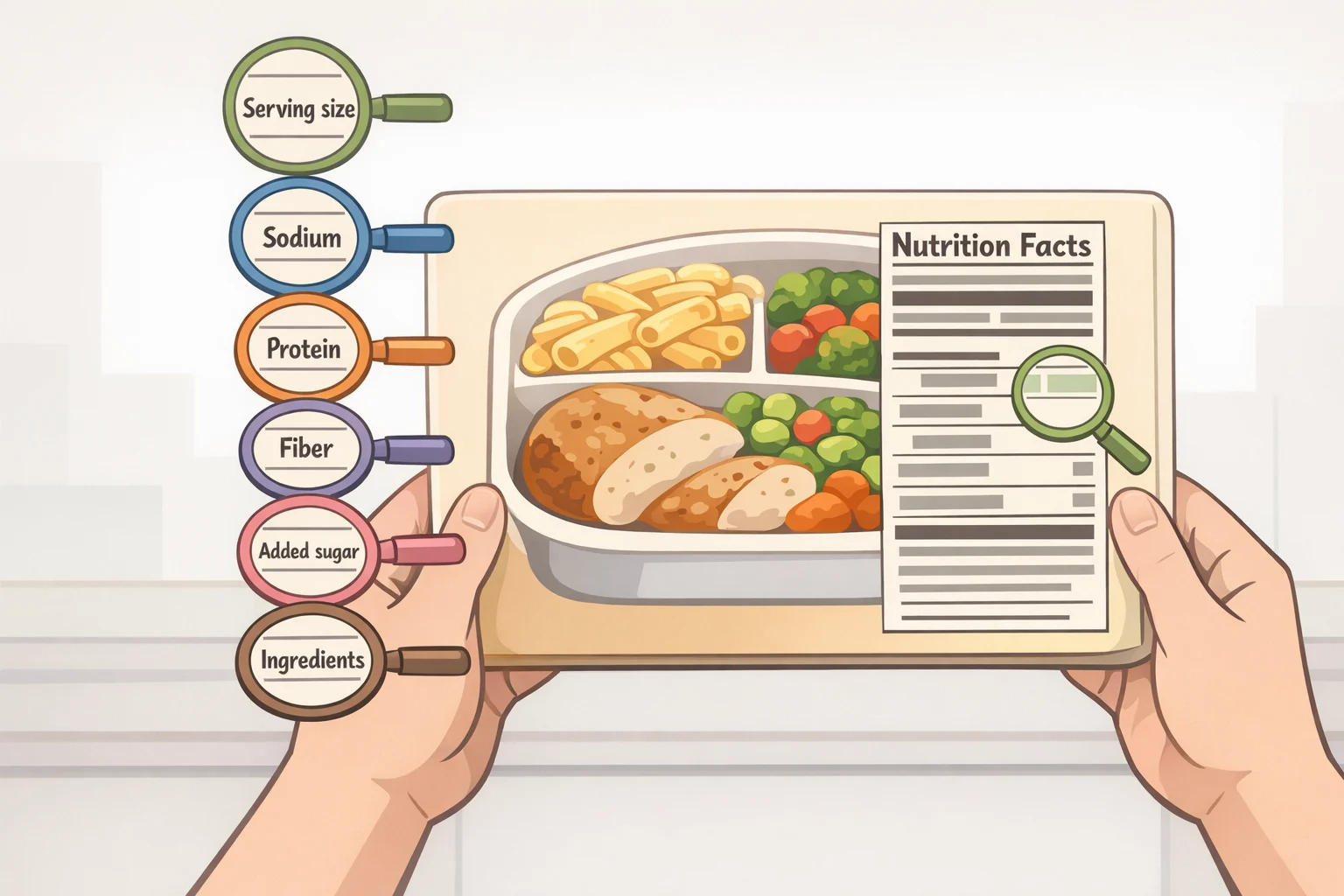
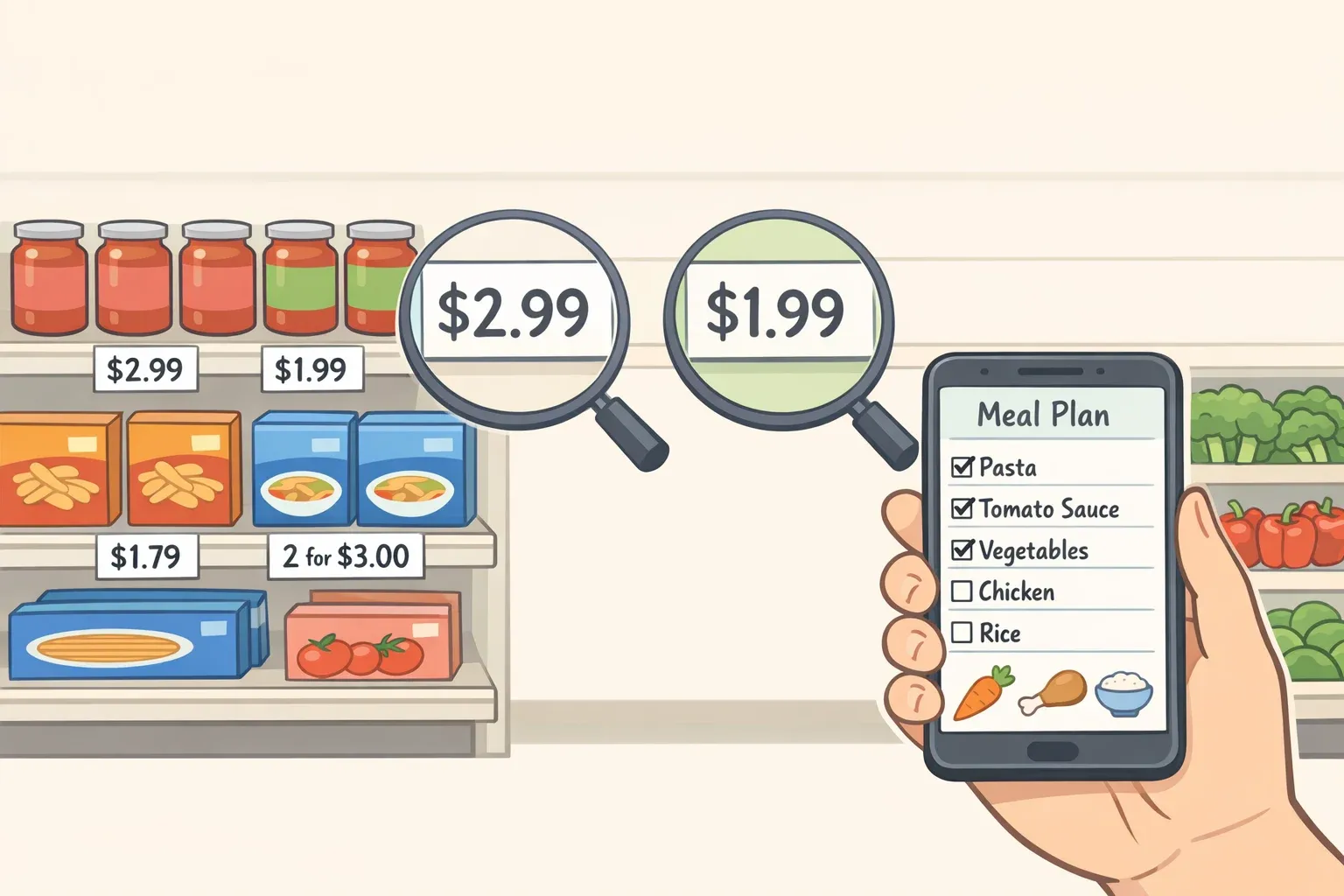
Prepared frozen entrées have a legitimate role on busy nights, especially for people with limited cooking space, equipment, or time. One practical advantage is that the full nutrition profile is disclosed on the label, making it easier to evaluate than a restaurant order where that data often doesn't exist (UF/IFAS). The catch is that quality varies dramatically, and front-of-pack claims like "plant-based," "organic," or "natural" don't reliably predict what's inside. Consumer Reports tested 25 popular frozen meals and found those labels correlated weakly with actual nutritional quality (Consumer Reports). Flip the box.
Check these in order:
1. Check the serving size first. Some "single-serve" packaging contains two servings or more. A 32 oz. family lasagna listing 320 calories per serving looks reasonable until you eat past one serving. This one step prevents the rest of the label from misleading you.
2. Sodium: target 600 mg or less per serving. The American Heart Association's daily cap is 2,300 mg total (Charitable Smiles). Consumer Reports found the real-world spread is wide: nine of 25 tested meals came in under 600 mg, while Marie Callender's Traditional Lasagna with Meat & Sauce Bowl contained 1,630 mg, 71% of the daily limit in a single bowl. By contrast, Healthy Choice Power Bowls Cauliflower Curry came in at 400 mg (Consumer Reports). Same freezer aisle category, very different numbers, which is exactly why the screen matters.
3. Protein and fiber, the fullness check. Aim for 15 to 25 g protein and at least 6 g fiber. Most people need 400 to 600 calories per meal to feel satisfied, and those calories should come primarily from protein and fiber rather than refined carbohydrates (Consumer Reports). A meal that clears the sodium bar but delivers 150 calories and 8 g protein is closer to a snack than a dinner. It will leave you raiding the cabinet an hour later.
4. Added sugar, check even savory meals. Some frozen entrées marketed as "healthy" contain 12 g of added sugar, roughly a tablespoon, according to Cleveland Clinic (Cleveland Clinic). Consumer Reports found one plant-based teriyaki bowl with 30 g of added sugar, more than a typical can of cola. The target: 1 g or less. Fifteen of the 25 Consumer Reports-tested meals hit that mark, so it's achievable (Consumer Reports).
5. Ingredients list, use it as a heuristic, not a hard rule. Cleveland Clinic suggests meals with fewer than seven recognizable ingredients lean toward whole-food composition over additive-heavy formulations (Cleveland Clinic). That's a useful filter, but Consumer Reports found most tested meals didn't have excessively long ingredient lists; only four of 25 were flagged for heavy use of additives and thickeners. A meal with eight ingredients isn't automatically disqualified. Use the list primarily to spot "partially hydrogenated oils," the marker for trans fats, which the FDA has ruled unsafe for human consumption (Cleveland Clinic). Those are a categorical pass.
Product profiles that tend to pass these screens: Grain bowls built around legumes, vegetables, and a lean protein tend to deliver more balanced macros in reasonable sodium ranges. Indian-inspired meals with lentils or chickpeas and cauliflower-rice bowls are solid structural choices. Lasagnas and mac-and-cheese entrées as a category consistently scored poorly on sodium, refined grains, and vegetable content across Consumer Reports testing (Consumer Reports). That doesn't mean you can never eat them; it means you need to know what you're working with before you do.
Step 3: Upgrade the gaps before you sit down
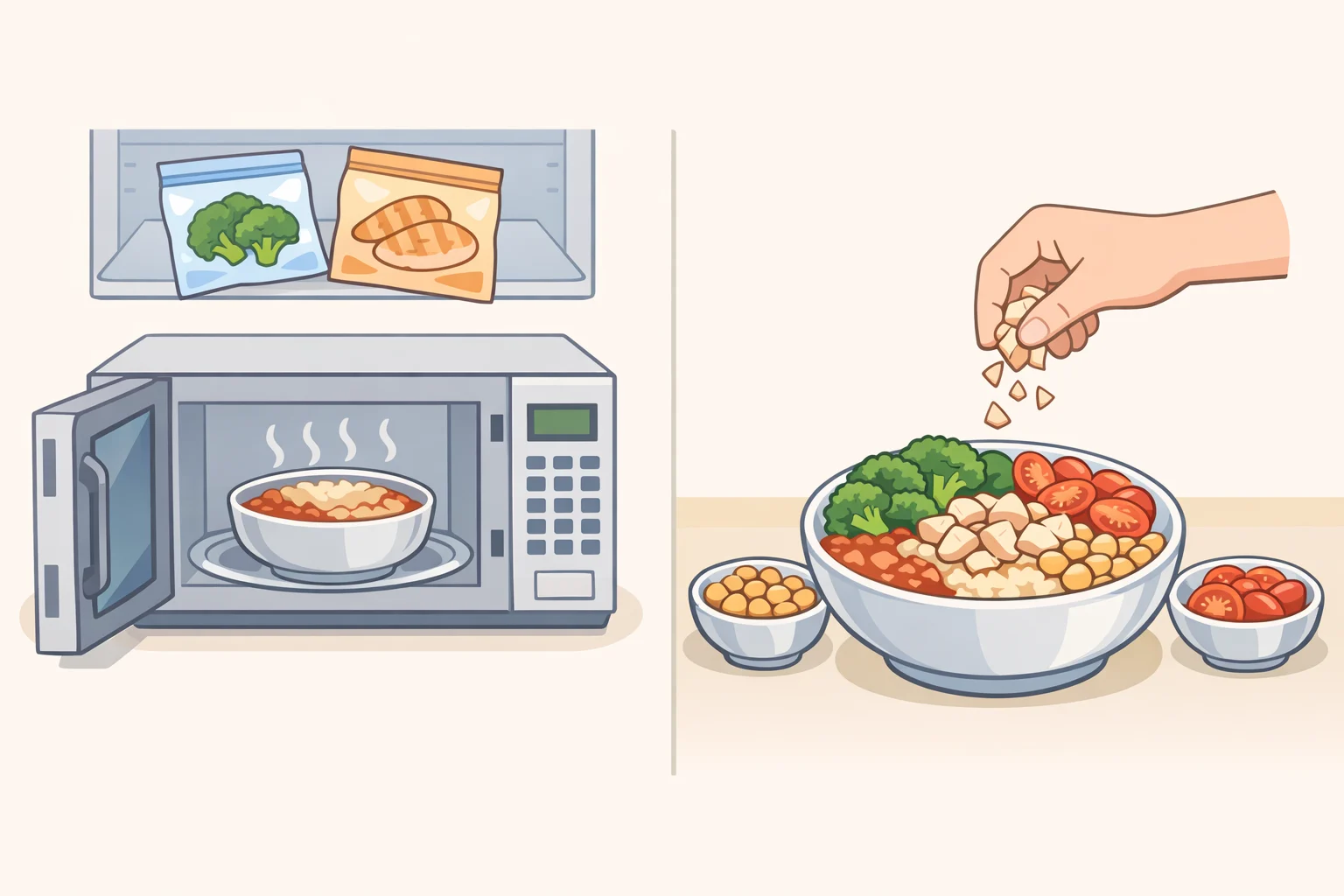
A prepared frozen meal that clears the label screens is a good start, not a complete dinner. Identify what it's missing, usually more vegetables, more protein, or more fiber, and fill the gap from your freezer staples. This takes four minutes.
The upgrade moves:
- Protein-thin meal: Pair it with frozen edamame, microwaved in a few minutes. Or add a hard-boiled egg from the fridge. NCHPAD recommends pairing a lighter frozen entrée with a side of steamed frozen vegetables to increase both satiety and nutritional balance (NCHPAD).
- Low-fiber meal: Add a handful of frozen broccoli or spinach as a side, or eat with a piece of fruit. If a meal doesn't reach 6 g of fiber, add frozen vegetables or fruit to close the gap (Consumer Reports).
- Calorie-dense, carb-heavy entrée (frozen pasta, mac and cheese): Eat half and pair with a protein source and raw vegetables, a hard-boiled egg and a side salad, for example. Cleveland Clinic's Taylor frames this as a practical comfort-food workaround rather than a reason to skip it altogether (Cleveland Clinic).
- Underseasoned or bland meal: Use frozen produce as the base and add fresh herbs, a squeeze of lemon, or a sauce made at home. This adds flavor without the sodium load built into pre-sauced packaged meals (Charitable Smiles).
What an upgraded prepared meal looks like in practice: a grain bowl entrée that passes the sodium and protein screens but delivers only 4 g of fiber becomes more filling and nutritionally stronger when you microwave a bag of frozen broccoli alongside it. Total additional time: four minutes. Total additional dishes: one bowl. That's the upgrade system, not a separate recipe, just a fast patch to the gap the entrée left.
Putting the system to work on your next grocery trip
These frozen food hacks for quick dinners work because they don't depend on willpower or elaborate planning. Frozen foods kept continuously at 0°F are safe indefinitely, and many cook straight from frozen, according to FoodSafety.gov data (University of Utah Health). They also reduce food waste and stretch budgets when fresh produce is out of season or limited in availability (Charitable Smiles).
One practical boundary worth carrying out of this guide: Cleveland Clinic recommends limiting fully prepared frozen entrées to roughly twice a week, not because freezing is the problem, but because heavy reliance on packaged meals makes sodium and fat intake harder to control over time (Cleveland Clinic). That applies to prepared entrées specifically. Plain vegetables, proteins, and grains can form the backbone of frequent weeknight dinners without issue.
Tonight, the move is simple: check what's already in the freezer against the protein-vegetable-grain template. If you have all three, dinner is ten minutes away. If you're buying a prepared meal this week, flip it over and run the five-point label check before it goes in the cart. Next grocery trip, build out the staple categories in Step 1 so the template is always available.
The same label hierarchy applies to frozen breakfast items, where added sugar tends to be a more acute problem, or extend the Step 1 staple approach to build a two-week freezer rotation that eliminates the "nothing to eat" problem before it starts.


Comments
Be the first, drop a comment!