



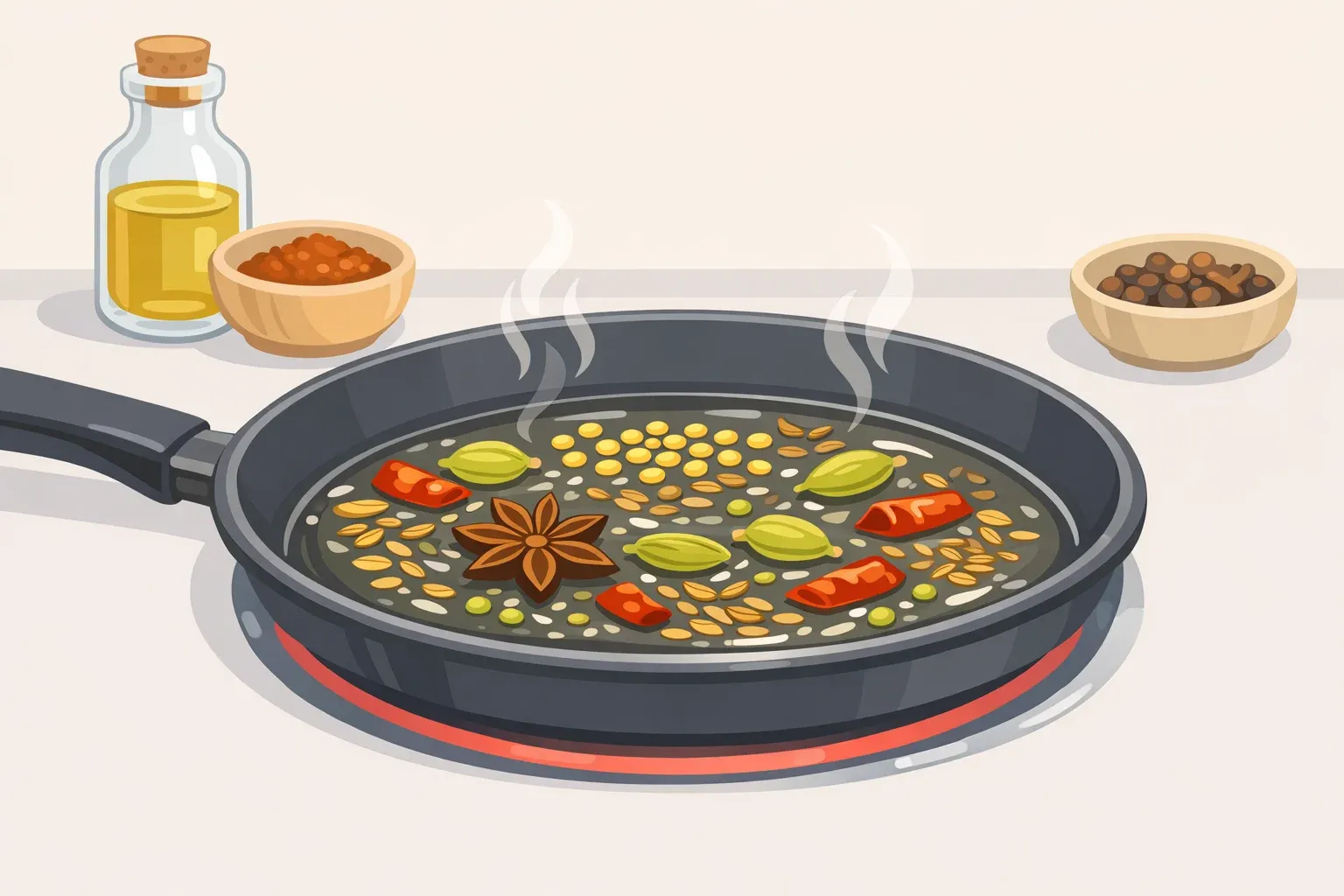
Blooming spices in oil takes under three minutes and requires no extra ingredients. Done right, it gives curries, dals, chilis, lentil soups, braises, and tomato-based sauces a depth that end-seasoning rarely matches. This guide covers what the technique actually does, which spices respond best, how to execute it without burning anything, and exactly where in a cook it belongs.
This is not a universal rule for every dish. It's a high-use habit for dried spice-driven cooking, and once you understand why it works, skipping it starts to feel like leaving flavor on the table.
The science behind the payoff is simpler than it sounds. Food chemistry research on spice aroma compounds shows that only some volatile compounds meaningfully contribute to perceived aroma. Most of what's chemically present in a spiced dish isn't moving the needle on what the nose and palate perceive. The fat those compounds are dissolved in affects whether they register at all.
Fat isn't a neutral carrier. It's an active variable. Blooming spices exploits that deliberately.
Why fat unlocks spice flavor: the mechanism worth understanding
Most aromatic compounds in dried spices are fat-soluble, meaning they dissolve more readily into oil than into water. That's established food chemistry, not an inference from a single study. Heating spice in fat extracts those compounds and keeps them available throughout the dish. Boiling spices in water extracts differently; if that liquid is reduced or discarded, the aroma impact won't be the same.
The fat-as-solvent effect has measurable consequences. The same 2025 Foods study found that linalool, a fragrant compound identified among the key odorants in Sichuan pepper hotpot, had a substantially different odor threshold depending on the fat medium. The same compound, in a different fat, requires vastly different concentrations to register as aroma. That's not a subtle difference. Fat composition is flavor architecture, not background detail.
The study's OAV framework helps explain the mechanism. OAV is calculated by dividing a compound's concentration by its detection threshold in oil; anything below 1 is generally considered below the aroma-active threshold. Of the 56 compounds identified, 27 were aroma-active, and only 16 reached an OAV of 1 or above. Since the detection threshold shifts with fat type, the fat medium directly shapes how many compounds clear that line in a finished dish.
One clarification before going further: the cited research examined Sichuan pepper in tallow hotpot, not home cooking broadly. The inference for everyday dried-spice cooking is reasonable, because fat-soluble aromatic extraction is well-established food chemistry, but the evidence supports the principle, not a controlled kitchen experiment. The practical guidance here draws on that principle.
Fat choice is itself a flavor decision:
Neutral oils (grapeseed, sunflower, refined avocado): let spice complexity speak without competition; best when spice is the structural flavor of the dish
Ghee or clarified butter: adds nutty dairy richness; the clarification removes milk solids, which means it can take more heat than whole butter without scorching during the bloom; well-suited to Indian-style preparations
Extra-virgin olive oil: assertive flavor that can compete with delicate spice blends; works better alongside Mediterranean aromatics like fennel, coriander, or dried red pepper
Whole butter: workable at low heat for a brief bloom, but milk solids burn fast; requires a cool pan and a short clock
Coconut oil: strong profile that pairs naturally with warm spices in South and Southeast Asian cooking; consider whether its flavor suits the dish before reaching for it in other contexts
The oil choice doesn't just carry flavor. It shapes which aromatic compounds become perceptible and at what concentration, which makes it worth thinking about before the pan goes on the burner.
Best way to bloom spices: which ones to use first
Not all spices bloom identically, and form, whole versus ground, changes timing significantly. The 2025 Foods study found that different Sichuan pepper varieties in the same tallow fat produced strikingly different volatile profiles. Three varieties were alcohol-dominant, with alcohols making up between 47% and 57% of volatile compounds. Two others were alkene-dominant at over 44% and 57%. One variety was ester-dominant at nearly 37%. Same fat, same technique, different spice variety, entirely different aromatic character.
Key aroma compounds identified in the study, including linalool, D-limonene, eucalyptol, β-myrcene, and terpinen-4-ol, belong to chemical families that appear across a range of common cooking spices. That's why the fat-extraction principle generalizes reasonably to the pantry most home cooks already have, though the study itself focused on Sichuan pepper specifically.
High-response: bloom these in oil first
Whole cumin seed, coriander seed, mustard seed, fennel seed
Cardamom pods (split), star anise, Sichuan peppercorn, fenugreek seed
Dried chiles (whole or torn), bay leaf, dried curry leaves
Use carefully: short bloom, lower heat
Ground cumin, ground coriander, ground turmeric, smoked paprika
These have far more surface area than whole spices and go from fragrant to acrid in under 30 seconds
Add them only at medium-low heat when wet ingredients are already within reach
Add later, not during the bloom
Delicate dried herbs like oregano, thyme, and za'atar hold up better added with liquids mid-cook
Fresh herbs lose their volatile compounds quickly with heat; finish with them off the heat
The bloom earns its place when dried spice is the structural flavor of a dish: curries, dals, chili, lentil soup, tomato-based braises, black beans, rice pilafs, shakshuka base, roasted vegetables finished in spiced oil. A pinch of cumin in a salad dressing won't benefit meaningfully from this treatment.
How to toast spices for more flavor without burning them: step-by-step
Before you start: Use a heavy-bottomed pan, cast iron or stainless steel preferred. Thin pans respond unevenly to heat adjustments, which makes timing harder. Have whole or coarsely ground spices measured out, and have the next ingredient, onion, garlic, tomato paste, or whatever follows, prepped and within arm's reach. The bloom moves fast. Don't start improvising after step one.
Step 1: Heat the pan dry for 30 to 60 seconds before adding oil. A preheated pan distributes heat more evenly, which reduces the hot spots that scorch spices before they've had a chance to bloom. Medium-low on most home stoves is the right starting point.
Step 2: Add oil and wait until it shimmers. The oil should move fluidly when you tilt the pan and show faint ripples across the surface. It should not be smoking. If it smokes immediately, pull the pan off the heat and give it 30 seconds before continuing.
For a base feeding four, roughly 2 to 3 tablespoons in a standard skillet or saucepan is a useful starting point. Enough that spices make full contact with the fat, not floating in a pool, but fully wetted.
Step 3: Add whole spices to the warm oil. They should sizzle gently within the first several seconds. No sizzle means the oil isn't hot enough. Aggressive spattering means it's too hot. Both are correctable: adjust the heat and give the pan half a minute to respond before adding anything.
Step 4: Watch for aromatic release, not a fixed timer. The kitchen will smell noticeably more fragrant than the dry spice does on its own. Whole seeds may pop slightly. The spices will deepen a shade in color. That combination is your cue. The nose is a better instrument here than the clock.
Ground spices bloom much faster. If using ground spice alongside whole, add it after the whole spices have had a head start, or run a separate brief bloom at lower heat immediately before adding wet ingredients.
Step 5: Add aromatics or wet ingredients immediately. Onion, garlic, ginger, tomato paste, or the first liquid goes in now. These drop the pan temperature and stop the bloom before it crosses into burnt. The spice flavor is now built into the oil base.
If spices turn dark brown or smell bitter rather than fragrant, don't try to work around it. Discard the spice-oil, wipe the pan, and start over. Bitter bloomed spice carries through the entire dish. The restart takes two minutes; continuing costs the whole pot.
Step 6: Build the dish on this base. Every subsequent ingredient picks up flavor from the spice-infused oil. The bloom is the flavor foundation, not a seasoning layer added at the end.
For very large batches of eight or more servings, bloom spices in two passes rather than crowding the pan. Overcrowding drops the pan temperature and produces uneven extraction: some spices bloom, others steam.
Common mistakes and how to avoid them
Heat too high. Aromatic compounds can evaporate quickly at high heat, and bitter compounds emerge as the spice darkens. If spices are going dark in under 30 seconds, the heat is too high. Medium-low almost always works; when in doubt, go lower and give it an extra 30 seconds.
Treating ground spice like whole spice. Ground spice has far greater surface area. It extracts faster and burns faster. Treat it as a different ingredient with a different timeline: lower heat, a shorter window, and wet ingredients ready to go in the moment it smells fragrant.
Too little oil. A thin film scorches before it extracts. The fat needs to fully wet the spice surface to do its job. A coating that covers the pan bottom is the minimum.
Next ingredient not ready. Once the aromatic peak hits, the bloom keeps going with or without you. Garlic not prepped means the spices keep cooking while you scramble, often past the point of recovery. Everything should be ready before the pan goes on the heat.
Using old spices. Stale spices have already lost a significant portion of their volatile compounds before they ever hit the oil. The bloom amplifies what's there; it can't rescue what isn't. Whole spices hold their aroma longer than pre-ground, which is one more reason to start whole when possible.
Where this leaves you, and what to try next
The steps above produce a flavor base in under three minutes that end-seasoning rarely matches. That depth is structural now, carried through every ingredient that follows, rather than applied on top at the end.
A simple rule set to carry forward: whole spices go in first, ground spices go in last with wet ingredients standing by, the oil should be shimmering but not smoking, and everything that follows the bloom gets prepped before the pan goes on the heat. Skip the step when dried spice is a minor note in the dish, not the structural flavor.
The next variable worth examining is fat selection. The 2025 Foods study showed that fat type actively shifts how much of a given aromatic compound the nose can detect, with linalool requiring nearly 30 times the concentration to register in tallow versus rapeseed oil. Different Sichuan pepper varieties in the same fat also produced volatile profiles ranging from alcohol-dominant to alkene-dominant to ester-dominant, which suggests that once the technique is reliable, spice sourcing is worth experimenting with too.
The oil you bloom in isn't a neutral default. It's a second aromatic layer working alongside the spice. That's where the technique starts compounding.



Comments
Be the first, drop a comment!