



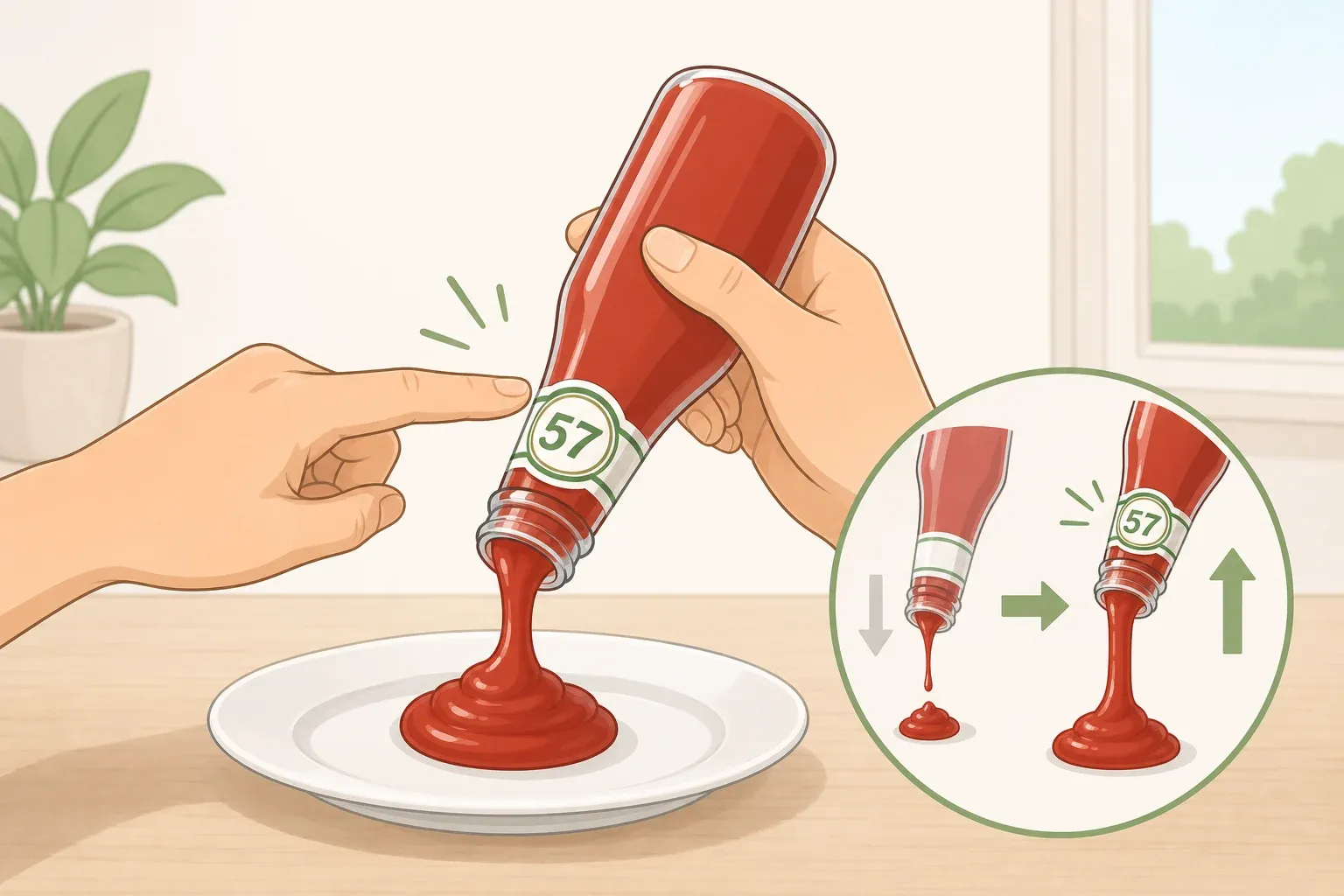
How to get ketchup out of the bottle: tap the Heinz 57
If you're standing over a plate wondering how to get ketchup out of the bottle and getting nothing but a stubborn glug of air, put the bottle down before you smack the bottom again. A Heinz spokesperson's guidance, reported by Chronicle Live, points to one specific spot: the "57" printed on the neck of the glass bottle, right where the glass narrows below the cap. The spokesperson told The Mirror that a firm tap on that mark is the "little secret" for releasing ketchup faster from a glass bottle, according to Chronicle Live.
This guide walks through the tap method step by step, what to try if the first tap doesn't get anything moving, why ketchup resists pouring in the first place, and what to do instead if the bottle in your hand is plastic.
How to get ketchup out of the bottle: identify your bottle first
This method works on the classic glass Heinz bottle, the kind with "57 varieties" printed on the neck where the glass tapers in below the cap threads. Henry Heinz picked the number 57 more or less at random in 1869, inspired by a shoe company's ad boasting 21 styles, but that label ended up doing double duty on the bottle. It marks the exact spot to tap or squeeze, a detail Chronicle Live reported only about 11% of people knew about when it went public in 2023.
If you're holding a plastic squeeze bottle, the tap isn't the fix. Heinz treats the two bottle types differently: the 57 trick applies to glass, and plastic bottles are built to be squeezed instead. Skip ahead to the plastic-bottle section if that's what you're working with.
What you'll need:
- The glass Heinz bottle
- A plate, bowl, or the food you're topping
- A clear counter or table to work over
No tools required.
Setup: Take the cap off completely before tapping. Working with the cap on gives loosened ketchup nowhere to go.
Before you tap, check the glass. Look over the bottle, especially near the neck, for any chip or crack. Do not use a chipped or cracked bottle. Set it aside and discard the contents rather than risk glass contamination.
The Heinz 57 ketchup bottle trick: step by step
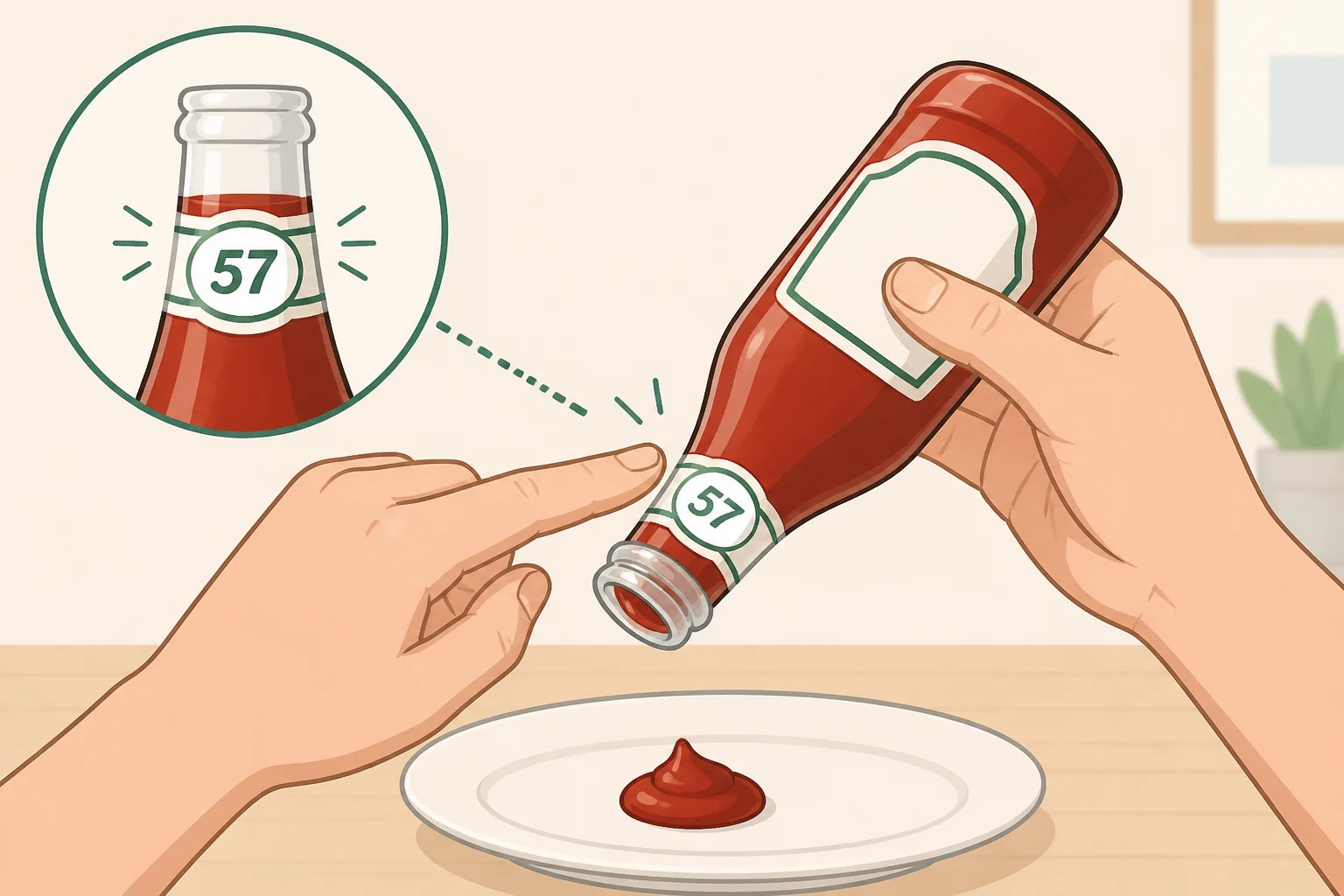
- Tip the bottle toward your plate. Hold it at a steady angle with the opening pointed down and slightly outward, rather than straight up and down. Aiming the neck this way gives ketchup somewhere to go as soon as it loosens, instead of sliding back down.
- Find the "57." It's printed on the neck of the bottle, right where the glass narrows below the shoulder.
- Give that spot one firm tap. Heinz's own guidance describes this exact motion: apply a firm tap where the bottle narrows, and the ketchup comes out easier.
- Watch the neck for movement. A successful tap gets ketchup moving down through the neck toward the opening.
- Keep the bottle tipped toward the plate as it flows, adjusting the angle if you need to slow it down or speed it up.
Common mistake: hitting the base repeatedly. Heinz's guidance points specifically to the neck, not the base or sides, which is where most people instinctively aim. Stick to the spot they recommend rather than defaulting to the bottom.
If the first tap doesn't start any flow, keep the bottle tipped toward the plate and try one more firm tap on the same spot rather than switching to shaking the bottle or banging it against the counter. Harder or more frequent strikes go beyond what Heinz recommends and raise the odds of cracking the glass or sending ketchup past the plate.
Before you try a third or fourth tap, double back on the basics: cap fully off, bottle tipped rather than upright, and the same "57" spot each time rather than drifting toward the shoulder or base. If an undamaged bottle still won't release ketchup after several calm attempts, stop tapping. Pour what you can into a bowl, or transfer the ketchup to a clean bottle, and serve with a spoon instead of continuing to strike an intact bottle.
Why ketchup won't come out of the bottle
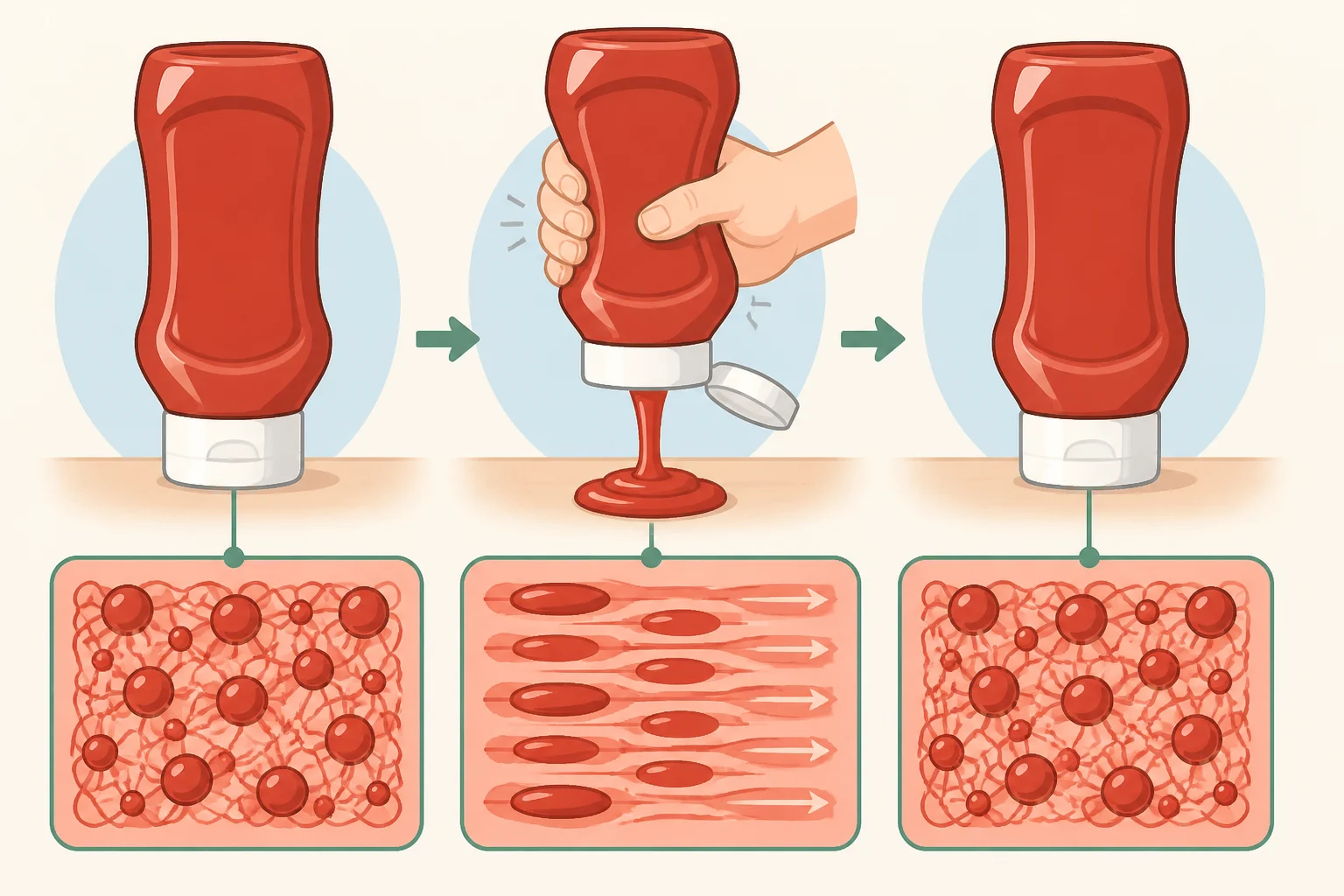
The reason a full bottle just sits there, even upside down, comes down to how the sauce behaves as a fluid. Ketchup is what food scientists call shear-thinning: its resistance to flowing, or viscosity, drops as force is applied to it, then climbs back up once that force stops, according to testing from NETZSCH.
At rest, ketchup's viscosity keeps climbing the closer it gets to zero motion, which is why NETZSCH's testing found it essentially won't flow on its own while sitting still. It behaves like a soft solid until enough stress breaks that structure down and lets it move. NETZSCH's lab measurements on the samples it tested found that breakdown happening around 15 pascals of stress, a result specific to those samples rather than a number every bottle of ketchup will match. Once flowing at a more typical pouring rate, that same testing calculated a shear rate around 236 per second through a narrow neck, at which point viscosity had dropped to roughly 400 millipascal-seconds, a small fraction of what it measures sitting still. That drop is the whole point: ketchup thins out dramatically once it's actually moving, which is why a tap only needs to get it started rather than keep pushing it along.
That behavior helps explain why applying force, including a tap, can get ketchup moving, though the research doesn't test Heinz's hand-tapping method specifically or measure how much force a tap on glass actually delivers. Once ketchup starts moving and then stops again, that same structure begins rebuilding almost immediately, based on NETZSCH's thixotropy testing, though the structure doesn't return to exactly its original state right away. That fast rebuild is why a dollop holds its shape on a plate instead of spreading into a puddle, and why there's no need to keep tapping once flow has started.
If you have a plastic bottle: how to make ketchup come out faster
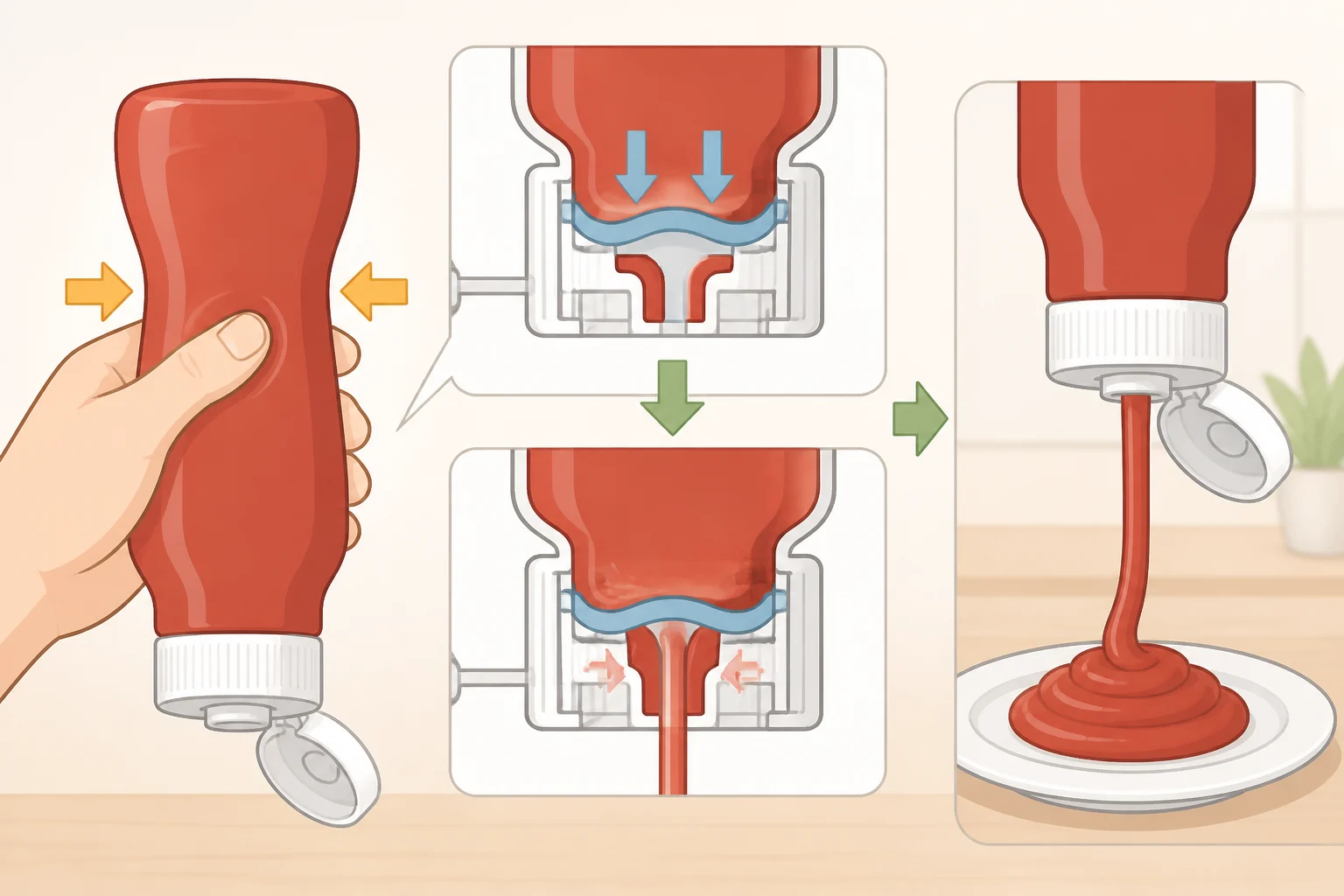
Heinz's guidance for its plastic squeeze bottles skips the tap entirely. The spokesperson cited by Chronicle Live points to plastic bottles' "stay clean cap," built for squeezing rather than tapping.
Orient the bottle cap-down as it's designed, and squeeze with steady, even pressure rather than short hard bursts. A CT scan of the Heinz cap by the research firm Lumafield, reported by ZME Science, found the cap is built around internal channels that only let ketchup through once squeezing builds enough pressure. That scan revealed a design representing roughly $1.2 million in engineering work over eight years, aimed at getting a simple squeeze bottle to behave predictably. A wall inside the cap keeps ketchup out of those channels until that pressure threshold is crossed, which is what lets you control flow by how hard you squeeze rather than the sauce dribbling out on its own.
When you stop squeezing, the ketchup's viscosity climbs back toward normal, which is part of what helps the cap cut off flow, per ZME Science's reporting on the design. Stop squeezing once enough sauce is on the plate; there's no need to keep pumping the bottle after it starts moving.
Finish-line guidance
Once ketchup is flowing in a steady stream, stop tapping or squeezing. Adding more force at that point risks overshooting the plate, and the sauce's own thickening will hold it in place on the plate anyway.
If you've checked the glass, found no chips or cracks, and several calm taps on the "57" still haven't produced any flow, stop tapping altogether. Transfer the ketchup to a bowl or a fresh bottle and serve it with a spoon rather than continuing to strike an intact bottle. If the glass is damaged in any way, don't tap or reach into it; discard both the bottle and its contents.
For a plastic bottle, the same rule applies in reverse: if steady squeezing produces nothing after several tries and the bottle isn't simply empty, check that the cap's opening isn't clogged with dried ketchup before assuming the bottle is defective. Either way, once ketchup is where you want it, the job is done. There's no advantage to extra force once flow has started, glass or plastic.

Comments
Be the first, drop a comment!