



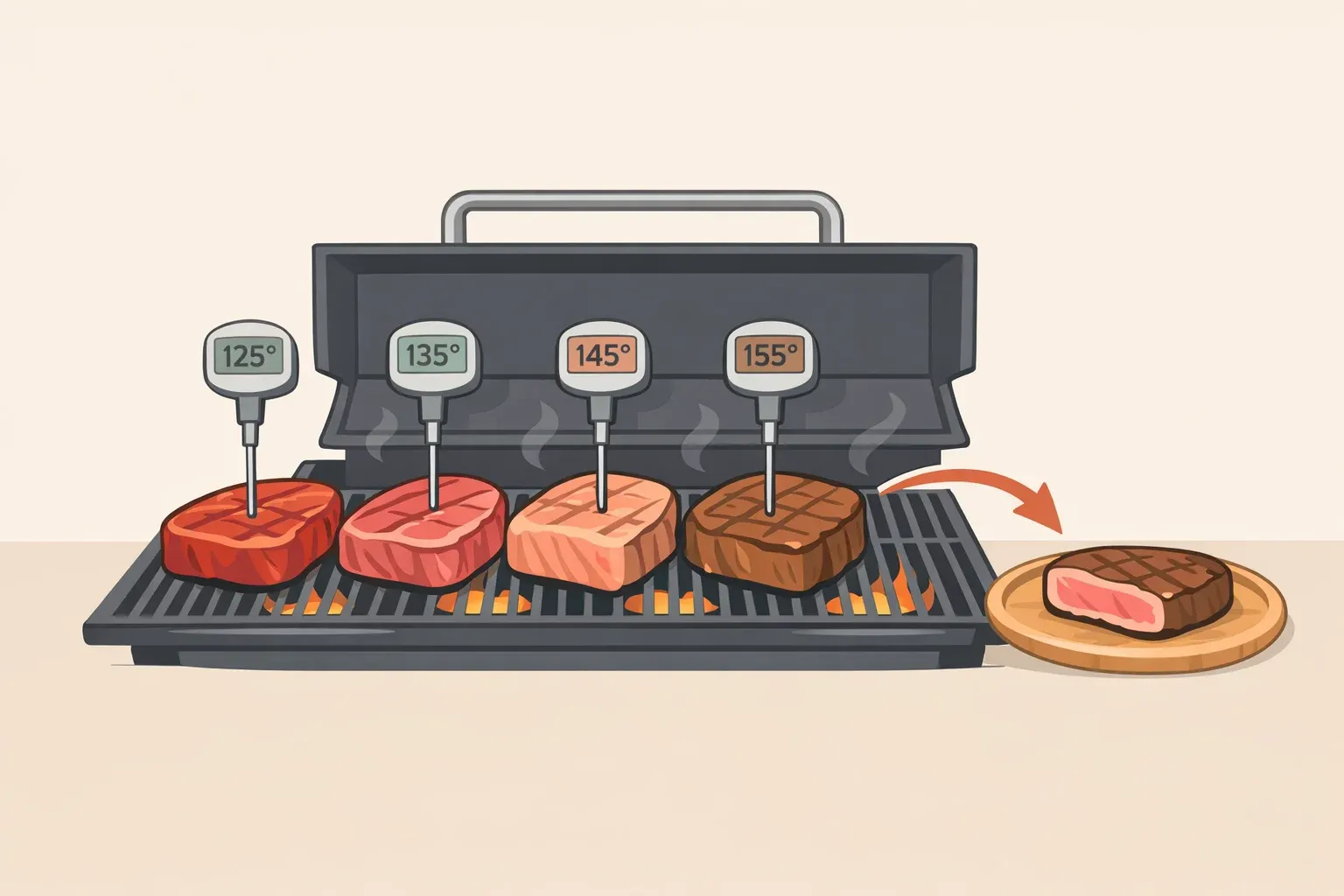
Pick up a thermometer. That's the whole secret, condensed to four words.
Every other variable in how to grill steak — cut selection, grill setup, timing — is secondary to knowing what's happening inside the meat. This guide walks through a simple decision system: match your method to the thickness of the cut, cook to internal temperature, and pull early enough for carryover heat to finish the job.
Follow it and you'll have a more reliable path to your preferred doneness on gas or charcoal, whether you're grilling skirt steak, ribeye, or a thick tomahawk.
Before you start, you need one tool: an instant-read digital meat thermometer. The thermometer is what makes this method reliable. ThermoWorks explains that steak doneness is an internal-temperature question, not something you can judge consistently by color, touch, or a fixed number of minutes per side.
The hand-feel test exists as a rough fallback: pressing the flesh between your index finger and thumb gives a crude proxy for doneness, but it's not consistent enough to stake a good steak on.
Three facts explain why timers fail:
Doneness temperatures vary by source, so a fixed minutes-per-side rule is less reliable than an internal temperature reading.
Steak keeps cooking after it leaves the grill, and thicker cuts usually carry over more than thin cuts.
Pulling a steak below the final serving temperature helps account for carryover, but the exact rise depends on steak thickness, grill heat, and rest conditions.
Match the steak thickness to the grilling method
Thickness determines your method. Everything else — cut selection, grill setup, and cook time — follows from it. Make this your first decision, not an afterthought.
Under ¾ inch: Use high-heat direct grilling only. Best for flank steak, skirt steak, and other thin cuts.
1 to 1½ inches: Use two-zone grilling. Sear over direct heat, then finish over indirect heat. Best for ribeye, New York strip, and sirloin.
Over 1½ inches: Use a reverse sear. Cook gently over indirect heat first, then sear at the end. Best for thick ribeye, T-bone, and tomahawk.
Within each band, fattier cuts are more forgiving than leaner cuts. Ribeye handles grill heat well because its marbling gives you more margin for error. New York strip is leaner, with a fat cap on one edge, but still sturdy enough for high-heat grilling. Sirloin dries out faster past medium, so it needs closer thermometer checks.
Steaks under ¾ inch cook through quickly, often before a deep crust can form. At the other end, steaks over 1½ inches can end up with an overcooked exterior before the center reaches your preferred doneness if you cook them entirely over direct heat. The thickness band isn't a preference; it determines which approach actually works.
On bone-in cuts, T-bone and porterhouse steaks contain two muscles — a strip loin and a tenderloin — that cook at different rates. The tenderloin side reaches temperature faster, so point it toward the cooler zone when positioning the steak on the grill.
Dry, season, and set up the steak
Good prep removes the variables that undermine crust and even cooking. Most of it is passive time.
First, take the steak out while you set up the grill, but don't rely on a long counter rest to fix uneven cooking. Serious Eats testing found that tempering meat at room temperature made little practical difference compared with better controls, such as dry-brining, flipping, and cooking to the correct internal temperature.
Pat the surface completely dry with paper towels. Moisture on the surface turns to steam when it hits the grates, and steam gets in the way of browning. A dry surface is one of the simplest ways to help the steak sear instead of gray.
Season with kosher salt and black pepper either 30–45 minutes before grilling or immediately before the steak goes on. Avoid salting 5–15 minutes before cooking, when surface moisture is most likely to interfere with browning.
For an optional dry brine, salt the steak and leave it uncovered on a rack in the refrigerator for up to 24 hours. If you have time, it's one of the easiest upgrades for a drier surface and better browning.
Skip butter during the high-heat sear. It can burn at grilling temperatures, so add butter after the steak comes off the grill, while it rests.
Set up the grill and choose your pull temperature
The grill setup is the same whether you're doing a standard two-zone cook or a reverse sear: one hot side, one cooler side. The sequence changes by thickness; the hardware setup does not.
For a gas grill, turn one burner to high and leave the others off. Preheat with the lid closed for 10–15 minutes. Oil the hot-side grates just before the steak goes on.
For a charcoal grill, fill a chimney starter and wait until the coals are covered in gray ash, roughly 15–20 minutes. Pour the coals onto one half of the grill, leaving the other side empty. Set the cooking grate in place, close the lid for five minutes to heat it, then oil the hot-side grates with a folded paper towel dipped in high-smoke-point oil and held with tongs.
Set your pull temperature before you start cooking. The temperature you pull at and the temperature you serve at are not the same number.
Use the guide below as culinary doneness guidance, not as USDA food-safety guidance. Pull temperatures are lower than final serving temperatures because steak continues cooking as it rests. Thicker steaks usually need a larger cushion than thin steaks.
Rare: Pull at 115–125°F. Approximate final temperature after rest: 120–130°F.
Medium-rare: Pull at 125–130°F. Approximate final temperature after rest: 130–135°F.
Medium: Pull at 130–140°F. Approximate final temperature after rest: 135–145°F.
Medium-well: Pull at 140–150°F. Approximate final temperature after rest: 145–155°F.
Well-done: Pull at 150°F or higher. Approximate final temperature after rest: 155°F or higher.
Food-safety note: The USDA recommends cooking raw beef, pork, lamb, and veal steaks, chops, and roasts to 145°F as measured with a food thermometer, followed by at least a 3-minute rest. That is a safety minimum, not a restaurant-style doneness chart. Rare and medium-rare targets are below USDA guidance, so use extra caution when cooking for children, older adults, pregnant people, or anyone with a weakened immune system.
This guide assumes intact whole-muscle steaks. For ground beef, USDA recommends 160°F. For mechanically tenderized or packaged beef products, follow the label instructions and use a food thermometer.
Grill thin, standard, and thick steaks differently
Under ¾ inch: Use direct heat only
Place thin cuts such as skirt and flank steak directly over the hot zone from the start. There's no indirect phase; thin cuts cook too quickly for one.
Flip once when the steak releases cleanly from the grates. If it sticks, wait another 30–60 seconds. Check the temperature frequently because thin steaks go from underdone to overdone fast.
Always slice flank and skirt steak against the grain. That shortens the muscle fibers and makes a major difference in tenderness.
1 to 1½ inches: Use the standard two-zone method
This is the best everyday method for ribeye, strip, and sirloin when you want a real sear without overcooking the center.
Place the steak on the hot zone. Leave the lid open during the sear phase.
Sear 2–3 minutes without moving it.
Flip once and sear the second side for 2–3 minutes.
Move the steak to the indirect zone and close the lid.
Insert the thermometer into the thickest part of the steak, away from bone, fat, or gristle.
Pull when the reading is about 5°F below your target.
Move the steak immediately to a clean cutting board, not a warm plate or the back of the grill.
If the steak sticks during the sear, wait another 30–60 seconds. Steak usually releases more easily once the surface has seared.
Don't worry that a quick thermometer check will ruin the steak. Overcooking is the bigger risk.
For a 1-inch steak aimed at medium-rare, roughly 3–4 minutes per side over direct heat and 2–3 minutes on the indirect side is a useful starting estimate. The thermometer is the finish line, not the timer.
Over 1½ inches: Use a reverse sear
For thick steaks, start gently and sear at the end. The reverse-sear method is especially useful for steaks at least 1½ inches thick because it gives the center time to heat through before the crust forms.
Place the steak on the cool side with the grill around 250–275°F. Close the lid.
Cook slowly, turning occasionally, until the internal temperature reads 10–15°F below your target. Depending on thickness and grill temperature, this can take roughly 25–40 minutes.
Move the steak to the hot zone and sear 60–90 seconds per side.
Pull and rest. Because most of the cooking happened gently, carryover is usually smaller than with an all-direct-heat cook, but very thick steaks may still climb several degrees.
If flames flare up, move the steak to the cool zone until they subside. Cooking through a flare-up can char the outside before the center reaches temperature.
Don't press the steak down. It does not improve the sear and can squeeze moisture onto the grates.
Three steak thickness examples
Use these as starting points, then trust the thermometer over the clock.
1-inch ribeye on gas, targeting medium-rare
Preheat the grill with one burner on high and the lid closed for 10–15 minutes. Oil the hot-side grates. Sear the ribeye over direct heat, lid open, for 3–4 minutes per side without moving it.
Move the steak to the indirect side, close the lid, and start checking temperature after two minutes. Pull at 125–130°F. Rest on a clean cutting board for 5 minutes. The target final temperature is 130–135°F.
1½-inch New York strip on charcoal, targeting medium
Light a chimney of charcoal. When the coals are covered in gray ash, pile them on one side of the grill. Heat the grate for five minutes with the lid closed, then oil the hot-side grates.
Sear the strip over direct heat, lid open, for 3–4 minutes per side. Move it to the indirect zone, close the lid, and check temperature after three minutes. Pull at 130–140°F. Rest 8–10 minutes. The target final temperature is 135–145°F.
Skirt steak, direct heat only
Skirt steak is usually thin enough to cook entirely over direct heat. Preheat the grill to high. You do not need an indirect phase for the cook itself, though a cool zone is useful for flare-ups.
Grill directly over high heat and flip once when the steak releases cleanly, roughly 2–3 minutes per side. Pull when the center reads about 5°F below your target. Rest 3–5 minutes. Slice against the grain before serving.
Rest, slice, and serve
Resting gives carryover heat time to finish the cook and lets the steak cool slightly before slicing. Rest times scale with thickness:
Under ¾ inch: 3–5 minutes
1-inch steak: about 5 minutes
1¼- to 1½-inch steak: 8–10 minutes
Reverse-seared steak: often little to no rest after the final sear, though very thick cuts can sit briefly if the temperature is still climbing
Move the steak to a clean cutting board or wire rack immediately after pulling it from the heat. Do not put it in a hot pan or back on the grill grates.
A loose foil tent is fine. Do not wrap the steak tightly. Tight foil can trap steam, soften the crust, and keep cooking the meat past your target — essentially building a small oven around the steak.
Slice against the grain on flank, skirt, and any cut with a prominent grain. On ribeye and strip, direction matters less, though thinner slices can improve the texture of thicker cuts.
The steak thickness rule to remember
Four moves: pick your thickness band, dry the surface, pull below your final target, and rest before slicing.
For medium-rare, a common culinary target is 130–135°F after resting, which usually means pulling a standard steak around 125–130°F. For thick reverse-seared steaks, start checking earlier and leave a 10–15°F cushion.
Once the temperature-first method feels natural, dry-brining is the easiest next upgrade for better browning.




Comments
Be the first, drop a comment!