



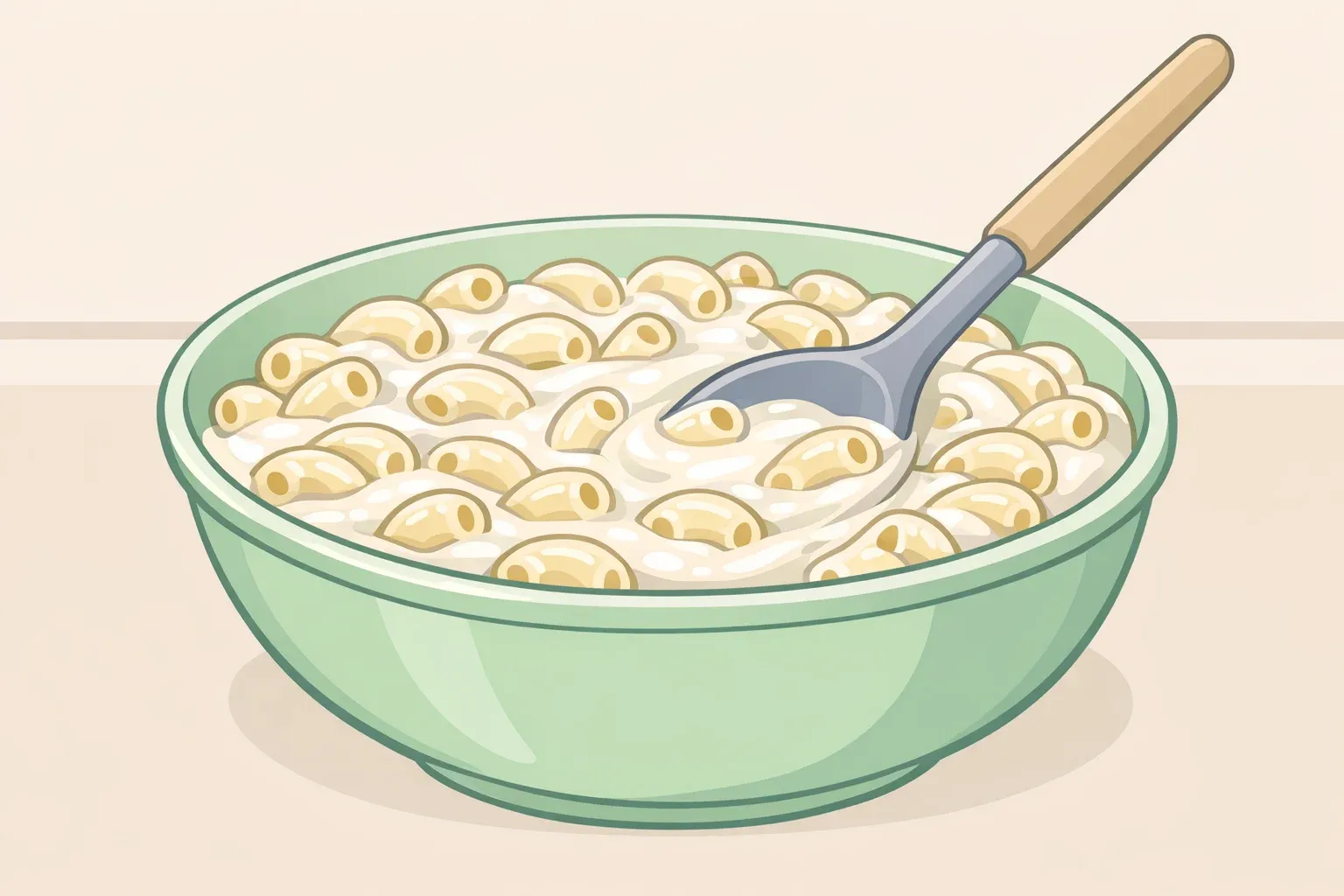
Cottage cheese sounds like an odd thing to stir into macaroni salad until it's blended past the point that feels necessary, 60 to 90 seconds, and turns into something that coats pasta the way mayo does, minus the curds.
That's the core idea behind this cottage cheese macaroni salad: drain the cheese, blend it smooth with dressing and seasoning, and it disappears into the noodles so completely that nobody at the table has to know what's in the bowl until told.
Worth saying upfront: the source recipe doesn't publish exact cup measurements for the pasta, cottage cheese, or dressing, only the process, the timing, and a yield of 8 servings. This piece treats the method as a technique to apply to whatever amount of pasta gets made, not a fixed recipe with locked ratios, and it flags every place a specific number isn't available.
What actually keeps the salad creamy has less to do with the dairy than with timing. Cold pasta keeps absorbing dressing for hours after it's tossed, which is why a bowl that looks perfect at 6 p.m. can look dry by 8. The fix runs through the whole method below: drain the cheese, blend it fully, hold back part of the dressing, and finish the salad right before it's served.
This no-mayo macaroni salad moves fast on the active side. The blending step itself takes just 60 to 90 seconds, though draining, cooking the pasta, and chilling add real time around it. The source recipe lists 15 minutes of prep and 10 minutes of cook time, plus at least two hours of chilling that can't be rushed.
What follows covers the cottage cheese pasta salad dressing technique, the mix-ins worth adding, the fix for a salad that's gone dry by day two, and two direct substitutes for anyone without cottage cheese on hand.
Building a creamy cottage cheese macaroni salad dressing
Cottage cheese comes packed in its own liquid, and the recipe treats that liquid as working against the final texture. What's left after draining is thick enough to actually coat a noodle once blended. Running the blender the full 60 to 90 seconds is what gets the dressing completely smooth, with no visible curds.
Before starting, gather short pasta (elbow macaroni, ditalini, or shells), a blender or food processor, a fine-mesh strainer, cottage cheese, Italian dressing, vinegar, Dijon mustard, garlic powder, salt, and pepper.
Drain the cottage cheese. Tip it into a fine-mesh strainer for 10 minutes while the pasta water comes to a boil.
Cook the pasta assertively, then cool it properly. Salt the water heavily, close to what a seasoned soup would taste like, and cook about a minute past al dente. Short curved shapes trap dressing better than long noodles. Drain and rinse under cold water to wash away the starch clinging to the pasta's surface; skip that step, and the dressing turns sticky rather than smooth.
Blend the dressing until no curds remain. Combine drained cottage cheese, Italian dressing, vinegar, Dijon, garlic powder, salt, and pepper, then run the blender 60 to 90 seconds, longer than feels necessary.
Add mix-ins to the cooled pasta before the dressing goes in (proportions covered below).
Toss with half the dressing only, then chill at least two hours. Reserve the rest for serving day.
One shortcut worth knowing: whipped cottage cheese can stand in for the blending step entirely. Cut the Italian dressing to ¼ cup and skip the added salt if using it.
If the dressing looks too thick straight off the blender, an extra spoonful of Italian dressing loosens it without diluting the flavor the way plain water would. If curds are still visible after 90 seconds, keep the blender running before reaching for more liquid. A full blend is what erases the curd texture, though the ratio of cottage cheese to dressing still determines how the finished salad tastes.
Choosing mix-ins and getting the proportions right
Since the source recipe doesn't specify amounts for vegetables or other add-ins, it helps to look at a comparable no-mayo macaroni salad for a sense of scale. Taste With Purpose's Greek-yogurt version, built on 8 ounces of macaroni, uses about a half cup each of diced celery and diced carrots, a quarter cup of diced bell pepper, and a quarter cup of chopped sweet onion.
That works out to roughly a cup and a quarter of chopped vegetables per half pound of dry pasta, a reasonable starting point to scale up or down for the cottage-cheese version.
Pat any diced vegetables dry before folding them in. Watery vegetables release liquid into the bowl and can leave the finished salad soupy, an issue flagged directly in the Greek-yogurt recipe's own troubleshooting notes. That logic holds regardless of which dairy carries the dressing.
Keeping it creamy after a day in the fridge
The dressing goes in two stages for a reason. Cold pasta keeps absorbing liquid for hours, so a bowl dressed all at once at the start has nothing left to give by serving time. Stir the reserved half in only after the salad has fully chilled, ideally right before it reaches the table.
Handled that way, the cottage cheese version reportedly holds up well past the first serving. Fork To Spoon describes it as better on day two than day one when the draining and reserve steps are followed, and calls it make-ahead friendly for up to four days in the fridge with that dressing trick in place.
If the salad still looks tight after the reserved dressing goes in, that's a texture problem shared with Greek-yogurt versions of this same salad style. Taste With Purpose recommends stirring in 2 to 3 extra tablespoons of yogurt plus a splash of apple cider vinegar to revive one that's absorbed too much liquid, and the same small addition, a spoonful of dressing plus a touch of vinegar, works as a fallback for the cottage-cheese version.
Cold also dulls seasoning, so taste and re-salt right before serving rather than trusting how the bowl tasted an hour earlier.
On storage limits specifically, the recipe sources cited here suggest up to four days refrigerated and no more than two hours at room temperature. Those numbers come from recipe blogs, not a food-safety authority, so treat them as a starting guideline rather than a hard rule. Anyone serving a crowd outdoors, at a cookout or potluck where the bowl might sit out longer than planned, should default to standard food-safety practice and keep it chilled whenever it isn't actively being served.
Cottage cheese isn't always in the fridge, though, and not everyone owns a blender. The two swaps below solve the same texture problem with dairy that's more commonly on hand.
Two mayo alternatives, if cottage cheese isn't in the fridge
These are reference points, not a second method; the cottage-cheese technique above is the core approach. Both swaps handle creaminess with different dairy and skip the blending step entirely.
Greek yogurt swaps in at a 1:1 ratio for mayo, with apple cider vinegar added to cut its richness. No straining, no blending, just yogurt in place of mayo, which makes it the faster option for anyone without a blender on the counter.
Sour cream works better as an addition than a full replacement. One established recipe pairs ½ cup sour cream with ¼ cup mayonnaise, along with 1½ tablespoons yellow mustard and 1 tablespoon apple cider vinegar. The tang from the sour cream is there to balance the mustard and any added sweetness, not to eliminate mayo from the bowl outright.
Treat any confident claim about sour cream's texture with some skepticism. One breakdown of the swap contradicts itself within the same piece, describing sour cream as thicker and richer than mayonnaise in one section and as a substitute that can leave the dressing thinner in another. Test a small batch before committing a full bowl to either assumption.
Adding protein without losing the texture
Once the base method is working, chopped hard-boiled eggs are a straightforward next addition, and they do more than pad the protein count. Fork To Spoon's own estimate has two chopped eggs pushing protein per serving past 18 grams, though that figure comes from the same source that couldn't settle on 14 versus 12 grams for the base recipe, so treat it as a single recipe's estimate rather than a verified number.
Stir the eggs in alongside the reserved dressing, at the same point the seasoning gets checked. It adds bulk and a different texture without touching the draining or blending steps that do the real work.
None of that changes the fundamentals. Drain, blend until the curds vanish, hold back half the dressing, chill, then refresh before serving. Everything else — the vegetables, the eggs, whatever ends up in the bowl next — is decoration on a technique that already does its job.




Comments
Be the first, drop a comment!