



How to make lemon box cake mix taste homemade with pudding
Get everything on the counter before you start. This guide walks you through making a moist, intensely lemony sheet cake from a box mix that keeps well for five days. Two moves are non-negotiable: dry pudding powder whisked into the batter before any liquid goes in, and a warm lemon glaze poured into fork holes while the cake is still warm. Three fast upgrades milk instead of water, one extra egg, and fresh lemon zest take about three additional minutes and push the result from good to genuinely excellent.
The pudding trick has been around longer than most people realize. Food52 traced a nearly identical formula to a 1962 Jell-O cookbook called The Joys of Jell-O, which featured a recipe folding gelatin powder into boxed cake mix and finishing with a poked-hole glaze of lemon juice and confectioners' sugar. The pudding-mix version eventually became the more common household shortcut. TODAY tested it last month and called the result "delightfully moist and spongy."
Make this when you're feeding a crowd, prepping ahead, or want a dependable lemon cake without a full afternoon of scratch baking. At room temperature it holds for two days; refrigerated, up to five. That's the practical advantage over most from-scratch lemon cakes, which tend to be best the day they're made.
How to improve lemon cake mix with two high-impact changes
Before starting, gather everything. The method moves quickly once you begin.
Quick-reference ingredient list (one 9x13 cake, 12 servings):
- 1 box (15.25 oz) lemon cake mix
- 1 package (3.5 oz) dry instant lemon pudding mix
- 4 large eggs
- ½ cup vegetable oil
- 1⅓ cups whole milk or half-and-half
- Zest of 1 lemon
- Glaze: fresh lemon juice + sifted confectioners' sugar
The best lemon cake mix hack: instant pudding plus warm glaze
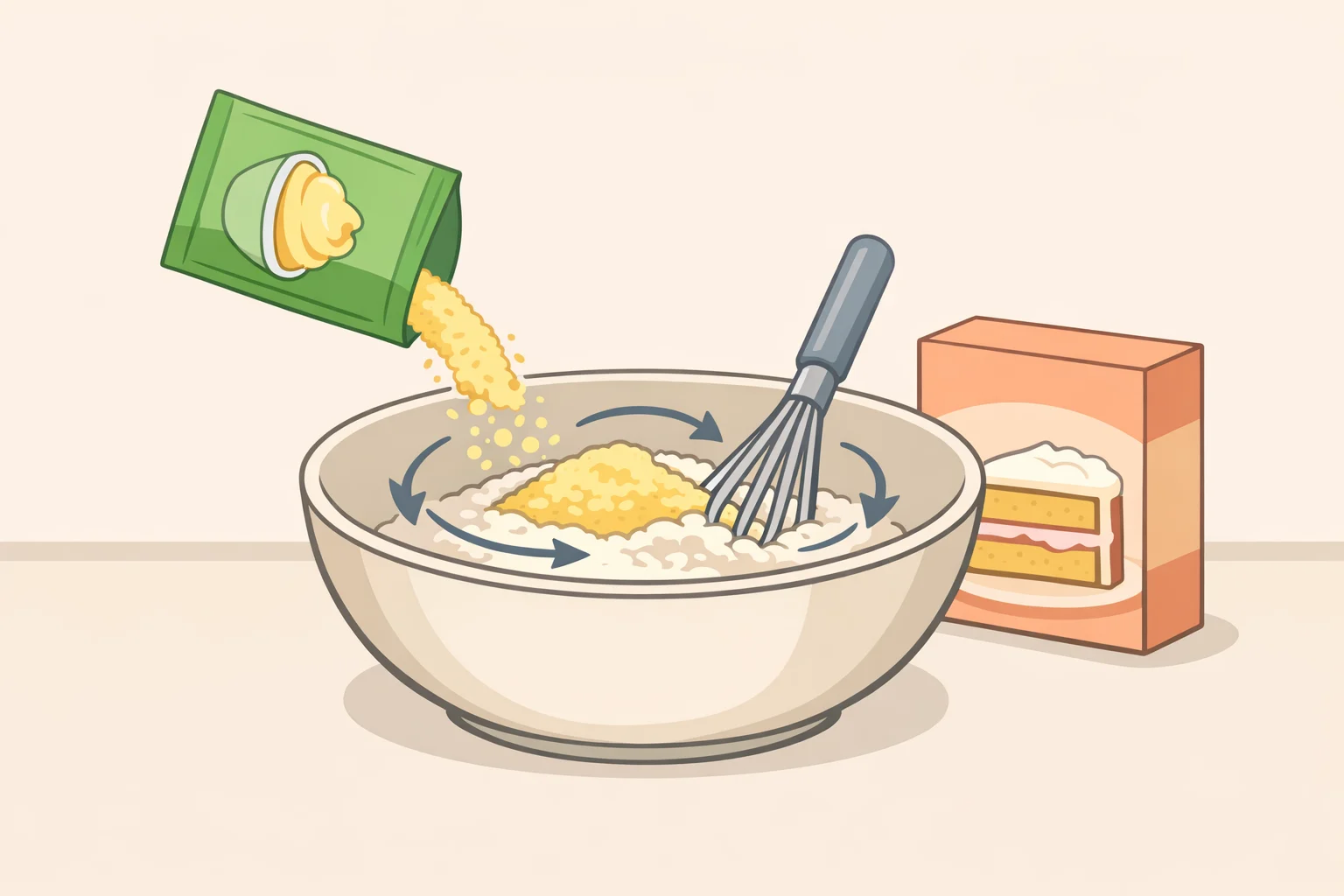
Bakers who use this method consistently specify instant pudding powder added dry, before any liquid goes in. Betty Crocker identifies pudding mix as one of the most reliable ways to lock in softness across cake flavors, noting that it makes cakes irresistibly soft. Using a lemon-flavored pudding packet doubles the citrus concentration without any extra steps.
The warm glaze poured into fork holes is the second essential move. It carries flavor into the interior rather than sitting on the surface, which is what separates this method from simply glazing a standard box cake after cooling. One soaks in. The other coats.
Use instant pudding mix only, not cook-and-serve. The two look nearly identical on the shelf. Bakery Cooks is explicit on this point: the dry instant mix is what the recipe requires. Check the front of the box before opening. There's no fix after baking if you use the wrong one.
Make boxed lemon cake taste better with three quick upgrades

Replacing the water the box calls for with whole milk or half-and-half adds fat and body that water can't provide. Betty Crocker describes the result as richer, with buttermilk as an alternative that introduces a slight tang. One extra egg, bringing the total to four, improves lift and tenderness. Serious Eats found in direct testing that the additional egg produced a lighter, fluffier crumb, with minor doming as the only tradeoff not a concern in a sheet cake.
Fresh lemon zest rounds out the three. One lemon's worth is the right amount for a 15.25-ounce box of batter, per Serious Eats, and it adds aromatic citrus oil that powdered flavoring can't replicate. None of these require baking expertise. Each one has a specific job.
Step-by-step: how to make it
Follow the order here. Steps 5 and 6 are time-sensitive. The glaze must go on while the cake is warm, not hot and not fully cooled. That window is where most people either get it exactly right or miss it entirely.
Step 1: Preheat the oven to 350°F (175°C) and prepare the pan.
Grease a 9x13-inch baking pan, bottom and sides. Butter plus a light flour dusting works well; nonstick spray is fine. Don't skip this even with a nonstick pan. You'll be pressing a fork across the entire surface later, and the cake needs to stay put.
Step 2: Whisk the dry ingredients together.
Combine the dry lemon cake mix and the dry instant pudding powder in a large bowl. Whisk for about 30 seconds until evenly blended. The pudding powder needs to be distributed uniformly before any liquid goes in. Clumps at this stage create uneven texture in the finished cake.
Step 3: Add the wet ingredients and zest.
Add 4 eggs, ½ cup vegetable oil, and 1⅓ cups whole milk or half-and-half directly to the dry mixture. Add the lemon zest. Stir until the batter is smooth and no dry streaks remain, then stop. The batter will be slightly thicker than a standard box cake batter that's expected.
Step 4: Bake for 40–45 minutes.
Pour the batter into the prepared pan and bake for 40 to 45 minutes, per Bakery Cooks. Start checking at 38 minutes: a toothpick inserted in the center should come out clean, and the edges will have pulled slightly from the pan. Don't rely on surface color as the primary signal. This batter can look done before the center has fully set.
Don't open the oven before the 35-minute mark. The pudding powder adds moisture weight to the batter. An early temperature drop can prevent the center from setting, which causes sinking.
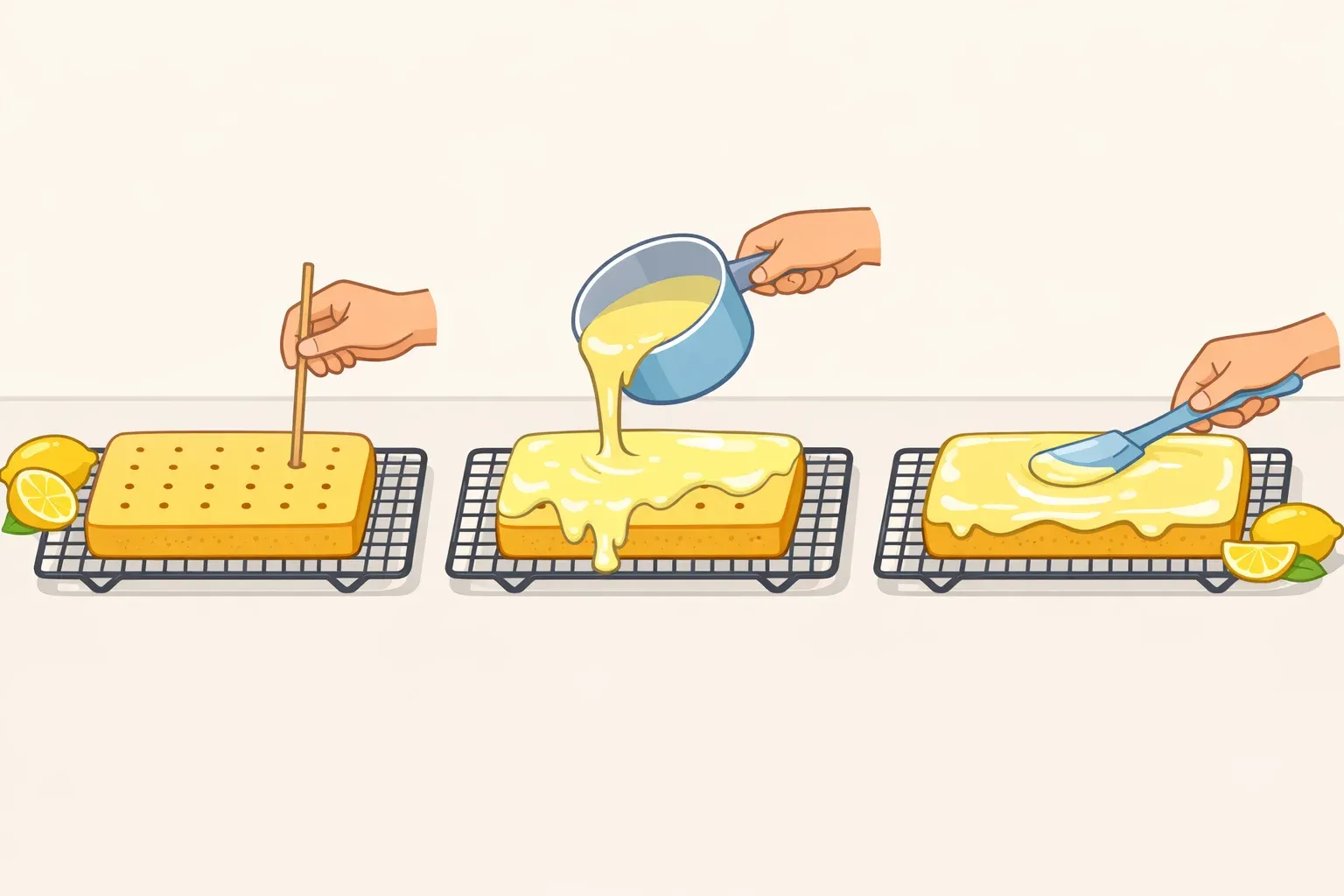
Step 5: Rest 10–15 minutes, then poke holes across the entire surface.
Remove the pan from the oven and let it sit, warm but not hot, for 10 to 15 minutes, per Bakery Cooks. Then use a dinner fork to poke holes evenly across the entire surface, pressing all the way to the bottom. Food52 documents this preference for a fork over a toothpick precisely because the wider holes allow the glaze to absorb more deeply into the crumb. Cover the whole surface, edge to edge.
Step 6: Make the glaze and pour it immediately.
Whisk together fresh lemon juice and sifted confectioners' sugar until smooth and pourable. The original formula documented by Food52 calls for ⅓ cup lemon juice to 2 cups sifted confectioners' sugar as a starting point. Add more sugar to thicken, more juice to thin. Pour the glaze evenly over the warm cake and let it absorb fully before covering or serving.
A fully cooled cake won't absorb the glaze as well it tends to pool on the surface. The 10-to-15-minute window is the right moment. If you miss it, warm individual slices briefly and spoon glaze over each. Reasonable recovery, but not quite the same result.
Food52 also notes this cake is forgiving by nature an abundant glaze can even salvage a slightly overbaked crumb. So if something goes sideways, lean into the glaze.
Troubleshooting common problems
Batter looks too thick: Normal for this recipe. The pudding powder and extra egg add density to the batter. It will spread in the pan and bake evenly. Don't add extra liquid to compensate.
Glaze sits on top instead of soaking in: The cake probably cooled too long before glazing. Let it rest another minute or two, then use a spoon to gently work the glaze into the fork holes so it settles into the crumb rather than pooling.
Glaze is too thin or too sweet: Adjust the ratio. More confectioners' sugar thickens it; more lemon juice loosens it. Taste as you go different lemons vary in acidity, and some cake-mix brands are sweeter than others, which affects how the finished glaze reads.
Center looks underdone: Leave it. Pull the pan only when a toothpick inserted in the dead center comes out clean. The edges will look set well before the middle is ready surface appearance is not a reliable indicator with this batter.
When to make this cake, and when not to
The finished cake is moist, strongly lemony, and more tender than a plain box cake. The glaze sets to a thin, slightly translucent layer on top while most of it has soaked into the holes, flavoring the crumb from the inside. Food52 documents the cake as just as good on the third, fourth, and fifth day as it is fresh. Covered at room temperature it holds for two days; refrigerated and wrapped, up to five. It also freezes for up to three months wrap tightly in plastic then foil, thaw overnight in the refrigerator, and bring to room temperature before serving, per Bakery Cooks.
For birthdays, potlucks, and any event where dessert sits before serving, this is the rare box-mix upgrade that solves a real problem: flavor and texture fade. It won't mimic a scratch bakery cake exactly the crumb is softer and more pillowy, which may matter if you're building a precise layer cake or want an airy, refined interior. But for a sheet cake that needs to travel, hold for two days, and still taste worth eating on day four? It beats a plain boxed cake by a wide margin with almost no extra work. Match the use case accordingly.












Comments
Be the first, drop a comment!