



How to pick a ripe peach that actually tastes good: a three-step method for any produce aisle
The palm rule tells you if a peach is ready. Ground color tells you if it ever had a chance. Here's how to use both.
By the end of this guide, you'll be able to answer two questions at any produce bin: Is this peach ripe right now? And was it ever going to taste good? The first question is about feel. The second is about color. You need both answers, because a peach can be perfectly soft and still be a disappointment.
The three-step method here look, palm, smell filters out two distinct categories of bad peach: the one that's still hard, and the one that was harvested too early to develop sugar and juice regardless of what happens afterward. Ground color is your harvest-maturity check. The palm test reads current ripeness. Smell confirms. Together, they give you the full picture in the time it takes to pick the peach up.
Two things to know before starting. The fingertip squeeze is the most common technique and the least reliable. Georgia farmer Lawton Pearson identified the core problem: the tip of a peach softens before the rest of the fruit is ready, so poking it can signal ripe when the whole fruit isn't. Cupping the entire peach in an open palm gives a more accurate read and doesn't bruise what you're testing. Also: this method can find the best peach in a given bin. It cannot rescue a bin where all the fruit was harvested too early. The triage section covers that scenario.
Step 1: Read the ground color before you touch anything
Pick up nothing. The first check is visual and eliminates fruit you shouldn't bother palming.
Look at the small indentation at the stem end of the peach. The skin color there, underneath any red blush, is called the ground color, and it's your clearest signal of harvest maturity.
You want yellow or cream at the stem end. It doesn't have to be red, but you don't want to see dark green. Yellow or cream ground color, which varies by variety, indicates proper maturity; green indicates immaturity.
Don't confuse blush with ground color. Red on the skin comes from sun exposure during the growing season, not from ripeness. A deeply red peach with green at the stem is immature. That distinction is worth holding onto, because store lighting can make it easy to mistake a vivid blush for a sign of quality.
Check the suture as a secondary visual cue. That's the seam running vertically down the fruit. Properly matured peaches have rounded, evenly developed flesh on both halves of that seam. An uneven or pinched profile often correlates with early harvest, useful when store lighting makes the stem color hard to read.
Small surface blemishes are not disqualifying. Pearson notes that a minor spot can be cut away without losing the rest of the fruit. What disqualifies a peach at this step: green at the stem end, large soft bruises, or significant deformity. Surface scuffs don't count.
If the entire bin shows green at the stem end, stop here. This is a supply problem, not a selection problem. Skip to the triage section below.
Why this visual check matters so much comes down to how commercial peaches travel. Peaches shipped from distant sources, including Chile or other parts of the U.S., have to be picked quite firm to extend shelf life, and fruit from those origins can spend a couple of weeks in transit. Fruit will often end up mealy and dry. Closer to home, most farms harvest a given tree only twice and accept some underripe fruit in the process. Ground color is your best proxy for which category the fruit in front of you belongs to.
Step 2: Check ripe peach texture and softness with the palm test
Only handle peaches that passed Step 1.
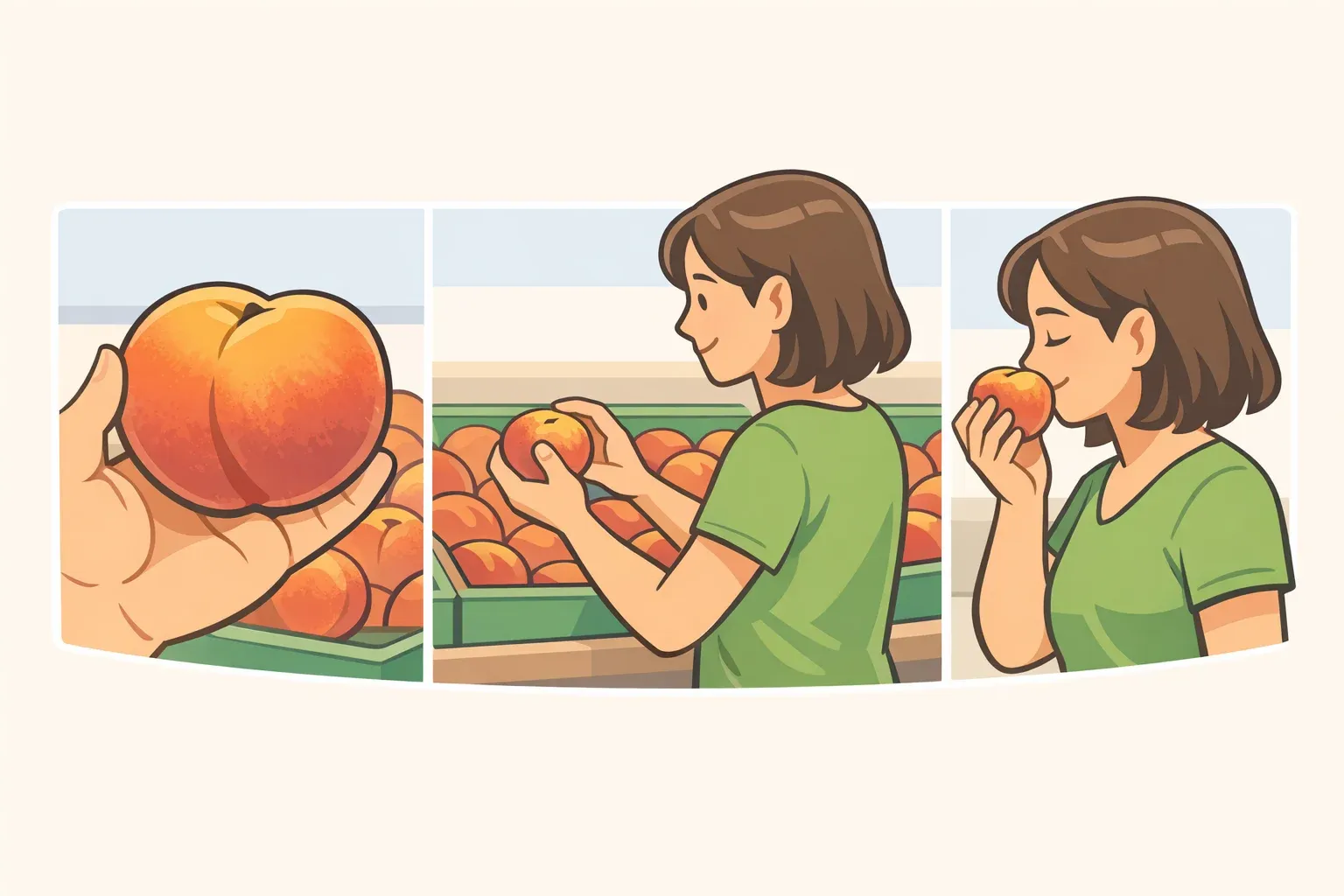
Cup the peach in an open palm. Apply light, even pressure; no fingertip prodding, no pinching. A ripe peach yields slightly and uniformly. That uniform give across the whole surface is what you're after.
Pearson describes the target feel as soft with a slight squishiness, similar to a tennis ball, per The Kitchn. Lanier Pearson, who co-owns the farm with her husband, puts it this way: a ready peach "gives" a little under light pressure and is slightly soft to the touch throughout, as AOL reported last summer.
The palm works because it spreads pressure across the whole fruit at once. Fingertip pressure concentrates force at the one point most likely to mislead: the tip softens first and can register as ripe before the rest of the peach is ready. One light cup is the complete test. Pressing harder gives no additional information and bruises the flesh for whoever handles it next. NC State Extension advises explicitly against fingertip handling during harvest for exactly that reason.
Firmness guide buy accordingly:
Baseball-firm, no give
What it means: Needs more time
When to buy it: Buy for later in the week
Tennis-ball give, slight softness throughout
What it means: Peak or near-peak
When to buy it: Buy if eating today or tomorrow
Stress-ball soft, yields easily
What it means: Past peak for fresh eating
When to buy it: Skip unless cooking it
Buy a mix if you're stocking up: firm ones for later in the week, one or two tennis-ball-ready ones for today. There's typically only about a day between a peach being ripe and too ripe, per The Kitchn, so buying everything at the same ripeness creates immediate pressure to eat them all at once.
Step 3: Smell; use it as a tiebreaker
A ripe peach should be noticeably fragrant at a short distance before you press your nose to the skin. Pearson lists strong aroma alongside palm feel as a readiness signal. Use scent to break ties between two peaches that passed Steps 1 and 2 equally.
Don't rely on scent as the only test. Refrigerated peaches can smell like nothing and still ripen well at home. Absent fragrance is a note of caution, not an automatic rejection.
Fragrance cannot rescue a peach with green at the stem. If it smells pleasant but failed Step 1, put it back. Immaturity at harvest overrides everything downstream, and peaches harvested green can fail to develop properly regardless of how they're handled afterward.
Triage: when the bin is messy
Most real produce decisions involve ambiguous cases. Here's how to handle each one:
Mature ground color, baseball-firm: Passed Step 1, failed Step 2. Buy only if you have several days before eating. Counter-ripen at home.
Soft at the tip, firm everywhere else: This is the false positive the palm rule is designed to catch. If the full-palm test returns baseball-firm, the peach isn't ready, regardless of what the tip says.
Fragrant but green at the stem: A pleasant smell doesn't redeem early harvest. Green ground color overrides it. Put it back.
Small blemish, otherwise good: Buy it. Cut the spot off. A surface mark is not a reason to reject a peach that passes Steps 1 and 2.
Entire bin is green, no fragrance, no give: No in-store technique fixes fruit that wasn't harvested mature. Return in two or three days, try a different market, or look for a local farmers market during regional peak season.
Triage priority order: mature ground color, then uniform palm give, then aroma, then surface appearance. A peach that ranks well on the first two is worth buying even if it smells faintly or has a minor scuff. Green at the stem overrides everything else.
How to tell if a peach is ripe enough to refrigerate and how to store it either way
The advice to buy firm peaches for later in the week only pays off with a workable plan for finishing the ripening at home.
Counter at room temperature is the default for firm peaches. Leave them stem-side down, out of direct sun. Wainwright recommends a covered porch or shaded surface to speed things along; direct sunlight doesn't help, and he advises against it.
Paper bag if you need them faster. Sealing a firm peach in a paper bag for 12 to 24 hours concentrates the ethylene it releases and accelerates softening. Check at the 12-hour mark; the window between ready and overripe is short.
Refrigerator to pause, not to ripen. Once a peach reaches tennis-ball softness, cold slows further softening and maintains current ripeness. Keep refrigerated peaches away from ice, which bruises the skin. One important caveat: the temperature range of most home refrigerators, roughly 37 to 45°F, falls squarely in the zone that can produce a mealy texture. Refrigerate a ripe peach briefly to pause it, not to ripen a firm one, and let it return to room temperature before eating.
Overripe peaches: don't discard them. The Pearsons recommend cooking overripe fruit in a peach cobbler, crisp, or crumble, where the fruit will soften further anyway, and the extra sweetness works in your favor.
Conclusion
The complete in-store method: look for yellow or cream at the stem end and pass on anything showing green there. Palm what's left with an open hand and light pressure, feeling for tennis-ball give distributed across the whole fruit, not just the tip. Smell to break ties. Buy a mix of firmness that matches when you'll actually eat them.
When a supermarket bin consistently underperforms, no selection method can fix fruit that was harvested too green. The better move is finding a regional source during peak local season. A well-grown, locally shipped peach can taste like one from a backyard. Failing that, return to the same store in a few days when a different delivery has arrived.
The window is genuinely short. There's typically only about a day between peak ripe and past it. Buying by intended eating date, using the counter to ripen and the fridge to pause, is how you stay on the right side of that line.


Comments
Be the first, drop a comment!