



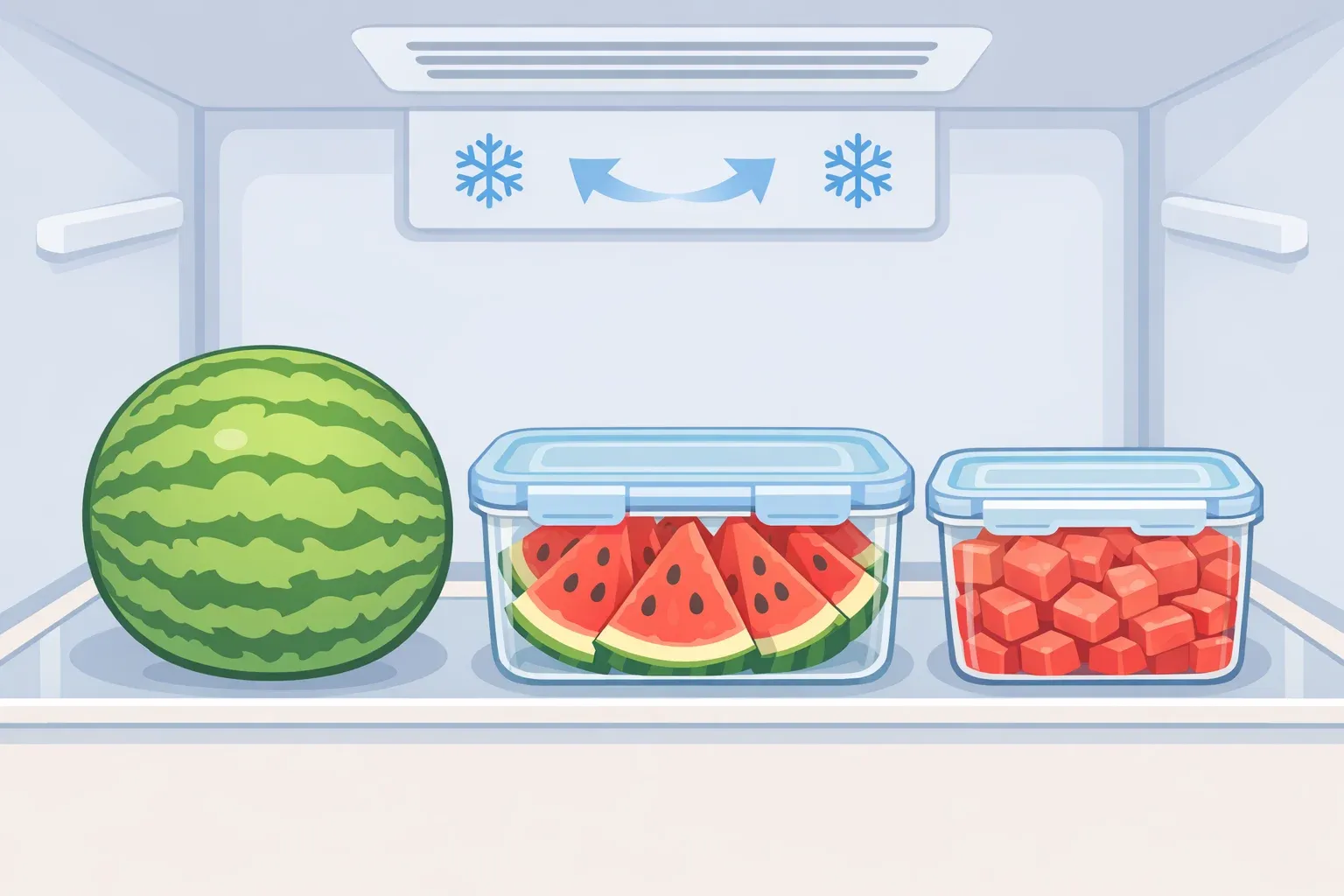
How to Store Watermelon: Whole, Wedged, or Cubed
By the end of this guide, you'll know exactly how to store watermelon at every stage whole, halved, wedged, or cubed so it stays firm, sweet, and safe to eat for as long as possible.
The quick answer:
| Form | Where to store | How long |
|---|---|---|
| Whole melon | Cool spot (50–60°F) if available; fridge if kitchen runs warm | 2–3 weeks |
| Large wedges or halves | Airtight in the fridge, 37–40°F | 3–4 days |
| Cubes | Airtight in the fridge, 37–40°F | 3–4 days (quality drops faster) |
| Frozen pieces | Airtight bag or container in freezer | Up to 6 months |
The rest of this guide explains the reasoning behind those numbers and one counterintuitive finding about rind-on storage that changes how most people should be cutting their melon in the first place.
Cutting watermelon starts a process you can slow but not stop. Fresh-cut processing triggers physical damage that drives juice leakage, firmness loss, and color changes in the flesh. Juice losses average 4% to 10% of the melon's fresh weight during storage, and cubes refrigerated for nine days at 5°C develop water-soaked areas and score lower on appearance and sensory panels than whole fruit (Frontiers in Genetics, published February 2025). A 2018 multistate Salmonella outbreak linked to fresh-cut fruit salad resulted in 60 cases across six states, as summarized in that same postharvest review citing FDA data a reminder that proper handling of cut melon isn't just a texture question.
The basic rule is simple: the less you cut, the longer it keeps. Whole beats wedge, wedge beats cube. Cut as you go, not all at once.
Storing a whole watermelon: what the research actually says for home kitchens
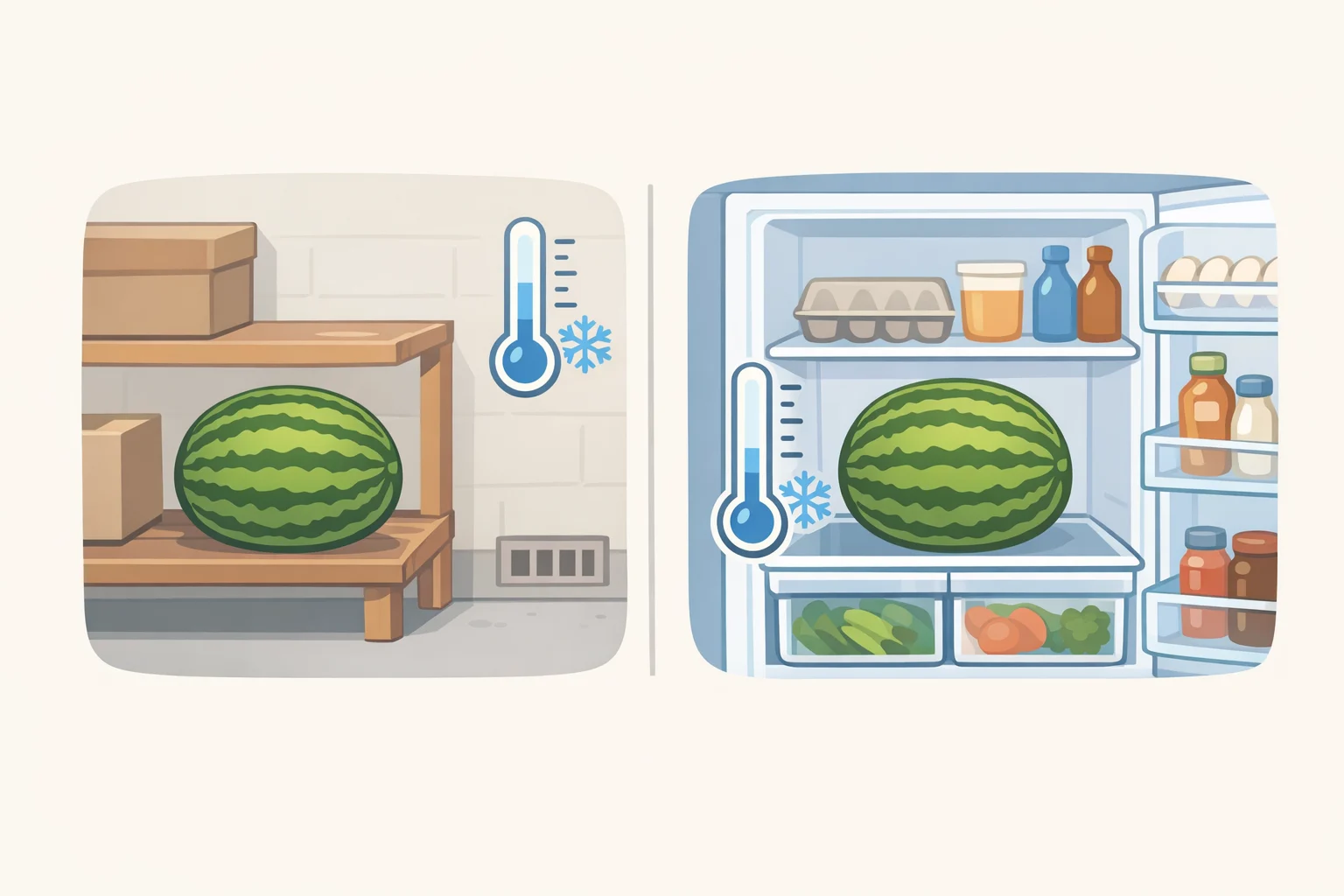
Whole-melon storage is where the guidance gets slightly complicated, so it's worth explaining the tension before giving a recommendation.
What ideal conditions look like and why most homes can't hit them. Food scientists recommend storing whole watermelons at 50–60°F with around 95% relative humidity, conditions under which they can last two to three weeks (University of Minnesota Extension, 2021). That's the sweet spot for a cool basement, a climate-controlled garage, or commercial cold storage. A typical home refrigerator runs too cold for ideal long-term whole-melon storage, while a warm kitchen counter accelerates deterioration.
What a 2025 postharvest study found and how to interpret it. A controlled study on seedless watermelons found that 4°C (about 39°F) was the optimal temperature for maintaining firmness and resisting water-soaking, with marketable quality held for up to 40 days under those conditions. Dropping to 2°C (about 35°F) caused chilling injury, accelerating the soggy, translucent damage most people are trying to avoid (KOPAST postharvest study, 2025). That study was conducted under controlled humidity, not in home refrigerators. So while it confirms that refrigeration near 39°F can work well, it also flags the risk of going too cold which is easy to do in a fridge set to its default or lowest setting.
What this means based on your actual kitchen:
- If you have a cool space at 50–60°F (basement, garage, mudroom): store the whole melon there. Keep it away from bananas, apples, tomatoes, and cantaloupe. Watermelons don't produce ethylene but are sensitive to it, and nearby ethylene-producing fruit will accelerate softening (University of Minnesota Extension, 2021). Under these conditions, two to three weeks is realistic.
- If your kitchen runs warm: skip the counter and refrigerate the whole melon. Warm-kitchen deterioration outweighs the quality trade-off from refrigeration. Set the fridge no lower than 37°F if you can, and plan to use the melon sooner rather than later.
- If you're refrigerating: place the melon away from the coldest zone. The rind buffers the flesh from minor temperature variation, but keep the thermostat off the lowest setting to stay above the chilling-injury threshold confirmed in the postharvest research.
How to store cut watermelon: cut less, cover more, and mind the temperature
Once the rind is broken, the approach changes. These steps apply to any cut form halves, wedges, or cubes with the biggest quality differences coming from how much you cut before storing.
Step 1: Wash your hands, then scrub the outside before the knife touches it. Start by washing your hands, then scrub the whole melon with a vegetable brush and cool water. Bacteria on the rind surface can transfer directly into the flesh as the blade passes through (Iowa State University Wellness, 2021). Neither step takes long, and both meaningfully reduce contamination risk in the cut pieces.
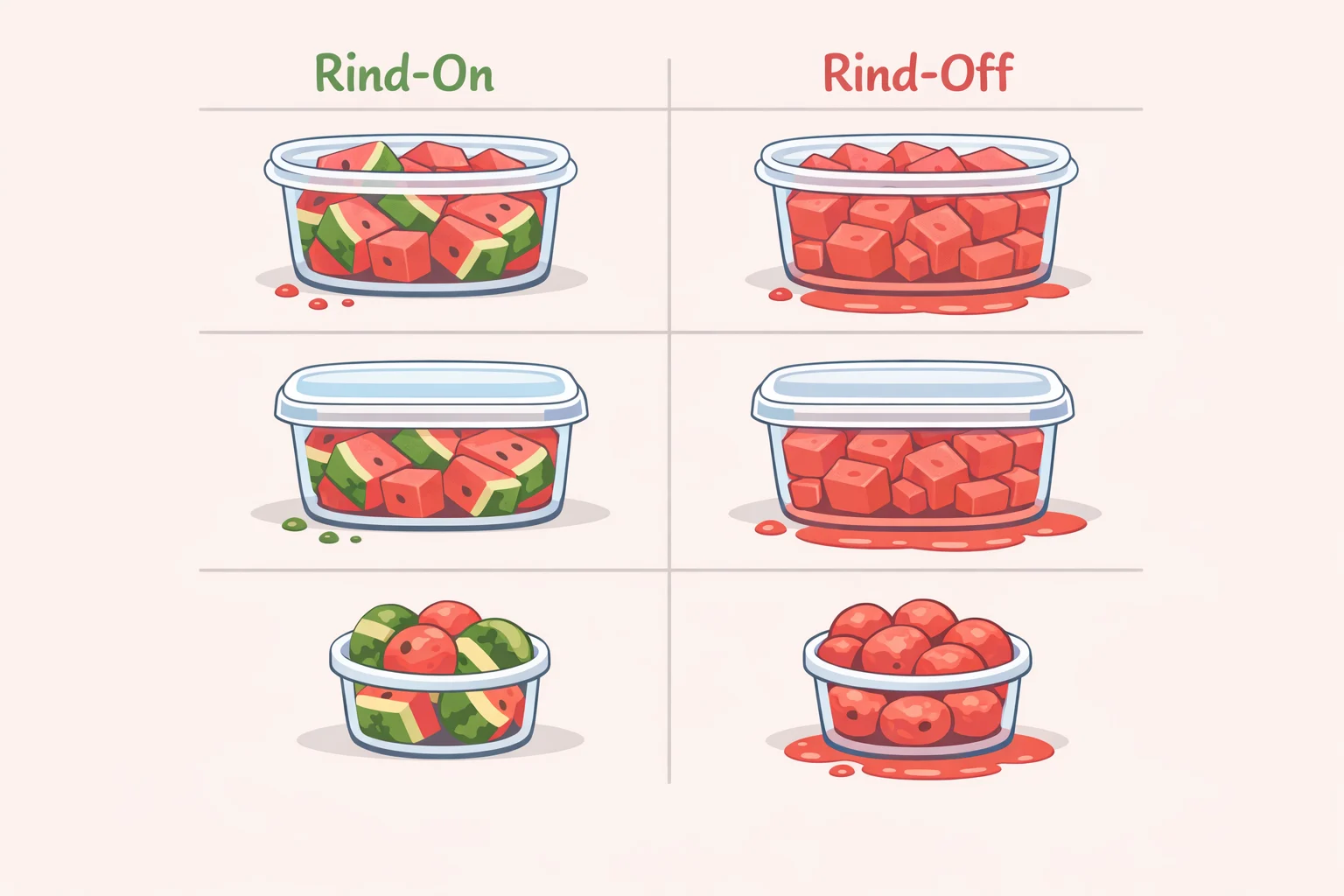
Step 2: Cut only what you need right now store the rest as large pieces with rind on. The clearest practical finding from current research: keep the rind attached for as long as possible. Rind-on slices showed 47% less juice leakage than fully peeled pieces stored under the same conditions, and held on to significantly more total sugars glucose, fructose, and sucrose (Frontiers in Genetics, February 2025). The ranking for storage quality is straightforward:
- Whole melon best
- Large wedges or halves with rind on next best
- Cubes or fully peeled pieces quality declines fastest
If you're feeding a crowd today, cube away. If you're prepping for the week, store wedges and cut as you go.
Step 3: Seal it immediately. Exposed watermelon flesh loses moisture, picks up refrigerator odors, and leaks juice onto everything below it. For halves, press plastic wrap directly against the cut surface before refrigerating. For wedges and cubes, use an airtight container not a bowl covered loosely with a plate or plastic wrap, which still allows air circulation. Iowa State University Extension specifically recommends tight wrapping or an airtight container for all cut melon (Iowa State University AnswerLine, May 2025).
Step 4: Refrigerate at 37–40°F and understand why that range matters. The food safety floor is 40°F or below; bacteria grow readily in cut melon held warmer than that (Iowa State University Wellness, 2021). But colder isn't always better. Cubes stored at 1°C (about 34°F) had roughly 50% more juice leakage than those held at 3°C (about 37°F) over 10 days. Cubes at 1–3°C lasted about 10 days before quality failed, while those stored above 7°C (45°F) fell below acceptable quality in under 6 days (Frontiers in Genetics, February 2025). The 37–40°F target zone is safe and avoids the texture penalty of near-freezing temperatures.
Step 5: Use cut watermelon within three to four days. After that window, the sweetness begins seeping out of the flesh into the pooling juice at the bottom of the container, and the flesh itself starts to soften and eventually ferment (Iowa State University AnswerLine, May 2025). Don't push it.
How to tell when watermelon is past its best
Most storage mistakes are easy to spot before you take a bite.
- Pooled liquid in the container. Some moisture is normal. A significant pool of juice at the bottom, combined with pale or translucent flesh, means the sugars have migrated out and the texture is gone.
- Soft, mushy cubes. Fresh watermelon should have some resistance. Cubes that compress easily have crossed the fermentation threshold. If there's any off-smell, discard.
- Storing cubes when wedges would do. This is the most common storage mistake. Removing the rind before refrigerating dramatically accelerates juice loss. Store the largest piece you can and cut to order.
- Loose covering instead of an airtight seal. A plate set on top of a bowl, or plastic wrap draped over it, still allows air exchange. The flesh dries out, picks up fridge odors, and loses moisture faster than it should. Use an airtight container or press wrap directly against the cut surface.
- Fridge running too warm. Cut melon held above 40°F creates conditions for bacterial growth (Iowa State University Wellness, 2021). If your fridge has been running warm or the door gets opened frequently, err toward the lower end of the 37–40°F range.
Can you freeze watermelon? Yes, but use it the right way
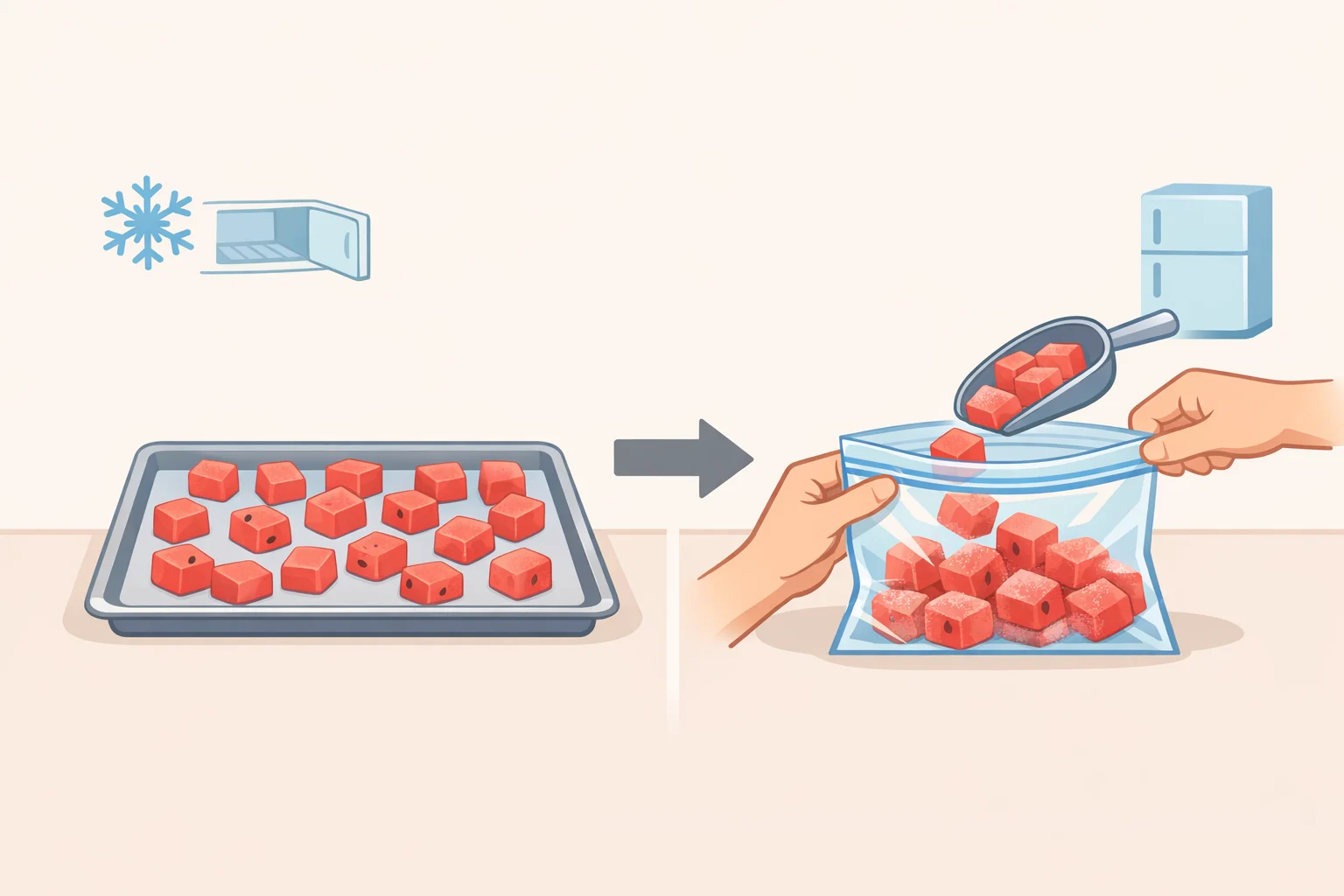
Freezing is a legitimate option when the melon outruns your appetite. One honest caveat: what comes out of the freezer won't work for fresh eating.
Remove the rind, cut the flesh into pieces, and arrange them in a single layer on a baking sheet. Freeze until solid, then transfer to an airtight bag or container. Properly frozen watermelon keeps for up to six months (Iowa State University AnswerLine, May 2025).
Because watermelon has very high water content, the cell walls collapse during freezing. Fully thawed pieces turn soft and mushy not suitable for eating fresh. The frozen version works very well in smoothies, blended drinks, slushies, and ice pops where texture gets blended away anyway.
The one exception: serve frozen watermelon while it still has some ice crystals in it. Semi-frozen pieces hold their shape well enough to eat directly and work as a cooling snack on their own terms (Iowa State University AnswerLine, May 2025). Think granita, not fruit salad.
Putting it together
If you remember one thing from this guide, make it this: leave the melon in the largest piece you can, and only cube what you're about to eat.
Whole melons last longest at 50–60°F with high humidity, away from ethylene-producing fruit. For most home kitchens without that option, a fridge set no lower than 37°F beats a warm counter (University of Minnesota Extension, 2021). Once cut, store wedges with the rind on, seal tightly, and finish within three to four days (Iowa State University AnswerLine, May 2025). For anything beyond that window, freeze it for blended use.
Small adjustments one fewer cut, one better seal, a fridge that's cold but not freezing add up to noticeably better watermelon all week.










Comments
Be the first, drop a comment!