


This maple brown sugar fudge cake recipe walks you through baking a single-layer sheet cake and topping it with a boiled fudge frosting that sets glossy and thick without a speck of powdered sugar. The payoff is a tall, tender 13-by-9 cake that serves 16 to 20 people, finished with a topping The Kitchn describes as creamy and smooth, lighter than fudge but firmer than a glaze, instead of a standard buttercream.
Baking the cake itself follows a method any home baker already knows: butter and sugar creamed together, eggs beaten in, dry and wet ingredients alternated. The frosting is a different animal. It's a boiled-sugar technique borrowed from fudge and penuche, and it calls for a candy thermometer and a bit of patience.
Plan for more total time than the short ingredient list implies: prep runs about 30 minutes and the cake bakes for close to an hour, but the frosting alone needs 45 to 55 minutes of undisturbed cooling plus another 10 to 35 minutes of beating, depending on whether you're using a stand mixer or a hand mixer. Most of that time is hands-off, since the cake cools in its pan while the frosting works on the stove.
What makes this brown sugar fudge cake different
Brown sugar and maple syrup are the whole personality of this cake, not background flavor. The Kitchn pairs the two because together they build an earthy, caramel-y, bright flavor that neither ingredient manages alone.
Brown sugar's molasses content makes it hygroscopic, meaning it draws in and holds onto moisture, which is one reason recipes built around it tend to bake softer and stay fresher longer than versions made with plain white sugar.
Sour cream isn't in the recipe for tang. It adds density to stand up to the heavy frosting, and works alongside the baking powder and baking soda to tenderize and lift the crumb. That's also why the substitutions covered later in this guide have real limits: the cake is built around two specific ingredients working together, not a generic vanilla base that happens to include brown sugar.
What you'll need for maple brown sugar cake and frosting
For the cake:
2 sticks (8 ounces) unsalted butter, at room temperature, plus more for the pan
1 cup whole milk, at room temperature
1/2 cup sour cream, at room temperature
3 large eggs, at room temperature
3 cups all-purpose flour
2 teaspoons baking powder
1/2 teaspoon baking soda
1 3/4 cups packed light brown sugar
1/2 teaspoon kosher salt
1 tablespoon vanilla extract
1/2 teaspoon maple extract (optional)
For the frosting:
2 cups packed light brown sugar
1 1/4 cups heavy cream
3/4 cup pure maple syrup (not pancake syrup)
1/4 teaspoon kosher salt
1/2 teaspoon vanilla extract
3 tablespoons unsalted butter, cut into 6 pieces
1/3 cup chopped, toasted pecans or walnuts
Equipment: a 13x9-inch metal baking pan, parchment paper (optional), a stand mixer or hand mixer, a high-sided saucepan that holds at least 3 quarts, a candy or deep-fry thermometer, and a small offset spatula.
Two ingredient notes matter before you shop. Use light brown sugar specifically: Its softness is essential for a soft cake and an evenly cooked frosting. And skip pancake syrup or sugar-free syrup entirely, since neither will boil correctly to set the frosting. Grade A amber and strong maple syrup both work fine, since they share a similar boiling point.
The cake batter is beginner-friendly. The frosting asks for more attention because it's a boiled-sugar technique; give it your full focus rather than juggling it alongside three other dishes.
How to make a maple brown sugar fudge cake recipe step by step
Bake the cake first
Heat the oven to 350°F. Butter the bottom of the 13x9-inch pan, then line the bottom and two long sides with a sheet of parchment that extends a few inches past the edges to form a sling; butter the parchment too. If you'd rather serve the cake straight from the pan, skip the parchment and just butter the pan.
Whisk 3 cups flour, 2 teaspoons baking powder, and 1/2 teaspoon baking soda in one bowl. In a separate bowl, whisk the milk and sour cream together. In a stand mixer, beat the butter, 1 3/4 cups light brown sugar, and salt on medium-high until light and creamy, 2 to 3 minutes.
Beat in the eggs one at a time, waiting until each is fully incorporated before adding the next, then beat in the vanilla and maple extract if using. Drop the mixer speed to low and add the flour mixture and milk mixture in three additions, starting and ending with flour. A slightly curdled look partway through is normal, not a sign anything went wrong.
Scrape the batter into the pan, spread it into an even layer, and bake 35 to 50 minutes, until the top is lightly browned and the center springs back to a gentle touch. Let the cake cool in the pan while the frosting comes together; frosting a warm cake will just melt the topping instead of letting it hold its shape.
Build the fudge frosting
Before the burner goes on: use a high-sided saucepan that holds at least 3 quarts, keep kids and pets away from the stove, and don't touch or taste the syrup once it starts bubbling. Boiling sugar syrup runs far hotter than boiling water and can cause a serious burn if it splashes.
Combine the light brown sugar, heavy cream, maple syrup, and salt in the saucepan. Cook over medium-low, stirring frequently, until the sugar dissolves and the edges begin to bubble, 4 to 5 minutes.
Clip a candy or deep-fry thermometer to the side of the pan and raise the heat to medium. Bring the mixture to a boil without stirring, and keep boiling until it registers between 234°F and 238°F, roughly 10 to 15 minutes. This soft-ball range is what lets the frosting set correctly later, so don't rush it off the heat early.
Remove the pot from the heat and leave it alone. Let it cool undisturbed until it reaches 120°F to 130°F, which takes 45 to 55 minutes. Resist stirring or moving the pot during this stretch; disturbing the syrup before it's cooled enough tends to push the sugar toward a grainy set instead of a smooth one.
Remove the thermometer, then stir in the butter and vanilla until the mixture turns shiny. Transfer to a stand mixer and beat with the paddle attachment on medium until the color lightens to a pale, milky-tea beige and a ribbon of frosting sits briefly on top without melting back in, about 30 to 35 minutes in a stand mixer or 10 to 15 minutes with a hand mixer worked directly in the saucepan.
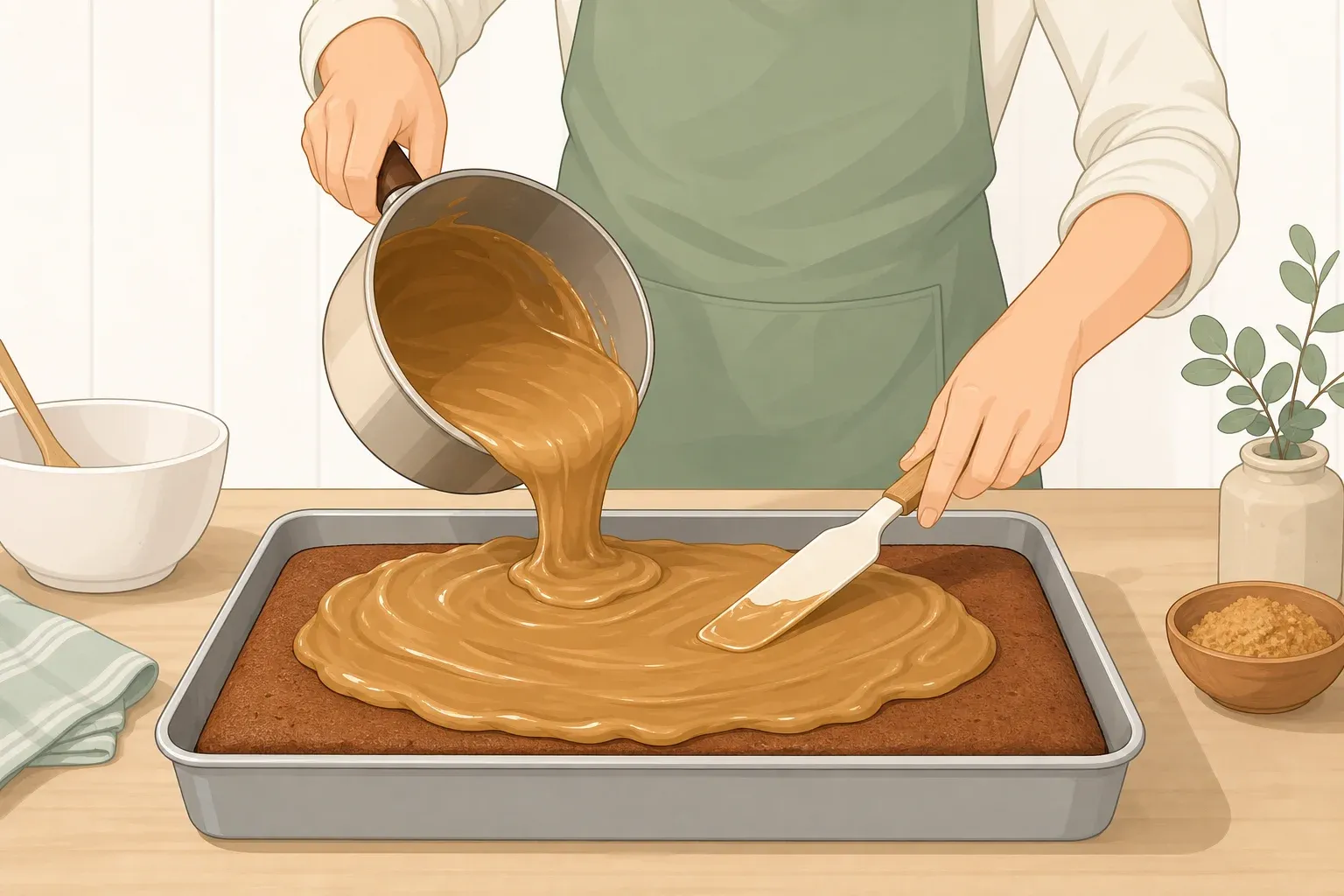
Spread the frosting onto the middle of the cooled cake with a small offset spatula, stopping just short of the edges since it spreads a little on its own. The surface sets quickly. Once it starts to firm up, make only a few light passes with the spatula; continued smoothing after that point tends to leave the surface looking grainy instead of glossy.
Sprinkle with the chopped, toasted pecans or walnuts and let the frosting sit until firm, 1 to 2 hours. Lift the cake out of the pan using the parchment sling before slicing.
Maple fudge frosting without powdered sugar: fixes for common problems
The frosting skips the standard powdered-sugar formula, which is why it tastes noticeably less sweet and sits lighter on the fork than a typical buttercream. It isn't butter-free, since it calls for 3 tablespoons, but that's a small amount compared to what most frosting recipes use.
If the frosting hasn't reached that pale beige ribbon stage by the top end of the beating window, it likely didn't hit the full soft-ball temperature during the boil. Keep beating a little longer before giving up on it. If it still won't thicken, treat it as a note for next time: aim for the higher end of the 234°F to 238°F range on the next batch.
If the frosting turns grainy after it's spread, something disturbed it after it started setting. Once graininess shows up, stop touching it; reworking a setting fudge frosting almost always makes the texture worse.
For syrup swaps, stick with Grade A amber or strong maple syrup. Both share a similar boiling point and will set properly. Pancake syrup and sugar-free syrup are ruled out because neither reaches the right consistency when boiled.
Heavy cream isn't a spot to cut corners. Its richness helps prevent curdling during the boil, and whipping cream works as a direct stand-in. Lighter dairy like half-and-half or milk hasn't been tested in this recipe, so treat that swap as unproven rather than assume it will behave the same way.
Finish, store, and serve your maple brown sugar fudge cake
Success looks like a tall, tender crumb under a set, glossy, light-beige frosting that holds its shape when you slice into it, not a puddled glaze and not a grainy crust.
For make-ahead planning, the cake layer can be baked up to a day in advance: cool it, wrap it well, and hold it at room temperature until you're ready to boil the frosting. Once frosted, the cake keeps in an airtight container at room temperature for up to a week. After refrigeration, slices stayed tender, and the frosting held its texture through more than a week of taste-testing.
For longer storage, the frosted cake freezes well for up to two months, which makes it easy to portion ahead of a gathering or keep a slice on hand for later.
Small differences in frosting height between batches are normal and come down to beating time, not a mistake. If a batch sets thinner than you'd like, jot down how long you beat it and add a minute or two next time before it reaches the ribbon stage. Once the frosting is glossy, pale beige, and holding a ribbon shape on top, stop adjusting and get it onto the cake.

Comments
Be the first, drop a comment!