



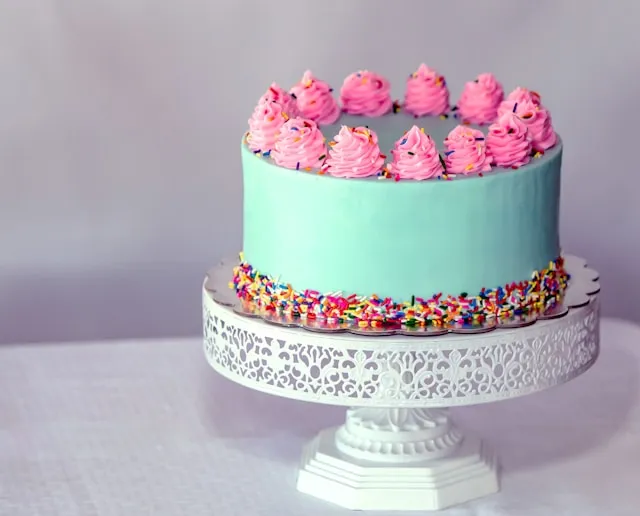
Press an embossed paper towel lightly onto chilled buttercream and lift it away, and its swirl or floral pattern transfers straight onto the frosting. Flip the same paper towel trick for smooth cake frosting instead, swapping in a plain, pattern-free sheet, and it works in reverse: it erases bumps and spatula marks rather than adding a design. All it takes is a paper towel and a properly crusted layer of buttercream.
The mechanism is the same both ways. Most paper towels feature an embossed texture that presses into soft frosting the way a stamp presses into ink. Swap in a smooth, unembossed sheet and that texture disappears, so the towel flattens ridges instead of adding them, producing a finish similar to what a specialty cake scraper delivers. The decorating version isn't new, either; it goes back at least half a century.
This guide covers both versions: which one fits the look you want, how to execute each, and the one prep detail, a properly crusted buttercream, that decides whether either one works at all. It's beginner-friendly. Patience while the frosting sets up is the real skill involved.
Choose your finish before you start
Both versions begin from the same base coat of buttercream, so the choice comes down to the look you want and what your frosting can support.
Pick an embossed towel for texture. The pattern reads as a repeating, lace-like design across the top and sides, a fast way to dress up a plain cake without a piping bag. Pick a smooth, pattern-free towel for the opposite effect: a smoother surface without an obvious towel imprint. Viva Signature Cloth Choose-A-Sheet Paper Towels is one documented option for this, and Chowhound notes a handful of other brands also make towels without embossed patterns
Either way, the frosting has to cooperate. This works best with a crusting buttercream, commonly a butter-and-shortening blend, that firms slightly after chilling. Non-crusting styles, including some whipped ganache or cream cheese frostings, may not hold up to either version and may need a cake scraper or warm offset spatula instead.
This is a surface-finishing technique, not a repair method. It won't fix exposed cake, thin frosting, or major gaps in the coat; those need more buttercream and another crumb-coat pass before the paper towel comes out.
Setup, timing, and the frosting condition that makes this trick work
Skip the crusting step, and a paper towel will just smear the frosting instead of stamping or smoothing it. Here's what to have ready:
Difficulty: beginner-friendly
Wait time: roughly 15 to 30 minutes to develop a crust, possibly longer to firm it further
Starting point: baked, cooled cake layers, already stacked and crumb-coated
Frosting requirement: a crusting buttercream that firms slightly in the fridge
Tools: a full sheet of paper towel, embossed for a pattern or smooth for a plain finish, plus optional powdered sugar, a flexible bowl scraper, or a fondant smoother
Prep is identical no matter which version you choose. Spread a thin crumb coat over the stacked cake and chill it, then apply a generous final layer of buttercream as evenly as you can manage; it doesn't need to look perfect yet.
From there, the two sources differ slightly on timing. The Kitchn recommends resting the cake 15 to 30 minutes to let the surface dry and form a light crust. Chowhound recommends an additional 30-minute chill on top of that to firm the frosting further. Treat both numbers as starting points rather than a fixed formula, and let the surface itself tell you when it's ready.
Before committing the whole cake, check the crust. To avoid marking the visible surface, you can test the towel on a small edge first. Press lightly. If frosting pulls away and sticks to the towel, the crust isn't set, so give it more time to crust before trying again. If the surface still hasn't crusted after 30 minutes total, the buttercream likely holds too much moisture for this method.
How to remove air bubbles from buttercream before frosting
This is a separate problem from crusting, and it's worth solving before the frosting ever touches the cake. If your buttercream looks airy or bubbly once mixed, switch from a whisk to a paddle attachment and run the mixer on low speed. It can take up to 20 minutes to see results, but the wait produces noticeably smooth buttercream frosting without air bubbles.
The towel step is intended to smooth the surface; it doesn't replace mixing techniques for reducing air bubbles trapped inside the buttercream. If frosting still looks pitted or uneven after piping or spreading, that's an internal air problem to fix at the mixer, not something either paper towel method will correct.
How to stamp a decorative pattern with a paper towel
Once the crust checks out:
Choose a full sheet of sturdy, lint-free paper towel with an embossed pattern. Skip thin, flimsy sheets that can shred into the frosting.
Press the towel lightly but firmly onto the crusted frosting.
Lift the towel straight up, then reposition and repeat across the top and sides, overlapping each press slightly so the pattern reads as continuous rather than patchy.
Done correctly, the towel's swirls, florets, or diamond pattern transfer onto the buttercream as a repeating, lace-like texture. This version smooths the frosting as it stamps, so the layer underneath doesn't need to be flawless going in.
Pressure is where most people go wrong. Too hard tears the crust; too light leaves a faint, patchy pattern. Test on a small, out-of-sight spot first so you know how much force the crust can take.
If a few ridges remain after stamping, flatten them with a fondant smoother, such as the Ateco 1301, rather than switching towels mid-project.
The paper towel trick for smooth cake frosting
If a stamped pattern isn't the look you want, the same crusted buttercream and the same basic motion get you a smoother surface instead, with one swap.
Swap the embossed sheet for a smooth, pattern-free towel. Most paper towels are imprinted with some kind of pattern or logo, which transfers onto the frosting the same way an embossed sheet does.
Lay the towel flat against the crusted frosting, then gently and evenly rub with your fingertips or a flexible bowl scraper, working around the cake.
If the towel starts sticking, dust it lightly with powdered sugar and keep going.
Work your way around the edge and top until the frosting feels smooth and ready for extra embellishments. This is the paper towel method for buttercream at its simplest: a flat sheet and a light touch, no fancy scraper required.
What success looks like
Check the result before moving on to decoration.
Stamped version: a continuous, repeating pattern with no torn frosting and no bare, unpressed patches.
Smoothed version: a flat surface with no visible quilting, logos, or transferred texture from the towel.
Either version: if the towel pulls frosting away instead of leaving a clean mark, stop. That's a sign the crust needs more time, not more pressure.
Troubleshooting: sticking, imprints, and frosting that won't cooperate
Frosting sticks or tears when the towel lifts. The crust isn't set. Give it more time to crust, or dust the towel with powdered sugar before pressing.
An unwanted pattern shows up during the smoothing version. The towel had some embossing, quilting, or a printed logo, even a faint one. Switch to a confirmed pattern-free sheet and check a small spot before continuing.
The stamped pattern looks uneven or patchy. Uneven pressing is the usual cause. Chowhound notes that practice and patience improve results over repeated attempts, so expect it to take a try or two before the spacing feels natural.
The frosting won't crust at all after 30 minutes. The buttercream may hold too much moisture for this method. Non-crusting styles, including some whipped ganache or cream cheese frostings, may need a different approach. For a smooth finish, switch to a cake scraper or warm offset spatula. If you're working with something less common, Swiss meringue, Italian meringue, or a vegan buttercream, consider testing a small area first, since the research behind this method doesn't confirm how those varieties behave.
The sources behind this method don't address the food-contact safety of paper towels directly. If that gives you pause, keep in mind the alternative only covers the smooth finish: a cake scraper or warm offset spatula. No source confirms another way to reproduce the stamped pattern without a paper towel.
Finishing up
Once the surface passes the check above, whether stamped or smoothed, move straight into piping a border, adding sprinkles, or whatever decoration the cake calls for.
Chill the finished cake according to whatever timing the recipe itself calls for before serving. If the frosting never developed a crust, or it kept sticking no matter how long it chilled, stop working the paper towel and switch to a cake scraper or warm offset spatula instead. The cake underneath is still fine; the buttercream recipe just isn't suited to this particular finishing method.



Comments
Be the first, drop a comment!