



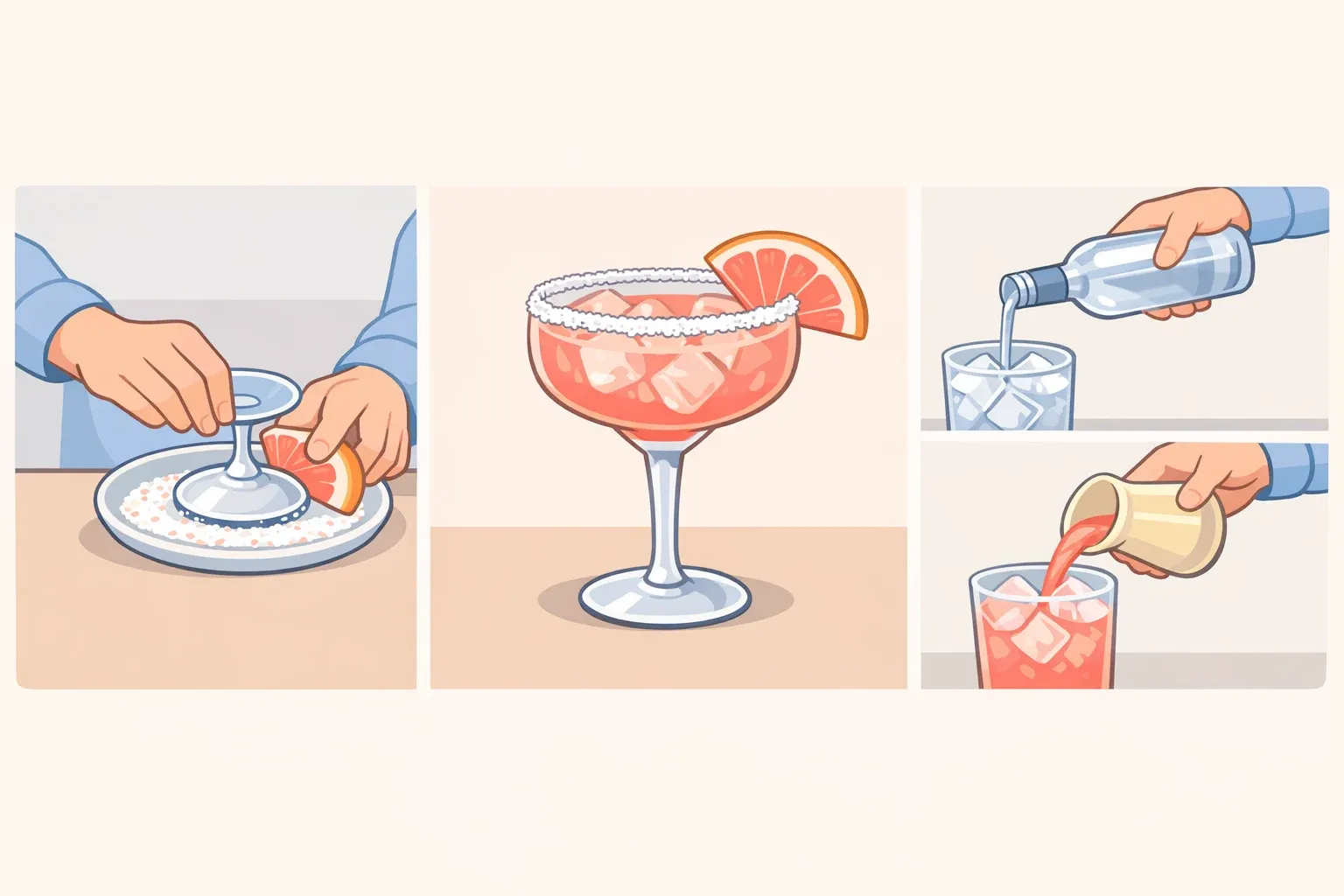
Salty Dog Cocktail Recipe: Why a Salt-Sugar Rim Works Better
Here's what this guide covers: why the standard salt rim underperforms on a drink this simple, how an equal-parts salt-and-sugar blend tastes more balanced in practice, and the exact steps to build the drink correctly. There are two common mistakes that undo an otherwise straightforward build. Both are avoidable.
The rim is the whole game
The Salty Dog is one of the most stripped-down cocktails you can make. Vodka, fresh grapefruit juice, ice, and a rimmed glass. There's almost nothing to adjust, which means the rim isn't a finishing touch. It's the only real decision in the recipe.
Most versions get it wrong.
The drink descends from the Greyhound, a 1930s build of gin, grapefruit juice, and ice, as Tasting Table noted in March 2023. The salted rim is precisely what separates the two drinks; the salt "distinguishes it from the related Greyhound," per Wikipedia. The original called for gin, but vodka has become the standard modern build. As for origins, FlawlessCooking acknowledged in December 2025 that "the true origins of the Salty Dog remain a mystery," so the history is context, not the point.
The point is that a two-ingredient cocktail with no mixer, no liqueur, and no sweetener lives or dies by the one variable you can actually control.
A pure salt rim tames bitterness but can dominate a drink this simple. Swap it for an equal blend of coarse salt and granulated sugar, and the same cocktail tastes noticeably more balanced: sharper citrus, softer edges, without changing a single thing inside the glass.
Greyhound cocktail vs Salty Dog
The Greyhound and the Salty Dog are essentially the same drink, separated by one element. Both are built on grapefruit juice and a base spirit over ice. The rim is all that distinguishes them; Wikipedia defines the Salty Dog as the salted-rim version, full stop.
Spirit choice is the other variable. The Greyhound is traditionally gin, and the botanical character of gin pairs well with grapefruit's citrus oils. The Salty Dog, as Tasting Table noted in March 2023, originally called for gin too, but vodka has become the default modern build. Vodka steps back and lets the grapefruit do the work; gin leans into it.
The version here uses vodka with a salt-and-sugar rim. That combination is documented in the New York Bartender's Guide, which Jolly Bartender referenced in February 2026 as specifying an Old Fashioned glass rimmed with both salt and sugar. Same bones as the Greyhound, same 1:2 spirit-to-juice ratio, different rim and different spirit. In practice, it's a cleaner, more balanced result than either the traditional gin-and-salt build or a plain vodka-and-salt version.
Why salt-and-sugar beats plain salt

Salt belongs in this drink for a specific reason. Tasting Table traces the salted rim back to an effort by George Jessel to soften the tartness of grapefruit, noting that salt "can tame bitter flavors." Grapefruit isn't just sour; it carries a distinct bitterness that hits mid-palate. The rim is doing real work on every sip, not just sitting there for aesthetics.
The limitation of salt alone is proportion. On a two-ingredient drink, a heavy coarse-salt rim can overwhelm both the fruit and the spirit. There's nothing else in the glass to push back.
Adding an equal measure of granulated sugar rebalances the rim itself. In practice, the blend tastes noticeably rounder than salt alone: the grapefruit's brightness comes through more cleanly, and the finish doesn't end on a sharp salt note. Jolly Bartender describes this variation, drawn from the New York Bartender's Guide, as one that "adds sweet and salt to the original drink." That description is accurate. It's a small change with a clear, tasted result.
The practical difference is this: a plain salt rim gives you bitterness suppression with a dominant salt note on the finish. An equal-parts salt-and-sugar rim gives you the same bitterness suppression, with the salt pulled back and the grapefruit's natural tartness and brightness coming through on every sip. Same vodka. Same juice. Different drink.
One more consideration: texture. Granulated sugar and coarse kosher salt together create a faintly gritty, crystalline coating on the glass lip that dissolves in a controlled way as you drink. Fine table salt collapses immediately into a slick. The coarser blend holds structure, which means the rim keeps doing its job through the last sip rather than fading after the first.
Salty Dog cocktail recipe: the exact build
What you need before you start:
- An Old Fashioned glass. The New York Bartender's Guide specifies this vessel for the salt-and-sugar version, per Jolly Bartender. It concentrates the aroma and gives the rim better surface ratio to the drink than a highball glass does.
- 2 oz vodka
- 4 oz fresh grapefruit juice. Tasting Table is direct: fresh juice delivers "crisp, bright citrus flavors." Bottled juice is flatter and carries more background bitterness with none of the lift. Don't substitute.
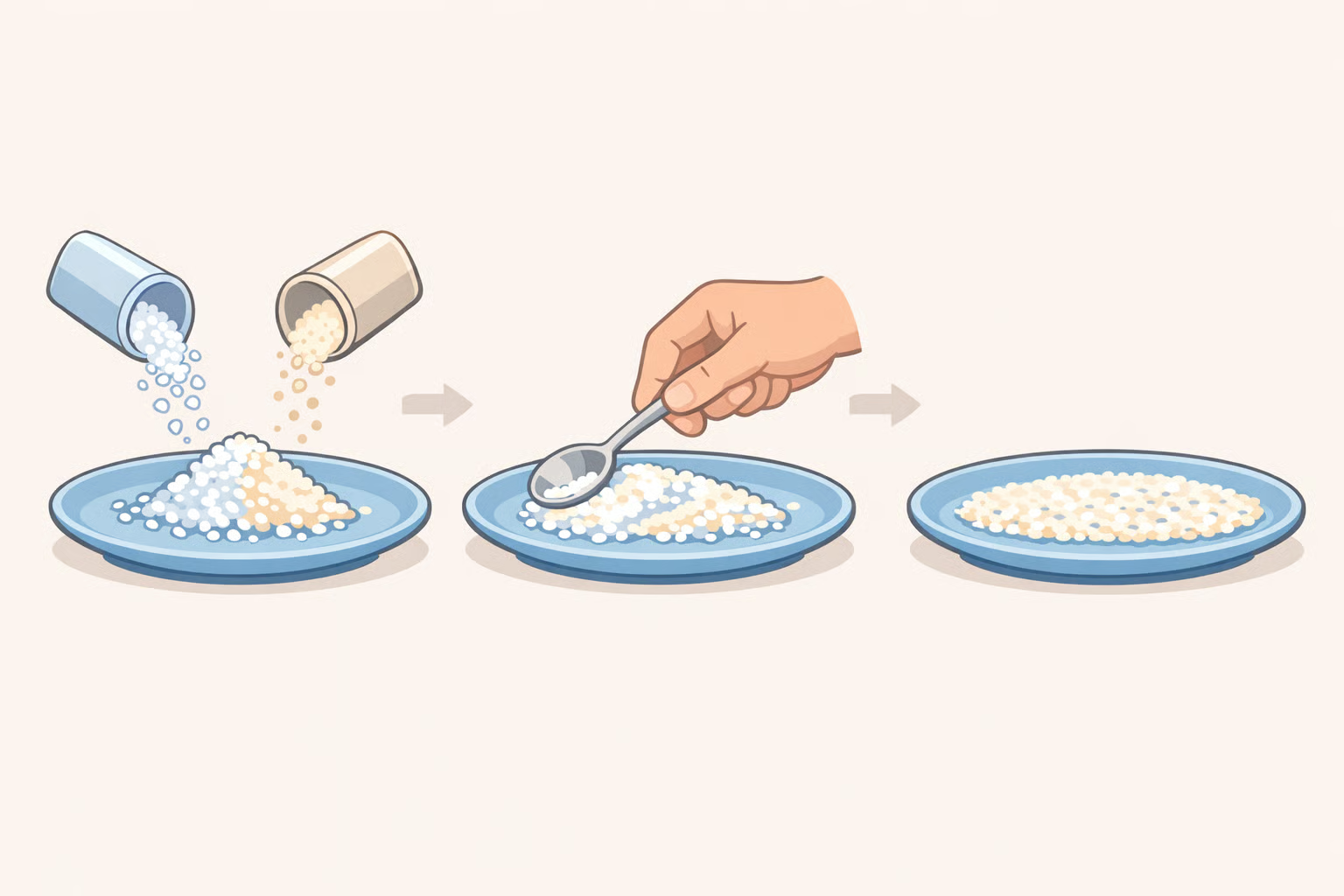
- Coarse kosher salt and granulated sugar, equal parts
- A lime wedge
- A shallow saucer
1. Mix the rim blend. Pour equal parts coarse kosher salt and granulated sugar onto the saucer and spread into an even, flat layer wide enough to accommodate the glass rim. Eyeballing it is fine. Equal parts is the right ratio; exact measurements don't matter here.
2. Rim the glass. Run the lime wedge around the outside edge of the glass only. Do not wet the inside lip, because that pulls salt and sugar into the drink rather than onto each sip. Dip the moistened rim straight down into the blend and rotate slowly for an even coat. Tap off any excess.
3. Fill the glass with ice. Pack it well. This drink is built in the glass, so the ice controls chilling and dilution from the first pour. A half-filled glass will produce a warm, over-diluted result by the end.
4. Add 2 oz vodka. Pour directly over the ice. The 1:2 spirit-to-juice ratio, which Tasting Table recommends in March 2023, keeps the grapefruit front and center. Gin works as a direct substitute if a more botanical result is what you're after.
5. Top with 4 oz fresh grapefruit juice. Pour over the vodka and stir gently two or three times. That's it. Do not shake.
6. Garnish with a grapefruit slice. It's the standard finish and earns its place visually. A lime wedge or a rosemary sprig adds aroma without sweetness if you want something different, per Tasting Table.
Two mistakes that undercut the build:
- Don't use fine table salt. It dissolves on contact with the wet rim and creates a salty slick rather than a textured coating. Coarse kosher salt holds structure through the drink and releases gradually. That texture is the point.
- Don't shake it. Shaking aerates and over-dilutes a drink this simple. More practically, any vigorous movement after you've rimmed the glass pulls salt and sugar down into the liquid and undoes the balance you just built. Stir two or three turns and stop.
Glass choice and a note on ratios
The Old Fashioned glass is worth using for a reason beyond tradition. A wider, shorter vessel means a higher rim-to-volume ratio: more of each sip makes contact with the salt-and-sugar coating compared to a tall highball, where the glass lip is a smaller fraction of the overall drink experience. Jolly Bartender notes the New York Bartender's Guide specifically calls for the rocks glass here, and it's the right call functionally, not just stylistically.
On ratios: Tasting Table recommends doubling the juice to the spirit as a baseline. At 2 oz vodka to 4 oz juice, the grapefruit leads and the vodka provides structure without dominating. Wikipedia notes that most modern recipes follow roughly this same proportion. Scaling up is straightforward: keep the 1:2 ratio and increase total volume to suit the glass or occasion.
Salt type matters too, and Tasting Table points out that experimenting with different salts can alter both texture and flavor on the finish. Kosher salt is the reliable baseline because the grain size is consistent and the flavor is clean. Flaky sea salt dissolves more unevenly and can produce patches of intense saltiness rather than a uniform coat. For the sugar component, standard granulated white sugar is the right call; powdered sugar will dissolve and vanish, and raw sugar crystals are too large to adhere evenly.
If you want to go further
The build above is the version worth making first. Once you know the drink, one addition is worth trying: about 2 oz of sparkling water added last, as Farm to Jar noted in April 2023. It lightens the body and makes the drink slightly longer without compromising the rim's work.
Beyond that, Farm to Jar also suggests flavored syrups as optional additions, including cardamom-infused grapefruit shrub or a cinnamon-vanilla simple syrup for a more layered result. These work if you're looking to complicate the drink deliberately. They aren't improvements to the base build so much as departures from it.
The Salty Dog, as Jolly Bartender puts it, is "refreshing and great when you need hydration and relaxation in equal measure." Its virtue is simplicity. For this drink, the salt-and-sugar rim is the cleanest upgrade available. Most variations after that are additions by preference, not corrections.
Make it this way first
The Salty Dog doesn't need a new ingredient or a more complex build. It needs the rim done right.
An equal-parts blend of coarse salt and granulated sugar, drawn from the New York Bartender's Guide and documented by Jolly Bartender in February 2026, is a direct, low-effort improvement over a plain salt rim. The result tastes more balanced: better grapefruit brightness, less harshness on the finish.
Full combination: Old Fashioned glass, equal-parts salt-and-sugar rim applied to the outside edge only, 2 oz vodka, 4 oz fresh grapefruit juice over ice, stirred. Tasting Table puts the underlying logic plainly: salt tames bitterness, fresh juice delivers brightness, and the rest is ratio. Get those three things right and the drink is done.
Make it this way once before adjusting anything. The upgrade is in the rim.




Comments
Be the first, drop a comment!