



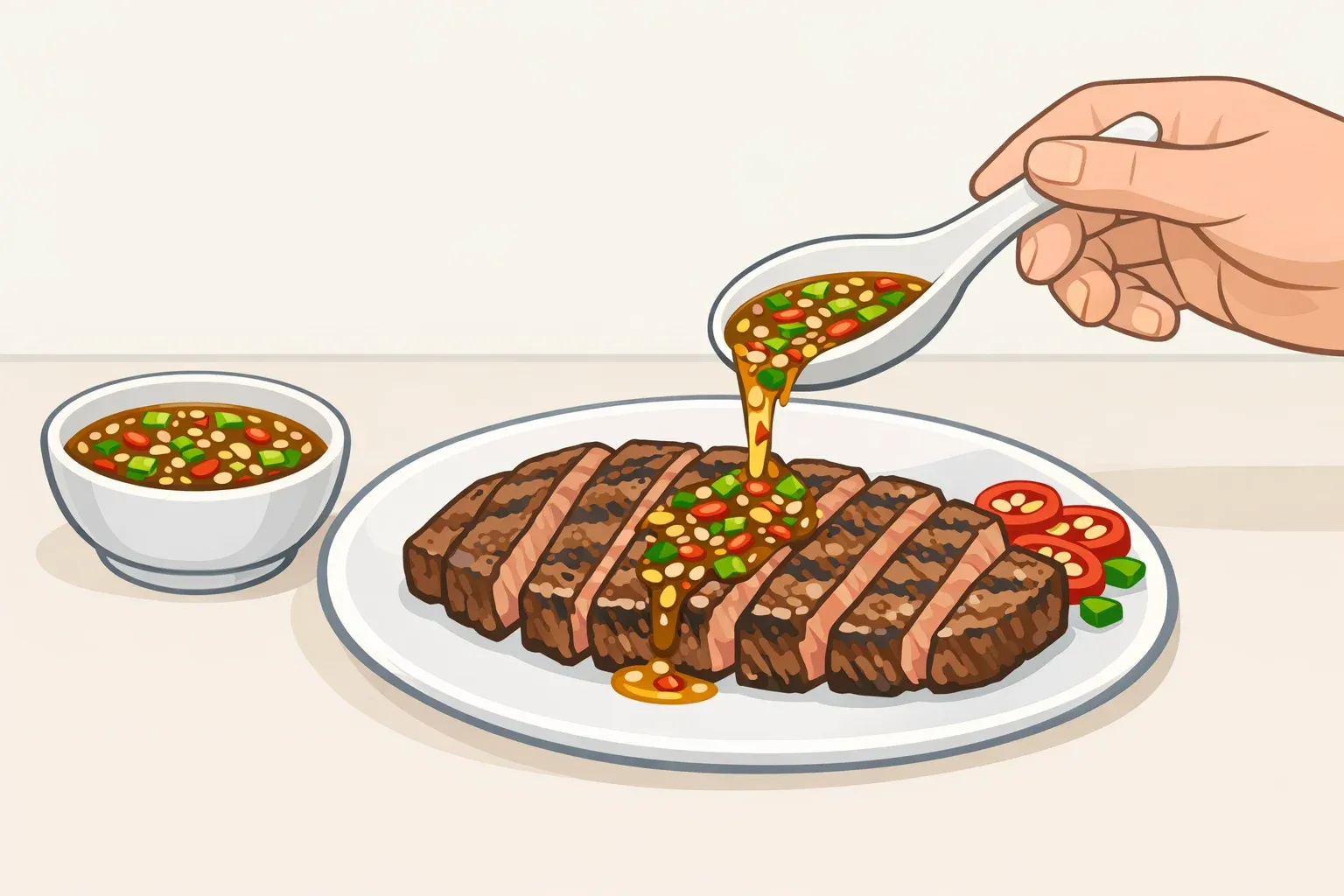
Most steak sauces add weight. Nam jim jaew does the opposite. This bright Thai dipping sauce, made with tamarind, lime, fish sauce, dried chile, herbs, and toasted rice powder, cuts through a charred steak's richness instead of masking the beef.
According to Rachel Cooks Thai, nam jim jaew comes from Northeastern Thailand (Isan), where grilled meats are central to the cuisine. It is traditionally served as a dipping sauce for grilled chicken, pork, beef, and sticky rice, which makes it a natural fit for steak.
This guide shows you how to make nam jim jaew from scratch and serve it with steak. The sauce takes about 20 minutes of active work, plus a short rest, and you only need a dry skillet and a way to crush the toasted rice, such as a mortar and pestle, spice grinder, or coffee grinder.
Best cut to start with: flank or skirt steak. Both are lean, grained cuts that grill quickly over high heat and have enough chew to stand up to an assertive sauce. Season the steak simply, get a good char, slice against the grain, and let the sauce provide the contrast.
Quick answer: Nam jim jaew is a Thai dipping sauce for grilled meats. To make it for steak, mix tamarind paste, lime juice, fish sauce, palm sugar, dried chile flakes, shallots, herbs, and toasted rice powder. Let it rest for about 30 minutes, then serve it on the side with sliced grilled steak.
Why nam jim jaew works with steak
Steak is rich, savory, and intense. Nam jim jaew works because it pushes in the opposite direction: sour tamarind and lime cut through fat, fish sauce adds salt and umami, dried chile brings smoky heat, palm sugar rounds the edges, and toasted rice powder gives the sauce body and a nutty texture.
Tamarind is especially useful with steak because it is sour and thick. Lime juice tastes brighter, but tamarind gives the sauce a deeper tartness and thicker texture, helping it cling to sliced beef instead of running off.
The goal is not sweetness. A good nam jim jaew should taste mostly sour, salty, and spicy, with just enough sugar to keep the sauce from tasting harsh. For lean cuts like flank and skirt steak, the standard balance works well. For fattier cuts like ribeye or short rib, add more lime and slightly reduce the sugar.
Ingredients for nam jim jaew
What you need: a small dry skillet, a mixing bowl, and a mortar and pestle, spice grinder, or coffee grinder. The only cooking step is toasting the rice and chile flakes.
Yield: about 1/2 cup, enough for 4 servings.
Ingredients:
2 tablespoons Thai tamarind paste or puree
1 to 2 tablespoons fresh lime juice
1 to 2 tablespoons fish sauce
1 tablespoon palm sugar, shaved, or brown sugar
1 teaspoon dried chile flakes
1 teaspoon toasted rice powder
2 tablespoons finely minced shallots
2 to 3 tablespoons chopped cilantro, green onion, or a mix of both
Tamarind format matters. Look for Thai tamarind puree or paste, but check the label: products marked "concentrate" are usually stronger and more sour, so start with half the amount and adjust after tasting. If you only have a block of seedless tamarind, dissolve 1/4 cup in 1/2 cup warm water, massage until a paste forms, and strain out the fibers.
Shopping tip: Look for tamarind puree or paste, sticky or glutinous rice, dried Thai chile flakes, fish sauce, and palm sugar at an Asian grocery. Brown sugar and crushed red pepper can work in a pinch.
Fish sauce substitute: For a vegetarian version, use vegan fish sauce if available, or soy sauce in a pinch, but expect a less traditional flavor.
How to make nam jim jaew
Step 1: Toast the rice
Add 1 tablespoon of raw sticky or glutinous rice to a dry skillet over medium-low heat. Stir or shake the pan often until the grains turn golden brown and smell nutty. Transfer the rice to a plate to cool so it does not keep cooking in the hot pan.
Don't skip this if you want the sauce to taste traditional. Toasted rice powder, or khao khua, gives nam jim jaew its nutty aroma, slight crunch, and thicker texture.
Step 2: Grind the rice
Once cool, crush the toasted rice with a mortar and pestle or pulse it in a spice or coffee grinder until it looks sandy, not floury. A little texture is correct; it helps the sauce cling to the steak.
Set the toasted rice powder aside.
Step 3: Toast the chile flakes
Add 1 teaspoon dried chile flakes to the same dry skillet over medium heat. Stir for a few minutes until they darken slightly and smell smoky. This step is optional, but it deepens the chile flavor without requiring more chile.
Remove the chile flakes from the heat before they scorch. Burnt chile will make the sauce taste bitter.
Step 4: Build the liquid base
In a mixing bowl, combine the tamarind paste, 1 tablespoon fish sauce, 1 tablespoon lime juice, and the palm sugar. Stir until the sugar fully dissolves. If your palm sugar is sold in a hard cake, shave it thin first or soften it with a few drops of water in the microwave.
Taste the base before adding the herbs, chile flakes, and rice powder. It should taste clearly sour, salty, and lightly sweet, with the acid leading.
Adjust as needed:
Too salty: Add lime juice or a small splash of water.
Too sharp or sour: Add a pinch more sugar, not more fish sauce.
Too sweet: Add lime juice, not tamarind; tamarind adds body along with acid and can over-thicken the sauce.
Too thin: Wait until after the toasted rice powder is added before adjusting; the rice will thicken the sauce as it sits.
Step 5: Add the aromatics and powders
Stir in the toasted chile flakes, toasted rice powder, minced shallots, and chopped herbs. The sauce will thicken slightly as the rice powder absorbs liquid.
Taste again. Add more lime for brightness, more fish sauce for salt, more chile for heat, or a splash of water if the sauce has become too thick.
Step 6: Rest about 30 minutes
Set the sauce aside while the steak cooks so the flavors can meld. Do not make it hours ahead; the herbs and shallots wilt, and the rice powder keeps absorbing liquid until the sauce turns thick.
Step 7: Serve alongside the steak
Slice the grilled steak against the grain and bring the sauce to the table in a small bowl. Dip each piece as you eat. Spooning the sauce over the steak too early can soften the crust.
Storage: Refrigerate leftovers for up to 2 days. The herbs taste duller by day two, and the sauce is not a good candidate for freezing.
How to adjust the sauce for different steak cuts
Flank steak is a smart starting point because it cooks quickly over high heat, slices cleanly against the grain, and stands up to a bold acidic sauce. Skirt, hanger, and bavette work for the same reason: they have enough chew and char to hold their own against nam jim jaew.
Nam jim jaew is also commonly served with crying tiger beef, a Thai grilled steak dish often paired with a sharp dipping sauce. Seasoning the steak before cooking matters: the sauce should add contrast, not compensate for bland meat.
For fattier cuts like ribeye or short rib, make the sauce sharper. Add a little more lime, reduce the sugar slightly, and avoid adding extra tamarind unless the sauce is too thin. Fatty beef needs more brightness, not more sweetness.
Common mistakes:
Oversweetening the sauce. Nam jim jaew should be assertive, not syrupy.
Using it as a glaze. Heat dulls the fresh lime, herbs, and shallots.
Serving it with steak that has little char. The sauce works best when it can contrast with a browned crust.
What to serve with nam jim jaew
Nam jim jaew takes about 30 minutes once you include the rest time, and the two ingredients that make it distinctive are toasted rice powder and Thai tamarind paste. The rice powder adds aroma and texture; the tamarind gives the sauce its deeper sourness and body.
Once you understand the balance, the adjustments are simple: more lime for brightness, more chile for heat, a pinch more sugar if the sauce tastes harsh, and a splash of water if it thickens too much.
The same method works with grilled chicken, pork shoulder, pork chops, mushrooms, or anything else with a good char. For steak, keep the cooking simple and let the sauce do the work.







Comments
Be the first, drop a comment!