



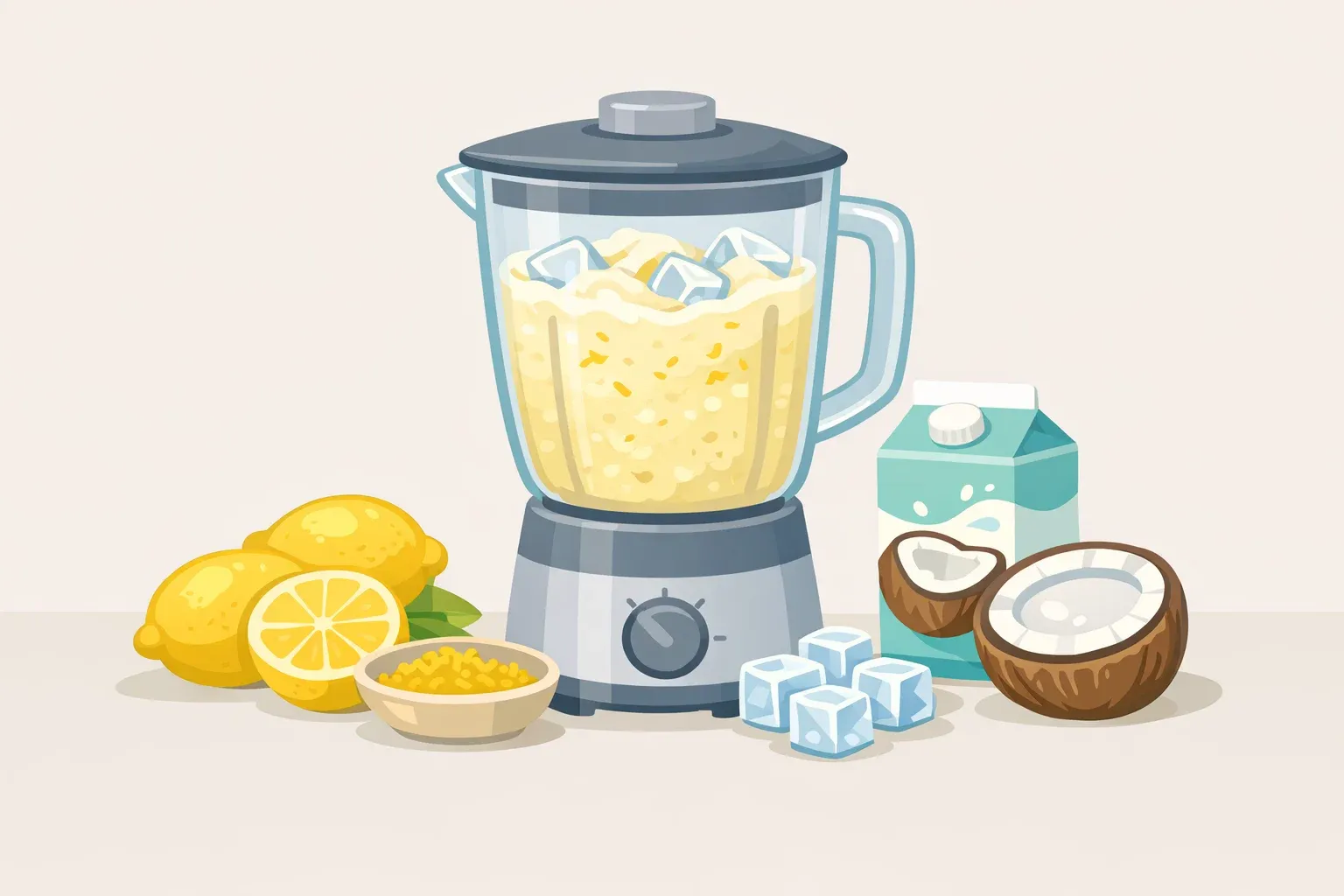
This guide walks you through making a tropical whipped lemonade recipe: a blended drink that sits somewhere between a slushy and a milkshake, built on fresh lemon, full-fat coconut milk, and enough ice to give it real body.
Four ingredients, a blender, and about 10 minutes of active effort once the syrup is ready. Which coconut product you grab shapes whether the finished drink reads as a creamy frozen lemonade or something closer to a dessert; that decision gets its own section before the steps begin.
One timing note upfront: the flavor-forward version uses a lemon-zest simple syrup that steeps for one hour. Active prep is estimated at 10 minutes and total time at 1 hour 10 minutes once steeping is included. Make the syrup the night before; it keeps refrigerated in an airtight container for up to a week, and the blend itself takes under 10 minutes when you're ready to serve.
Choose your coconut ingredient first
Every version of this drink starts with fresh lemon and ice. What changes the character is the creamy element. These three coconut products are not interchangeable, and grabbing the wrong one will throw off the entire balance of the drink.
Coconut milk is the base recipe ingredient. Lighter body, higher water content, mild flavor it balances against lemon without competing with it. EatingWell notes that light or refrigerated coconut milk produces a noticeably less rich result. Full-fat is the right call. Use coconut milk when you want a whipped frozen lemonade that still leads with citrus.
Coconut cream has more coconut meat and less water than coconut milk, making it thicker and richer. An iteration pairs it with coconut yogurt for a denser, more indulgent result. The lemon is still present, but the coconut comes forward. Use coconut cream when you want a dessert-leaning drink.
Cream of coconut is a different product entirely: pre-sweetened, emulsified, and closer to a cocktail syrup than a cooking ingredient. What separates coconut cream from cream of coconut is the added sweetener, and that its sweetened, emulsified texture makes it the standard for tropical blended cocktails, including the piña colada, the Chi Chi, and the Painkiller. Because it already contains sweetener, using it means dropping your separate sweetener entirely. Use cream of coconut for the cocktail variation near the end of this guide, not the base recipe.
One practical note on extracting cream from a full-fat coconut milk can: chill the unopened can overnight. The cream separates and rises to the top; scoop it off and leave the water behind. Don't attempt this with a lite coconut milk; the lower fat content means there's no distinct cream layer to collect.
How to make whipped lemonade: the base recipe step-by-step
The build below uses full-fat coconut milk. The result is milkshake creaminess meeting the tartness of freshly squeezed lemonade, all from four ingredients and a blender. This serves 4.
What you need:
½ cup granulated sugar + ½ cup water (lemon-zest simple syrup)
Zest of 1 lemon
½ cup fresh lemon juice (approximately 2 lemons)
1 cup full-fat coconut milk
2½ cups ice cubes
Step 1: Make the lemon-zest simple syrup. Bring ½ cup sugar and ½ cup water to a simmer in a small saucepan over medium heat, stirring until the sugar dissolves. Remove from heat, stir in the zest of one lemon, cover, and steep for one hour. Strain through a fine-mesh sieve and discard the zest. This recipe uses ½ cup of the syrup; the remainder keeps refrigerated for up to a week. Make it the night before, and the blend itself takes under 10 minutes.
Step 2: Juice your lemons. You need ½ cup of fresh lemon juice, roughly two average lemons. Strain out seeds. Skip bottled juice: fresh juice and zest deliver far superior results to bottled juice. Fresh lemon's brightness keeps the drink from going flat against the coconut fat, and it's the one correction you can make mid-recipe if something's off.
Step 3: Combine the liquid base. Add ½ cup lemon syrup, ½ cup fresh lemon juice, and 1 cup full-fat coconut milk to the blender. If prepping ahead, stop here. Blend and refrigerate this base for up to several hours, then add ice and finish blending right before serving.
Step 4: Add 2½ cups of ice and blend. Start on low, then ramp up to high, gradually blend the liquid base until smooth and well-combined before adding ice, then pulse until frosty and smooth. If you only have ice cubes rather than crushed ice, that source recommends blending the ice separately to crush it, storing it in the freezer until ready, then adding it to the liquid base at serving time.
Step 5: Pour into four 8-ounce glasses and serve immediately. The texture is the whole point of this drink, and it doesn't hold. Refrigeration melts the ice and collapses the frothy consistency; the freezer turns it solid. Keep the liquid base ready and add ice only at the moment of serving.
Troubleshooting texture and taste
The drink is too thin. Add more ice in small increments and blend in short pulses. If the problem persists, check whether you used light coconut milk. Lower fat content produces a noticeably less rich result at that point; starting over with full-fat is the only reliable fix.
The blend is icy rather than slushy. Stop earlier next time. The target is thick and smooth; if it pours like juice, it's gone too far. Add a small amount of fresh ice and pulse rather than blend continuously.
Too sweet. Add fresh lemon juice one tablespoon at a time and pulse. If the sweetness is significant rather than slight, check that you haven't used cream of coconut instead of coconut milk. Cream of coconut contains added sweetener and will throw off the entire balance of the base recipe.
Lemon is buried under the coconut. Add one tablespoon of fresh lemon juice and blend briefly. Even in coconut-heavy versions, lemon should be the dominant flavor. Bottled juice can't do the same correction work; it doesn't carry enough punch.
Need it in 10 minutes, no syrup on hand. Swap to a simpler formula: blend 4 cups of ice, 1 cup of store-bought lemonade, ½ cup sweetened condensed milk, and the juice of one fresh lemon until smooth. Total time is 10 minutes for this version. It's sweeter, dairy-based, and loses the coconut-tropical character of the main recipe entirely, a genuinely different drink, not a shortcut to the same one.
Going further: mango and the cocktail riff
Mango variation. Laird Superfood built a creamy coconut mango lemonade using one cup of puréed ripe mango alongside fresh lemon juice, structured as a layered pitcher drink with a whipped coconut cream topping rather than a fully blended one.
For a blended version, that combination translates cleanly to the base recipe: add ½ cup of frozen mango chunks to the blender before the ice. Frozen mango adds body and natural sweetness, so taste before serving and consider pulling back on the lemon syrup by about two tablespoons. Keep extra fresh lemon juice on hand; mango can soften citrus brightness, and a small hit of fresh juice restores it quickly.
Cocktail riff. Swap full-fat coconut milk for cream of coconut and drop the separate sweetener; the cream of coconut handles both roles. Cream of coconut's sweetened, emulsified consistency is precisely why it became standard in tropical blended cocktails.
Add 1.5 oz of white rum or coconut rum per serving before blending. White rum keeps it clean; coconut rum pushes the tropical character further. Fresh lemon does the citrus work here that pineapple usually does in a piña colada; the swap is surprisingly direct.
Before you blend
Three things are worth carrying out of this guide.
The coconut decision comes first. Full-fat coconut milk for a balanced, citrus-forward drink; coconut cream when you want it richer and more dessert-like; cream of coconut when you're building a cocktail and want the sweetener built in.
Fresh lemon juice is non-negotiable. Fresh juice and zest deliver far superior results to bottled juice. Beyond flavor, it's the one mid-recipe correction tool available for sweetness, coconut heaviness, and flatness. Bottled juice can't do that work.
The syrup keeps; the finished drink doesn't. Make the liquid base ahead and refrigerate it. Add the ice only at serving. The mango variation is the most natural place to take it next; frozen fruit adds body without changing the technique at all.









Comments
Be the first, drop a comment!