



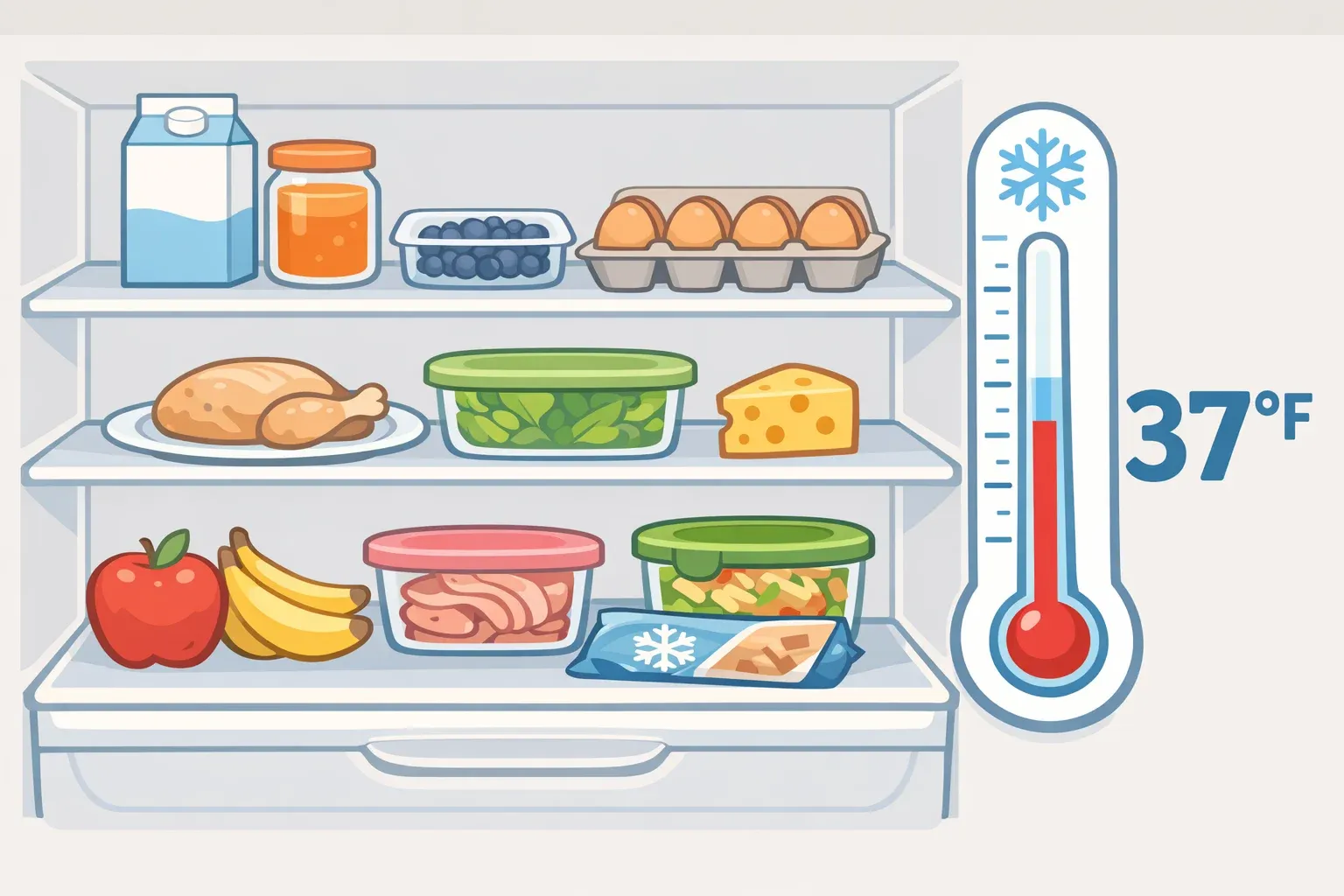
40-Degree Rule for Refrigerators: Why 37°F Is Your Real Target
The 40-degree rule for refrigerators is the foundation of home food safety: keep your fridge at or below 40°F, and you stay ahead of the bacteria most likely to make you sick. The FDA recommends 40°F or below for refrigerators and 0°F for freezers as the baseline defense against bacterial growth. But 40°F is a safety ceiling, not a target. Your fridge may be set to 38°F and still run warmer than that.
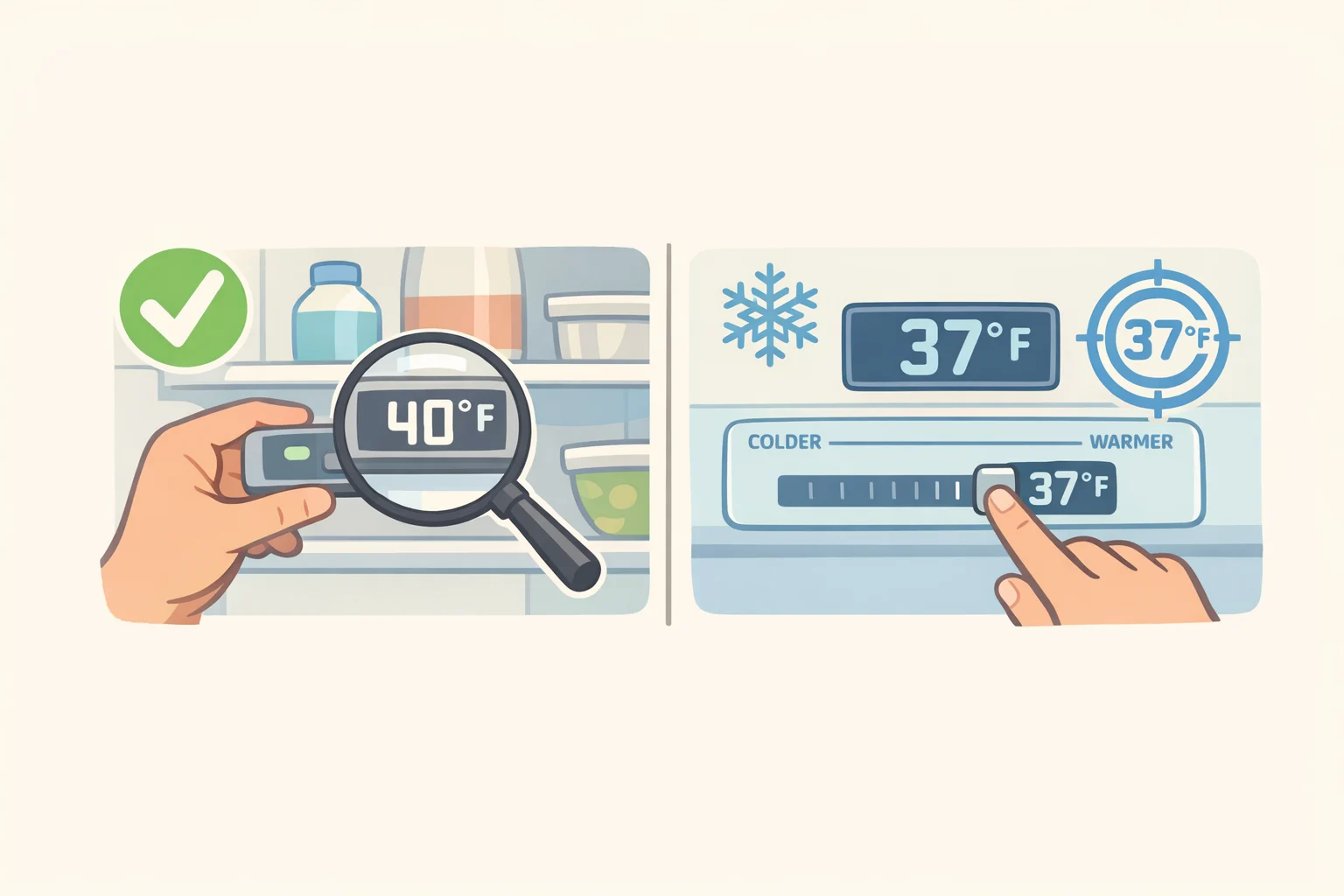
If you do one thing after reading this, put a thermometer in the center of your fridge tonight.
What is the 40-degree rule for refrigerators?
The rule draws a line between two bacterial realities. Below 40°F, bacterial growth slows significantly. Above it, food safety risk climbs in direct proportion to how long food spends in that warmer range.
Federal health agencies define the window between 40°F and 140°F as the "temperature danger zone," where pathogens multiply rapidly on perishable foods. The CDC specifically notes that Staph and other pathogens can multiply rapidly in food left in that range. The FDA's commercial food code uses a slightly tighter danger zone of 41°F to 135°F, reflecting stricter standards applied in professional food service settings (FDA). For home refrigerators, 40°F is the practical upper limit.
The important distinction: 40°F is the ceiling, not the goal. Think of it like a speed limit the maximum allowed, not the speed you should be driving. Where you want to actually land is a few degrees colder.
The best refrigerator temperature is 37°F here's why the gap matters
Consumer Reports, whose testing protocols use calibrated thermocouples in climate-controlled chambers set to mimic a typical kitchen at 70°F, identifies 37°F as the practical optimal temperature for a home refrigerator. At 37°F, bacterial growth is effectively suppressed and food quality holds cold enough to do the job, but not so cold that lettuce develops ice crystals or delicate produce gets damaged near the unit's cold spots.
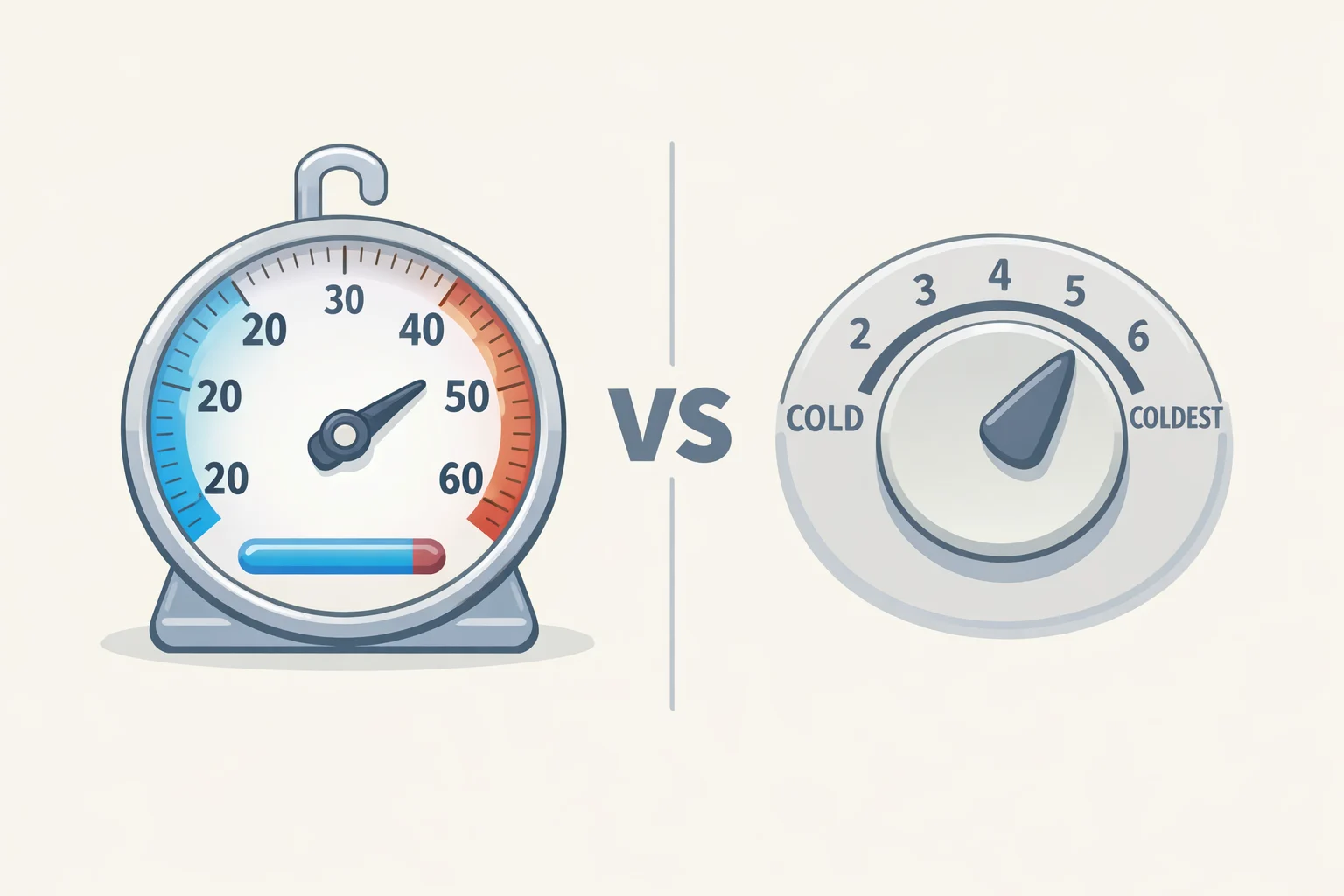
That three-degree buffer between 37°F and the 40°F ceiling exists for a concrete reason: refrigerator thermostats can be wrong. Consumer Reports testing found that some units run as much as 5°F warmer than their settings indicate (Consumer Reports). A fridge set to 40°F that's actually running at 43°F or 44°F is not a minor inconvenience. It's a food safety failure that's invisible unless you measure it.
There's also the uneven-temperature problem, which affects most refrigerators. A unit running at 37°F in the center may have spots near the door approaching 44°F or 45°F. Safety and quality are both temperature-dependent; they just fail at different points.
Aim for 37°F as your target. It gives you buffer against thermostat drift and keeps you well clear of the danger zone even if your unit runs a degree or two warm.
How to actually check your refrigerator's temperature
The FDA recommends verifying temperature with a standalone appliance thermometer rather than relying on the built-in display or dial. These cost a few dollars at any grocery or hardware store and are the only reliable way to know what's happening inside your unit.
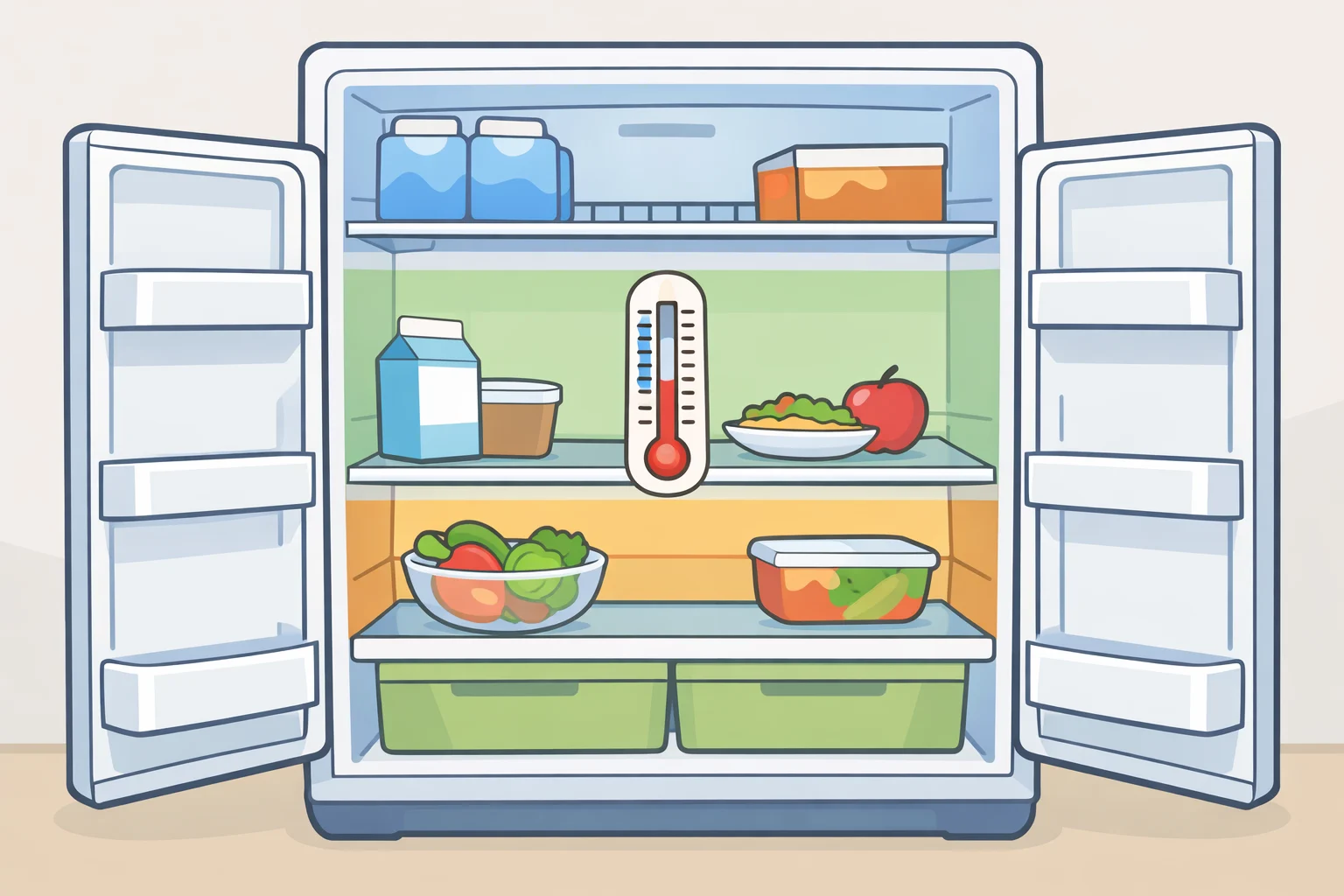
Placement matters. Temperature inside a refrigerator is not uniform:
- Center of the main compartment is the reference point. It represents average internal conditions and is where Consumer Reports positions thermometers during testing. Put yours here.
- The door is among the warmer spots in the refrigerator, exposed to room-temperature air every time it opens. Skip it for measuring, and don't store the most perishable items there either.
- The back wall and bottom tend to run colder, often because the cooling element is nearby. Food pushed against the back wall can freeze even when the center of the fridge reads correctly.
How to check:
- Place the thermometer in the center of the main compartment. Not the door, not the back wall.
- Leave it undisturbed for several hours, ideally overnight, without opening the door frequently.
- Compare the reading to your thermostat setting. If there's a gap of more than a degree or two, adjust and recheck after 24 hours to let temperatures stabilize.
- Repeat for the freezer, targeting 0°F. Consumer Reports' lab targets a range of -1°F to 1°F (Consumer Reports).
A consumer-grade appliance thermometer won't match laboratory precision, but it will get you within a degree or so close enough to know whether your fridge is actually performing safely (Consumer Reports).
When the temperature climbs: everyday rules and the outage scenario
Once you know your refrigerator is holding a safe temperature between 37°F and 40°F, the 40-degree rule extends to how you use it specifically, how quickly food gets into it.
The CDC advises refrigerating perishables within two hours of cooking or purchasing, and within one hour if the ambient temperature exceeds 90°F. The FDA's commercial cooling guidance is more precise: cooked foods should drop from cooking temperature (135°F) to 70°F within two hours, then continue cooling to 41°F or below within the next four hours. For large batches of soup, stew, or roasted proteins, shallow containers and ice baths speed that process considerably. Leaving a stockpot on the counter to "cool down" before refrigerating is exactly the slow-cooling scenario that creates risk.
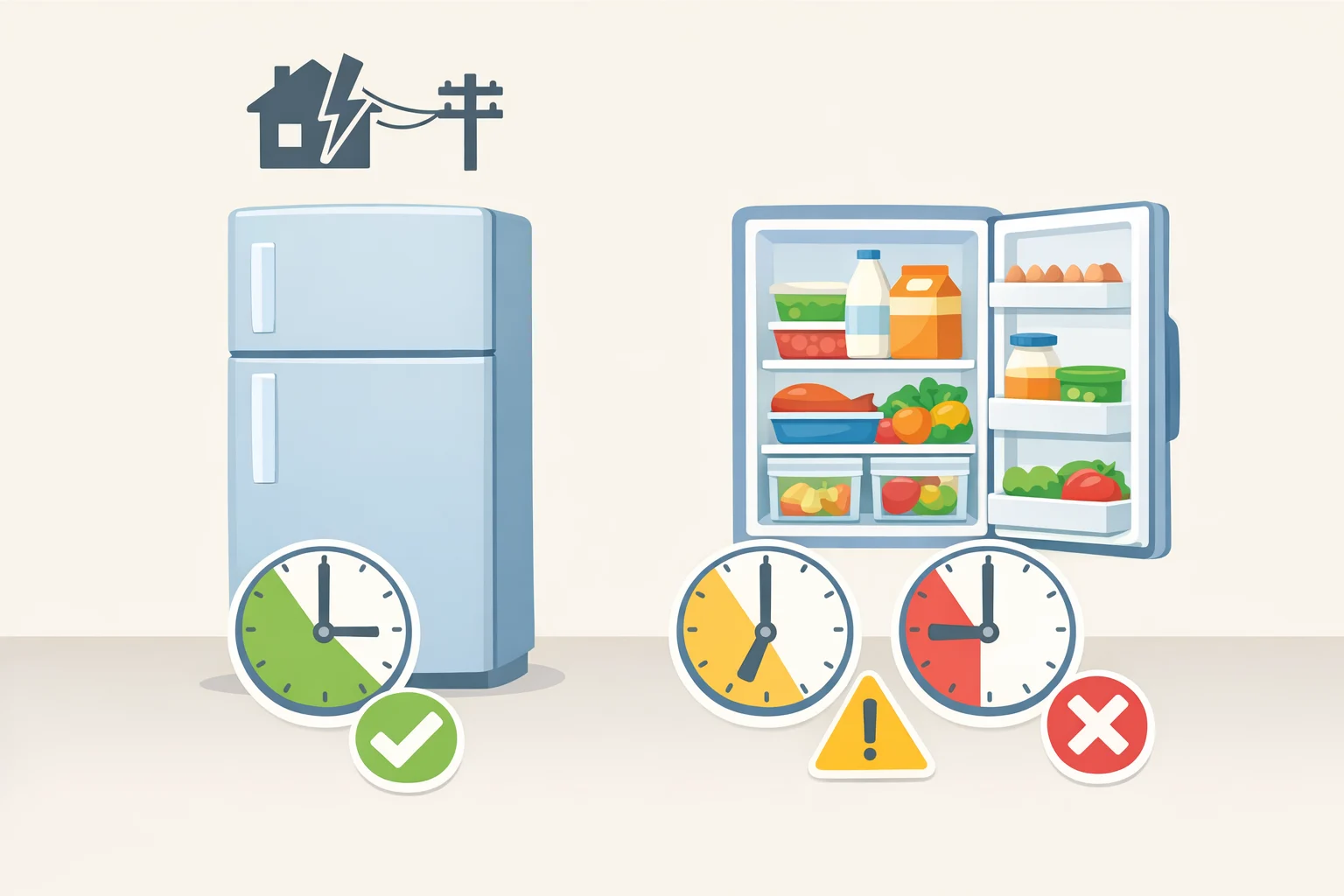
Power outages are where the 40-degree rule becomes most concrete. A closed refrigerator holds food safely for up to four hours, according to USDA guidance via FoodSafety.gov but only if the door stays closed. After four hours, perishables that have risen above 40°F should be discarded.
The list of foods people commonly misjudge after an outage is longer than most expect: soft cheeses (brie, ricotta, cream cheese, mozzarella, cottage, and others), cut fruits and vegetables, cooked pasta, rice and potatoes, egg dishes, custards, and opened sauces all go in the discard pile after more than two hours above 40°F (FoodSafety.gov). The smell test is not a reliable method. Many pathogens produce no detectable odor at concentrations sufficient to cause illness. When you don't know how long the temperature has been above 40°F, the FDA is unambiguous: throw it out.
An appliance thermometer makes this decision straightforward. After power is restored, check the actual temperature. At or below 40°F, food is safe. Above it, you know what to do.
Three things worth doing, starting today
Most foodborne illness at home is a temperature problem that went unnoticed. The fix costs a few dollars and takes ten minutes.
- Buy a thermometer and check your fridge. The built-in display can be off by several degrees. Place an appliance thermometer in the center of the main compartment, leave it overnight, and compare the reading to your setting. The FDA recommends this as the only reliable verification method.
- Set your target at 37°F, not 40°F. Targeting 37°F gives you buffer against thermostat inaccuracy and keeps you well clear of the danger zone without risking frozen produce in the colder zones of the compartment (Consumer Reports).
- Respect the two-hour rule. Perishables need to be refrigerated within two hours at room temperature, or one hour above 90°F. Hot leftovers should reach 70°F within two hours and 41°F within four more not left in a covered pot on the counter overnight (FDA).
Temperature checks aren't a one-time event. Recheck after loading a large grocery haul, after your fridge has been open repeatedly on a hot day, or any time you adjust the dial. Refrigerators cycle and drift, and the thermostat setting that worked in February may not hold the same reading in July. A quick overnight check every few months costs nothing and closes the gap between what you think your fridge is doing and what it's actually doing.








Comments
Be the first, drop a comment!