



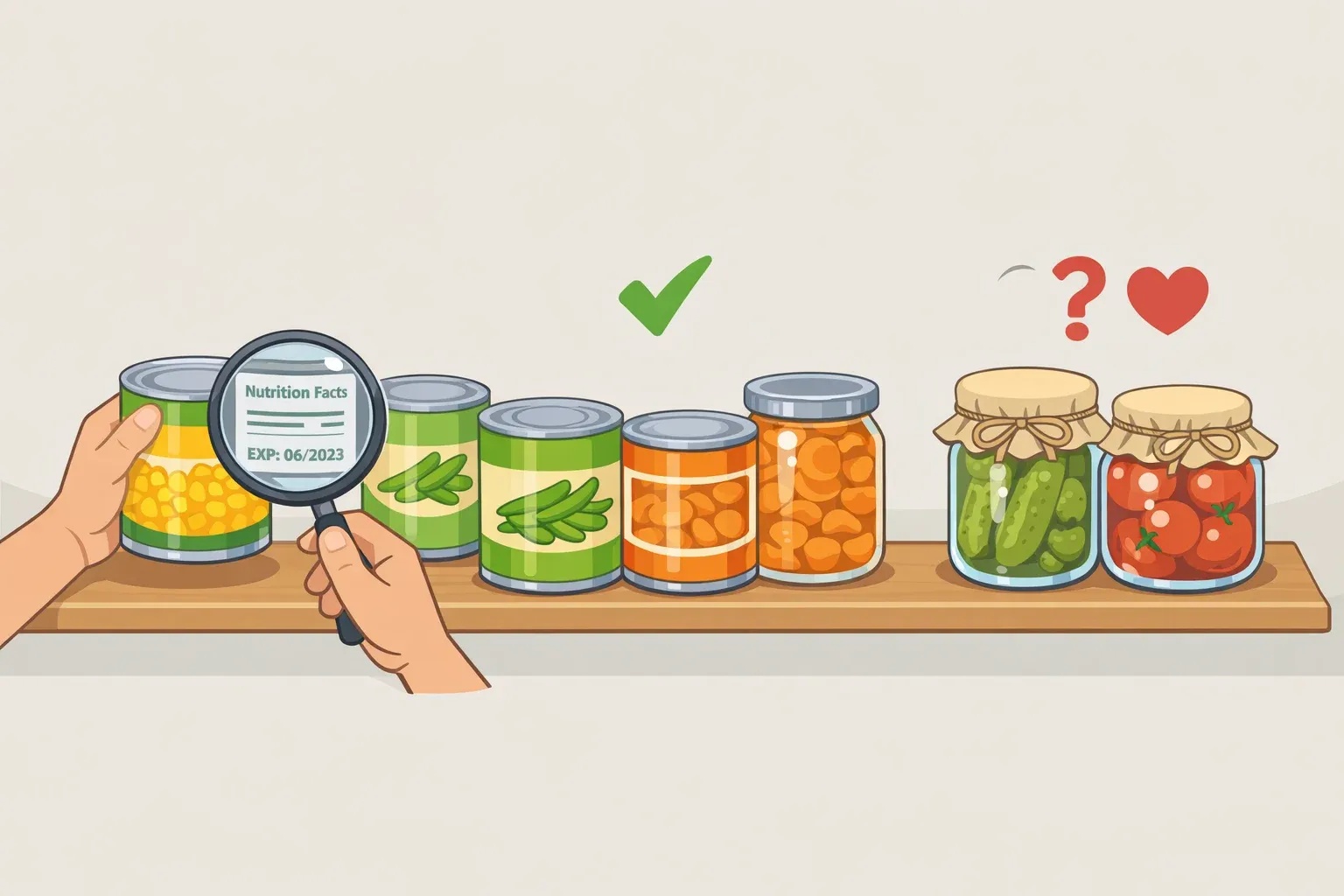
That can of green beans from three years ago is almost certainly safe to eat. The jar of home-canned green beans from your neighbor's garden harvest is a different question entirely, and the answer has nothing to do with how long it's been sitting there.
People often treat these as the same question. They aren't. Do canned vegetables expire? For commercial products, the printed date is a quality estimate, not a safety threshold. For home-canned low-acid vegetables, the relevant question isn't age at all; it's whether the jar was processed correctly. Those are two separate conversations, and conflating them is where real risk enters the picture.
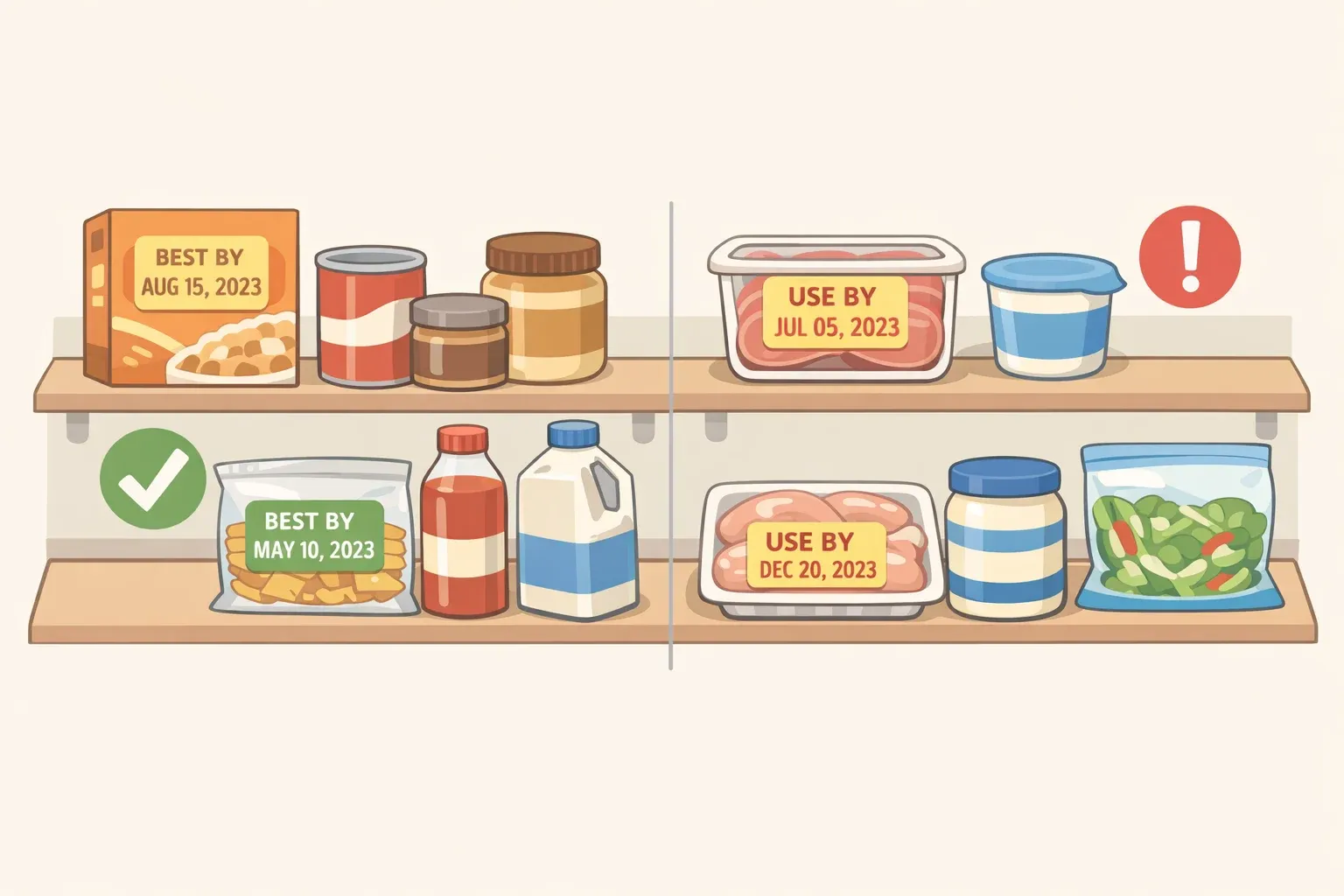
The dates on commercially canned goods are voluntary quality markers. Federal regulations don't require product dating on canned vegetables at all. Infant formula and some baby foods are the narrow exception, and retailers are legally permitted to sell canned goods past the printed date as long as the product is wholesome.
Meanwhile, improperly home-canned foods are the leading cause of foodborne botulism outbreaks in the United States, with low-acid vegetables corn, green beans, beets, spinach, asparagus, peppers accounting for the majority of cases. The toxin can be present in a jar with no detectable off smell, unusual taste, or visible change in the food. Sensory checks are an unreliable safety test.
What follows covers what date labels actually mean for commercial cans, how storage conditions affect quality, why home-canned low-acid vegetables occupy a different risk category entirely, and what to do with whatever is currently in your pantry.
Are canned vegetables safe to eat after the expiration date?
The number stamped on a commercial can is the manufacturer's estimate of when the product will be at peak quality, flavor, color, and texture. It is not the point at which the food becomes unsafe. Understanding that distinction changes how you should think about the cans already in your pantry.
An intact commercial can eaten past its printed date can still be perfectly safe. Quality particularly flavor and color begins declining past that date, but the trajectory is gradual, not a cliff. Think of the date as a "best enjoyed by" window, not an on/off switch. These are quality markers, not safety dates.
The quality window varies by what's inside. Low-acid commercially canned vegetables green beans, corn, peas, carrots hold best quality for two to five years in a cool, dry pantry. High-acid canned foods like tomatoes and fruits have a shorter quality window of twelve to eighteen months before taste and texture noticeably degrade.
For practical planning, food safety authorities recommend using commercially canned foods within two years for best quality, not because they become dangerous after that point, but because quality erodes steadily and storage never improves it.
The shelf-life question doesn't end at the can opener. Once opened, canned vegetables should be transferred to a covered glass or plastic container and refrigerated; they're best used within three days. Left in the opened metal can, they're both a quality and a hygiene concern.
For commercial cans, the decision framework is simple: intact container plus reasonable storage history equals likely fine. The date narrows the quality window; the condition of the can determines the safety question.
How storage conditions affect canned vegetable shelf life
Every quality window above assumes a cool, dry pantry. A hot garage or damp basement doesn't just accelerate quality loss at the extremes; it can create genuine spoilage. Where a can has been living matters as much as how old it is.
The recommended storage temperature for all canned foods, commercial and home-canned alike, is 50–70°F. Storage time decreases significantly when temperatures rise above 75°F, Clemson HGIC notes. For home-canned jars specifically, the National Center for Home Food Preservation recommends keeping jars away from heat pipes, furnaces, uninsulated attics, and direct sunlight; any environment above 95°F can cause food to lose quality within weeks or months and may lead to spoilage. The one-year quality guidance for home-canned foods assumes these conditions are being met.
Moisture is the other variable most people underestimate. Rust on metal lids and can seams isn't just cosmetic rust that penetrates a seal and allows contamination. Keeping canned goods dry is as important as keeping them cool.
First-in, first-out is the standing guidance from food safety authorities. Storage never improves food quality; it only erodes it. The can that's been in the pantry longest should be used first.
A commercial can that's spent two summers in an uninsulated garage may not be at peak quality even if it's technically within its printed date range. Assess storage history, not just the date, and that goes double for home-canned jars, where the stakes of a compromised seal are considerably higher.
Home-canned vegetables and botulism: why this is a separate conversation
Home-canned low-acid vegetables don't just go stale. Improperly processed jars can harbor one of the most dangerous toxins in food. The key question for any jar of home-canned beans or corn is not "how long has it been in the pantry?" but "was it ever safe to begin with?"
Canning removes oxygen from a sealed container, creating exactly the low-acid, anaerobic environment in which Clostridium botulinum thrives. The bacterium's spores are ubiquitous in soil and water worldwide, not a contamination problem so much as a constant background condition.
The spores themselves are harmless until given the right environment; if the canning process doesn't reach the temperatures required to destroy them before sealing, they can germinate during storage and produce toxin. Scientifically proven pressure canning processes are specifically designed to destroy C. botulinum spores.
Destroying those spores requires sustained heat of 240°F, a temperature only a pressure canner achieves. A boiling water bath reaches only 212°F at sea level, which kills many pathogens but leaves botulism spores intact. Using a boiling water bath to process home-canned low-acid vegetables is not a safe method.
The toxin produced in an improperly processed jar leaves no reliable trace. No off smell, no unusual taste, no visible gas or cloudiness; the food can look and smell completely normal. Tasting to check is not a viable safety test.
There are also some vegetables for which no scientifically validated home-canning process exists at all: pumpkin puree, pumpkin butter, sweet potato puree, and yellow summer squash. Any home-canned jar of these products should be considered unsafe regardless of how it was processed.
The consequences are serious. CSU Extension reports approximately 110 botulism cases in the U.S. each year, with roughly a quarter being foodborne. All forms are medical emergencies. Without prompt treatment, foodborne botulism can be fatal within three to seven days of symptom onset. With modern treatment, the death rate has fallen from around 50% to roughly 5%, but recovery requires growing new nerve endings, which takes months, and Clemson HGIC notes that survivors may experience fatigue and breathing difficulties for years.
Unlike commercial canning, where the industry had resolved its botulism problem by 1926 through industrial-scale pressure processing, home canning places the full burden of correct technique on the individual. A jar processed in a water bath looks identical to one correctly pressure-canned. The label doesn't tell you which one you're holding.
Pantry triage: what to keep, what to boil, what to toss
The risk framework above collapses into a practical decision: what do you actually do with what's in front of you? The answer differs by scenario.
Old commercial cans
An intact commercial can no bulging, no rust-through, no leaking, no damaged seams is almost certainly safe. Quality fades past the printed date, particularly for high-acid vegetables like tomatoes after eighteen months, but an intact commercial can does not become a botulism risk with age. Bulging or swollen cans should be discarded without opening, Clemson HGIC advises.
Commercially canned vegetables can be eaten straight from the container when the can is intact. No precautionary boiling is required, Clemson HGIC confirms.
Home-canned jars you processed yourself
If you used a pressure canner with a tested recipe at the correct pressure for your altitude, the jar was processed correctly. As an added precaution before eating, boil home-canned low-acid vegetables for 10 minutes; 20 minutes for corn, spinach, and meats, adding one minute per 1,000 feet above sea level. Boiling destroys any toxin that may be present.
If you used a boiling water bath for low-acid vegetables, the jar was not processed safely, regardless of how recently it was made. Do not taste it.
Inherited, gifted, or unlabeled jars
If you cannot confirm that a home-canned jar of low-acid vegetables was made with a tested recipe in a pressure canner, treat it as unsafe. This is the default, not a pessimistic edge case. The toxin cannot be detected by looking, smelling, or tasting, and getting it wrong carries serious consequences. Before disposal, boil the contents for 30 minutes to neutralize any toxin present, then discard where people, pets, and wildlife cannot access it.
Products that should never be home-canned
No approved processing method exists for pumpkin puree, sweet potato puree, pumpkin butter, or yellow summer squash. Any home-canned jar of these should be discarded using the same boil-and-discard method, Clemson HGIC confirms.
The short version for your pantry
Commercial can, intact, stored cool and dry: safe; use oldest first; expect quality decline past 2–5 years (low-acid) or 12–18 months (high-acid)
Commercial can with bulging, rust-through, or leaking: discard without opening
Home-canned jar, pressure-canned with a tested recipe: boil before eating as a precaution; discard if the lid bulges or contents look or smell off
Home-canned jar, water-bath processed, low-acid vegetables: do not eat; boil 30 minutes and discard
Home-canned jar, unknown method or history: treat as unsafe; boil 30 minutes and discard
Any jar containing pumpkin puree, sweet potato puree, or yellow summer squash: discard
The core distinction is straightforward: for store-bought cans, age affects quality. For home-canned low-acid vegetables, method determines safety. A jar that was never safely processed is not made safer by being recent, and an unknown processing history should be treated as a failed one.
Readers who home-can or plan to should consult the National Center for Home Food Preservation for tested recipes and current pressure-canning procedures by food type and altitude. Following tested recipes is the single most reliable way to eliminate the botulism risk that runs through every jar of home-canned vegetables, and the peace of mind that comes with knowing the process was right is worth considerably more than any shortcut.


Comments
Be the first, drop a comment!