



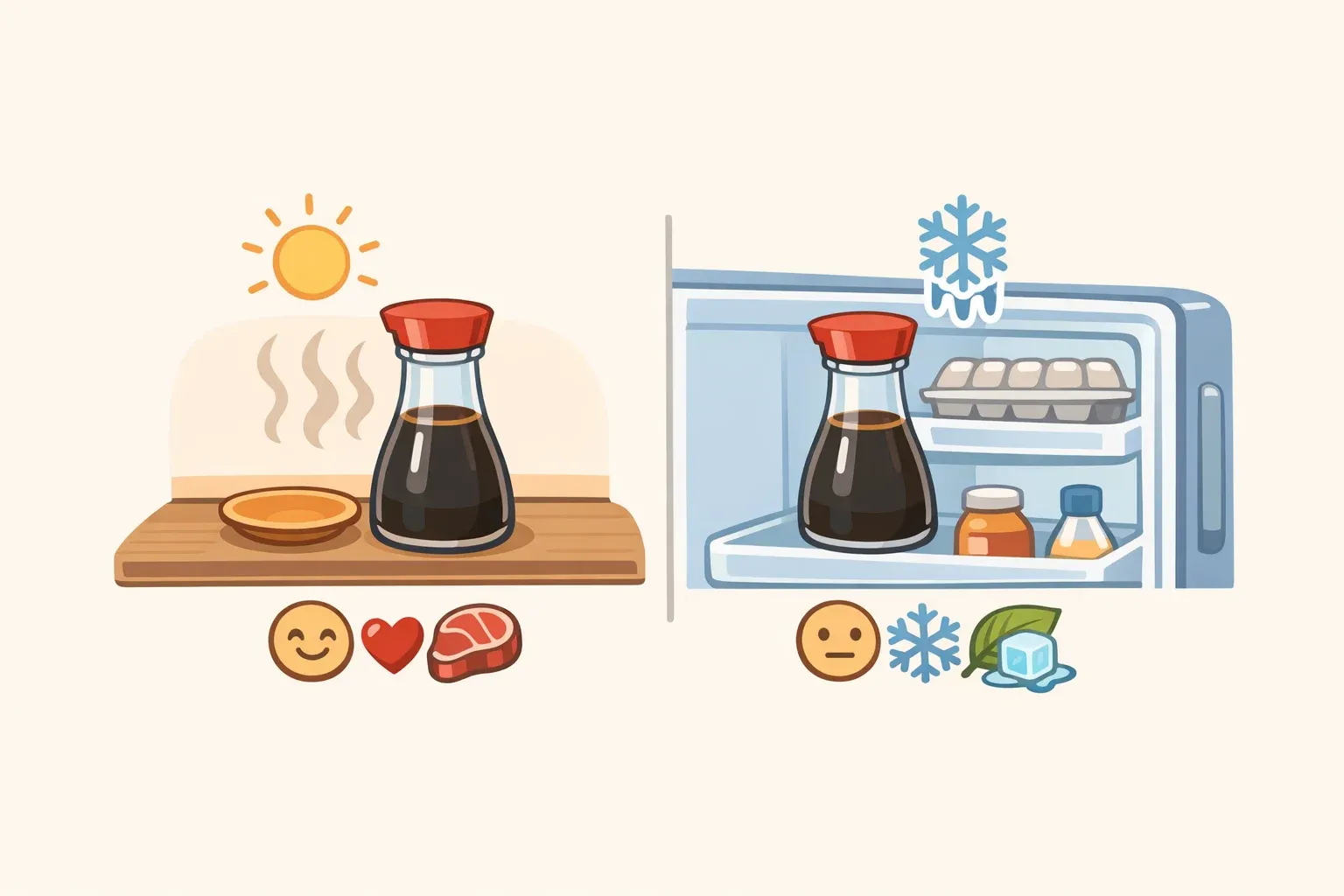
For standard supermarket soy sauce, leaving an opened bottle on the counter won't cause a food safety problem. It will, however, quietly and gradually ruin the flavor. Refrigeration is a quality decision, not a safety one. The exception: raw and non-pasteurized soy sauces sit in a different handling category entirely, and they get specific treatment below.
Kikkoman's current guidance is slightly more specific: regular soy sauces are recommended to be refrigerated for quality, while less-sodium soy sauces and other sauces should be refrigerated after opening. For freshest taste, Kikkoman recommends using sauces within one month of opening.
Once opened, soy sauce doesn't spoil the way milk does. It oxidizes. Cold storage is the most effective way to slow that process, and the difference between a fridge and a warm kitchen shelf isn't dramatic day-to-day but compounds significantly over months.
The right call for any given bottle comes down to two variables: whether it's been opened, and how quickly it gets used.
Finishing the bottle within a month or so? A cool, dark pantry works.
Keeping it for several months? Refrigerate. Flavor drops off noticeably without it.
Using a delicate light soy sauce, low-sodium soy sauce, or raw/non-pasteurized soy sauce? Refrigeration is the safer default; follow the producer's label for raw or specialty bottles.
An unopened bottle stored below 25°C (77°F) can hold its quality for two to three years, per the cooking site Woks of Love. Opening it changes the conditions fundamentally. Once air gets in, pantry storage is only appropriate if you'll finish the bottle within roughly three to six weeks, according to the same source. Beyond that, the quality loss becomes real and cumulative.
The guidance throughout this article applies to standard pasteurized soy sauce. Raw varieties are a different case, addressed directly below.
What happens to soy sauce once it's exposed to air
When soy sauce meets air, a slow chemical reaction begins that breaks down the aromatic compounds and amino acids responsible for its depth, color, and umami. The sauce doesn't go dangerous. It goes dull. Think of a cut apple browning on a counter: still edible, but already losing something you can't get back.
Heat and light accelerate this process considerably. A bottle parked next to the stove is a particularly bad habit. Woks of Love notes that ambient cooking heat significantly accelerates the flavor loss that would otherwise take months. What refrigeration does is slow that same process down: Woks of Love estimates that refrigeration at around 4°C / 40°F can substantially slow oxidation — by roughly 70% — though that figure should be treated as culinary guidance rather than a controlled laboratory finding.
The practical implication is worth sitting with. A bottle that would lose its character in a few weeks on a warm shelf could stay close to its best for the better part of a year in the fridge. That's not a minor margin.
Light soy sauce is especially vulnerable. It's thinner than standard dark soy sauce and used primarily for its floral, fermented aroma. That aroma is also what disappears fastest under heat and light exposure, as Woks of Love notes. Cool, dark storage matters more for light soy sauce than for thicker, darker varieties, where the flavor profile is broader and somewhat more resilient. The bottle that lives by the window and gets a dose of afternoon sun every day is probably not tasting the way it should.
The principle that cold slows oxidation is basic chemistry. Where the sourcing supports specific timelines, those figures are noted. Where it doesn't, the guidance is framed as culinary practice rather than regulatory fact.
How long does soy sauce last after opening?
The answer depends almost entirely on where you store it. The same opened bottle follows very different timelines depending on conditions. These are culinary quality estimates, not universal manufacturer rules; Kikkoman's own freshness guidance is more conservative, recommending use within one month of opening for freshest taste.
Pantry (cool, dark cupboard, away from the stove): Peak quality for roughly three to six weeks, according to Woks of Love. Acceptable for standard pasteurized soy sauce you cycle through quickly. Not the right choice for a bottle you'll nurse over several months.
Refrigerator: Peak flavor maintained for six to twelve months, according to the same source. The professional standard for opened bottles. Not dramatically more effort than leaving it in the cupboard, and the payoff is significant.
Raw or non-pasteurized soy sauce: Neither timeline applies reliably. Refrigerate immediately after opening and follow whatever guidance the producer provides on how long it keeps.
These timelines are culinary guidance from a single source, not regulatory standards. For manufacturer-specific advice, particularly on specialty or raw varieties, Kikkoman and Lee Kum Kee both publish storage guidance on their labels and websites, and those are worth consulting before making assumptions.
One misconception worth clearing up: some people assume that because soy sauce is already fermented and salty, it's essentially self-preserving indefinitely once opened. Salt does inhibit microbial growth, which is part of why standard pasteurized soy sauce handles a few weeks at room temperature without becoming a hazard. But salt doesn't stop oxidation. Those are two different processes, and salt only addresses one of them. The flavor degradation from oxidation happens regardless of how salty the sauce is.
Which soy sauce you have determines how carefully you need to store it
Standard dark soy sauce: the everyday bottle
Most supermarket soy sauce is pasteurized and stable at room temperature for short stretches. Pantry storage is defensible if the bottle gets finished within a few weeks; refrigeration is the stronger call for anything longer. The reason is flavor preservation, full stop.
Either way, keep it in a cupboard away from the stove. Counter storage next to a heat source is the worst option across all types. The bottle looks convenient there; it's not.
Light soy sauce: treat it more carefully
Light soy sauce is thinner, saltier, and used primarily for the floral, fermented aroma it brings to a dish. That aroma is also what disappears fastest. Woks of Love describes light soy sauce as highly sensitive to both light and heat, making it the most storage-demanding of the common varieties.
For light soy sauce, refrigeration after opening is the best quality-preserving default, especially for bottles used slowly or kept in warm kitchens. If the reason you bought a particular bottle was its complexity, a warm shelf is a poor way to protect that investment.
Raw or non-pasteurized soy sauce: a different category entirely
Raw or fresh soy sauce is non-pasteurized, as Woks of Love notes, which is what separates it from the rest of the category in handling terms. Standard pasteurized soy sauce has been heat-treated to stop microbial activity; raw soy sauce hasn't. That distinction matters when the bottle is opened.
The three-to-six-week pantry window that applies to standard pasteurized varieties doesn't carry over here. For raw soy sauce, the refrigerator is where it goes after opening, and the producer's guidance on how long it keeps after that is the relevant timeline. Because handling can vary by producer, follow the label or maker's storage instructions. This is the one category where refrigeration shifts from a quality decision to a practical necessity.
How to tell whether your soy sauce is still good
Assume nothing about the bottle in the back of the cabinet. Run through three tiers.
Still good: The aroma is rich and fermented. Color is dark and clear, not murky. The taste is as expected. Use it normally.
Past peak, still usable: The aroma has faded. Color is in range but losing clarity. The taste is flat, not harsh. It won't ruin a dish, but it won't improve it much either. Use it soon, or replace it if the dish calls for soy sauce to do real work.
Discard: Three signals, any one of which is definitive. White film on the surface is a sign the sauce is past its best, according to Woks of Love. A metallic or harshly chemical taste means the amino acid compounds responsible for umami and depth have broken down past the point of usefulness, a sign of advanced oxidation per the same source. Murky near-black color with no aroma left delivers the same verdict visually, according to Woks of Love. At that stage, the sauce has stopped functioning as soy sauce in any meaningful culinary sense.
None of those discard signals are food safety judgments for otherwise healthy people. They're quality thresholds. The white film yeast is the closest thing to a firm stop sign, and even there, the source frames it as a discard call rather than a toxicity warning. The metallic taste and muddy color are signs that oxidation has run its course and there's nothing left worth cooking with.
A word on freezing, since the logic seems appealing: cold slows oxidation, so colder should be better. It doesn't work here. Soy sauce's salt content pushes its freezing point far below what a standard home freezer reaches, as Woks of Love explains. What you get is thick, partially solidified slush. Not preserved; just inconvenient. The refrigerator is the right tool. The freezer isn't.
The storage decision, simplified
For standard pasteurized soy sauce, the answer to how to store soy sauce after opening is a single question: how long will this bottle sit? The simplest rule, per Kikkoman: refrigerate opened regular soy sauce for best quality, and refrigerate less-sodium soy sauce or other sauces after opening. A few weeks, a cool dark pantry is fine. Several months, the fridge. The flavor cost of skipping refrigeration is real and cumulative, even when it's invisible until the dish tastes unexpectedly flat.
For light soy sauce, refrigeration is the best quality-preserving default from the day the bottle opens. For raw soy sauce, it's the only sensible option.
The two unambiguous discard signals are white film yeast on the surface and a metallic taste, both documented by Woks of Love as signs that oxidation has run its full course. Everything short of those is a quality call.
Soy sauce is a fermented product built on precision: months or years of controlled microbial activity, compressed into a bottle. The fridge isn't fussy. It's just the right tool for protecting what that process produced.






Comments
Be the first, drop a comment!