



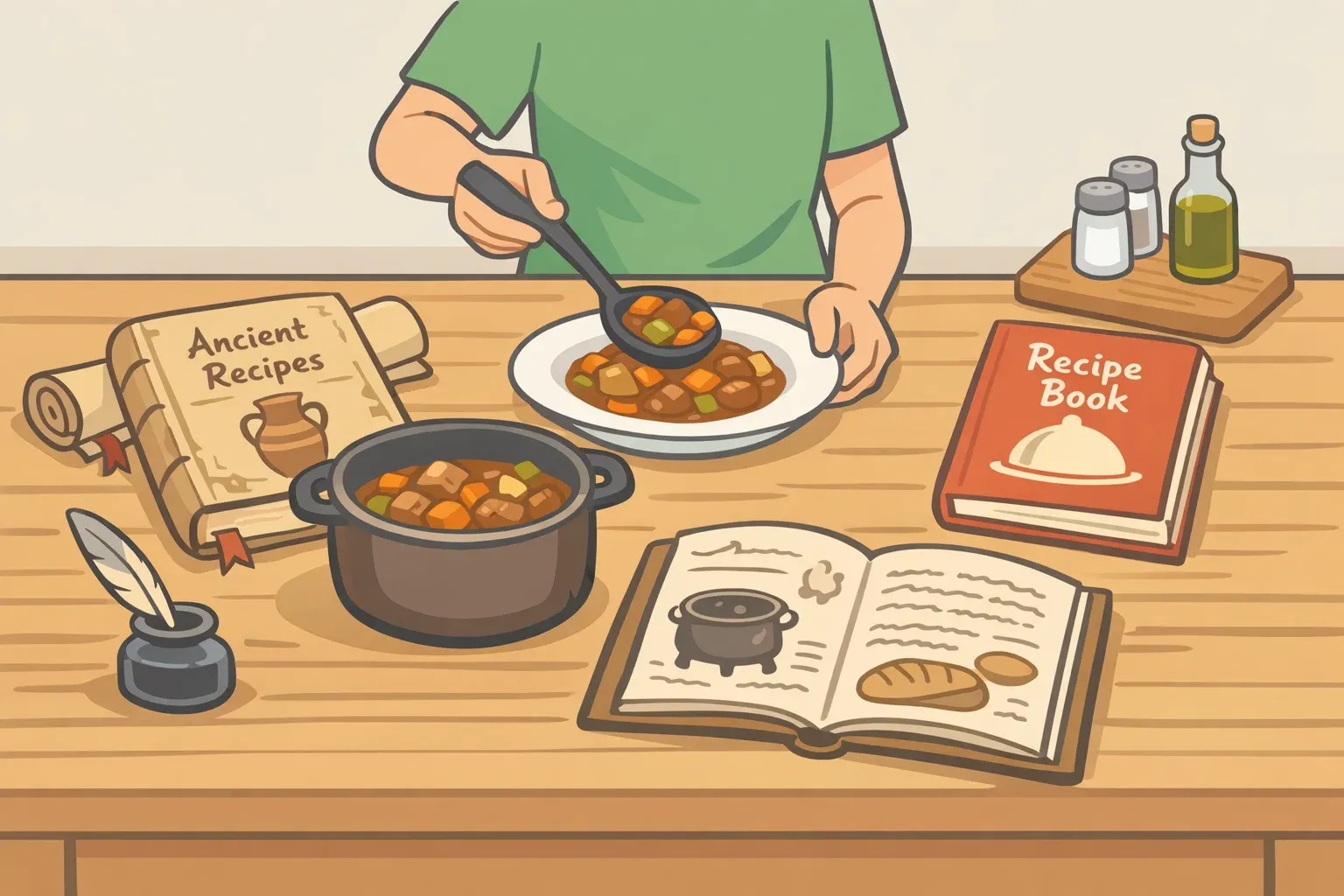
Max Miller Tasting History: How Recipes Become Primary Sources
A 4,000-year-old beet-and-lamb stew from ancient Babylon is nearly identical to a dish still made in modern Iraq. That single fact is more revealing than a thousand "weird old recipes" videos it's evidence of cultural continuity that survived empire collapses, mass migrations, and culinary upheavals that reshaped nearly everything else. It's also a fair summary of what Max Miller Tasting History is actually doing: using recipes as primary sources to make the past tactile, surprising, and human.
Public history means history made accessible to general audiences outside academic institutions. Miller's version is built in a home kitchen and delivered via YouTube. RNZ reported that Miller launched the channel in 2020 after being furloughed from Disney Studios, where he had worked in theatrical sales and marketing. The first video posted two weeks before COVID lockdowns began. As Miller put it: "I had nothing to do except make videos, and it seems that other people had nothing to do but watch videos."
By 2024, RNZ reported the channel had attracted more than two million subscribers. That's not a niche. It suggests a genuine appetite for history that comes with something you can smell and taste.
The source material ranges from Babylonian cuneiform tablets to Egyptian tomb paintings to Titanic-era cruise liner menus a span that signals this is less a cooking show than a history program that happens to involve cooking, as Reason noted. Miller's central argument is direct: cooking what a medieval peasant or a Roman gladiator ate is one of the most immediate ways to understand how they actually lived.
This piece explains how the channel works as both a format and a historical method, why reconstructing old recipes is inherently interpretive rather than definitive, and what its most revealing examples teach about trade, taste, and the surprising durability of some human habits. The channel succeeds precisely because it is honest about what it doesn't know and that honesty is what makes it meaningful public history rather than novelty entertainment.
The format: how a history lesson gets built around a recipe
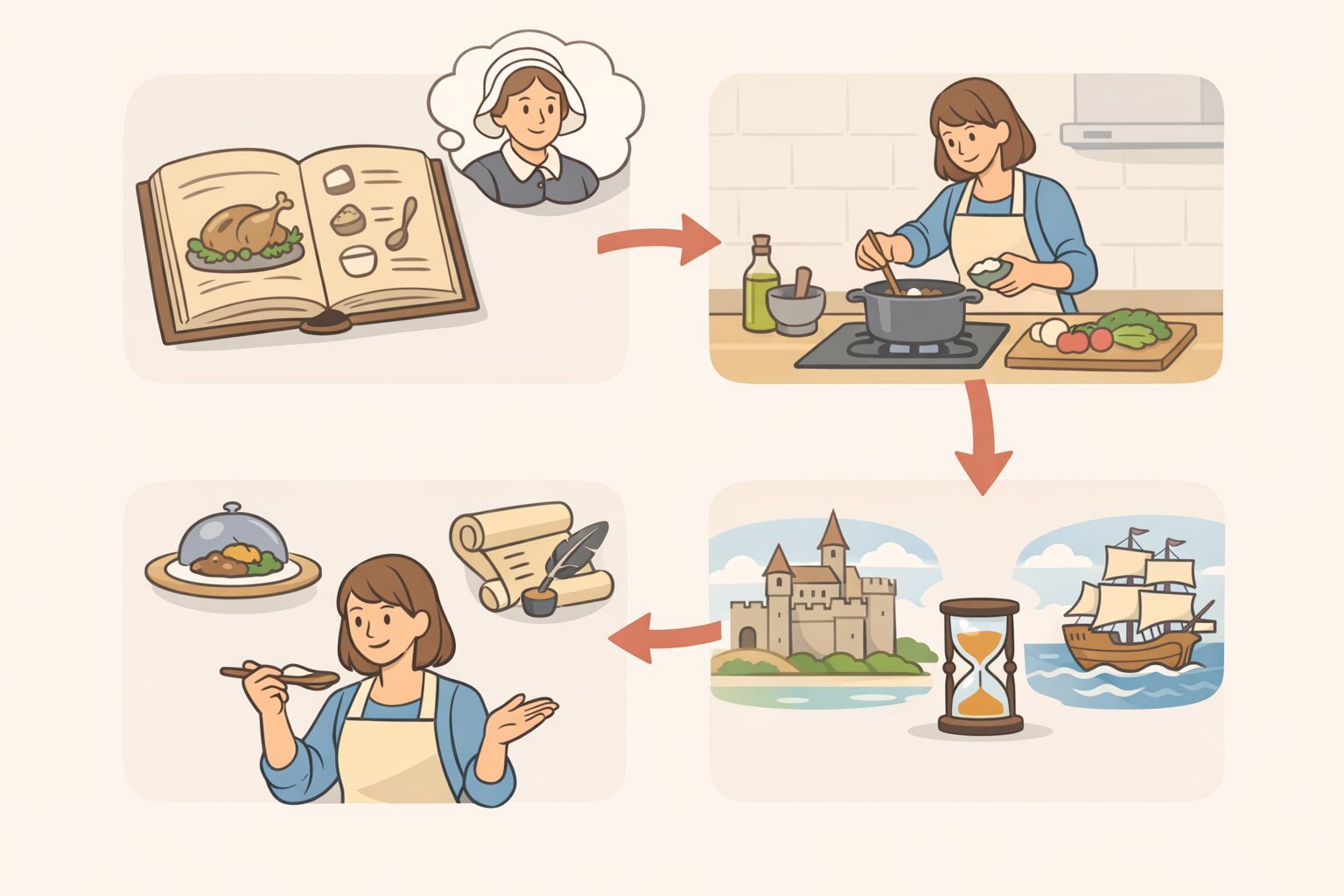
Before getting into what the channel reveals about the past, it helps to understand how an episode actually works, because the structure is doing more than organizing content.
Each video follows a consistent sequence: Miller introduces a historical recipe, adapts it for a modern kitchen, prepares it on camera, and delivers a history segment during the cooking, supported by graphics and archival material. Episodes run roughly twenty minutes, according to Pop Culture Press. Production time varies considerably: lighter episodes take around 20 to 25 hours, most fall in the 30 to 40-hour range, and heavier ones can run 50 to 60 hours sometimes twice as long as a standard episode, Pop Culture Press reported. The research burden accounts for most of that time, not the cooking.
Miller says he prefers to start from history rather than from a dish, because it's easier to find a recipe that fits an interesting story than to take a dish and hope a story is hiding behind it. The minimum threshold for a topic: enough material for six to eight minutes of substantive narration, according to Pop Culture Press.
His path to this work followed an indirect route. Miller came to baking through The Great British Bake Off, whose early seasons included brief historical segments on the dishes being made. When the show dropped those segments, he decided to make his own. He had no cooking background, as RNZ reported. He has described that as a feature rather than a liability: "seeing as I am usually fumbling my own way through the kitchen, I think it makes people feel comfortable fumbling their own way through the kitchen as well."
Think of the format as a museum exhibit you can taste. The recipe is the artifact; the history segment is the interpretive label. The difference is that the label here runs eight minutes, has a narrative arc, and occasionally involves fermenting fish for three months.
The structure also signals what kind of show this is. The history segment isn't filler between cooking steps. The cooking is the delivery mechanism for the history and that distinction matters for understanding why the channel functions as public history rather than food content.
Why Tasting History with Max Miller feels different from a typical historical recipes YouTube channel
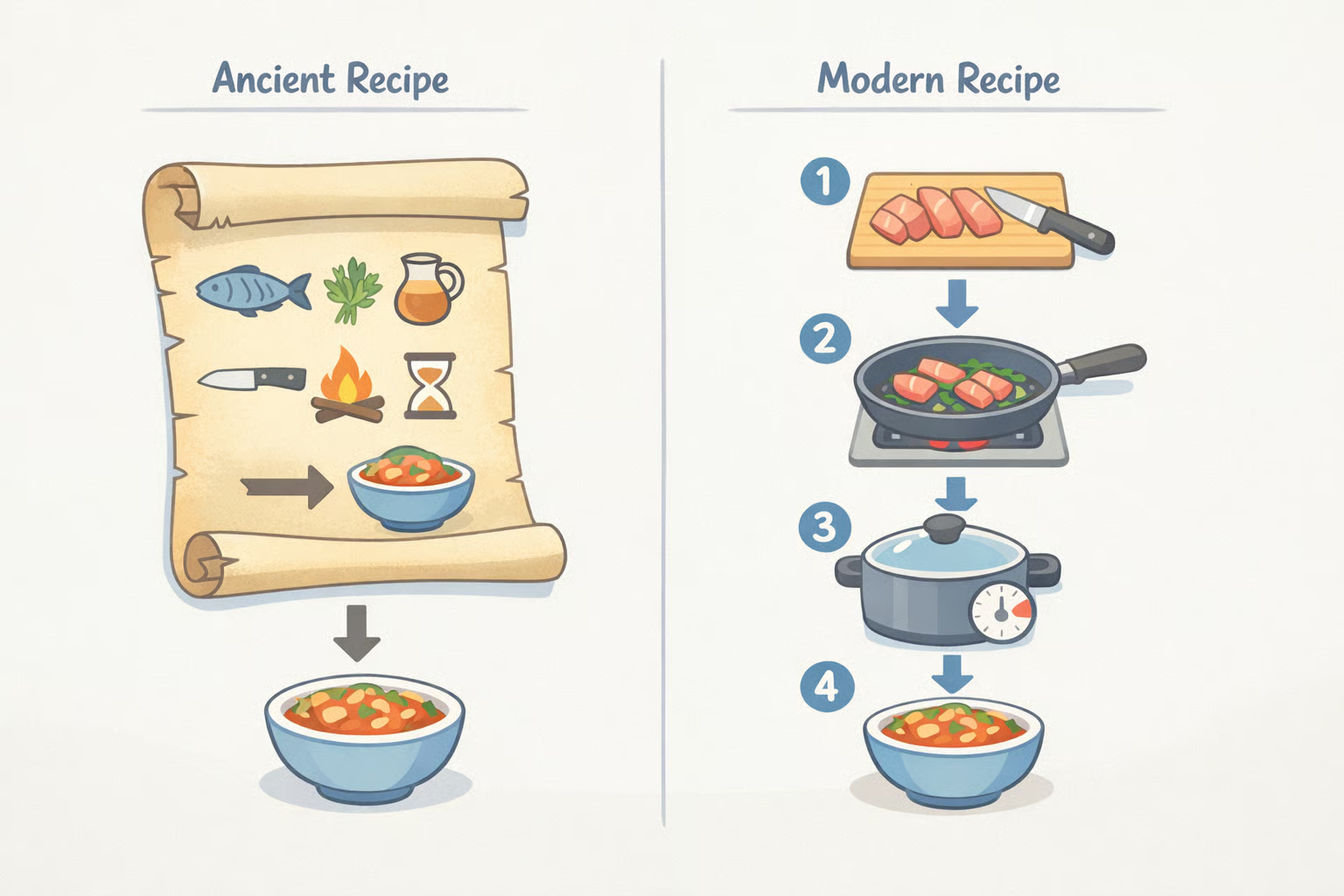
Most historical food content treats old recipes as curiosities: look how strange people used to eat. Tasting History treats them as evidence. The difference shows up most clearly in how Miller handles the limits of what the sources actually say.
Until well into the 19th century, written recipes were not instructions for novices. They were abbreviated reminders for trained cooks who already understood technique, ratios, and timing. A modern reader approaching them cold is essentially reading shorthand in a language that assumed fluency, as RNZ reported. Miller describes pre-modern recipes as "maddeningly vague" for exactly this reason written for people who already knew what they were doing, not for posterity, as a 2026 interview made clear.
The oldest written recipes come from Babylonian clay tablets dating to around 1750 BC, during the reign of Hammurabi. Miller is explicit about what can honestly be claimed from them: "this might be what an ancient Babylonian king ate" a careful hedge, not a confident reconstruction, as the 2026 interview showed.
The difficulty compounds as sources get older and less textual. Ancient Egyptian food "recipes" are largely pictorial scenes on tomb walls, requiring archaeological inference to interpret identifying residues, cross-referencing material culture, reading images that may carry symbolic rather than instructional meaning. Miller is clear that he relies on specialists for that groundwork rather than doing it himself, as RNZ reported.
Even relatively recent sources present the same problem differently. The Forme of Cury, compiled by the master chefs of King Richard II of England around 1390, is one of the more complete medieval English recipe collections but it was written for elite professional cooks in a royal court, as the 2026 interview noted. What it tells us about ordinary medieval diets is limited; that's an analytical inference, not a claim Miller made directly, but the point follows from the source's obvious context.
At the other end of the spectrum, the Nostradamus cookbook and Titanic-era cruise liner menus come with full instructions but represent narrow social contexts that carry their own distortions, as Reason observed. Complete documentation of elite dining is not a window into how most people ate.
What Tasting History offers is not a time machine but an honest approximation built from primary sources, cross-checked against archaeological and historical scholarship, and presented with its caveats intact. A recipe can carry the same evidentiary weight as a diary entry if you read it carefully enough. For a YouTube channel with millions of subscribers, that epistemic humility is genuinely unusual.
What the recipes actually reveal: trade, taste, and surprising continuity
Three patterns emerge from the channel's most instructive examples not catalogued for novelty, but because each one illustrates something specific about what food can tell us.
Ingredient availability shapes flavor as much as preference does
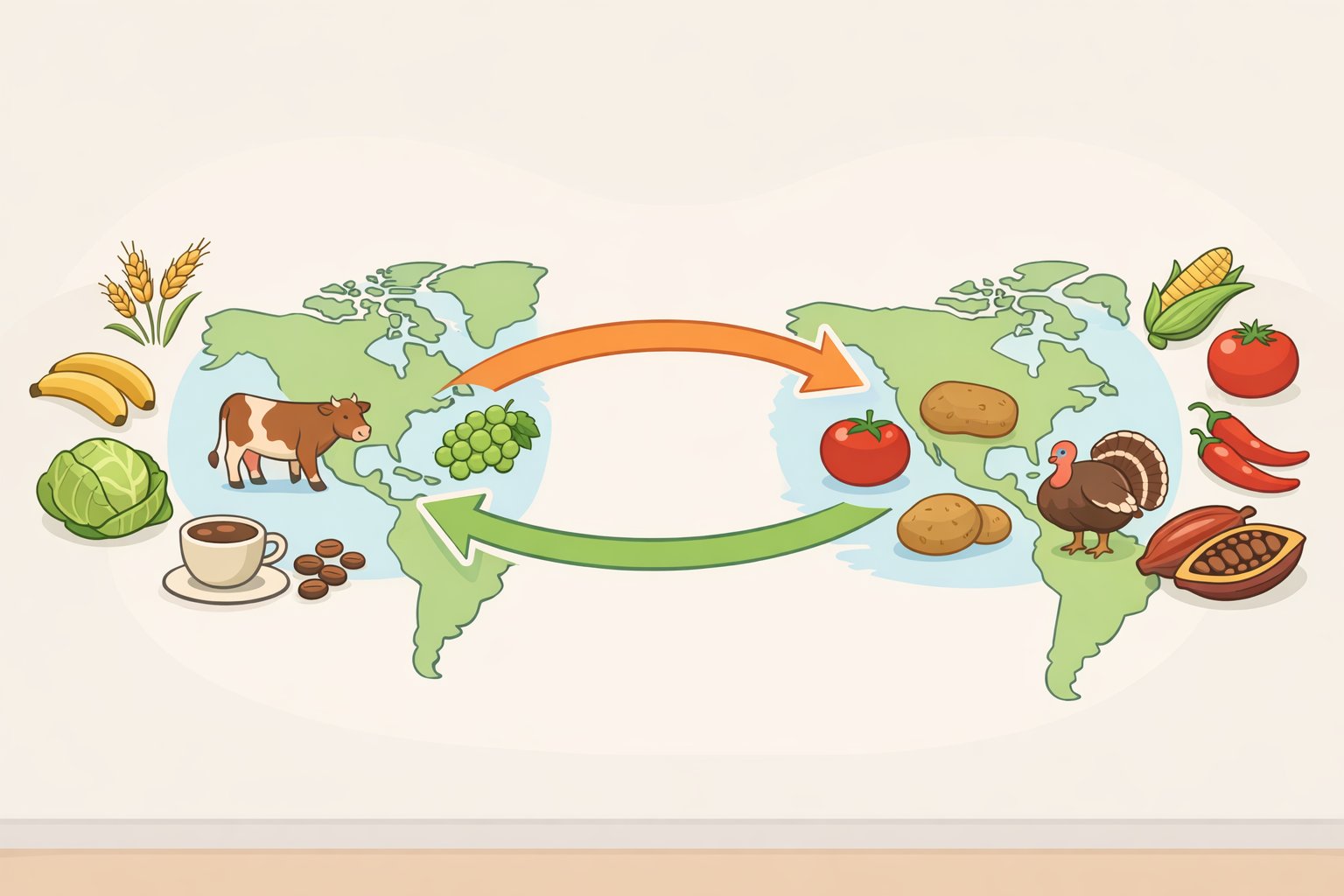
The Columbian Exchange of 1492 is the sharpest illustration. Before sustained contact between Europe and the Americas, European cooking had no tomatoes, no potatoes, and no varieties of squash now considered staples. The Americas, meanwhile, had no sugar, no cattle, and no pigs. The ingredient transfer that followed permanently altered food cultures on both sides in ways that cannot be undone, as Miller explained to RNZ.
The implication runs deeper than historical trivia. Any dish combining tomatoes and onions, or cocoa and sugar, required transcontinental trade routes to exist first, as Reason put it. What we call "traditional" food is usually just old enough to feel permanent.
This is what recipes reveal that menus and cookbooks alone cannot: the invisible infrastructure behind a flavor combination. A dish isn't just a set of ingredients it's a record of which trade networks were operating, which empires were intact, and which routes were open when that recipe was written down.
Taste itself is a historical variable, not a biological constant
Roman cooking centered on garum a fermented fish sauce made from whole, ungutted fish packed in salt and left to break down over roughly three months outside in the open air, as the 2026 interview described. Most of the Roman recipes we have include it, and it was produced at industrial scale. The resulting flavor profile has been compared to Southeast Asian cooking, not anything conventionally Italian, according to Reason.
The broader pattern of surprising combinations holds throughout. Early ice cream used parmesan cheese. The first recorded guacamole recipe included molasses. Pre-modern cooks combined pumpkin with lasagne-style spicing, and stirred almond milk into wine not as eccentricity, but because their flavor logic operated on different assumptions about what belonged together, as Reason noted.
It's worth separating what's actually changing across these examples. Garum is a changed ingredient preference: Romans liked a funk that modern Western palates have largely abandoned. Ice cream with parmesan reflects a different sweet-savory boundary, a flavor category distinction that shifted over centuries. Pastry "coffins" dense hot-water-crust casings sealed around meat that could sit on a shelf in a cold room for days or even weeks represent something else entirely: food technology, not taste. They weren't meant to be eaten; they were the container, the precursor to canning, as Miller put it in the 2026 interview. Understanding that reframes an apparently bizarre preparation as a rational engineering solution.
Some things have barely changed at all
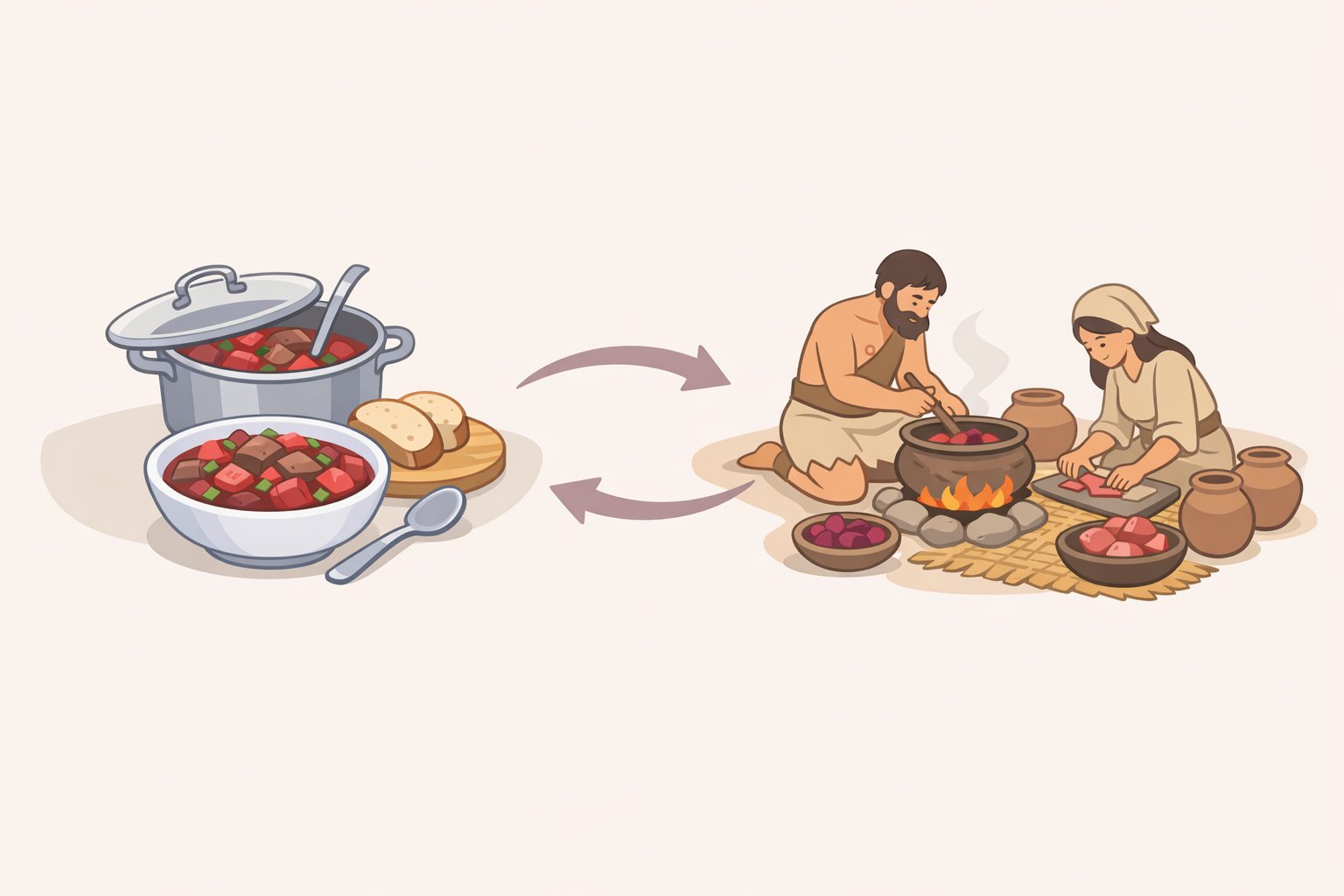
That 4,000-year-old Babylonian beet-and-lamb stew is nearly identical to a stew still made in modern Iraq. The continuity survived the fall of the Babylonian empire, multiple successor civilizations, and every culinary disruption in between, as RNZ reported. Roman stuffed dates walnut-filled, drizzled with honey, apparently sold as concession food at gladiator events are described in recipes that require almost no interpretation and almost no adaptation, according to Reason.
The combined picture is the channel's actual argument: food is not a static cultural artifact or a timeless tradition. It is a record of trade routes, technological constraints, class structure, and accumulated taste and it changes constantly, except when it doesn't.
Why this format matters beyond the channel
Recipes are primary sources as revealing as letters, ledgers, or legislation, and considerably more accessible to a general audience. A dish tells you what ingredients were available (trade), what tools existed (technology), whose tastes were being served (class), and what flavors were considered compatible (culture). The channel works because it applies that evidentiary logic systematically, as Reason observed.
The channel's honesty about uncertainty the missing instructions, the elite bias in surviving sources, the interpretive leaps required to bridge ancient texts to modern kitchens is what distinguishes it from entertainment dressed as education. That transparency is a choice, and it signals something about how public history can function when it isn't filtered through institutional credentialing, as both RNZ and the 2026 interview made clear.
Miller has since expanded into cookbooks and fan travel experiences to historical sites in Jordan and Egypt, with a second cookbook Tasting History: A Recipe for Disaster, organized around food connected to historical disasters in production, according to the 2026 interview. That expansion matters not just as a business story but as evidence that the concept has depth a single format can't exhaust.
For readers new to the channel, pay attention to three things: where Miller modernizes an ingredient and says so, where he cites a primary source by name, and where he flags that he's guessing. Those moments are not weaknesses in the presentation. They are the method made visible and they are what separates a show that happens to involve history from one that takes it seriously.
What Tasting History points toward is a model for creator-led public history that doesn't require institutional authority, only research rigor, narrative skill, and the willingness to say "we don't know" without treating that as a failure. The interesting question now is whether that model can travel to other historical subjects, other formats, other voices willing to show their work. As a proof of concept, a beet-and-lamb stew that has outlasted four thousand years makes a reasonable starting point.

Comments
Be the first, drop a comment!